

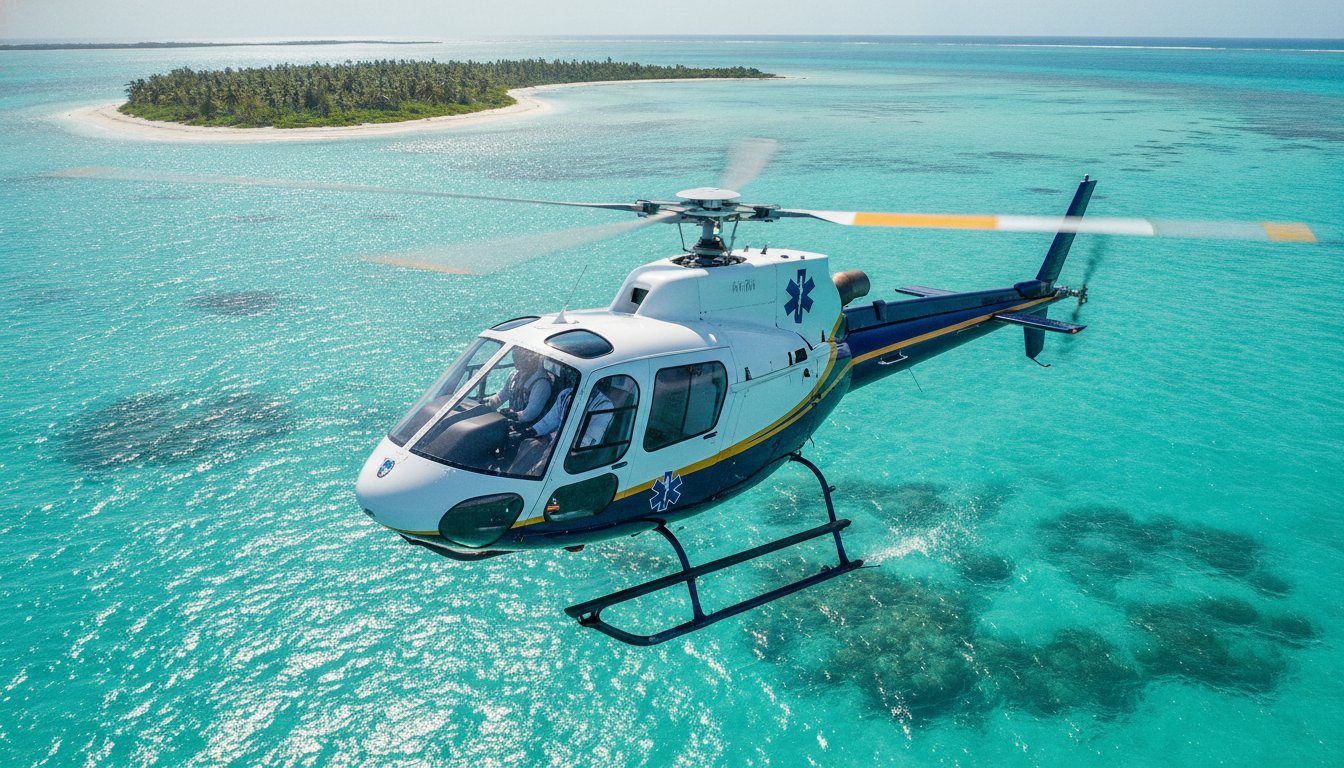
In a critical trauma situation on a remote island, the distance to a surgical suite isn’t measured in miles. It’s measured in minutes that standard logistics simply cannot recover. You already understand that the geographic isolation of the archipelago creates a terrifying vulnerability during a medical emergency. The fear of being stranded or facing the staggering costs of private international transfers is a heavy burden for anyone navigating these waters. This is why elite trauma air transport Bahamas services have become a vital operational necessity for those who value precision and professional preparedness.
You’ll discover how specialized helicopter medical evacuation bypasses the traditional hurdles of ground transport and fixed-wing limitations to provide direct, life-saving access to care. We’ll detail the 2026 protocols for trauma center coordination, the strategic advantages of membership-based coverage, and how to ensure zero financial friction at the point of care. This guide serves as your definitive operational briefing for navigating emergency medical logistics across the Bahamas with total confidence. It’s about moving beyond the uncertainty of being stranded and securing a professional, agile response when seconds determine the outcome.
Key Takeaways
- Helicopter-based medical evacuation functions as a specialized airborne ICU, delivering critical care directly to remote locations inaccessible to traditional aircraft.
- Precision landing capabilities allow for immediate retrieval from beaches or vessels, significantly reducing the number of patient transfers compared to fixed-wing alternatives.
- Securing a membership is the essential first step for trauma air transport Bahamas, enabling immediate launch and direct insurance billing with zero out-of-pocket costs.
- Direct coordination with elite Florida trauma centers ensures a seamless transition for members from the point of injury to definitive surgical intervention.
- Advanced avionics and specialized medical equipment provide the necessary technical edge for safe, rapid operations across the complex geography of the archipelago.
What is Trauma Air Transport in the Bahamas?
Professional trauma air transport Bahamas is more than a rapid flight; it’s a specialized airborne ICU service designed for immediate intervention. In the context of the 2026 emergency medical landscape, this service functions as a mobile extension of a Level 1 trauma center. It’s engineered to stabilize patients with life-threatening injuries while maintaining a high-velocity transit to definitive care. Unlike standard medical charters, these operations utilize helicopters equipped with advanced life-support systems, enabling them to bypass the logistical delays of ground ambulances and airport-bound aircraft. In an island nation where local clinics are often unequipped for major surgical emergencies, this specialized transport is the only link to survival.
The 2026 standards for airborne emergency medical services (EMS) demand a high level of technical integration. Modern trauma flights now require advanced avionics for night-vision operations and satellite-linked medical monitoring. This ensures that the medical team in the air can share real-time vitals with receiving surgeons in Florida before the aircraft even touches down. It’s a disciplined, proactive approach to emergency logistics that prioritizes clinical precision and operational speed above all else.
The “Golden Hour” in an Archipelago
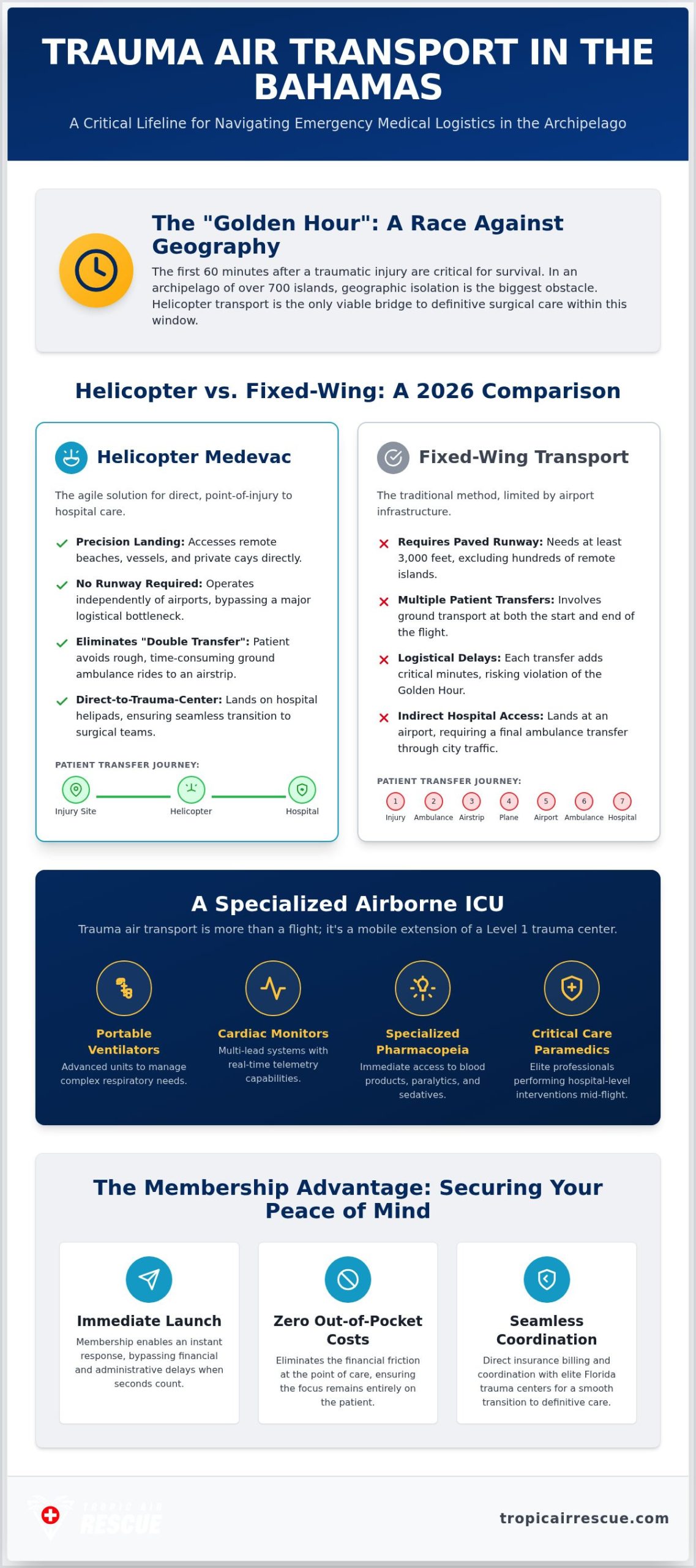
The “Golden Hour” is a foundational medical principle stating that the chances of survival for a trauma patient increase significantly if they receive definitive surgical care within sixty minutes of the injury. In the Bahamas, the geography of over 700 islands and cays makes this window exceptionally difficult to hit. Traditional response times are often slowed by remote locations, lack of paved runways, and the need for multiple patient transfers. Helicopter-based trauma air transport Bahamas solves this by landing directly at the point of injury, whether that’s a private resort, a vessel at sea, or a remote beach. In the Bahamas archipelago, the Golden Hour is a race against geography where helicopter agility serves as the only viable bridge to survival.
Trauma vs. Non-Emergency Medical Transport
It’s vital to distinguish between high-acuity trauma transport and standard medical repatriation. Non-emergency transfers involve stable patients moving between facilities for recovery or routine care. Trauma transport, however, handles critical cases such as severe burns, multi-system organ failure, or penetrating injuries. The equipment requirements are significantly more intensive, including:
- Portable Ventilators: Advanced units capable of managing complex respiratory needs.
- Cardiac Monitors: Multi-lead systems with real-time telemetry capabilities.
- Specialized Pharmacopeia: Immediate access to blood products, paralytics, and emergency sedatives.
Specialized critical care paramedics are essential for these missions. These professionals don’t just monitor the patient; they perform invasive procedures that are typically reserved for hospital settings. This elite level of care ensures that the patient’s condition is managed proactively during every minute of the flight. For a comprehensive overview of how these airborne platforms replicate ground-based hospital standards, our guide to helicopter ICU transport Bahamas details the full scope of advanced life-support capabilities available during critical care transit.
Helicopter Medevac: The Critical Advantage for Island Rescue
Fixed-wing aircraft are often marketed as the primary solution for international medical flights. However, in the context of the Bahamas archipelago, these airport-bound jets present a significant logistical bottleneck. A jet requires a paved runway of at least 3,000 feet, which effectively excludes hundreds of remote islands and private cays. Trauma air transport Bahamas relies on the agile capabilities of helicopters to bridge this gap. By operating independently of traditional runways, helicopters provide a direct link from the point of injury to the operating room. This eliminates the “double transfer” problem where a patient must first endure a rough ground ambulance ride to a local airstrip before even beginning their flight.
The tactical advantage of helicopter medevac is its ability to land on hospital helipads. When every second is critical, bypassing the traffic and transfer delays of a secondary ground ambulance in Florida is life-saving. This “direct-to-trauma-center” model ensures that members transition from the aircraft cabin to the surgical team in minutes, not hours. It’s a seamless, concierge air medical service response that prioritizes clinical outcomes over logistical convenience.
Reaching the Unreachable: Remote Landings
Modern emergency operations in the Bahamas demand precision in environments where traditional aviation fails. In 2026, the standard for elite rescue includes 4-axis autopilot systems and high-intensity searchlight technology. These tools allow pilots to execute stable landings on private yachts, remote island docks, and even narrow beach strips under challenging conditions. Night-vision goggles (NVG) are now a mandatory component for safe operations, allowing crews to navigate the unlit terrain of the Out Islands with total clarity. While fixed-wing competitors are grounded by the lack of airport infrastructure, a specialized helicopter remains operational, ensuring that no member is ever truly stranded. For those exploring the more secluded regions of the archipelago, securing an annual membership provides the peace of mind that help can land exactly where you are.
Hospital-Grade Care at 1,000 Feet
The interior of a trauma-equipped helicopter is a compact, high-tech intensive care unit. The fleet is outfitted with advanced life-support systems, including transport ventilators, multi-parameter heart monitors, and biphasic defibrillators. This setup allows critical care paramedics to maintain hospital-grade stability throughout the transit to Florida. These professionals are trained to manage high-acuity trauma, performing complex interventions while airborne to ensure the patient arrives in the best possible condition. The focus is on proactive stabilization; the team doesn’t just monitor vitals, they actively manage the trauma using the same protocols found in world-class emergency departments. This level of sophistication ensures that the quality of care never wavers, even while cruising at 1,000 feet over the Atlantic. To understand the full technical scope of what a mobile ICU flight for critical care air transport entails, including the bedside-to-bedside process and advanced platform capabilities, our 2026 guide provides a detailed clinical breakdown.
Trauma Transport vs. Fixed-Wing: A Comparison for 2026
Selecting the correct platform for trauma air transport Bahamas isn’t merely a matter of flight speed; it’s an assessment of total mission time and patient safety. While fixed-wing jets are often viewed as the standard for long-distance medical repatriation, they’re fundamentally ill-suited for the immediate demands of trauma care within the archipelago. A jet’s speed at 30,000 feet is irrelevant if the patient is stuck in a ground ambulance for two hours waiting for runway clearance. In 2026, the operational standard for high-acuity trauma favors the helicopter for its ability to eliminate the “dead time” associated with airport logistics and ground transfers.
Helicopters provide a level of inter-island medical transfer capability that fixed-wing aircraft cannot match. For short-haul missions between the Out Islands and Florida, the helicopter is the most cost-efficient and clinically sound asset. It bypasses the high landing fees and fuel surcharges of private jet terminals while offering a level of agility that allows for rapid repositioning between multiple island sites if necessary. This makes it the definitive tool for proactive emergency response in a region defined by its fragmented geography.
Speed and Deployment Logistics
Fixed-wing transport typically introduces significant logistical friction. Every mission requires a synchronized dance between a ground ambulance at the origin, the aircraft, and another ground ambulance at the destination. This process often adds two to three hours of transit time that has nothing to do with flying. In contrast, a helicopter mission utilizes point-to-point efficiency. By launching directly to the trauma site and landing on a hospital helipad, the crew removes the need for secondary vehicles. We coordinate directly with local emergency services to ensure the extraction happens the moment the rotors stop, providing a streamlined path to surgical intervention that jets simply can’t provide.
Patient Stability and Transfer Risks
In the medical field, we track the number of “patient touches”-every instance where a patient is moved from a bed to a stretcher or shifted between vehicles. Each touch is a high-risk event for a trauma patient, increasing the potential for line dislodgement or physical destabilization. A single-vehicle journey from the site of injury to the trauma center is the gold standard for clinical safety. By maintaining a consistent environment from the beach to the hospital, we preserve the patient’s physiological state. For a comprehensive breakdown of these operational trade-offs, read our guide on Helicopter vs Fixed Wing Medevac: The Critical Choice. Minimizing transfers isn’t just about comfort; it’s a disciplined approach to reducing clinical complications during high-stakes transit.
Navigating the Logistics: Membership and Insurance
The financial complexity of emergency medical aviation often rivals the clinical difficulty of the mission itself. Without a pre-established protocol, trauma air transport Bahamas can cost between $25,000 and $50,000 for a single mission. Most private air ambulance providers require cleared funds or proof of financial capacity before the aircraft is even pulled from the hangar. This administrative delay is a critical failure point in trauma care, where every minute lost to banking logistics is a minute lost to recovery. Our membership model eliminates this friction entirely. By collecting essential medical data and insurance information during enrollment, we ensure that the launch sequence begins the moment the call is received. This is a disciplined, concierge air medical service approach to safety that prioritizes immediate intervention over paperwork.
Securing Membership for Island Stays
Coverage must mirror your specific risk profile and length of stay in the Bahamas. Short-term memberships are designed for yachting guests or resort visitors who need elite protection for a defined window of a few weeks. In contrast, annual plans offer year-round security for residents and frequent travelers who navigate the islands regularly. This proactive step ensures that all logistical hurdles, from flight clearances to the collection of government-issued identification for international transit, are addressed in advance. You can explore the specific benefits of sustained, long-term protection in our Annual Air Rescue Membership Guide. Being prepared means your medical profile is active and ready for deployment before an emergency occurs.
Direct Billing and Coordination with Insurers
Effective 2026 protocols emphasize the importance of direct insurance billing to reduce patient and family stress during a crisis. We function as your professional advocate, coordinating with global insurance carriers to handle the high costs of trauma evacuation. Pre-certification is the mechanism that makes this possible. It allows our team to verify coverage and secure the necessary authorizations while the helicopter is already in transit. This coordination ensures that members face no financial friction at the point of care, avoiding the “pay and claim” burden that characterizes many private medical flights. It’s a premium standard of service that replaces administrative hurdles with a streamlined, direct-billing operation. For families concerned about the full scope of international regulatory requirements and cost management involved in a Bahamas to Florida patient transfer, our 2026 operational guide details the complete blueprint for navigating these complexities with precision. To guarantee this level of professional response for yourself or your guests, secure a membership plan before your next arrival in the archipelago.
Tropic Air Rescue: The Gold Standard in Bahamas Trauma Transport
Tropic Air Rescue operates as the definitive leader in high-stakes medical aviation within the archipelago. Our “Ready. Agile. Direct.” philosophy isn’t just a tagline; it’s an operational mandate. We provide a concierge level of emergency medical evacuation that treats every mission as a precision-engineered rescue operation. With decades of collective experience in critical care medical aviation, our teams are trained to manage the most complex logistical and clinical challenges. This elite status is reinforced by our specialized capabilities, including organ transport and patient repatriation, which go far beyond the scope of generic utility flight services. When you choose our trauma air transport Bahamas service, you’re securing a private, elite partner dedicated to meticulous preparedness and proactive safety.
Our role extends beyond the cockpit. We function as a vigilant guardian for our members, managing every detail of the transfer from the moment of injury to the final hospital admission. This comprehensive approach ensures that families and organizations can focus on recovery while we handle the intricate coordination of international borders, medical clearances, and surgical team briefings. It’s the highest standard of care available in the region, designed for those who refuse to leave their safety to chance.
Coordination with International Trauma Centers
The transition from an island site to a surgical suite requires expert medical oversight. Our Medical Director plays a pivotal role in this process, evaluating the patient’s specific clinical needs to determine the optimal facility for admission. We maintain direct coordination with elite Florida trauma centers, ensuring that a specialized team is standing by before the helicopter touches down. This seamless integration allows for immediate admission to Level 1 facilities, bypassing the delays of traditional emergency room triaging. For more complex cases involving movement between medical institutions, our Guide to Coordinating Inter-Hospital Medical Transfers provides a detailed briefing on how we maintain clinical continuity during high-acuity transits.
Ready for the Unexpected: 24/7 Readiness
Operational excellence is built on a foundation of constant vigilance. Our flight and medical teams maintain an “Always Ready” mindset, with aircraft and equipment subjected to rigorous daily inspections. Every piece of life-support technology, from transport ventilators to cardiac monitors, meets or exceeds 2026 international standards for airborne EMS. In 2026, our fleet utilizes Terrain Awareness and Warning Systems (TAWS) and synthetic vision technology to ensure safe low-altitude navigation during nocturnal operations. This investment in advanced technology and disciplined maintenance ensures that we’re prepared to launch into the most challenging environments at a moment’s notice. We don’t rely on hyperbole; our focus on specialized equipment and professional experience provides the weight behind our reputation as the definitive solution for trauma air transport Bahamas.
Operational Security for Your Island Arrival
Professional emergency response in the Bahamas requires proactive preparation rather than reactive hope. You’ve seen how helicopter agility bypasses the inherent limitations of fixed-wing aircraft and ground logistics. By landing directly at the point of injury, we ensure the Golden Hour isn’t lost to unnecessary transfers. This specialized level of trauma air transport Bahamas serves as an essential safety net for anyone navigating the remote reaches of the archipelago. It’s about securing an elite, specialized offering that’s always ready for deployment.
Securing your protection before an emergency occurs is the only way to guarantee a frictionless response. Our fleet features advanced life-support equipment and provides direct access to elite Florida trauma centers. Active members benefit from direct insurance billing with no out-of-pocket costs, allowing you to focus entirely on recovery. Don’t leave your critical care to chance in a region defined by its geographic isolation. Secure Your Bahamas Medevac Membership Today and gain the peace of mind that comes from expert medical preparation. Your safety remains our primary mission.
Frequently Asked Questions
Is trauma air transport covered by standard travel insurance in the Bahamas?
Standard travel insurance often operates on a “pay and claim” basis, which is insufficient for an emergency flight that can cost between $25,000 and $50,000. Most carriers require substantial upfront payments before dispatching an aircraft. Our trauma air transport Bahamas membership model solves this by facilitating direct insurance billing. We coordinate with your provider to ensure the mission launches without financial delays, protecting your liquidity and your health simultaneously.
How long does a helicopter medevac take from a remote island to Florida?
Flight times vary based on your specific island location, but helicopters eliminate the two to three hours typically lost to ground ambulance transfers and airport logistics. A direct flight from the northern islands to a Florida trauma center often takes less time than the combined ground and air segments of a fixed-wing mission. We prioritize a high-velocity, point-to-point transit that delivers you directly to a hospital helipad for immediate surgical admission.
Can a helicopter land on a private yacht for emergency trauma transport?
Yes, our helicopters are capable of landing on private yachts and remote island docks equipped with suitable landing areas. Our pilots utilize advanced 2026 avionics, including 4-axis autopilot and night-vision technology, to execute precision landings in challenging maritime environments. This capability is a critical advantage for members who spend time on vessels far from traditional runways, ensuring that help arrives exactly where the injury occurred during a crisis.
What is the difference between an air ambulance and a trauma air transport service?
A standard air ambulance often focuses on non-emergency repatriation for stable patients, whereas trauma air transport Bahamas is a high-acuity ICU service. Trauma transport is engineered for surgical emergencies, utilizing specialized paramedics and advanced life-support equipment to maintain stability during high-speed transit. The primary difference lies in the level of clinical intervention provided and the urgency of the flight path directly to a Level 1 trauma center.
Are there out-of-pocket costs for Tropic Air Rescue members?
Active members face zero out-of-pocket costs for emergency evacuations covered by their insurance. Our concierge team manages the entire billing process directly with your insurance carrier. This eliminates the burden of paying for a flight upfront and waiting months for reimbursement. Membership is the mandatory prerequisite for this benefit, providing a seamless financial experience during the most stressful moments of a medical crisis while ensuring that launch protocols begin immediately.
What medical equipment is available on a trauma transport helicopter?
Our helicopters function as mobile intensive care units, outfitted with the latest 2026 medical technology. Every aircraft carries portable ventilators, multi-lead cardiac monitors, biphasic defibrillators, and advanced infusion pumps. We also maintain a specialized pharmacopeia for trauma management, including emergency sedatives and paralytics. This equipment allows our critical care paramedics to perform invasive procedures and maintain hospital-grade stability while cruising at 1,000 feet over the Atlantic toward definitive care.
How do I arrange an inter-hospital transfer from the Bahamas to the US?
Inter-hospital transfers are managed through our specialized coordination team and Medical Director. We handle the logistical complexity of securing a receiving physician in the US and managing international flight clearances. Members simply initiate the request, and we take over the professional briefing and transport logistics. This service ensures a disciplined transition between facilities, maintaining clinical continuity from a Bahamian medical clinic to a world-class surgical center in Florida.
Can family members fly with the patient during a trauma evacuation?
Space for family members is strictly determined by the patient’s clinical needs and the aircraft’s weight and balance requirements. In critical trauma situations, the priority is always the medical team and their life-saving equipment. While we make every effort to accommodate one passenger, the safety of the mission and the patient’s stability are the definitive factors. Our concierge team assists family members with alternative travel arrangements if they cannot fit on the flight.