

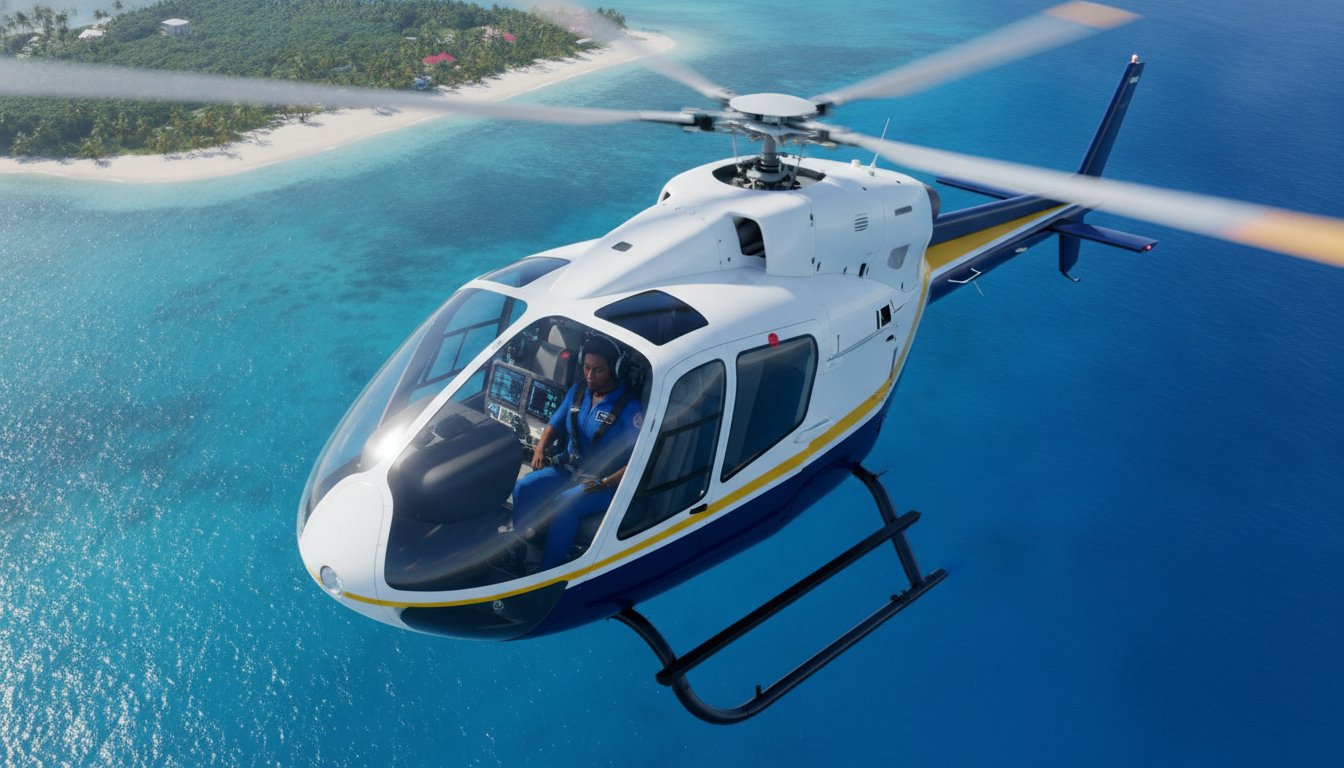
A medical emergency in the islands shouldn’t force a choice between rapid evacuation and hospital-grade clinical care. When every second dictates the outcome, a standard transport isn’t enough; you require a mobile ICU that maintains the same rigorous standards as a ground-based trauma center. We understand the fear that comes with a critical diagnosis, especially when faced with the logistical maze of moving a loved one across international borders. The anxiety regarding high out-of-pocket costs and the quality of care at altitude can be overwhelming.
This 2026 guide demonstrates how specialized helicopter ICU transport Bahamas services transform emergency logistics into a seamless medical bridge. You’ll discover how advanced life-support equipment and elite clinical teams provide a continuous care environment during the transition to Florida trauma centers. We’ll outline the bedside-to-bedside process, the technical capabilities of modern air medical platforms, and how a membership-based model ensures that your focus remains on recovery rather than financial coordination.
Key Takeaways
- Differentiate between standard medical flights and mobile ICU platforms equipped with hospital-grade ventilators and real-time hemodynamic monitoring.
- Identify the tactical advantages of helicopter ICU transport Bahamas, including the ability to bypass airport runways for direct bedside-to-bedside transfers.
- Understand the logistical coordination required for moving critical patients from local clinics to specialized Florida trauma centers across international borders.
- Secure financial peace of mind through an annual membership that enables direct insurance billing and eliminates surprise out-of-pocket expenses.
- Learn how specialized aviation technology and expert clinical teams maintain a continuous care environment during high-stakes emergency missions.
Defining the Mobile ICU Flight: Beyond Standard Air Ambulance
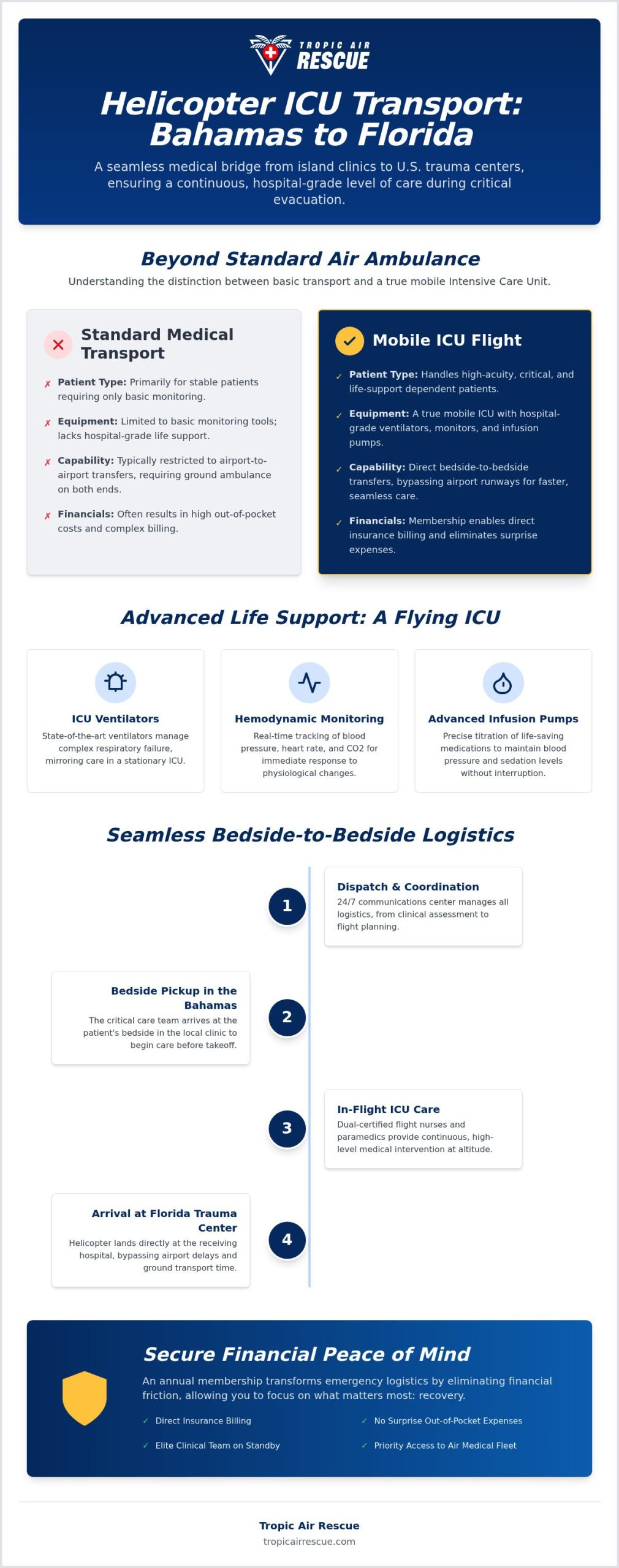
A mobile ICU flight isn’t merely a faster way to travel. It’s a sophisticated clinical extension of a tertiary care center, engineered to maintain a hospital-grade environment at altitude. While standard air ambulances often cater to stable patients requiring basic monitoring, a mobile ICU handles the high-intensity needs of life-support dependency. For those requiring helicopter ICU transport Bahamas, the distinction is critical. A standard charter lacks the specialized equipment and the high-acuity clinical staff necessary to manage unstable conditions during transit.
The core of this service is the bedside-to-bedside mandate. This protocol ensures a seamless clinical continuum from the moment a patient leaves their room at a local facility until they are admitted to a Florida trauma center. Air medical services have evolved to bridge these gaps, but only a dedicated mobile ICU provides the specialized avionics and power systems required to run multiple life-saving machines simultaneously. Operational readiness is non-negotiable. In critical care, 24/7 dispatch capability and specialized medical aviation are the baseline requirements for achieving positive clinical outcomes.
The High-Acuity Spectrum
High-acuity patients are those facing complex medical challenges. This includes individuals on mechanical ventilation, those requiring multiple titrating IV drips, or patients needing continuous invasive hemodynamic monitoring. Standard charter flights cannot legally or clinically perform these transfers because they lack the necessary certifications and specialized medical interiors. Specialized helicopters utilize advanced avionics to ensure a smoother flight path, which is vital for maintaining the stability of a patient whose vitals are fragile.
Concierge Coordination and Clinical Continuity
Precision in the air requires expert logistics on the ground. A centralized communications center manages every detail of the hospital hand-off, ensuring the receiving trauma team is fully briefed before the helicopter lands. This concierge approach to medical flights significantly reduces the administrative and emotional burden on the patient’s family. By integrating strictly with international medical repatriation protocols, the service ensures that cross-border care is handled with professional composure and technical accuracy. This meticulous preparation turns a complex international transfer into a disciplined, life-saving operation.
Advanced Life Support: Hospital-Grade Technology in the Air
A mobile ICU is defined by the technology it carries. For helicopter ICU transport Bahamas missions, the aircraft must function as a high-acuity treatment room. We utilize state-of-the-art ventilators designed to manage complex respiratory failure, ensuring patients receive the same ventilation strategies found in a stationary ICU. Multi-parameter cardiac monitors provide real-time hemodynamic tracking, allowing the team to respond instantly to subtle physiological shifts. These monitors track everything from arterial blood pressure to end-tidal CO2, providing a complete clinical picture throughout the flight.
Precision is paramount. Advanced infusion pumps allow for the precise titration of life-saving medications, maintaining critical blood pressure and sedation levels without interruption. Unlike standard medical charters, these aircraft feature onboard oxygen supplies and backup power systems that significantly exceed standard aviation requirements. This redundancy is essential for missions across the islands, where airport infrastructure might be limited. The power systems are designed to support multiple high-draw devices simultaneously without compromising the helicopter’s primary avionics.
The Clinical Crew: Elite Medical Expertise
Technology is only as effective as the hands that operate it. The backbone of every mission is a team of dual-certified flight nurses and critical care paramedics. These professionals are trained to manage high-stakes transport protocols under the oversight of a dedicated Medical Director. They possess specialized training in flight-specific physiology, understanding how altitude and pressure changes affect patient stability and gas expansion. This expertise ensures that the clinical care remains uninterrupted from takeoff to landing. For those planning for future contingencies, an annual air rescue membership provides the security of knowing this elite team is always on standby.
Specialized Equipment for Critical Care Air Transport
Diagnostic capability doesn’t stop on the ground. Portable blood gas analyzers provide immediate diagnostic feedback during transit, allowing for real-time adjustments to ventilator settings or medication dosages. The aircraft is also equipped with advanced airway management tools, including video laryngoscopy for difficult intubations. External pacemakers and defibrillators are specifically optimized for the helicopter environment, ensuring they remain effective despite vibration or electromagnetic interference. This comprehensive equipment suite allows for the management of the most complex clinical cases. When you choose helicopter ICU transport Bahamas services, you’re choosing a platform that rivals a terrestrial trauma center in both capability and clinical precision.
Strategic Advantages of Helicopter-Based Mobile ICUs
The geography of the Bahamas presents a unique logistical challenge for critical care. Traditional air medical transport often relies on fixed-wing aircraft, which necessitates a ground ambulance transfer to an established runway. For helicopter ICU transport Bahamas, this bottleneck is eliminated. Helicopters provide point-to-point precision, landing directly at remote resorts, private vessels, or hospital helipads. This capability ensures that the clinical environment is brought directly to the patient’s side without the delays of multi-modal transport. By removing the need for intermediate ground transfers, we maintain a higher level of clinical stability for the duration of the mission.
Operational flexibility is the hallmark of a specialized helicopter service. Reaching locations that fixed-wing aircraft simply cannot access is a life-saving necessity in a region defined by scattered islands and varying infrastructure. This agility allows for a time-critical response that prioritizes the patient’s immediate medical needs over airport availability. Every minute saved by bypassing ground logistics is a minute gained for clinical intervention in a hospital-grade environment.
Remote Location Medical Landing Capabilities
Reaching private islands or remote coastal areas without runways is a primary operational advantage. While a jet might fly faster in a straight line, the total “transit time” is often higher due to the logistics of getting a patient to and from the airport. Helicopter agility allows for immediate extraction from the point of injury or illness. The mobile ICU advantage means the clinical team begins stabilizing the patient on-site before takeoff. This immediate intervention is a core component of the advantages of helicopter medevac in the Bahamas, prioritizing clinical stability over simple cruise speed. It’s about getting the hospital to the patient, not just the patient to the hospital.
Helicopter vs Fixed-Wing: The Critical Choice
Choosing the right platform is a decision that dictates patient outcomes. In island environments, door-to-door speed is the only metric that matters. Fixed-wing aircraft require a functional airport, which can be miles away from the patient’s location. Helicopters are the primary choice for trauma air transport Bahamas because they bypass these geographic constraints. Advanced avionics allow pilots to navigate complex island geography with precision, even in challenging conditions. By utilizing helicopter ICU transport Bahamas, the medical bridge to US-based care remains direct and uninterrupted. This operational flexibility ensures that even the most secluded locations have access to elite medical repatriation without the friction of traditional aviation logistics.
Seamless Logistics: Navigating Inter-Hospital Transfers
Moving a patient from a local clinic to a Florida surgical suite is a high-stakes transition. It isn’t just about speed. It’s about maintaining a seamless clinical bridge across international borders. Efficient helicopter ICU transport Bahamas operations require meticulous logistical planning to avoid delays that can compromise patient outcomes. We manage the entire process, including the complex coordination with U.S. Customs and Border Protection. This proactive approach ensures that the patient moves through the system without administrative friction, even during a medical emergency.
The complexity of an inter-hospital transfer is often underestimated. It requires constant communication between our flight physicians, nurses, and the receiving staff in Florida. We don’t just transport; we integrate. This disciplined approach handles every detail, from medical records to immigration clearance. By managing these logistical hurdles, we allow the family to focus on their loved one while we secure the medical bridge to advanced care.
Coordination with Florida Trauma Centers
Our established protocols facilitate direct admission to Level 1 and Level 2 trauma facilities. We utilize real-time data transmission to send telemetry directly from the aircraft to the receiving surgical team. This ensures a zero-delay hand-off. For time-sensitive conditions like stroke or cardiac arrest, these saved minutes are vital. Our team remains with the patient until the receiving hospital staff has fully assumed care, maintaining total clinical continuity. This coordination is designed to honor the “Golden Hour” principle, maximizing the chances of a successful recovery. Families navigating the full scope of a Bahamas to Florida patient transfer will find that understanding the 2026 regulatory requirements and coordination protocols is essential for a seamless international transition. For those specifically departing from Nassau, a detailed overview of the air ambulance from Nassau to Miami process provides critical insight into the logistics, clinical standards, and coordination required for this high-stakes route.
High-Acuity Patient Safety Protocols
Patient safety is our primary metric. Pre-flight stabilization is a non-negotiable requirement. We optimize the patient’s condition before they are loaded onto the helicopter to ensure they can withstand the stresses of flight. During long-distance over-water transfers, our in-flight monitoring standards remain rigorous. We track every vital sign with hospital-grade precision. Every mission ends with a comprehensive post-flight debriefing and detailed clinical documentation. This provides the receiving facility with a clear, minute-by-minute record of the patient’s status. Ensure your family has access to elite coordination by reviewing our inter-hospital transfer protocols.
The Elite Membership Model: Eliminating Financial Friction
Critical care doesn’t wait for bank transfers or credit clearances. In a high-stakes medical emergency, the interval between the call for help and the arrival of the clinical team is the most vulnerable period for a patient. An annual air rescue membership is the definitive tool for eliminating this financial friction. By pre-securing elite medevac access, you remove the administrative hurdles that typically stall international medical transfers. This proactive approach is essential for anyone relying on helicopter ICU transport Bahamas services. It transforms a complex financial negotiation into a disciplined, immediate operational response.
The “pay-first” barrier is a reality for many non-members in the islands. Without a pre-established membership, families are often forced to navigate high out-of-pocket costs during their most stressful moments. Our model utilizes direct insurance billing to protect our members from these unexpected financial shocks. We position ourselves as a concierge medical bridge, coordinating directly with health insurers to handle the complexities of reimbursement. For residents and expats, this provides a level of security that standard travel insurance cannot match. It ensures that your medical repatriation is governed by clinical necessity, not financial liquidity.
How Direct Insurance Reimbursement Works
Our billing department specializes in high-acuity claim management. We accept insurance payouts as “payment in full” for members, which means the patient is not billed for any remaining balance. This protocol is compatible with a wide range of major international health insurance plans. There is a fundamental difference between standard “medical flight insurance” and a dedicated medevac membership. While insurance acts as a reimbursement tool, a membership provides a guaranteed operational platform. It ensures that the clinical team is authorized to launch the moment the Medical Director approves the mission.
Securing Your Membership
Coverage must be established before the need arises. We offer a variety of tiered subscription options to match your residency status or length of stay. Short-term membership is ideal for seasonal visitors, while annual membership offers year-round security for residents. The activation process is fast but must be completed in advance to ensure your data is in our dispatch system. We also provide specialized B2B membership plans for yacht crews, private estates, and luxury resorts. These corporate options provide a unified safety net for staff and guests alike. When you secure your membership, you’re not just buying a service; you’re ensuring that helicopter ICU transport Bahamas remains a seamless, hospital-grade extension of your emergency plan.
Securing the Medical Bridge to Advanced Care
The standard for emergency evacuation in the islands has shifted from simple transport to continuous, high-intensity clinical care. A mobile ICU flight provides the technological and expertise-driven bridge necessary for high-acuity patients. By utilizing specialized helicopter ICU transport Bahamas services, you ensure that geography and infrastructure never dictate the quality of medical intervention. We maintain 24/7 operational readiness across all islands; landing directly at resorts or bedside where fixed-wing aircraft cannot reach.
This elite level of preparedness is matched by a membership model that removes financial friction. Our team handles the complex concierge medical coordination and utilizes direct insurance billing to ensure zero out-of-pocket costs for members. This disciplined approach allows you to focus on recovery rather than logistics or payment barriers. Secure your elite medevac protection today with a Tropic Air Rescue membership. Your safety and stability are our primary mission.
Frequently Asked Questions
What exactly is a mobile ICU flight?
A mobile ICU flight is a specialized medical transport platform designed for high-acuity patients requiring continuous, intensive clinical monitoring. Unlike basic transport, it replicates the environment of a hospital ICU. It serves as a clinical bridge, ensuring life-support measures remain uninterrupted during transit. For those utilizing helicopter ICU transport Bahamas services, this means hospital-grade ventilators and cardiac monitors are operational from takeoff to landing at a Florida trauma center.
Who is part of the medical team on a critical care transport?
Every mission is staffed by an elite clinical team, typically consisting of dual-certified flight nurses and critical care paramedics. These professionals operate under the direct oversight of a Medical Director who establishes high-stakes transport protocols. Their training focuses on managing complex physiological changes caused by altitude and pressure. This expert preparation ensures that critical care remains seamless during the entire inter-hospital transfer process from the islands.
Can a mobile ICU flight land at a private residence or remote resort?
Yes, the primary tactical advantage of a helicopter is its point-to-point precision. We can land at remote resorts, private islands, or even bedside at local clinics where no runway exists. This eliminates the need for ground ambulance transfers to fixed-wing airports, which can be a significant bottleneck in a crisis. This flexibility is vital for reaching patients in secluded Bahamas locations where traditional aviation platforms cannot easily access.
How does a mobile ICU flight differ from a standard air ambulance?
A standard air ambulance typically handles stable patients who require basic medical supervision. In contrast, a mobile ICU flight is engineered for life-support dependency. It carries specialized equipment like advanced ventilators and invasive hemodynamic monitoring tools. For helicopter ICU transport Bahamas missions, the focus is on maintaining a high-acuity clinical environment for patients who are too unstable for standard medical charters or basic transport platforms.
Will my health insurance cover the cost of a mobile ICU flight?
Coverage depends on your specific plan and the determination of medical necessity by the insurer. For our members, we utilize a direct insurance billing model. This allows us to bill the health insurer directly for the service, which typically results in zero out-of-pocket costs for the member. Non-members often face the pay-first barrier, where upfront payment is required before seeking reimbursement from their provider.
What medical equipment is required for a flight to be considered a mobile ICU?
To be classified as a mobile ICU, the aircraft must carry hospital-grade ventilators capable of managing respiratory failure. It also requires multi-parameter cardiac monitors for real-time tracking and advanced infusion pumps for precise medication titration. Additionally, onboard oxygen supplies and backup power systems must exceed standard aviation requirements. These tools allow the clinical team to perform invasive monitoring and advanced life support at altitude for the most complex cases.
How is an inter-hospital transfer coordinated between different countries?
Coordination involves a centralized communications center that manages hospital hand-offs and international logistics. Our team works directly with U.S. Customs and Border Protection to handle immigration and customs clearance during the emergency. We maintain established protocols with Florida trauma centers for direct admission. This disciplined approach ensures a zero-delay transition from the sending facility in the Bahamas to the receiving surgical team in the United States without administrative friction.
Is a helicopter or fixed-wing aircraft better for critical care transport in the islands?
In the island environment, helicopters are superior for critical care because they provide bedside-to-bedside service. Fixed-wing aircraft require airports and ground ambulance transfers, which adds transit time and increases the risk of clinical instability during hand-offs. Helicopters bypass these bottlenecks by landing directly at the point of care. This agility is essential for trauma cases where the Golden Hour dictates the patient’s ultimate outcome.