

In the 700 islands of the Bahamas, a fixed-wing aircraft is simply a flight, but a helicopter is a true rescue. For those on remote cays, the nearest runway might be miles of rough terrain or water away, making the “last mile” of a medical emergency the most dangerous. You likely worry about being stranded without hospital access or facing a $100,000 bill for a flight that still requires multiple ground transfers. These anxieties are valid in a region where traditional logistics often fail when minutes matter most.
Understanding the advantages of helicopter medevac in the Bahamas is essential for anyone navigating the archipelago in 2026. This article explores why point-to-point transport is the superior choice for critical care and how you can secure elite coverage that removes the burden of out-of-pocket expenses. We will compare the logistics of fixed-wing versus helicopter transport, identify the most reliable national rescue service, and explain how a membership model provides a seamless bed-to-bed solution without the financial sting of traditional air medical claims.
Key Takeaways
- Compare landing requirements between 5,000ft runways and 50ft clear surfaces to understand the logistics of island rescues.
- Analyze why Total Mission Time (TMT) is the critical metric for the “Golden Hour” in archipelagic medical emergencies.
- Discover the specific advantages of helicopter medevac in the Bahamas for bypassing ground ambulance transfers and reaching remote islands.
- Learn how a membership model utilizes direct insurance billing to eliminate the financial burden of high-cost medical flight claims.
- Explore the benefits of a specialized helicopter fleet for direct coordination with leading Florida trauma centers.
Navigating Archipelagic Medical Emergencies: Helicopter vs Fixed Wing Medevac
Medical evacuation, or medevac, is the specialized transport of critically ill or injured patients via aircraft equipped with advanced life-support technology. In the Bahamas, this service is not a luxury; it is a critical lifeline. The archipelago presents a unique logistical environment that demands high-precision coordination and rapid response. Two primary modes of air medical services exist: fixed-wing aircraft and rotary-wing helicopters. While both serve vital roles, the geographical reality of 700 islands and limited runway access often determines the outcome of a medical emergency. The “last-mile” medical gap represents the lethal delay incurred when a patient must be transported across unpaved roads or open water just to reach a functional runway.
What is Fixed-Wing Medevac?
Fixed-wing medevac employs pressurized, long-range aircraft configured as mobile intensive care units. These planes excel in long-distance transport and international repatriation, particularly when moving patients from Nassau to specialized trauma centers in the United States. They offer high cruising speeds over open ocean and a stable, pressurized environment for complex medical cases. However, their operational utility is tethered to infrastructure. They require certified runways, often 5,000 feet or longer, and specialized airport ground handling. In remote island scenarios, this requirement necessitates a secondary transport step. Patients often endure a bumpy ground ambulance ride or a slow boat transfer to reach the tarmac, adding stress to an already unstable condition.
What is Helicopter Medevac?
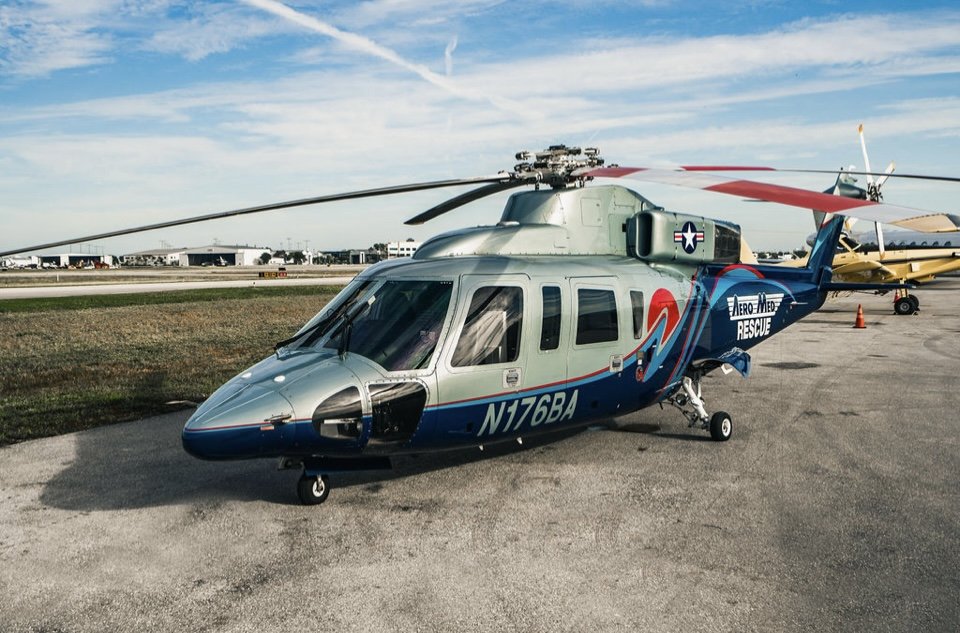
Helicopter medevac functions as a high-precision, point-to-point rescue tool. Unlike planes, helicopters do not require airports or paved runways. They can land directly at a resort, on a remote beach, or even on the deck of a vessel. This flexibility is one of the primary advantages of helicopter medevac in the Bahamas. These aircraft focus on rapid stabilization and immediate intervention during the “Golden Hour,” the critical sixty-minute window where medical treatment is most likely to prevent death or permanent disability. By landing exactly where the patient is located, helicopters eliminate the need for multiple ground transfers. This ensures a seamless bed-to-bed transition from a remote island directly to a regional hospital or trauma center, saving minutes that are often the difference between recovery and tragedy.
Technical Capabilities: Point-to-Point Transport vs Airport Logistics
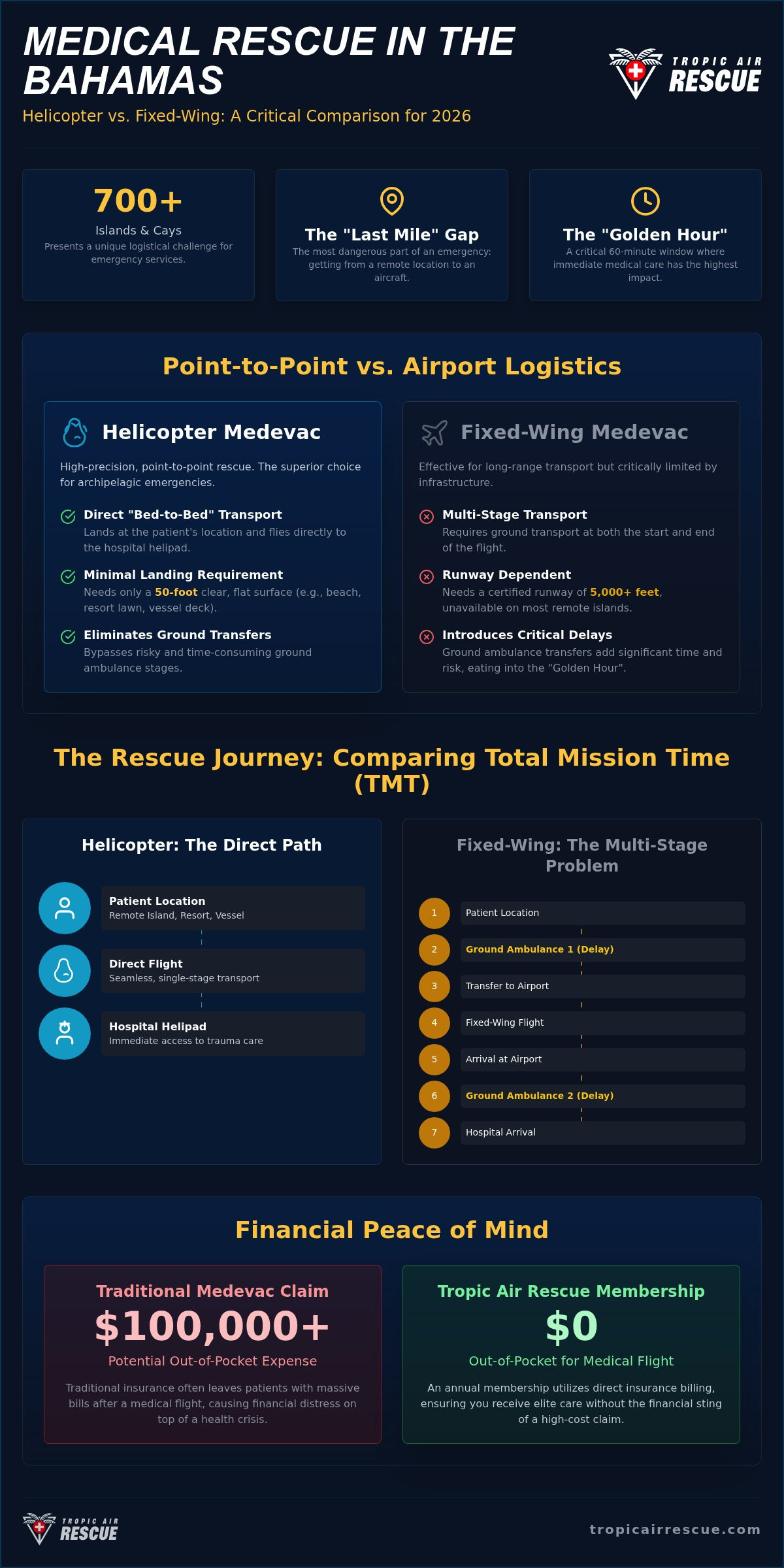
Operational success in an archipelagic environment depends on landing precision. Fixed-wing aircraft are bound by rigid infrastructure requirements. Most medical jets require at least 5,000 feet of certified runway to operate safely—a logistical standard for luxury business aviation providers like flyelitejets.com. In contrast, a specialized medical helicopter requires only a 50-foot clear, flat surface. This technical flexibility allows for direct extraction from resorts, private estates, or even offshore vessels. These advantages of helicopter medevac in the Bahamas provide a level of accessibility that fixed-wing fleets cannot match. For a deeper understanding of how elite flight crews execute a remote location medical landing in the unique terrain of the Bahamian archipelago, our dedicated guide covers the full scope of these specialized operations.
Efficiency is measured by the “bed-to-bed” protocol. A helicopter mission is a single-stage evolution. The aircraft lands at the scene, the medical crew stabilizes the patient, and the flight proceeds directly to the receiving hospital helipad. Fixed-wing missions are multi-stage. They involve a ground ambulance from the scene to the airport, a transfer onto the plane, the flight itself, another transfer to a second ground ambulance, and finally the arrival at the hospital. Each transfer increases the risk of patient handling fatigue and clinical destabilization. Helicopters provide a smoother transition for high-acuity patients by eliminating these intermediate handling points. When a patient requires escalation to a higher level of care, understanding the protocols for a successful inter-hospital transfer is essential for ensuring clinical continuity and minimizing adverse events during transit.
Runway Dependency and the Ground Ambulance Delay
Fixed-wing logistics necessitate two separate ground ambulance transfers. These transitions are not just time-consuming; they are medically intensive. Every time a high-acuity patient is moved, there is a risk of dislodging lines or experiencing equipment failure. Helicopters bypass these vulnerabilities entirely. They also avoid the logistical friction of airport security checkpoints and tarmac wait times that plague commercial and private airport operations. To ensure you have access to this streamlined response, it’s wise to maintain an annual membership for your family or guests.
Advanced Life Support: Hospital-Grade Care in the Air
The 2026 helicopter fleet models are engineered to function as flying intensive care units. These aircraft integrate full Advanced Life Support (ALS) systems into a compact, high-efficiency cabin. Essential equipment includes:
- Transport ventilators for invasive and non-invasive support
- Multi-parameter cardiac monitors with 12-lead ECG capability
- Precision infusion pumps for critical medication delivery
- Advanced airway management and trauma kits
Specialized medical crews manage these systems with surgical precision. These teams usually consist of a flight nurse and a flight paramedic trained in high-altitude critical care. Modern 2026 avionics also include enhanced over-water safety systems and terrain awareness technology. These features ensure that even in the most remote reaches of the archipelago, the standard of care remains uncompromising and the response remains immediate. Learn more about how an advanced life support helicopter functions as a mobilized ICU to deliver gold-standard care between a remote crisis and a specialized trauma center.
The ‘Golden Hour’ in the Islands: Why Accessibility Trumps Airspeed
In trauma medicine, the Golden Hour represents the critical window where clinical intervention most effectively prevents mortality or long-term disability. In the Bahamas, this window is frequently squandered by logistical friction. While fixed-wing aircraft offer superior cruising speeds over long distances, they often fail to deliver the patient to a trauma center within this vital hour. The advantages of helicopter medevac in the Bahamas are most evident when analyzing Total Mission Time (TMT). A helicopter mission prioritizes accessibility over raw airspeed, ensuring the patient receives definitive care without the delays of ground ambulance staging.
Operational success in 2026 relies on more than just flight physics. Modern response times are further enhanced by advanced weather-tracking systems and Night Vision Goggles (NVG). These technologies allow specialized crews to maintain a high state of readiness even during marginal weather or hours of darkness. By landing exactly where the patient is located, the aircraft becomes a mobile emergency room that brings the hospital to the victim, rather than forcing the victim to navigate a complex chain of ground and air transfers.
Total Mission Time Analysis
The efficiency of a medevac mission is determined by the clock, not the speedometer. A fixed-wing timeline is a fragmented process. It requires dispatch, ground ambulance transport to a certified runway, patient transfer, flight time, landing at a secondary airport, another patient transfer, and a final ground ambulance leg to the hospital. This multi-stage evolution is prone to delays at every junction, including tarmac wait times and airport security protocols. Conversely, a helicopter timeline is a streamlined, two-stage process: dispatch directly to the scene and flight directly to a hospital helipad. By eliminating four separate transfer points, a helicopter consistently delivers a patient to a Florida or Nassau trauma center faster than a high-speed jet.
Reaching the Unreachable: Remote Site Landings
Emergency scenarios in the islands rarely occur near a paved 5,000-foot runway. For incidents on private vessels, remote coastal areas, or undeveloped cays, a helicopter is the only viable rescue asset. Point-to-point transport significantly reduces the physiological stress on a patient by avoiding the vibration and jostling inherent in multiple ground ambulance transfers. This is especially critical for spinal injuries or cardiovascular events where stability is paramount. Understanding the full complexity of a remote location medical landing — from site assessment to crew coordination — is essential for anyone spending time on isolated Bahamian cays. For those planning a visit to the archipelago, consulting the Short-Term Medevac Guide for Island Travelers 2026 is a critical step in emergency preparedness. This proactive approach ensures you understand the logistical landscape of the islands before a crisis occurs, allowing for a faster, more coordinated response when every second counts.
Financial and Operational Considerations for Air Medical Coverage
The financial reality of a medical emergency in the archipelago is stark. Retail medevac flights in 2026 frequently generate invoices between $90,000 and $140,000. For an uninsured patient, these costs are often due immediately, sometimes before the aircraft even departs the tarmac. One of the primary advantages of helicopter medevac in the Bahamas is the ability to access specialized concierge membership programs that manage these astronomical fees on your behalf. These programs move beyond simple transport; they provide a comprehensive financial shield against the volatility of international medical billing.
Operational readiness is sustained through these subscription models. By maintaining a dedicated fleet and specialized medical crews, a concierge service ensures that the aircraft is available for immediate dispatch. This contrasts with retail air ambulances, which may require hours or days to position an aircraft and verify funds. In a high-stakes environment where the “Golden Hour” is already compressed by geography, financial delays are a risk no traveler or resident should accept.
Eliminating Out-of-Pocket Costs
Traditional travel insurance operates on a reimbursement model. You pay the $100,000 bill upfront and petition for repayment later. This is a high-risk strategy during a medical crisis. Elite air rescue services utilize a Direct Insurance Billing model for their members. The provider coordinates directly with health insurance companies to secure a “Guarantee of Payment,” removing the requirement for direct patient invoicing. Most standard travel plans fall short in the Bahamas because they have restrictive coverage caps or only cover flights they deem “medically necessary” rather than “medically reasonable” for remote island logistics.
Membership Models for 2026
Coverage tiers are designed for specific operational needs. Short-term Membership plans cater to yacht guests and temporary island visitors, providing elite protection for stays as short as one week. Annual Membership plans serve residents and second-home owners who require year-round readiness across the islands. B2B Membership Plans are also available for resorts and charter companies seeking to protect their clients. These subscriptions ensure that when a crisis occurs, the focus remains on clinical outcomes rather than financial authorization. To secure your peace of mind, you can view our Annual Membership options to eliminate potential out-of-pocket expenses.
The value of these memberships extends to concierge coordination. Upon activation, the service manages the entire logistical chain, including communication with international trauma centers in Florida. This ensures that the receiving facility is fully briefed on the patient’s condition before the helicopter even touches down. This level of professional preparation is the hallmark of an elite rescue service.
Securing Elite Air Medical Protection with Tropic Air Rescue
Tropic Air Rescue operates as a high-end guardian for those navigating the Bahamian waters and islands. We maintain a state of constant readiness, ensuring that critical care is never more than a radio call away. Our organization specializes in complex logistical challenges, including Interhospital Transfer Services and Organ Transport. By focusing solely on rotary-wing operations, we eliminate the delays associated with airport-dependent aviation. This specialized focus maximizes the advantages of helicopter medevac in the Bahamas, ensuring that every mission is executed with clinical precision and logistical speed.
Our “Always Ready” posture is a commitment to meticulous preparedness. We don’t just provide a flight; we provide a comprehensive medical bridge between remote island locations and advanced clinical facilities. This proactive approach to safety ensures that members receive elite care without the administrative friction typically found in international medical emergencies. We function as a private partner that values exclusivity and operational excellence above all else.
Why a Dedicated Helicopter Fleet Matters
A dedicated fleet ensures that specialized life-support equipment is always on board and ready for immediate deployment. We don’t waste time reconfiguring cabins or sourcing medical kits from storage. Our crews are trained exclusively for the high-stakes environment of rotary-wing medical missions. They understand the nuances of over-water navigation and remote-site landings. This expertise allows us to provide national reach across the archipelago without the limitations of airport availability or runway conditions. Our helicopters are equipped with advanced avionics designed for the unique demands of the Caribbean environment, ensuring safety and reliability in every response.
Enrolling in a Concierge Plan
Securing elite protection is a straightforward process that should be completed before your arrival or residency begins. Our membership model is designed to remove the friction of emergency logistics. When you become a member, you gain access to a “no-bill” guarantee that protects you from the financial shock of a six-figure medevac invoice. We handle the direct billing to your health insurance provider, allowing you to focus entirely on recovery. Our team provides direct coordination with leading Florida trauma centers and regional hospitals, ensuring a seamless handoff from the aircraft to the clinical team.
Membership tiers are tailored to your specific needs:
- Short-term Membership for yacht guests and seasonal visitors
- Annual Membership for residents and second-home owners
- B2B Membership Plans for resorts and charter operators
This level of professional preparation is what distinguishes a concierge rescue service from a standard utility. Don’t leave your safety to chance in a region where geography can be your greatest adversary. Secure your 2026 air rescue membership today and ensure that you have the most capable solution standing by.
Readiness is the Only Strategy for 2026
The logistical reality of 2026 requires more than just a contingency plan; it requires an operational bridge. Point-to-point transport is the only way to bypass the hazardous ground transfers and airport delays that waste the critical Golden Hour. By leveraging the specific advantages of helicopter medevac in the Bahamas, you ensure that high-acuity care arrives exactly where it’s needed, whether on a remote beach or a private vessel. This isn’t just about speed. It’s about the precision of bringing a flying intensive care unit directly to the patient’s side without the friction of airport infrastructure.
Tropic Air Rescue stands as your vigilant guardian across the archipelago. Our advanced life support helicopter fleet and direct trauma center coordination provide a level of medical precision that traditional fixed-wing services can’t match. Through our concierge membership model, you eliminate the threat of six-figure medical bills and secure a “no-bill” guarantee for your family or guests. Don’t leave your emergency response to chance when expert preparation is available. You deserve the peace of mind that comes from having a dedicated, elite rescue partner standing by.
Secure Your National Air Rescue Membership today and navigate the islands with absolute confidence.
Frequently Asked Questions
Is helicopter medevac safer than fixed-wing transport?
Safety is defined by the stability of the patient throughout the entire mission. Helicopters offer a superior safety profile for high-acuity patients by eliminating the risks of multiple ground ambulance transfers. Every time a patient is moved between vehicles, there is a risk of clinical destabilization or equipment failure. By providing point-to-point transport, helicopters ensure a seamless bed-to-bed transition that protects the patient from the physical stress of fragmented logistics.
How much does a medical evacuation from the islands cost in 2026?
Retail medical flight costs are a significant financial risk in the archipelago. Industry data for 2026 shows that international medevac bills frequently exceed $100,000, with some complex claims reaching $142,000. These “retail” prices are often due immediately upon dispatch. A concierge membership is designed to mitigate this volatility, providing a professional rescue solution that removes the burden of these unpredictable and high-cost retail invoices.
Can medevac helicopters fly directly to US trauma centers?
Yes, specialized medical helicopters are equipped for over-water missions directly to leading Florida trauma centers. This capability is one of the primary advantages of helicopter medevac in the Bahamas, as it allows the aircraft to land on hospital helipads rather than at international airports. This bypasses the need for a final ground ambulance leg, ensuring the patient reaches definitive care in the shortest possible time frame.
What is the difference between travel insurance and a medevac membership?
Travel insurance is a reimbursement-based financial product, while medevac membership is a proactive service guarantee. Insurance often requires the patient to pay the six-figure retail bill upfront before filing a claim for repayment. Membership utilizes a direct-billing model where the provider coordinates with your insurer and waives any remaining balance. This ensures members face zero out-of-pocket costs and receive immediate dispatch without financial delays. For a comprehensive breakdown of how an annual air rescue membership provides this elite level of Bahamas medevac security, our dedicated guide covers every aspect of the coverage model.
What medical equipment is standard on a rescue helicopter?
Every aircraft in the fleet is configured as a mobile intensive care unit. Standard Advanced Life Support (ALS) equipment includes transport ventilators, multi-parameter cardiac monitors with 12-lead ECG, and precision infusion pumps. These systems are managed by specialized flight nurses and paramedics trained in high-altitude critical care. This technology ensures that the level of care provided in the air is equivalent to that of a modern hospital emergency room.
How do I activate a medevac mission in an emergency?
Activation is a streamlined process initiated through a dedicated 24-hour concierge dispatch line. Members provide their location and the patient’s condition to a specialized coordinator. The team immediately handles all logistics, including flight planning, medical crew briefing, and trauma center coordination. This professional protocol removes the administrative burden from the family, allowing the rescue to proceed with surgical precision and maximum speed.
Does my health insurance cover helicopter air ambulance services?
Standard health insurance plans often have significant gaps for international air medical transport. Many policies include restrictive caps or only cover flights deemed “medically necessary” by their own internal reviewers. Membership services close these gaps by acting as a secondary layer of protection. The provider bills your insurance company directly for any available coverage and waives the rest, ensuring the mission is fully covered without out-of-pocket expenses.
Are there weight or size limitations for patients on a helicopter?
All aircraft are subject to strict weight and balance requirements to ensure flight safety. While modern medical helicopters can accommodate the majority of patients, specific limits apply based on the patient’s weight and the volume of life-support equipment required. These parameters are assessed during the initial dispatch call. This careful evaluation is a critical part of mission planning, ensuring that the aircraft operates within its technical performance envelope at all times.