


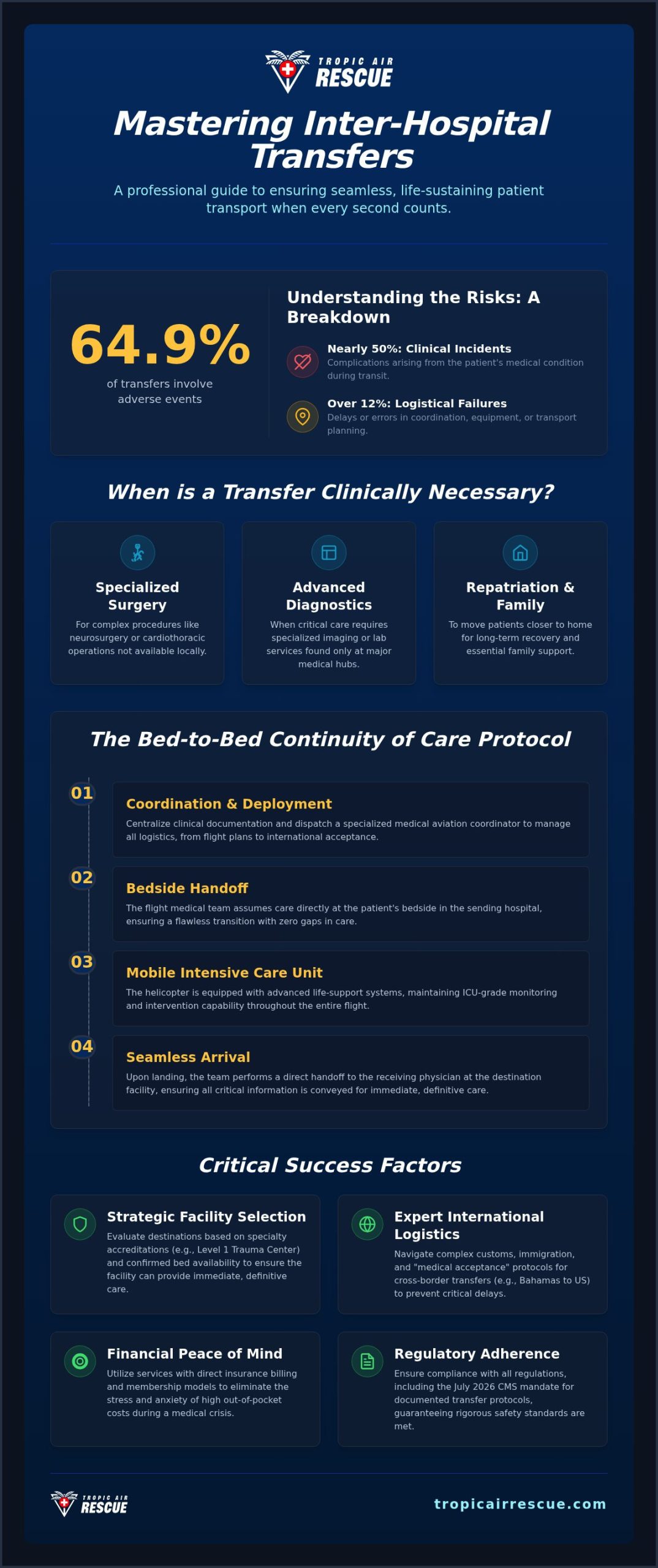
Research indicates that 64.9% of inter-hospital transfers involve adverse events. Nearly half of these incidents are clinical, while over 12% result from logistical failures. When a patient requires a higher level of care, the inter-hospital transfer becomes a high-stakes mission where precision is as vital as medical expertise. You likely feel the urgency of every passing minute. The fear of clinical decline during transit is a heavy burden for any family or medical team to carry.
This professional guide provides the framework to master the complexities of moving a patient between facilities. You’ll learn to manage logistics, clinical continuity, and the specifics of medical aviation with the composure of an expert. We detail the protocols for a bed-to-bed transfer with zero gaps in care. This includes strategies for direct billing to insurance to avoid out-of-pocket stress. We also outline the steps for rapid arrival at specialized trauma centers. From navigating the July 2026 CMS regulations to securing helicopter transport across the Bahamas, this briefing ensures you’re prepared for every variable.
Key Takeaways
- Identify the specific clinical triggers that necessitate an inter-hospital transfer, such as the requirement for specialized surgery or Level 1 Trauma Care.
- Evaluate destination facilities based on specialty accreditation and geographic proximity to ensure the most rapid and effective medical response.
- Streamline the coordination process by centralizing essential clinical documentation and utilizing specialized medical aviation coordinators for deployment.
- Protect your finances by leveraging membership models that facilitate direct insurance billing, eliminating the anxiety of high out-of-pocket costs.
- Maintain bed-to-bed continuity of care with advanced life-support equipment designed to turn a helicopter into a mobile intensive care unit.
Understanding the Dynamics of Inter-Hospital Transfer
An inter-hospital transfer is the planned movement of a patient from one acute care facility to another. It’s a clinical operation, not a logistical convenience. While standard patient transport often covers routine non-emergency moves, high-acuity transfers require a higher level of readiness. In many remote or underserved regions, this often means moving a patient from a local clinic to a specialized trauma center in a major medical hub or an advanced facility in another country. These missions differ from routine hospital moves because they involve patients who require active, life-sustaining care during every mile of the journey.
When is a Transfer Clinically Necessary?
Clinical necessity is the primary driver for these missions. Data from 2026 indicates that 86.1% of transfers occur because the patient needs specialized treatment unavailable at their current location. Common triggers include:
- Specialized Surgery: Many smaller or remote facilities aren’t equipped for complex neurosurgery or cardiothoracic procedures.
- Advanced Diagnostics: Critical cases may require specialized imaging or lab services found only at major medical hubs.
- Repatriation: Patients often need to move closer to home for long-term recovery and family support.
New CMS regulations effective July 1, 2026, mandate that all acute-care hospitals maintain formal, documented protocols for these movements. These rules ensure that the decision to transfer is backed by rigorous safety standards and clear medical necessity.
The Critical Role of Continuity of Care
The most dangerous part of a patient’s journey is the gap between facilities. A 2026 study revealed that adverse events occur in 64.9% of transfers, with nearly half of those being clinical in nature. Maintaining continuity of care is the only way to mitigate this risk. This requires a bed-to-bed handoff. The medical team doesn’t just meet the patient at the aircraft; they assume care at the bedside of the sending hospital. By using aircraft equipped with advanced life-support systems, the clinical team maintains ICU-grade monitoring throughout the flight. This prevents transfer lag, ensuring the receiving physicians get a patient who has been stabilized and monitored with the same precision they would expect in a stationary ICU.
How to Select the Right Transfer Facility
Selecting the destination for an inter-hospital transfer is a strategic decision that directly impacts clinical outcomes. It’s not merely about finding the nearest bed. It’s about matching the patient’s specific acuity with a facility’s specialized resources. In high-stakes trauma or cardiac events, the choice of facility can be the difference between recovery and permanent decline. Proximity matters, but the facility’s ability to provide immediate, definitive care is the priority. This is especially true when moving patients from the Bahamas to specialized centers in the United States. Understanding the full scope of a Bahamas to Florida helicopter transfer — including the logistics, medical advantages, and international coordination required — is essential for making informed decisions during a crisis.
Evaluating Trauma Center Capabilities
Families and medical teams must understand the distinction between trauma designations. A Level 1 Trauma Center is a comprehensive regional resource that provides every aspect of care for all injuries. These facilities maintain 24-hour in-house coverage by specialized surgeons and anesthesiologists. Level 2 centers offer similar clinical expertise but may lack the research and residency components found in Level 1 hubs. When assessing a facility, verify the presence of specialized units such as neurosurgery, burn care, or advanced neonatal intensive care. Following established guidelines for safe patient transfer ensures that the receiving hospital has a dedicated transfer center. This unit manages rapid intake and ensures a physician is ready to assume care the moment the aircraft lands.
Logistics of International Acceptance
International transfers introduce unique regulatory hurdles. Moving a patient from the Bahamas into the US requires more than just a flight plan. The transport coordinator must secure “medical acceptance” from a receiving physician. This is a formal clinical agreement that the hospital has the specific resources to manage the patient’s condition. Simultaneously, the team must navigate customs and immigration protocols for the patient and any accompanying family members. Securing an interhospital transfer service with deep expertise in international logistics prevents delays at the border. Bed availability must be confirmed before the rotor blades start turning. This proactive approach eliminates the risk of “ramping,” where a patient is held in transit because the receiving facility isn’t prepared for the arrival. Speed is the objective; precision is the method.
Coordination between the transport team and the receiving hospital must be absolute. The transport team provides real-time status updates, ensuring that the trauma team is scrubbed in and ready. This level of synchronization maintains the “bed-to-bed” continuity that elite medical missions demand. Every second saved in the coordination phase is a second gained in the operating room. For a detailed operational blueprint on patient transfer to Florida trauma centers, including how to navigate international logistics and secure rapid access to Level I and II facilities, our strategic guide provides the precise steps your team needs.
Step-by-Step Guide to Coordinating a Medical Flight
Coordinating an inter-hospital transfer by air is a precise operation that begins with a dedicated medical aviation coordinator. This individual acts as the central hub, synchronizing clinical needs with flight logistics. The process starts with the rapid collection of documentation. You must provide a comprehensive History and Physical (H&P), current vital signs, and a complete medication list. These records allow the flight team to prepare the correct life-support configuration before the aircraft leaves the hangar. This data is also essential for the receiving physician to grant formal medical acceptance, which is the final green light for any mission.
Choosing the Aircraft: Helicopter vs. Fixed-Wing
The choice of airframe dictates the speed and efficiency of the mission. For transfers within the Bahamas or to South Florida, helicopters offer a distinct tactical advantage. They facilitate direct hospital-to-hospital transit, bypassing the need for ground ambulance transfers at both ends. This point-to-point capability reduces total transit time and minimizes the risk of clinical decline during multiple handoffs. To understand the operational differences in more detail, read our analysis on Helicopter vs Fixed Wing Medevac: The Critical Choice for Bahamas Emergencies in 2026. Helicopters can access remote island locations and land directly on hospital helipads, ensuring the patient remains under continuous care without the vibration and delays of road transport.
The Pre-Flight Medical Briefing
Precision care requires a thorough clinical briefing between the referring physician and the flight medical director. This exchange ensures that the transport team is fully apprised of the patient’s current status and potential complications. All life-support equipment must be calibrated for the specific physiological stresses of flight. This includes adjusting ventilator settings and infusion pumps for altitude changes. Stabilization protocols are implemented immediately to minimize the impact of takeoff and landing forces. The goal is a seamless extension of the hospital’s ICU environment into the cabin of the aircraft. When the flight team arrives at the bedside, they aren’t just transporters; they’re an elite medical unit prepared to maintain clinical continuity at the highest level.
The final step involves synchronizing the bed-to-bed handoff. This includes coordinating with ground ambulance providers if the aircraft cannot land directly at the facility. Every link in the chain is verified, from the hospital elevator timing to the clearance at the receiving trauma center’s intake bay. This methodical approach ensures that the inter-hospital transfer proceeds without operational gaps, delivering the patient directly to the specialists who are already scrubbed in and waiting.
Navigating Insurance and Financial Logistics
Financial transparency is paramount during an inter-hospital transfer. The complexity of international billing often creates a secondary crisis for families already managing a medical emergency. While federal protections like the No Surprises Act offer safeguards for air ambulance services within the United States, missions originating in the Bahamas require a different level of logistical foresight. Costs for un-contracted air medical services are often substantial. Insurance providers typically only authorize payment for transfers deemed “medically necessary.” This means the patient requires specialized treatment, such as a Level 1 Trauma Center, that isn’t available at the originating facility. Transfers for personal convenience or repatriation without a clinical mandate often result in denied claims. You don’t want to be caught in a dispute over coverage while a patient’s health is on the line.
The Membership Model Explained
A membership model transforms a medical emergency from a financial negotiation into a coordinated response. By securing a subscription, you eliminate the need for immediate payment or complex cost-sharing discussions during a life-critical event. This proactive approach ensures the aircraft is deployed the moment clinical acceptance is confirmed. For those visiting the region, a Short-Term Medevac Guide for Island Travelers 2026 details how coverage works for temporary stays. Members benefit from an “insurance as full payment” policy. The service provider handles the entire claim process with your insurer, accepting the payout as the complete fee for the mission. It’s a system designed to remove the threat of balance billing, ensuring the focus remains entirely on clinical outcomes. For those spending extended time in the region, an annual air rescue membership provides the most comprehensive and cost-effective layer of protection, guaranteeing a rapid helicopter response and zero out-of-pocket costs when seconds matter most.
Direct Billing Protocols
Elite rescue services operate with a dedicated concierge team to manage financial logistics. Upon initiation of an inter-hospital transfer, you provide your insurance credentials for immediate verification. The team works directly with international health insurers to secure pre-authorization. This administrative effort is intense. It involves documenting the medical necessity and coordinating with the receiving facility’s billing department. Professional services prioritize transparency and provide clear briefings on what is covered. This ensures no financial surprises follow the clinical recovery. It’s the hallmark of a high-end guardian. It allows families to focus at the bedside while experts handle the ledger. Precision in billing is as critical as precision in the cockpit.
Secure your peace of mind by exploring our interhospital transfer services today.
The Tropic Air Rescue Concierge Transfer Advantage
Tropic Air Rescue projects the personality of an authoritative expert and a vigilant, high-end guardian. We maintain an elite, always ready posture that defines our inter-hospital transfer operations. This isn’t a generic utility. It’s a specialized offering for those who demand meticulous preparedness and professional composure. Our teams are disciplined and focused. They successfully balance the gravity of emergency operations with the calm, collected language of expert preparation.
Advanced Life Support at High Stakes
Our aircraft are configured as mobile intensive care units. We utilize advanced life-support equipment that mirrors a stationary ICU. This includes high-performance ventilators, multi-parameter cardiac monitors, and advanced infusion pumps. Our medical staff consists of elite flight nurses and paramedics trained in high-acuity care. They manage complex clinical needs with the same precision our pilots apply to the flight deck. The precision of our helicopter avionics ensures an all-weather response. We can land at remote island facilities in the Bahamas, providing a level of geographical precision that fixed-wing options cannot match. Every mission is a demonstration of operational excellence. For a comprehensive overview of how specialized trauma air transport Bahamas services operate — including 2026 protocols for trauma center coordination and the strategic advantages of membership-based coverage — our emergency guide details the full operational framework.
Seamless International Coordination
Managing a cross-border inter-hospital transfer requires more than just medical skill. It requires administrative mastery. We handle all cross-border medical flight clearances and customs protocols for our members. Our concierge team serves as a professional liaison with major international trauma centers. We ensure that the receiving specialists are not just informed, but fully prepared for the patient’s specific acuity. This commitment to professional composure ensures that every handoff is seamless. We avoid the clinical gaps that occur during uncoordinated moves. Our team remains at the patient’s side until the receiving facility’s staff has assumed full control.
You gain the peace of mind that comes from a single point of contact. We manage every logistical variable, from the initial bedside assessment to the final handoff at a specialized trauma center. This structured approach eliminates operational gaps. It suggests an organization that values precision and safety above all else. We don’t rely on hyperbole. Our focus on specialized equipment and professional experience provides its own weight. It’s the definitive solution for high-stakes medical challenges in the Bahamas. We are your elite partner in critical care logistics.
Operational Readiness for Critical Care
Mastering a high-acuity inter-hospital transfer requires a fusion of medical expertise and logistical precision. You now understand that clinical continuity depends on a bed-to-bed handoff and the use of aircraft configured as mobile ICUs. Choosing the right facility and navigating international regulations are critical steps that shouldn’t be left to chance during a crisis. Financial logistics, including the complexities of insurance authorization, are best managed by a team that prioritizes transparency and proactive coordination. You don’t have to navigate these complexities alone.
Tropic Air Rescue maintains an elite, always ready posture to handle these high-stakes missions. We operate a specialized life-support helicopter fleet capable of remote landings across the Bahamas. Our concierge team provides expert international coordination with major trauma centers, ensuring a seamless transition of care. We also facilitate direct billing to major health insurers for our members, removing the burden of financial negotiation from your family. You can face the unexpected with the confidence of an expert partner at your side. Secure your peace of mind with a Tropic Air Rescue membership today.
Frequently Asked Questions
What is the difference between an emergency medevac and an inter-hospital transfer?
An emergency medevac typically involves responding to a scene or remote location to provide immediate rescue and stabilization. Conversely, an inter-hospital transfer is the planned movement of a patient already admitted to an acute care facility who requires specialized treatment elsewhere. While both require high-acuity medical care, the transfer focuses on clinical continuity between two medical teams. This ensures the patient is moved safely to a facility with advanced capabilities like a Level 1 Trauma Center.
Can a family member fly with the patient during an inter-hospital transfer?
One family member can typically accompany the patient if the aircraft’s weight and balance limits allow it. The flight medical director makes the final decision based on the patient’s clinical status and the space required for life-support equipment. In high-acuity missions, the medical team’s ability to provide care is the priority. If a family member cannot be accommodated, the concierge team assists in coordinating alternative travel arrangements to the destination facility.
How long does it take to coordinate an international medical flight?
Coordination of an international medical flight often occurs within a matter of hours for our members. This timeline includes securing medical acceptance from the receiving physician, verifying insurance, and obtaining cross-border flight clearances. Our “always ready” posture ensures that the aircraft and medical team are deployed as soon as the clinical handoff is finalized. Non-members may face delays due to the time required for financial verification and logistical planning during a crisis.
Is a helicopter or a fixed-wing plane better for hospital-to-hospital moves?
Helicopters are superior for hospital-to-hospital moves within the Bahamas and to South Florida because they facilitate direct bed-to-bed transfers. Unlike fixed-wing aircraft, helicopters land on hospital helipads or at remote island locations. This eliminates the need for ground ambulance transfers at both ends of the flight. Reducing these handoffs minimizes the risk of clinical decline and significantly shortens the total transit time for the patient during a critical mission.
Will my health insurance pay for a transfer to a specialized trauma center?
Health insurance typically covers an inter-hospital transfer if it is deemed medically necessary. This means the current facility cannot provide the specialized care required to stabilize or treat the patient’s condition. Our concierge team works directly with major health insurers to verify coverage and secure pre-authorization. For members, we utilize direct billing protocols to eliminate out-of-pocket stress. We accept the insurance payout as full payment, protecting you from unexpected balance bills.
What medical staff will be on board during the inter-hospital transfer?
Every mission is staffed by an elite medical team consisting of a flight nurse and a flight paramedic. These professionals specialize in high-acuity care and are trained to manage ICU-grade equipment in the aviation environment. They operate under the direction of a flight medical director who oversees the clinical protocols for the mission. This ensures the patient receives continuous, advanced life support from the moment they leave their hospital bed until they reach the receiving facility.
What happens if the destination hospital does not have an available bed?
The aircraft does not depart until a bed and a receiving physician are confirmed at the destination facility. Our coordination team acts as a liaison with international trauma centers to verify availability before the mission begins. If the primary choice is at capacity, we utilize our network to secure acceptance at an equivalent specialized center. This proactive approach prevents “ramping,” where a patient is held in an aircraft or ambulance because a bed is unavailable.
Can inter-hospital transfers be used for organ transport or time-critical deliveries?
Yes, we provide specialized services for organ transport and other time-critical medical deliveries. These missions utilize the same high-readiness helicopter fleet and precise logistics as our patient transfers. Speed and geographical precision are vital when moving life-saving organs between facilities. Our teams coordinate with transplant centers to ensure that the delivery is synchronized with the surgical schedule. This elite service is a core component of our B2B and membership offerings.