


In a medical emergency on a remote Bahamian cay, the nearest runway is often miles of ocean away. You know that when every minute dictates a clinical outcome, waiting for a ground ambulance to reach a fixed-wing aircraft isn’t just an inconvenience; it’s a critical risk. The fear of being stranded without an airstrip is real, compounded by the anxiety of facing astronomical out-of-pocket expenses for air medical flights. This analysis reveals why direct helicopter-based medical evacuation has redefined the gold standard for Bahamas to Florida medical transport by 2026.
We’ll explore how the industry has moved beyond traditional charters toward elite, membership-based rescue services. You’ll discover how point-to-point logistics bypass airports entirely, delivering hospital-grade care directly from a yacht deck or resort helipad to a Florida trauma center. We’ll also break down the shift toward membership models that eliminate financial uncertainty and provide immediate, specialized readiness. This is the new era of Caribbean emergency response: precise, proactive, and prepared.
Key Takeaways
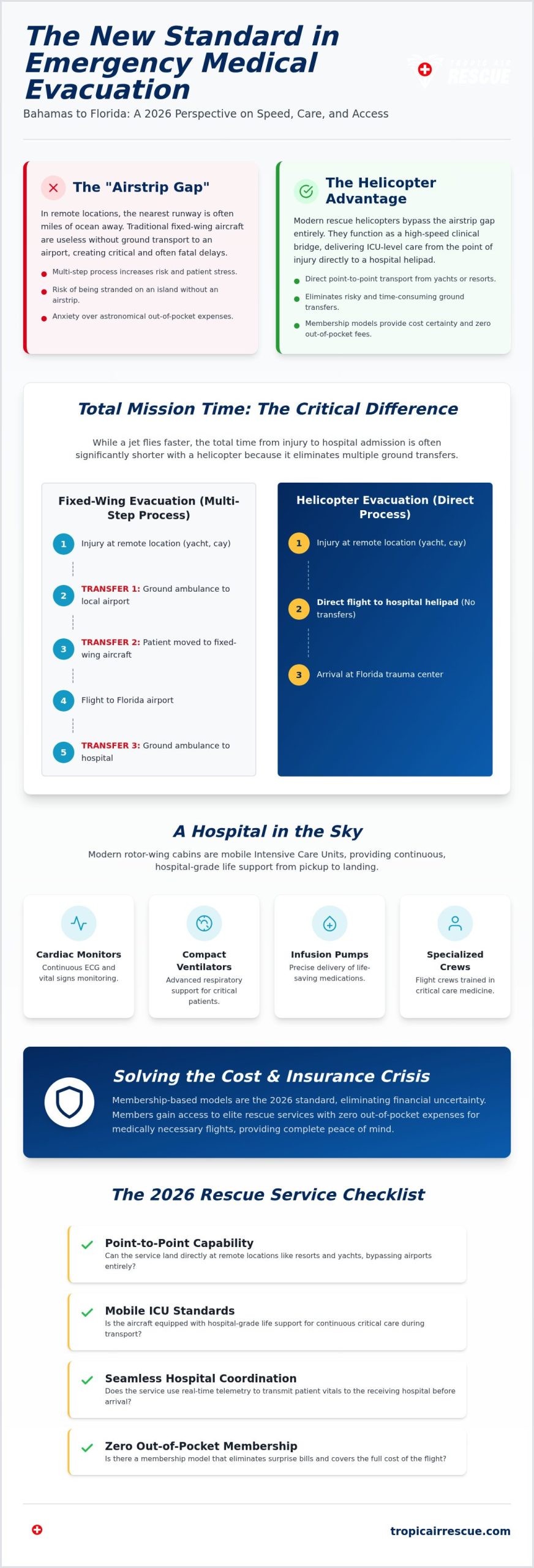
- Helicopter evacuation bypasses the “airstrip gap” by landing directly at remote resorts or yachts, cutting critical minutes from the total time to hospital.
- Modern rotor-wing cabins now function as mobile intensive care units, delivering hospital-grade life support during Bahamas to Florida medical transport.
- Membership-based models solve the 2026 insurance gap, providing zero out-of-pocket access and eliminating the risk of being stranded on an island.
- Specialized flight crews and advanced avionics ensure a seamless transition from remote Bahamian locations to elite Florida trauma centers.
- Our 2026 checklist helps you evaluate fleet standards and coordination protocols to ensure your rescue service meets the highest safety benchmarks.
What Are Modern Helicopter Rescue Services?
Modern helicopter rescue services represent a sophisticated evolution in emergency response. They have moved beyond simple transit to provide a clinical environment that mirrors a hospital intensive care unit. Unlike traditional air charters, these operations focus on the immediate stabilization and extraction of patients from environments where fixed-wing aircraft cannot operate. By 2026, the integration of advanced avionics and critical care equipment has established rotor-wing transport as the definitive solution for Bahamas to Florida medical transport.
The transition from simple transport to mobile ICU status is driven by equipment density. Modern cabins are outfitted with compact ventilators, cardiac monitors, and infusion pumps that meet or exceed ground-based hospital standards. This allows for continuous critical care during the crossing, ensuring no lapse in treatment occurs. This level of specialized readiness is what distinguishes an elite rescue service from a standard utility flight.
Defining the Rotor-Wing Advantage
Helicopter rescue services serve as a high-speed clinical bridge, connecting remote island crises directly to specialized tertiary care centers. While search and rescue (SAR) focuses on locating and extracting individuals from immediate danger, medical evacuation (Medevac) involves the delivery of advanced life support during the flight itself. To operate safely across the Bahamian archipelago, modern helicopter rescue services utilize specialized avionics designed for complex over-water flight paths. These systems allow pilots to maintain precision in varied weather conditions, ensuring that distance never compromises patient safety.
The 2026 Standard for Air Medical Readiness
Readiness in 2026 is measured by the speed of clinical intervention rather than just flight hours. Rapid dispatch protocols now allow crews to initiate launch sequences within minutes of a confirmed emergency call. This efficiency is supported by real-time telemetry, which transmits the patient’s vital signs directly from the aircraft to receiving Florida trauma centers. This proactive coordination ensures that surgical teams are briefed and ready the moment the helicopter touches down. Elite concierge services are now replacing traditional, generic air charters because they offer this specialized, always-ready posture.
The true advantage lies in point-to-point logistics. Traditional transport requires a ground ambulance to reach an airport, a plane to cross the ocean, and another ambulance to reach the hospital. Helicopters eliminate these secondary transfers. They land at the point of injury, whether that is a private resort, a yacht at sea, or a local clinic, and fly directly to the hospital helipad. This streamlined approach preserves the “golden hour,” the critical window where immediate medical intervention most significantly impacts survival rates during Bahamas to Florida medical transport.
Helicopter vs. Fixed-Wing: The Critical Comparison for Island Travel
Speed isn’t just about knots; it’s about arrival at the trauma center. Fixed-wing aircraft require runways. In the Bahamas, this creates a logistical bottleneck known as the “airstrip gap.” If you are on a remote cay, a plane is useless without a ground ambulance transfer to a major hub like Nassau or Marsh Harbour. This delay can be fatal in time-sensitive emergencies. Helicopters bridge this gap by operating independently of paved infrastructure.
This technical flexibility is central to a Helicopter vs. Fixed-Wing comparison in medical contexts. While a jet flies faster once airborne, the total mission time is often shorter with rotor-wing aircraft. The “total mission time” includes every second from the moment of injury to hospital admission. By eliminating ground transfers, helicopters often win the race to the hospital, even with a lower cruising speed than a jet.
Bypassing the Airstrip entirely
remote location medical landings are the primary advantage for island travelers and maritime residents. We land on private yachts, resort lawns, or even beach clearings. Fixed-wing transport involves a grueling multi-step process: ground ambulance to the airport, patient transfer to the plane, flight, and another ground ambulance in Florida. Each transfer point increases patient risk and physical stress. Rotor-wing transport is a single, continuous clinical event that starts at the patient’s side.
Total Mission Time: A Strategic Breakdown
We define efficiency through “bed-to-bed” service. A helicopter eliminates the typical 45-minute ground ambulance crawl through traffic on both ends of the flight. It also avoids airport security and taxiing delays. For Bahamas to Florida medical transport, this means the patient remains under the care of the same flight crew from the island to the hospital roof. It’s a closed-loop system that prioritizes stability and speed. Understanding how a true bedside to bedside medevac service eliminates dangerous handoff gaps is essential for anyone planning emergency transport across the Caribbean.
Weather and sea states also factor into the decision. Seaplanes are often grounded by high swells that don’t affect helicopter operations. When you need Bahamas to Florida medical transport, you can’t afford to wait for the sea to calm. Reliability is non-negotiable. To ensure this level of specialized readiness is always available for your family or vessel, you may want to explore our membership plans and secure your access before an emergency occurs.
Hospital in the Sky: Advanced Life Support Capabilities
The transition from a remote island to a Florida trauma center requires more than just a fast aircraft. It demands a clinical environment that maintains the same standard of care found in a stationary intensive care unit. For high-acuity patients, the crossing over the Gulf Stream is a period of critical vulnerability. Modern Bahamas to Florida medical transport manages this risk by transforming the helicopter cabin into a high-tech stabilization suite. This ensures that life-saving interventions continue without interruption during the entire flight path.
Adherence to international medical transport regulations ensures that these mobile units are recognized and cleared for immediate entry into U.S. airspace. This regulatory compliance is coupled with advanced telemetry that allows the flight crew to consult with receiving surgeons in real-time. By the time the aircraft clears the Florida coastline, the trauma team already possesses a complete digital record of the patient’s status.
ICU-Grade Equipment on Board
Operating an advanced life support helicopter requires a meticulous balance of weight and capability. By 2026, weight-saving carbon fiber components and miniaturized electronics have allowed us to pack a full ICU suite into the rotor-wing airframe. Every mission carries essential life-support systems, including:
- Multimodal ventilators capable of managing pediatric and adult respiratory failure.
- Invasive cardiac monitors for real-time arterial and venous pressure tracking.
- Multi-channel infusion pumps for precise medication delivery during transit.
- Portable point-of-care testing units for immediate blood chemistry and gas analysis.
Climate-controlled cabins are non-negotiable for patient stability. Maintaining a precise internal temperature prevents the physiological stress that often accompanies high-altitude or over-water travel. This environment allows the medical team to focus on stabilization rather than fighting the elements.
The Specialized Flight Crew
The hardware is only as effective as the hands operating it. Our concierge model utilizes a “double-crew” system: two expert pilots and two critical care clinicians. These flight nurses and paramedics aren’t generalists. They are specialists trained specifically for the high-pressure environment of Bahamas to Florida medical transport. Their expertise includes managing advanced airways and maintaining hemodynamic stability in a cramped, moving cabin.
Training for over-water emergencies differs significantly from land-based rescue. Crews undergo rigorous water egress training and specialized survival protocols unique to the Bahamian archipelago. This disciplined approach ensures that the medical team remains focused on the patient, regardless of the logistical challenges outside the aircraft. It is this combination of elite technology and specialized human expertise that defines the modern gold standard for air medical care.
The Membership Model: Solving the Insurance and Cost Crisis
Traditional “pay-per-flight” models have become a significant liability for travelers in 2026. In a crisis, the last thing a family should do is negotiate a $50,000 wire transfer while a patient’s condition worsens. Most non-membership air ambulance firms require massive upfront deposits before they initiate a launch sequence. This financial friction creates a dangerous delay in Bahamas to Florida medical transport. By shifting to a membership-based model, travelers establish a pre-authorized rescue protocol that prioritizes clinical outcomes over credit limits.
The membership model acts as a high-end guardian for your health and your assets. It removes the uncertainty of whether an insurer will approve a flight in the heat of the moment. Instead of waiting for a claims adjuster, members rely on a service that is already integrated with their insurance profile. This proactive approach ensures that the “golden hour” is spent in transit, not in a financial negotiation.
Eliminating Out-of-Pocket Costs
Membership transforms the financial landscape of air rescue through a “billing as full payment” protocol. We bill your health insurance provider directly and accept their reimbursement as payment in full for all covered services. You don’t face a surprise bill for the remaining balance or “out-of-network” surcharges. Our concierge team manages the entire administrative burden of international medical claims, navigating the complex paperwork that follows a cross-border evacuation.
This stands in stark contrast to the typical industry experience. Without membership, families are often forced to provide $20,000 to $50,000 as an upfront deposit. Even after the flight, they may spend months fighting for reimbursement. Our model ensures that financial barriers never dictate the speed of your Bahamas to Florida medical transport.
Tailored Coverage for Every Traveler
Coverage must be as flexible as the flight paths we fly. Annual memberships provide year-round security for Bahamian residents and second-home owners who frequent the islands. However, the needs of the maritime community are different. For those on a seasonal cruise or a fishing expedition, short term medevac coverage is the essential choice for yachting. It provides elite ICU-grade readiness for the specific duration of your stay.
Membership is a pre-authorized ticket to Florida trauma centers. It signals to our dispatch team that you are a priority client with verified medical and insurance credentials. Whether you are a frequent yacht visitor or a local resident, having this status ensures immediate action. Don’t wait for a crisis to realize the value of preparation. You can secure your membership plan now to ensure you are never stranded when minutes matter most.
Selecting a Helicopter Rescue Service: A 2026 Checklist
Choosing a provider for Bahamas to Florida medical transport is a strategic decision that requires rigorous vetting. You must look beyond marketing claims to verify operational reality. The 2026 standard for air medical rescue demands a fleet equipped with advanced avionics specifically rated for long-range, over-water missions. Older airframes without modern terrain awareness or synthetic vision systems represent an unnecessary risk in the variable weather of the Caribbean. Safety in this niche is not a generic utility; it is a product of specialized equipment and disciplined preparation.
Operational transparency is the mark of an elite service. Ask for documentation regarding fleet maintenance cycles and the specific medical equipment packages carried on over-water missions. A provider should be able to demonstrate a history of successful remote extractions and a clear protocol for managing high-acuity patients in transit. If a service cannot provide these details with precision, they lack the “always ready” posture required for island emergencies.
Operational Integrity and Safety Standards
Safety is built on specific, verifiable certifications. When evaluating a service, confirm they hold international medical transport credentials and specialized clearance for Bahamian operations. A premium provider must demonstrate the ability to land in non-airport environments, such as beach clearings or yacht decks, without external assistance. This requires precision piloting and a dedicated 24/7 coordination hub that manages every logistical detail from launch to landing. Verify that the service maintains a “double-crew” model to ensure that both aviation and clinical care receive undivided expert attention.
Checklist for operational readiness:
- Fleet utilization of real-time satellite tracking for over-water safety.
- ICU-rated medical equipment maintained under strict biomedical schedules.
- A single point of contact for the entire mission, from dispatch to hospital admission.
- Proven ability to bypass secondary ground transfers through direct hospital helipad access.
Florida Continuity of Care
The mission doesn’t end when the aircraft enters U.S. airspace. Efficient Bahamas to Florida medical transport relies on pre-arranged landing rights at major Level I and Level II trauma centers. Without these protocols, patients face delays at general aviation airports and secondary ground transfers that compromise the “golden hour.” A concierge service manages the transition into the U.S. healthcare system seamlessly, handling customs clearances and hospital admissions while the patient remains under continuous critical care. The commitment to a true bedside to bedside medevac service ensures that no gap in clinical supervision occurs from the moment of pickup to final hospital handoff. This level of logistical coordination is what distinguishes an elite guardian from a simple transport firm.
Understanding the advantages of helicopter medevac in the Bahamas should be the foundation of your emergency plan. Once you’ve selected a provider, ensure your membership is active and your insurance credentials are on file. In an emergency, activation should be a single-step process: one call to a dedicated hotline that triggers an immediate launch. This level of preparation ensures that when minutes matter, the logistics are already solved.
Mastering the Golden Hour in the Caribbean
The landscape of emergency response in the Bahamas has shifted toward precision and proactive readiness. By 2026, the reliance on distant airstrips has been replaced by the immediate, point-to-point capability of elite helicopter services. You now have the power to bridge the gap between a remote island crisis and a Florida trauma center without the delays of secondary ground transport. This evolution ensures that hospital-grade care begins the moment the flight crew arrives at your side, transforming Bahamas to Florida medical transport into a seamless clinical event.
Preparation is the only defense against the unpredictable. By choosing a membership-based model, you eliminate the financial barriers and administrative burdens that often paralyze emergency operations. You gain access to a specialized rescue infrastructure that prioritizes your survival over logistical hurdles. Secure your peace of mind with a Tropic Air Rescue membership today. Our members benefit from direct billing to insurance with no out-of-pocket costs; specialized point-to-point transport that bypasses all Bahamas airports; and hospital-grade Advanced Life Support (ALS) on every flight. Take control of your safety and ensure your family or vessel is never stranded when seconds dictate the outcome.
Frequently Asked Questions
Is a helicopter rescue faster than a jet for Bahamas to Florida transport?
Yes, helicopters typically win the total time-to-hospital race. While jets maintain higher cruise speeds, they are restricted to runways and require secondary ground ambulance transfers on both ends. A helicopter bypasses these logistical bottlenecks by landing at your specific location and flying directly to a Florida hospital helipad. This streamlined point-to-point process eliminates the delays associated with airport transitions and traffic.
Does my standard health insurance cover helicopter medevac from the Bahamas?
Standard policies often contain restrictive clauses that only cover transport to the nearest adequate facility, which may not be a U.S. trauma center. Many travelers discover too late that their insurance has low coverage caps or requires massive upfront deposits. Membership solves this by providing a pre-authorized protocol. We handle the direct billing to your insurer and accept their payment as full compensation for members.
Can a medical helicopter land directly on my yacht?
Yes, our pilots are specialized in maritime extractions and can land on vessels with suitable deck space. This capability is a critical advantage for Bahamas to Florida medical transport, as it allows for immediate stabilization without waiting for the vessel to reach a port. We coordinate closely with your captain to ensure a safe approach and a seamless transition from the deck to our ICU-equipped cabin.
What happens if I need emergency transport but am not a member?
Non-members face significant financial and operational hurdles during a crisis. You will likely be required to provide a substantial upfront deposit, often exceeding $20,000, before an aircraft is even dispatched. Furthermore, active members always receive priority in the dispatch queue. This delay can compromise the golden hour of care, making a proactive membership the only way to ensure an immediate, frictionless rescue response.
Are there weight or size limits for patients on a medical helicopter?
All aircraft operate under strict weight and balance regulations to ensure flight safety. The patient’s weight, along with the required medical crew and advanced life support equipment, must fall within the helicopter’s certified performance envelope. If a patient has specific bariatric requirements, it is essential to disclose this during membership enrollment. This allows our coordination hub to verify that our fleet can meet your clinical needs safely.
Which Florida hospitals do Bahamas helicopter services typically fly to?
We maintain established coordination protocols with elite Level I and Level II trauma centers in South Florida. Common destinations include Jackson Memorial Hospital and Broward Health Medical Center, both of which offer specialized surgical teams and dedicated helipads. This direct access is a cornerstone of Bahamas to Florida medical transport, ensuring that the patient moves from the aircraft to the trauma suite without any secondary ground delays.
Is helicopter rescue available at night in the Bahamas?
Yes, our fleet utilizes advanced night-vision technology and sophisticated avionics to maintain 24/7 readiness. Night operations require specific safety protocols, including verified landing site illumination and real-time weather monitoring. While some extremely remote or unlit locations may require a brief ground transfer to a safe LZ, our dispatch team is trained to coordinate these complex nighttime extractions with professional precision and speed.
How do I secure coverage for a short-term vacation in the islands?
You can secure specialized protection by enrolling in a Short-term Membership tailored for visitors and seasonal yachting guests. This coverage becomes active 48 hours after enrollment and provides the same ICU-grade medical readiness as our annual plans. It is the most efficient way to ensure you have a pre-authorized rescue protocol in place for the exact duration of your stay in the Bahamian islands.