

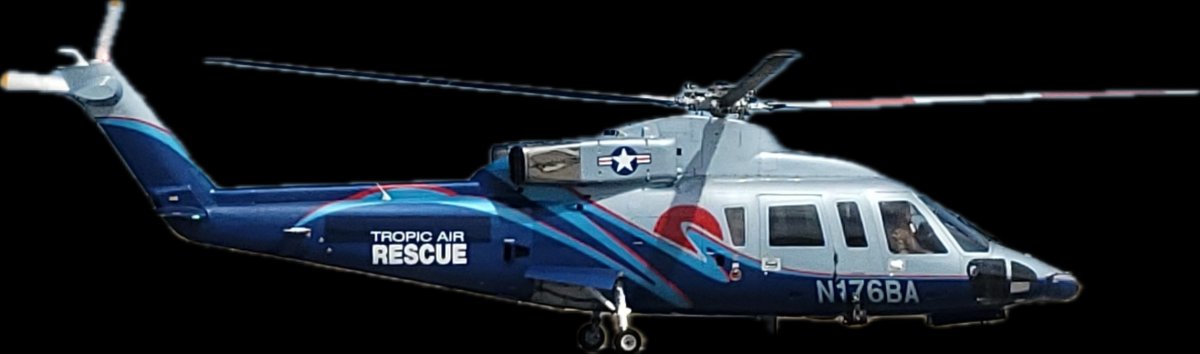
A medical emergency in the remote reaches of the Bahamas shouldn’t be a gamble with geography. When minutes determine the clinical outcome, the difference between a standard transport and an advanced life support helicopter is the difference between simple transit and active, life-saving intervention. These aircraft are not just vehicles. They are flying intensive care units equipped with the latest medical technology, such as the ZOLL Zenix monitor and specialized Technimount systems. You deserve the same clinical excellence in the air that you would expect in a premier Florida trauma center.
It’s natural to feel anxious about the logistics of a crisis or the potential for staggering out-of-pocket costs. We understand that you need certainty when every second counts. This guide details how these elite helicopters function as mobilized ICUs to bridge the gap between a remote crisis and specialized care. You’ll discover the technical capabilities of the Sikorsky S-76B fleet, the rigorous expertise of the medical crew, and how a dedicated membership ensures your focus remains on recovery rather than financial logistics.
Key Takeaways
- Understand why an advanced life support helicopter functions as a mobile Intensive Care Unit, delivering specialized clinical intervention instead of basic transport.
- Identify the critical medical technology onboard, including advanced ventilators and cardiac monitors designed for high-stakes patient stabilization.
- Learn how rotor-wing aircraft provide a strategic advantage by landing in remote Bahamas locations where traditional fixed-wing planes cannot operate.
- Gain confidence in the expertise of specialized flight crews who follow rigorous medical protocols tailored for the aviation environment.
- Discover how membership ensures immediate access to concierge evacuation services with direct billing to your insurance provider.
Defining the Advanced Life Support Helicopter
An advanced life support helicopter is more than a rapid transit vehicle. It represents a specialized clinical environment designed to maintain the continuity of intensive care during flight. In the Bahamas, where geographical barriers often separate patients from specialized trauma centers, these aircraft serve as the vital link in the chain of survival. They provide the necessary platform for complex medical interventions that ground transport or basic aircraft simply cannot support.
BLS vs. ALS: Understanding the Levels of Care
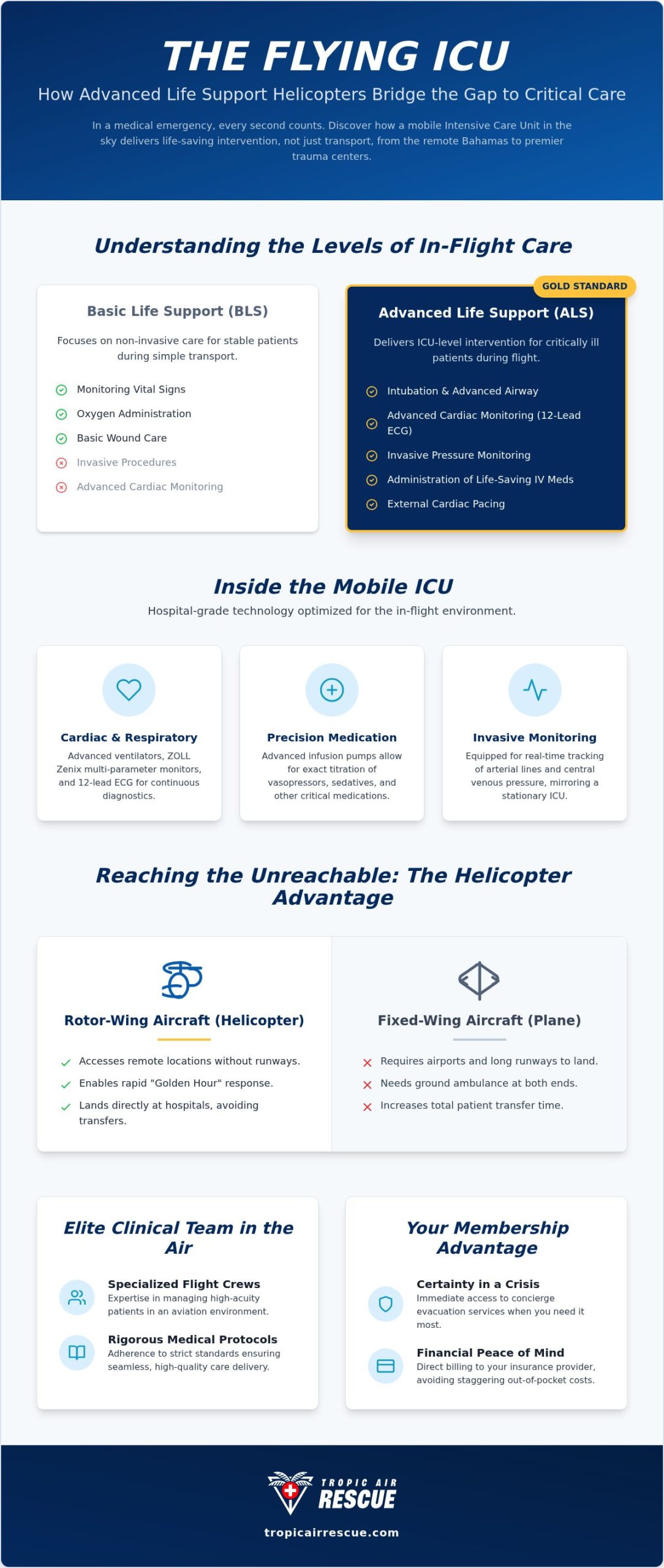
Basic Life Support (BLS) focuses on non-invasive procedures. This includes monitoring vital signs, administering oxygen, and providing basic wound care for stable patients. While sufficient for minor injuries, BLS lacks the depth required for life-threatening conditions. Advanced Life Support (ALS) introduces a higher tier of clinical intervention. It involves invasive procedures such as intubation, advanced cardiac monitoring, and the administration of life-saving medications. For high-acuity patients, the ALS designation isn’t a luxury; it’s a physiological requirement for safe transit across the water.
The Concept of the ‘Flying ICU’
The modern advanced life support helicopter functions as a mobile Intensive Care Unit. It maintains hospital-grade care standards at 5,000 feet, ensuring that the patient’s condition doesn’t deteriorate during transport. Modern Air medical services rely on this “Flying ICU” model to manage critically ill patients who require continuous neurological and hemodynamic monitoring. The integration of specialized aviation protocols with medical precision allows for seamless care delivery. This is particularly critical during the “Golden Hour,” the window immediately following a traumatic injury where rapid, high-level intervention significantly improves survival rates.
ALS capabilities ensure that a patient remains stable during high-acuity transfers to Florida trauma centers. The presence of advanced ventilators and multi-parameter monitors allows the crew to mirror the environment of a stationary ICU. This proactive approach to stabilization minimizes the risks associated with altitude changes and vibration. It provides a controlled, disciplined environment where every medical decision is backed by real-time data and specialized expertise.
Essential Medical Technology Onboard ALS Helicopters
The cabin of an advanced life support helicopter is a masterpiece of medical engineering where every cubic inch is optimized for critical care. Unlike standard medical transport, these aircraft carry the same sophisticated diagnostics and life-sustaining equipment found in a tertiary hospital’s intensive care unit. This high-density technical environment allows for the management of the most complex clinical cases while in transit across the Bahamas.
Respiratory and Cardiac Management Systems
High-acuity patients often require immediate and precise respiratory support. The fleet utilizes advanced transport ventilators capable of both invasive and non-invasive modes to manage patients with severe respiratory failure or those requiring chemical sedation. For cardiac emergencies, the integration of multi-parameter monitors is vital. The Association of Air Medical Services highlights that the availability of high-tier equipment is a primary factor in successful patient outcomes during long-distance air transit. A 12-lead ECG provides the continuous diagnostic clarity needed to detect a myocardial infarction during flight, allowing the crew to alert the receiving trauma center before touchdown. This proactive diagnostic capability ensures that the hospital team is ready to intervene the moment the aircraft lands.
Invasive Monitoring and Medication Delivery
Precision is mandatory when administering high-risk medications during a flight. Advanced infusion pumps, including syringe and volumetric systems, allow the medical crew to perform exact titration of vasopressors, sedatives, and anti-arrhythmic drugs. The aircraft is also configured to support invasive pressure monitoring, which is essential for patients with arterial lines or central venous access who require real-time blood pressure tracking. To maintain this level of care, the aircraft features several critical systems:
- Portable Point-of-Care Testing (POCT): This allows for immediate blood gas and chemistry analysis at the patient’s side, enabling real-time adjustments to treatment.
- External Pacemakers: Specialized equipment for emergency cardiac pacing in the event of life-threatening bradycardia.
- Advanced Cardiac Monitors: Devices like the ZOLL Zenix, which received FDA approval in September 2025, offer the latest in portable defibrillation and monitoring technology.
- Onboard Pharmacy: A comprehensive supply of Advanced Cardiovascular Life Support (ACLS) medications is always staged and ready for immediate use.
Having this level of technology ready to deploy at a moment’s notice is the primary reason many residents and travelers in the Bahamas secure an annual membership for total peace of mind. It ensures that if a crisis occurs, the response isn’t just a flight; it’s a fully equipped clinical intervention.
Strategic Advantages of Rotor-Wing ALS Transport
The geography of the Bahamas presents a unique logistical challenge for emergency medicine. With over 700 islands and cays, traditional ground transport is often impossible. An advanced life support helicopter bypasses these physical barriers entirely. It offers the specific advantage of point-to-point speed. By landing directly at a resort, local clinic, or the scene of an accident, the aircraft eliminates the need for multiple ground ambulance transfers. This direct access is vital for time-critical conditions like stroke or cardiac arrest where every second of delay results in lost tissue or neurological function.
Helicopter vs. Fixed-Wing: The Speed of Access
Speed isn’t just about knots per hour; it’s about total transit time. Fixed-wing aircraft require established airport infrastructure and runways. This necessitates “double patient loading.” A patient must be moved by ground ambulance to an airport, loaded onto the plane, flown to a major hub, and then moved by another ground ambulance to the final trauma center. Each transfer increases patient stress and consumes precious minutes during the Golden Hour. In contrast, helicopters land directly at specialized centers or remote clinics. For a deeper analysis of these logistical differences, review our guide on Helicopter vs Fixed Wing Medevac.
Reaching Isolated and Remote Environments
Many of the most beautiful locations in the Bahamas lack paved runways. When a medical crisis occurs in these areas, an advanced life support helicopter is the only viable option for rapid evacuation. These aircraft possess the maneuverability to perform a remote location medical landing on beaches, clearings, or even helipads at private estates. This capability bypasses logistical bottlenecks like traffic on New Providence or water crossings between cays that would otherwise stall critical care.
Safety remains the priority during these complex operations. The flight crew is trained to assess landing zone (LZ) requirements in real-time, ensuring the terrain is stable and clear of obstructions. This agility allows for rapid island-to-mainland transfers that would take hours by boat or ground. It provides a level of security for residents and travelers in isolated environments. You don’t have to worry about being stranded during a crisis; elite medical care is always within reach regardless of your location’s infrastructure.
The Clinical Team: Expertise Behind the Flight
The advanced life support helicopter relies on a specialized human element to translate technology into survival. Every mission involves a multidisciplinary team trained specifically for the high-stakes aeromedical environment. These professionals operate under rigorous standards to ensure that the transition from a remote Bahamas island to a Florida trauma center is clinically seamless. It’s a level of care that mirrors a premier hospital wing, maintained with professional composure at 5,000 feet.
Advanced Certifications for Flight Clinicians
Flight Registered Nurses and Flight Paramedics must possess extensive experience in critical care or emergency medicine before entering the flight environment. Most clinicians hold the Certified Flight Registered Nurse (CFRN) or Flight Paramedic-Certified (FP-C) designation. These certifications require deep knowledge of flight physiology, including how altitude affects oxygenation and gas expansion in the body. Trauma-informed care is central to their scope of practice. It allows them to manage complex injuries while maintaining the patient’s physiological stability during transit.
Operational Coordination and Safety
Managing intensive care in a confined, high-vibration space requires a methodical approach to safety and coordination. The crew uses standardized communication protocols to relay patient data to receiving trauma centers while still in the air. This ensures that the hospital’s surgical or interventional teams are briefed before the aircraft arrives. The Flight Pilot plays a critical role beyond navigation, managing the mission’s logistics and selecting safe landing zones in remote areas. During critical phases of flight, the ‘Sterile Cockpit’ rule mandates that all crew members refrain from non-essential conversation to focus entirely on safety and navigation.
Continuous education is a hallmark of this elite service. Crews participate in regular simulation training to refine their response to high-stress scenarios and rare clinical complications. This disciplined preparation ensures that when a crisis occurs, the team’s response is instinctive and precise. You can secure this elite level of clinical expertise for your family by choosing an annual membership today. This proactive step removes the uncertainty of emergency logistics, placing your care in the hands of the region’s most capable flight clinicians.
Securing Elite ALS Transport with Tropic Air Rescue
Tropic Air Rescue delivers a concierge air-medical experience that extends far beyond the cabin of an advanced life support helicopter. We manage the entire logistical chain, from the initial scene response to the final handover at a premier Florida trauma center. This comprehensive approach ensures that patients and their families don’t have to navigate complex international transport requirements during a crisis. Our fleet of Sikorsky S-76B helicopters is maintained with disciplined precision, ensuring an “Always Ready” posture for every mission.
Concierge Care from Scene to Hospital
Managing a medical evacuation involves more than flight hours. It requires expert coordination with international medical facilities, customs officials, and receiving surgical teams. Tropic Air Rescue acts as the definitive logistical lead, securing the necessary clearances for rapid entry into the United States. This level of service is essential for interhospital transfer services where a patient’s condition requires immediate movement to a specialized facility. Our commitment to a true bedside to bedside medevac service means we handle every handoff with precision, eliminating dangerous gaps in clinical supervision from the moment of patient contact to final hospital delivery. We handle the paperwork and the protocols so that your family can focus entirely on the patient’s recovery.
The Benefits of Air Medical Membership
The primary barrier to air medical access is often the fear of financial liability. Emergency air transport involves significant operational expenses that can lead to substantial out-of-pocket burdens for those without specialized coverage. Tropic Air Rescue addresses this pain point through a membership-based model. Our specialists handle direct insurance billing and reimbursement claims. This eliminates out-of-pocket costs for members at the time of service, providing a predictable solution to a high-stakes problem.
Membership provides several operational advantages for residents and visitors in the Bahamas:
- Priority Response: Annual and short-term members receive priority for dispatch and resource allocation during peak periods.
- Financial Predictability: Direct billing to health insurance providers removes the threat of surprise balance bills for emergency services.
- Comprehensive Access: Coverage applies to both emergency scene responses and critical interhospital transfers to higher levels of care.
For those visiting the islands for a limited time, securing short term medevac coverage is a vital component of a responsible travel plan. It provides the same elite clinical standards as our annual plans, ensuring that the gold standard of an advanced life support helicopter is always within reach. Whether you are a full-time resident or a seasonal visitor, membership transforms a high-stakes emergency into a managed, expert-led clinical event.
Securing Your Clinical Future in the Bahamas
The transition from a remote emergency to specialized trauma care must be seamless and disciplined. An advanced life support helicopter serves as the definitive solution for bridging this gap, providing hospital-grade intervention at the moment of contact. By combining an elite rotor-wing fleet with specialized inter-hospital transfer expertise, we’ve removed the geographical barriers that once complicated island medicine. You’re no longer dependent on airport infrastructure or ground ambulance delays when every second is vital for recovery. As detailed in our 2026 trend analysis of Bahamas to Florida medical transport, the industry has fundamentally shifted toward point-to-point helicopter evacuation that bypasses airports entirely to deliver hospital-grade care directly to a Florida trauma center.
Our concierge approach ensures that the logistical and financial complexities of a crisis are managed with professional composure. We prioritize your health by handling direct insurance billing for members, eliminating the anxiety of unexpected out-of-pocket expenses. This model reflects our commitment to meticulous preparedness and elite service standards for residents and travelers alike.
Secure your peace of mind with a Tropic Air Rescue membership today. It’s the most effective way to ensure that your family is protected by the gold standard of air medical care.
Frequently Asked Questions
What qualifies a helicopter as an advanced life support (ALS) unit?
A helicopter earns the ALS designation by its ability to perform invasive clinical interventions. This includes the administration of high-risk medications, advanced airway management, and continuous cardiac monitoring. Unlike basic units, an advanced life support helicopter is staffed by specialized flight clinicians who can manage unstable patients. The aircraft must also carry a specific suite of intensive care equipment, such as ventilators and multi-parameter monitors, to maintain hospital-grade standards during flight.
Can an ALS helicopter transport a patient on a ventilator?
Yes, transporting ventilated patients is a core capability of this service. The aircraft carries specialized transport ventilators designed to provide both invasive and non-invasive respiratory support. The medical crew is trained to manage complex ventilator settings and titration of sedatives while in the air. This ensures that patients with severe respiratory failure or those who are chemically paralyzed remain stable throughout the entire interhospital transfer process to a trauma center.
How many medical crew members are typically on an ALS helicopter?
The standard clinical configuration consists of two highly trained medical providers. This usually includes a combination of a Flight Nurse and a Flight Paramedic. This dual-provider model ensures that complex procedures, such as intubation or advanced cardiac life support, can be performed safely in the confined space of the cabin. Each member brings specialized expertise in emergency medicine and flight physiology to provide a redundant layer of patient safety during high-stakes missions.
What is the difference between a medical helicopter and a standard air ambulance?
The term air ambulance often refers to fixed-wing aircraft that require an airport runway. A medical helicopter provides the specific advantage of point-to-point speed. It can land directly at a remote clinic, a resort, or even the scene of an accident. This eliminates the need for multiple ground ambulance transfers between the patient and the aircraft. For many emergencies in the Bahamas, an advanced life support helicopter is the fastest route to specialized care.
Is there a weight limit for patients on an ALS helicopter?
Aviation safety requires strict adherence to weight and balance limitations. Each helicopter has a maximum takeoff weight that includes the patient, medical crew, equipment, and fuel. While we accommodate most patients, bariatric cases may require specific logistical planning or a different aircraft configuration. It’s essential to provide accurate patient information during the dispatch process so the pilot and crew can ensure the flight meets all safety and performance requirements for the specific mission.
How does weather affect the availability of an ALS helicopter?
Safety is the primary factor in every flight decision. Adverse weather conditions, such as high winds, low visibility, or severe tropical storms, can ground an aircraft. The pilot in command makes the final “go or no-go” decision based on real-time meteorological data and aviation regulations. If weather prevents a helicopter flight, our coordination team works to identify alternative transport options or waits for a safe weather window to ensure the patient’s safety.
How do I request an ALS helicopter in an emergency?
Members can initiate a request by contacting our dedicated dispatch center directly. In many cases, the attending physician at a local clinic or hospital will recognize the need for a higher level of care and request the transport on the patient’s behalf. Our team then coordinates with the medical facility and handles all flight logistics. Having a membership ensures that the activation process is streamlined and that the focus remains entirely on the clinical needs of the patient.
Does health insurance usually cover ALS helicopter transport?
Most private health insurance plans provide coverage for air medical transport when it’s deemed medically necessary. However, patients often face significant out-of-pocket costs or surprise balance bills from out-of-network providers. Our membership model eliminates this financial anxiety. We bill your insurance provider directly and handle the reimbursement process. This ensures that members don’t receive a bill for the remaining balance, allowing them to focus on recovery rather than the cost of their life-saving flight.