

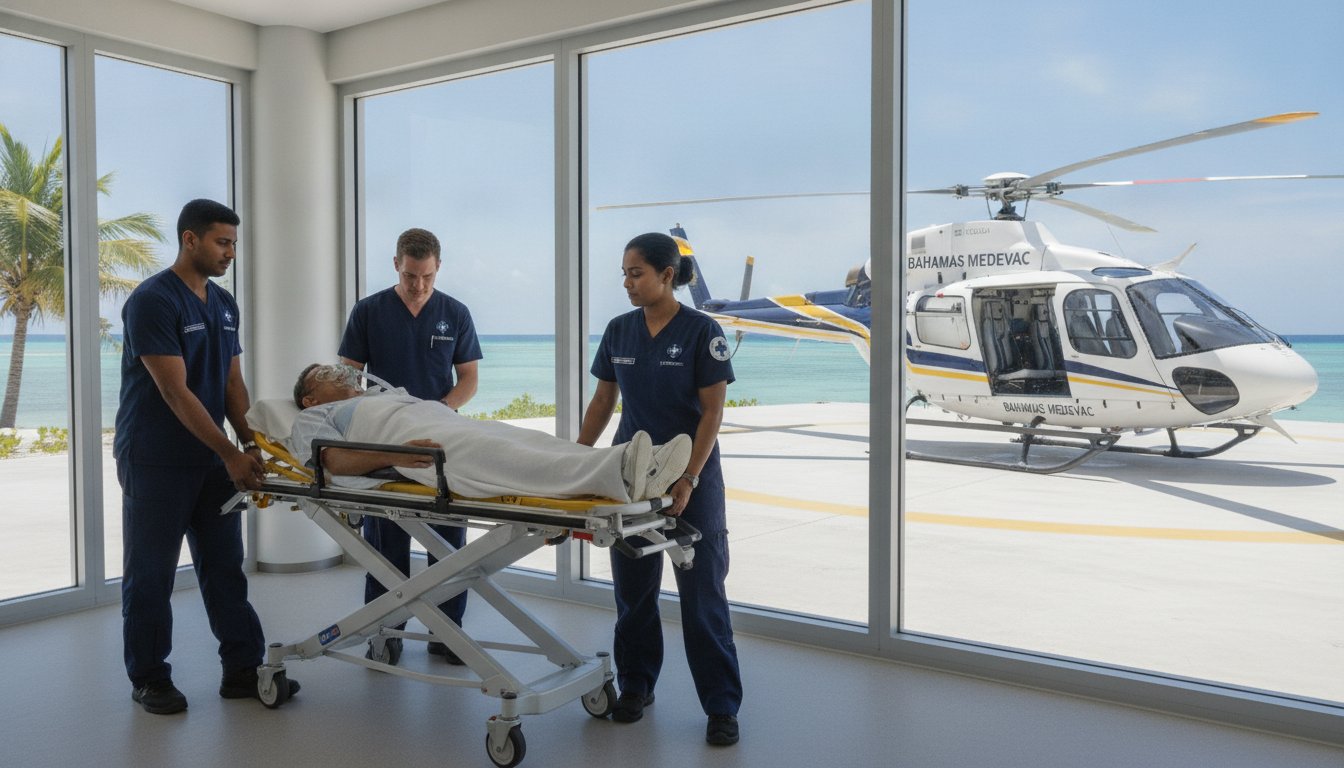
What if the most dangerous part of a medical emergency isn’t the injury itself, but the moments your loved one is passed from one team to another? In the high-stakes environment of air medical transport, a bedside to bedside medevac service is the only way to eliminate the “danger zone” of medical handoffs. You already know that navigating the logistics of a remote island during a crisis is a nightmare. The fear of a communication breakdown or a gap in clinical care during transport to Florida is a heavy burden for any family to carry.
It’s a valid concern because continuity is the foundation of patient safety. This article explores how elite bedside to bedside medevac service ensures a seamless continuum of care, moving patients from remote Bahamian locations directly into the hands of specialized trauma centers without a single second of interrupted supervision. You’ll learn about the precision logistics required for international transfers and how a membership-based model eliminates the anxiety of insurance disputes. We’ll outline the operational protocols that turn a complex evacuation into a coordinated, concierge medical experience.
Key Takeaways
- Understand why a bedside to bedside medevac service is essential for eliminating clinical gaps during high-stakes patient handoffs.
- Learn how mobile intensive care units equipped with advanced life support systems maintain hospital-grade stability during transit.
- Discover the tactical advantage of helicopter transport for direct island-to-hospital transfers, bypassing the delays of multiple ground ambulance legs.
- Gain insight into the complex coordination required between Bahamian facilities and Florida trauma centers to ensure a seamless medical handoff.
- Explore how a membership model provides financial security through direct insurance billing, removing the burden of out-of-pocket costs during emergencies.
Defining the Bedside to Bedside Medevac Service
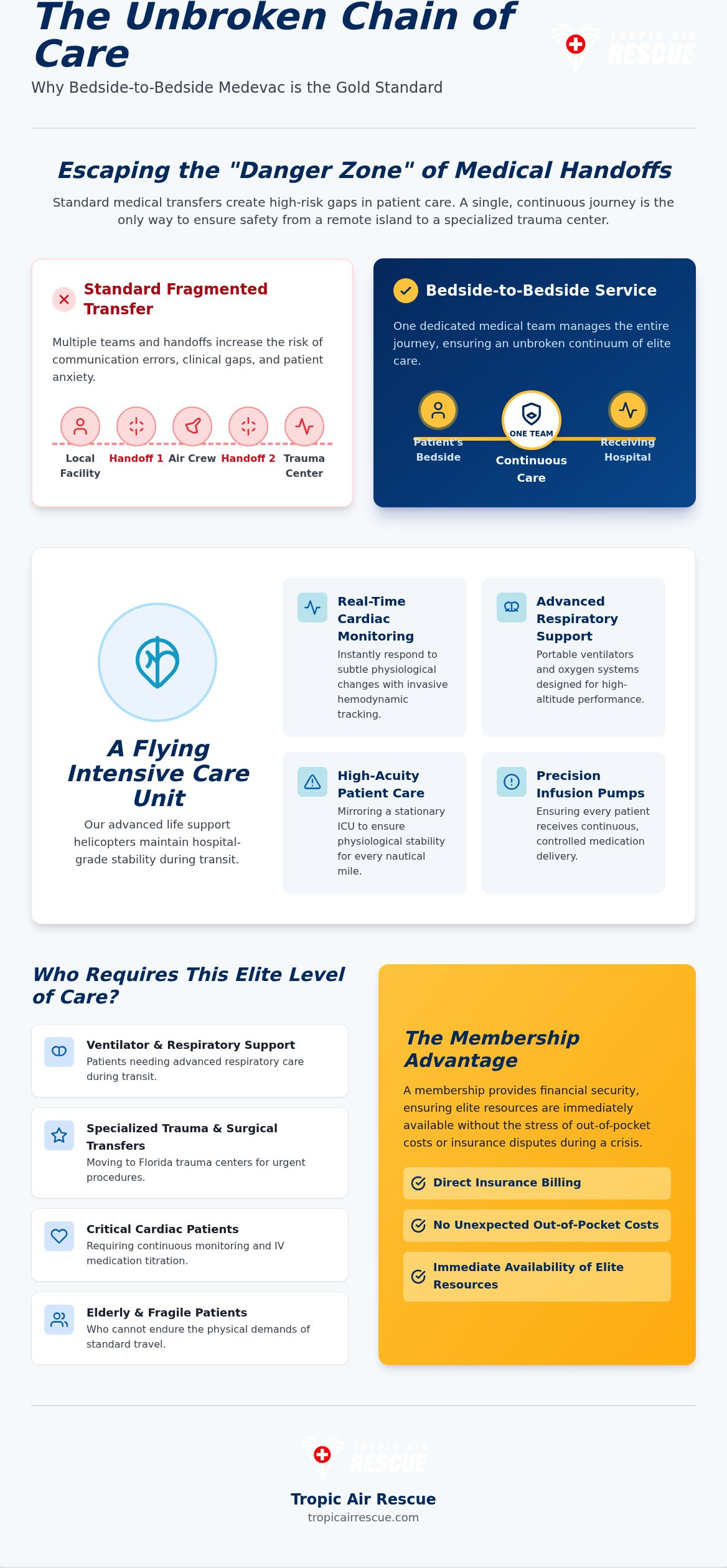
A bedside to bedside medevac service is a complete clinical solution. It isn’t merely a flight from point A to point B. It’s a controlled medical environment that begins at the patient’s current hospital bed. The medical crew assumes full responsibility for the patient before they ever leave the originating facility. This level of integration ensures that supervision remains constant through ground transit, the flight itself, and the final admission at a receiving hospital. By maintaining this unbroken chain, the service eliminates the gaps in care that frequently occur during standard medical repatriations. Standard transfers often involve fragmented handoffs between disparate ground and air agencies. This model replaces those risks with a single, professional standard of care that prioritizes clinical integrity over simple transportation.
The “One Team, One Mission” Philosophy
Clinical precision in Air medical services is achieved through continuity. When one medical crew manages the entire journey, handoff errors disappear. There’s no need to re-learn the patient’s status mid-transit. Families experience reduced anxiety when they see the same experts managing every detail. It transforms a logistical challenge into a concierge medical experience where the patient’s safety remains the primary focus. The crew acts as the patient’s primary advocate throughout the mission, ensuring that clinical standards don’t slip during transitions.
Who Requires Bedside-to-Bedside Care?
High-acuity patients require this level of dedicated oversight. It’s the standard for inter-hospital transfers involving complex medical needs. This includes:
- Patients requiring ventilator support or advanced respiratory care.
- Individuals undergoing transfer to Florida trauma centers for specialized surgery.
- Cardiac patients needing continuous monitoring and IV titration.
- Elderly or fragile patients who can’t navigate the physical demands of standard travel.
The crew acts as a clinical bridge between Bahamian physicians and Florida specialists. They ensure that every medical record, imaging result, and pharmaceutical requirement is communicated accurately. This level of advocacy is essential when dealing with international borders and different hospital systems. It removes the burden of coordination from the family during a crisis. By choosing a bedside to bedside medevac service, you ensure that medical supervision is never interrupted, regardless of the geographical challenges. It’s the definitive solution for those seeking elite care and absolute continuity. This proactive approach to safety is what distinguishes a premium service from a basic utility. It’s about meticulous preparation and an “always ready” demeanor.
Advanced Helicopter Life Support Systems in Transit
Modern medevac helicopters are not just transport vehicles; they function as high-performance flying intensive care units (ICUs). A true bedside to bedside medevac service relies on the seamless integration of hospital-grade technology into a compact, mobile environment. The equipment must be portable enough to accompany the patient during the initial bedside transition yet powerful enough to provide continuous life support at high altitudes. This duality is essential for maintaining clinical stability during the journey from a Bahamian clinic to a Florida trauma center. Advanced helicopter life support systems allow for high-acuity care that was once only possible within a stationary hospital wing. Tropic Air Rescue utilizes a fleet equipped with sophisticated monitors, ventilators, and precision infusion pumps to ensure every patient receives elite medical attention.
Critical Care Capabilities Onboard
The cabin of a medical helicopter is engineered for maximum clinical density. Real-time cardiac monitoring and invasive hemodynamic tracking allow the crew to respond to subtle physiological changes instantly. Advanced respiratory support is provided via portable ventilators and dedicated oxygen systems designed for high-altitude performance. These integrated technologies mirror a stationary ICU environment to ensure physiological stability during every nautical mile of the journey. This level of technical preparedness is what makes a bedside to bedside medevac service the gold standard for patients who cannot risk a single minute of unmonitored travel. Securing an Annual Membership ensures these elite resources are immediately available without the delay of financial negotiations during a crisis.
The Role of the Specialized Flight Crew
Technology is only as effective as the experts who operate it. Our flight crews consist of highly trained critical care nurses and paramedics who work in perfect synergy. These professionals are trained to maintain rigorous bedside standards within the dynamic environment of a medical helicopter. One of the most critical phases of the mission is the transition from hospital power to aircraft power. The crew manages this shift with surgical precision to ensure that life-sustaining equipment never loses a second of functionality. This proactive approach defines our role as more than just medical providers; we are the patient’s elite guardians in the sky. Beyond their clinical duties, the crew acts as a concierge advocate for the patient. They communicate directly with receiving physicians in Florida, providing a level of professional advocacy that basic transport services simply don’t offer. This “one team” approach reduces the potential for clinical errors and provides families with the reassurance of a familiar, expert presence throughout the entire evacuation process.
The Helicopter Advantage for Island Bedside Transfers
Traditional air medical transport often relies on fixed-wing aircraft. While these planes are efficient for long-range travel, they face a significant limitation in an archipelago like the Bahamas: they require a runway. This necessity introduces multiple ground ambulance legs into the patient’s journey. Every additional handoff between a hospital bed, a ground ambulance, an airport tarmac, and another ambulance at the destination increases the risk of clinical “misses.” A bedside to bedside medevac service utilizing helicopters eliminates these unnecessary transitions. By landing directly at a local clinic or specialized facility, the medical team provides a more direct, uninterrupted experience. Speed is maximized because the aircraft meets the patient where they are, rather than forcing the patient to travel to the aircraft. This logistical efficiency is the cornerstone of premium island care.
Reaching Remote Locations Directly
Helicopters offer the unique capability to land at resorts, private villas, or small local clinics that lack airport access. This direct access is vital for patients in remote regions where ground infrastructure is limited. It eliminates the need for long, bumpy ground ambulance rides over unpaved or damaged roads. For patients with spinal injuries or severe trauma, avoiding these vibrations is a clinical necessity. This tactical flexibility ensures that the “bedside” promise is kept even in the most unreachable parts of the islands. For more details on these specialized operations, read our guide to remote location medical landing.
Comparing Transport Modalities for the Bahamas
In the Caribbean, helicopters are the critical choice for Bahamas emergencies. When every minute counts, the time-to-treatment advantage of a helicopter is undeniable. Fixed-wing transfers often involve a “triple handoff” protocol: hospital to ambulance, ambulance to plane, and plane back to ambulance. Each of these steps consumes valuable time and requires shifting the patient between stretchers. Helicopters provide superior stability for certain high-acuity conditions by maintaining a consistent environment from the moment the patient leaves their bed. This streamlined approach ensures that a bedside to bedside medevac service remains a clinical reality rather than just a logistical goal. It reduces the physical stress on the patient and allows the medical crew to maintain total focus on stabilization rather than repetitive loading and unloading procedures.
Logistics and Coordination for International Transfers
An elite bedside to bedside medevac service is built on a foundation of invisible, high-stakes logistics. Long before the helicopter rotors start turning, a team of specialists is already working behind the scenes. This stage is critical for international transfers, where crossing borders adds layers of administrative and clinical complexity. Effective transfers require seamless, real-time communication between the sending physician in the Bahamas and the receiving specialist in Florida. Our logistics experts manage the entire administrative burden. This includes filing international flight plans, securing customs clearances, and managing trauma center acceptance protocols. This meticulous preparation allows the medical team to focus entirely on the “clinical bridge” they provide during international transit. It transforms a chaotic emergency into a disciplined, modular operation.
Coordination with Florida Trauma Centers
Managing Bahamas to Florida medical transport involves more than just crossing the Gulf Stream. It requires securing a guaranteed bed at a specialized U.S. facility equipped to handle the patient’s specific acuity level. We maintain direct lines of communication with major Florida trauma centers to facilitate rapid, pre-cleared admissions. This coordination ensures that the receiving team is standing by before the aircraft even touches down. Upon arrival, our medical crew provides a comprehensive, data-driven clinical briefing to the Florida team. This ensures a total transfer of knowledge regarding the patient’s status and interventions. This level of professional advocacy eliminates the “information decay” that often occurs during standard emergency handoffs. To secure this level of coordination for your family, explore our Interhospital Transfer Services today.
The Step-by-Step Handoff Process
The physical execution of a bedside to bedside medevac service follows a disciplined, three-step protocol designed for maximum patient safety. Each phase is managed by the same medical crew to maintain total continuity of care.
- Step 1: Bedside Assessment. The crew meets the patient at the originating facility. They perform a full clinical assessment and stabilize the patient for transport, ensuring all IV lines and monitors are secured.
- Step 2: Monitored Transit. The patient is moved to the helicopter under constant supervision. Monitoring continues without interruption throughout the flight, mirroring a hospital ICU environment.
- Step 3: Direct Admission. The mission concludes with a formal handoff at the receiving facility. The crew stays with the patient until they’re safely admitted into their new hospital bed.
This structured approach ensures that no detail is overlooked. It provides a level of precision that basic transport services cannot match. By managing every variable, we provide a concierge experience that prioritizes clinical integrity and operational excellence. It’s about being always ready and meticulously prepared for any logistical challenge.
The Tropic Air Rescue Membership Advantage
Membership is the final piece of the continuity puzzle. It ensures that elite medical care isn’t a subject of negotiation during a critical window of time. For expats, second-home owners, and frequent travelers in the Bahamas, it provides a permanent safety net that replaces uncertainty with a disciplined response protocol. One call activates the entire logistical chain discussed in previous sections. This concierge approach handles every detail from the initial bedside assessment to the final Florida admission. It removes the heavy burden of coordination from the family. This isn’t just a transport service; it’s a dedicated partnership in safety. By securing a membership, you guarantee that a bedside to bedside medevac service is an immediate right rather than a complex logistical hurdle to clear during a crisis.
Eliminating Out-of-Pocket Costs
The financial logistics of air medical rescue are often as complex as the clinical ones. Membership solves this by utilizing a direct billing model with health insurance providers. This eliminates the stress of massive upfront payments during a medical emergency. For visitors, securing short term medevac coverage is a strategic move to mitigate the unpredictable costs associated with international medical transport. It ensures that a bedside to bedside medevac service remains accessible without depleting personal savings or waiting for reimbursement. Our administrative team acts as your advocate, handling the claims process directly with insurers so the family can focus entirely on recovery. It’s the most cost-effective way to guarantee hospital-grade care in the sky while maintaining absolute financial predictability.
How to Secure Your Coverage
Securing elite protection is a straightforward process designed for immediate peace of mind. We offer both Annual Membership and Short-term Membership options to suit different residency and travel patterns. Once you’re enrolled, the activation process is streamlined for maximum speed and efficiency. In an emergency, a single notification triggers the deployment of our advanced life-support fleet and specialized medical crew. There are no hidden fees or complex hurdles to clear when time is the most valuable resource available. This proactive approach ensures you’re always ready for the unexpected. Our team maintains a constant state of readiness to serve as your vigilant, high-end guardian in the archipelago. Don’t wait for a crisis to seek out a solution that should already be in place. Become a member of Tropic Air Rescue today to ensure your loved ones have access to the gold standard of continuity and clinical excellence.
Preparing for the Unpredictable in the Archipelago
Continuity of care is the difference between a fragmented transport and a life-saving clinical bridge. You’ve seen how direct island access via helicopter removes the risks of multiple ground ambulance transfers. By integrating advanced life support equipped helicopters with an elite concierge medical team, the standard of care remains hospital-grade from the first assessment to the final admission. This level of precision ensures that no vital information is lost and no patient is left without expert supervision.
Choosing a professional bedside to bedside medevac service is about more than logistics; it’s about clinical advocacy. Membership transforms this elite service into a guaranteed right. With direct billing to health insurance, the focus stays on medical stability rather than financial administration. It’s the definitive solution for those who value meticulous preparedness and operational excellence above all else.
Secure your peace of mind with a Tropic Air Rescue membership today. You deserve the confidence that comes with having a vigilant guardian ready to respond at a moment’s notice.
Frequently Asked Questions
What is included in a bedside to bedside medevac service?
This service includes comprehensive medical oversight from the initial hospital bed to the receiving facility bed. It covers all ground ambulance coordination, international flight logistics, and continuous clinical supervision by a specialized crew. The service manages every administrative detail, including customs and trauma center acceptance. This ensures that families don’t have to navigate separate transport legs during a medical crisis.
Does the medical team stay with the patient during the entire flight?
Yes, the medical team provides uninterrupted supervision throughout the entire mission. They assume care at the originating facility and remain at the patient’s side during ground transit, the flight, and the final admission. This “one team” approach ensures that clinical monitoring never pauses. It eliminates the risks associated with multiple handoffs between different medical providers during the transfer process.
How is ground ambulance transportation coordinated at both ends?
Our logistics specialists manage all ground ambulance arrangements as part of the integrated mission plan. We synchronize with local providers in the Bahamas and pre-arrange transport at the receiving Florida airport. This coordination ensures the aircraft is met immediately upon landing, maintaining the continuity of the bedside to bedside medevac service. It removes the burden of logistical planning from the patient’s family.
Can family members travel with the patient during a medevac flight?
One family member can typically accompany the patient, provided their presence doesn’t interfere with clinical operations or aircraft weight limits. Our crew evaluates each situation based on the patient’s acuity and safety requirements. We prioritize the patient’s medical needs while recognizing the psychological benefit of family support. If space is limited, our logistics team can help coordinate alternative travel for additional family.
Will my health insurance cover bedside to bedside medical transport?
Most premium health insurance plans cover air medical transport when it’s deemed medically necessary. Tropic Air Rescue simplifies this by working directly with your provider for billing. Membership ensures that these high-stakes logistics are pre-authorized, removing the burden of upfront costs. This proactive approach eliminates the stress of complex insurance negotiations while you focus on the recovery of your loved one.
What medical equipment is available on a medevac helicopter?
Every helicopter operates as a mobile intensive care unit. The fleet is equipped with hospital-grade ventilators, multi-parameter cardiac monitors, and precision infusion pumps. These systems are specifically designed for high-altitude performance. This allows the crew to manage critical care patients with the same level of sophistication found in a stationary ICU, ensuring stability throughout the bedside to bedside medevac service.
How quickly can a bedside-to-bedside transfer be launched in the Bahamas?
Launch times depend on aircraft readiness and international flight clearance, but we prioritize rapid deployment. Our teams maintain a state of professional readiness to minimize delays. For members, the activation process is significantly faster because all administrative and insurance details are already on file. This allows our logistics experts to focus immediately on flight plans and trauma center coordination.
What happens during the handoff at a Florida trauma center?
The medical crew conducts a formal, data-driven clinical briefing with the receiving trauma team. They provide a detailed report of the patient’s status, interventions performed, and vital sign trends recorded during transit. The handoff isn’t complete until the patient is safely transferred to their new hospital bed. This professional advocacy ensures the receiving physicians have all the necessary information to continue treatment without delay.