

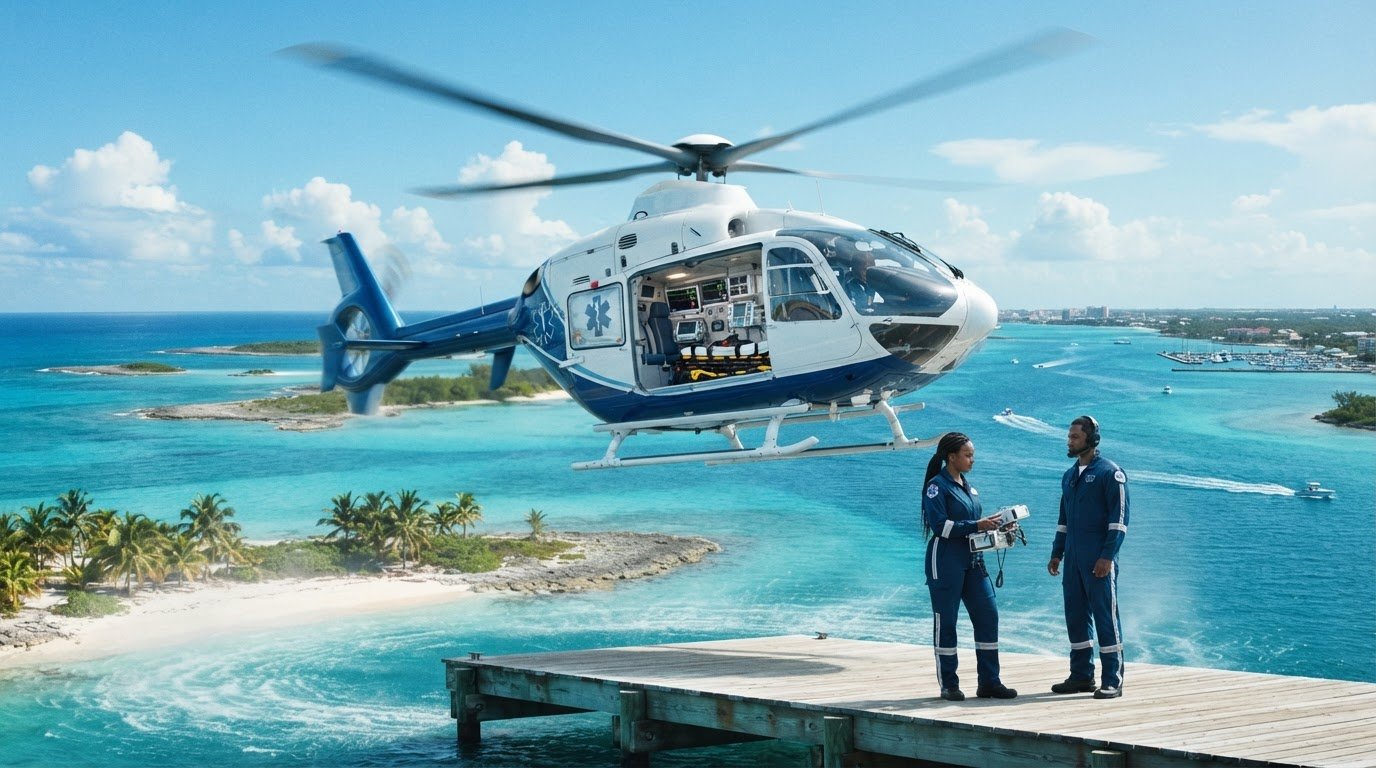
Imagine standing on a remote Bahamian dock when a medical emergency turns the surrounding ocean into a wall between you and the care you need. In these high-stakes moments, the distance to a trauma center isn’t measured in miles; it’s measured in minutes and the sophistication of your critical care air transport provider. You likely already know that standard emergency response isn’t enough when high-acuity care is required. The fear of inadequate local facilities or the anxiety of navigating complex insurance hurdles during a crisis is a heavy burden to carry.
This guide provides the clarity you need to master the complexities of modern medical aviation. You’ll discover how elite helicopter services function as mobile ICUs, bridging the gap between isolated islands and global trauma centers with surgical precision. We’ll break down the 2026 standards for onboard life-support technology and explain how a structured membership plan eliminates the threat of financial ruin. By the end, you’ll have the confidence to choose a high-acuity provider that treats logistics with the same discipline as medicine.
Key Takeaways
- Understand the specialized nature of critical care air transport and why 2026 protocols prioritize stabilizing high-acuity patients mid-flight over simple rapid transport.
- Identify the hospital-grade ICU equipment and advanced avionics that transform specialized helicopters into mobile intensive care units capable of reaching remote island environments.
- Learn why helicopter-based logistics offer superior point-to-point speed by bypassing the time-consuming ground transfers required by traditional fixed-wing services.
- Gain insight into the complex clinical and diplomatic coordination required by Tropic Air Rescue to move patients seamlessly from island facilities to elite mainland trauma centers.
- Discover how annual and short-term membership models utilize direct-to-insurance billing to ensure high-acuity transfers result in zero out-of-pocket costs for members.
Defining Critical Care Air Transport: More Than Just a Medical Flight
Critical care air transport represents the most sophisticated tier of air medical services. It’s a specialized discipline that transforms an aircraft into a high-functioning intensive care unit. While basic medical flights focus on rapid relocation, elite transport prioritizes the delivery of advanced clinical interventions during the journey. This distinction is vital for patients in life-threatening conditions where every second dictates the outcome.
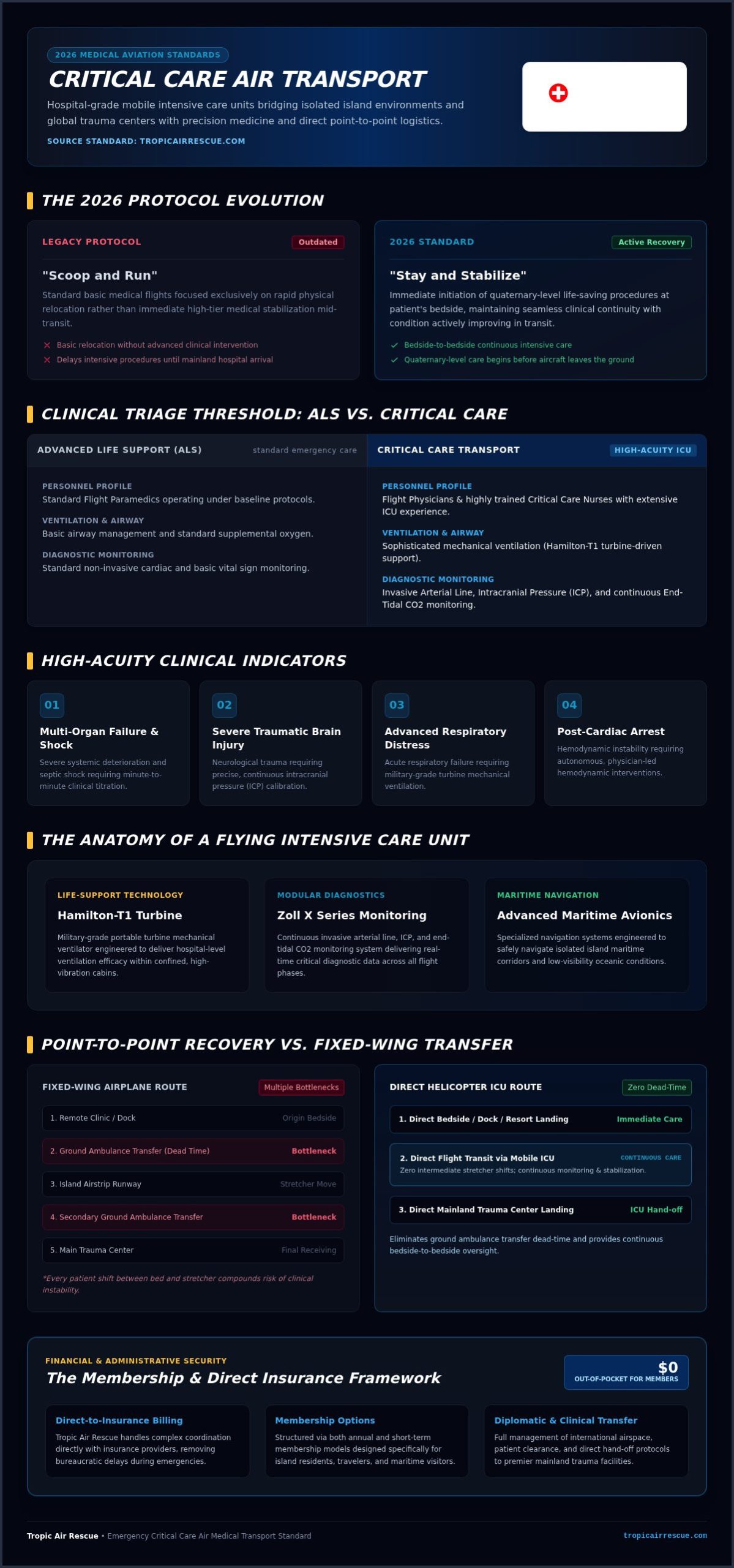
The industry has moved beyond the traditional “scoop and run” model. Under 2026 protocols, the focus has shifted to a “stay and stabilize” approach. This methodology ensures that critical care clinicians begin life-saving procedures immediately upon arrival at the patient’s side. It creates a seamless bridge of care, maintaining clinical continuity from the initial bedside to the final receiving facility. The goal is simple: the patient’s condition should not just be managed, but actively improved during transit.
In remote island environments, the “Golden Hour” takes on a unique logistical dimension. Geography often dictates that a patient is hours away from a major trauma center by traditional means. Critical care air transport collapses these distances. It brings quaternary-level medical expertise to the patient, effectively starting the recovery process before the aircraft even leaves the ground. This proactive approach is the definitive standard for modern medical aviation.
The Clinical Threshold: ALS vs. Critical Care
Distinguishing between Advanced Life Support (ALS) and critical care is essential for proper medical triage. ALS provides necessary interventions like cardiac monitoring and basic airway management. However, critical care serves a higher-acuity patient profile. These individuals often present with complex conditions that require constant, minute-to-minute adjustments. Common patient types include:
- Multi-organ system failure or septic shock
- Severe traumatic brain injuries requiring intracranial pressure monitoring
- Advanced respiratory distress requiring sophisticated mechanical ventilation
- Post-cardiac arrest stabilization and hemodynamic support
Achieving this level of care requires a specialized crew. Teams typically include flight physicians or highly trained critical care nurses with years of intensive care experience. They operate with a level of autonomy and expertise that exceeds standard paramedic protocols, ensuring that the mobile ICU remains as capable as a stationary hospital unit.
Geography as a Medical Variable
The Bahamas presents unique challenges that standard medical transport cannot always overcome. Maritime environments and isolated islands make traditional fixed-wing logistics difficult; planes require runways that may be miles from the patient. Standard transport often fails because it adds unnecessary ground transfers to an already fragile timeline. Every time a patient is moved between a bed and a stretcher, the risk of clinical instability increases.
Utilizing specialized trauma air transport Bahamas services allows for direct point-to-point recovery. Helicopters can land at resorts, local clinics, or even remote docks. This capability removes the logistical “dead time” associated with ground ambulance transfers. It ensures the patient remains under continuous ICU-level supervision throughout the entire mission profile, rendering the geographical isolation of the islands irrelevant to the quality of care received.
The Anatomy of a Flying Intensive Care Unit
A critical care air transport helicopter is not merely a vehicle; it is a high-density clinical environment engineered for the most fragile patients. Every cubic inch of the cabin is optimized for medical efficacy. Unlike standard transport, these aircraft carry hospital-grade equipment that meets or exceeds 2026 standards. This includes military-grade portable turbine ventilators, such as the Hamilton-T1, and modular monitoring systems like the Zoll X Series. These devices provide continuous invasive arterial line, ICP, and end-tidal CO2 monitoring in a confined, high-vibration setting. Precision is the priority.
Safety in the Bahamas requires more than just medical gear. Advanced avionics are mandatory for navigating remote maritime corridors. Every aircraft utilizes Helicopter Terrain Awareness and Warning Systems (HTAWS) and Flight Data Monitoring Systems. These tools allow pilots to maintain professional composure while operating in challenging weather or landing at unlit, remote island locations. The integration of technology and skill ensures that geography never compromises safety.
Onboard Life Support Systems
Modern mobile ICUs rely on seamless integration. In 2026, technology allows for real-time data transmission directly to receiving Florida trauma centers. This means surgeons can review a patient’s hemodynamic trends while the helicopter is still over the Atlantic. The equipment is specifically hardened against maritime salt and humidity, which can be aggressive in island environments. Every infusion pump and monitor is calibrated to function perfectly despite the electromagnetic challenges of flight. The sophistication of these systems is a primary reason why specialized billing models are necessary, a topic further explored in this GAO report on air ambulance insurance and billing.
The Elite Flight Crew Profile
The machinery is only as effective as the hands operating it. An elite flight crew consists of a critical care flight nurse and a flight paramedic, both holding advanced certifications like CFRN or FP-C. They don’t just “monitor” patients; they provide a concierge medical experience with one-on-one focus. This level of attention is impossible in a crowded hospital ward.
Coordination is disciplined and methodical. The pilot and medical team maintain a constant loop of communication. If a patient’s blood pressure drops, the pilot can adjust the flight path or altitude to ensure stability. It’s a vigilant, high-end partnership designed for one outcome: survival. To ensure this level of protection is always available, considering an annual membership is a proactive step for anyone living in or visiting the islands.
Strategic Advantages of Helicopter-Based Critical Care
In the context of critical care air transport, the most significant variable is often the “transfer gap.” This is the time lost moving a patient from a hospital bed to a ground ambulance, then to an airport, and finally onto a fixed-wing plane. In the Bahamas, where medical facilities and luxury resorts are often miles from the nearest functional runway, these transitions can consume hours of critical time. A helicopter eliminates this logistical friction by providing direct access. It renders the traditional airport bottleneck obsolete, allowing the medical team to maintain a steady clinical state without the jarring interruptions of multiple vehicle transfers.
Speed and precision are also vital for specialized missions like organ transport services. When the viability of a donor organ is measured in minutes, the ability to lift off directly from a facility and transit directly to a quaternary transplant center in Florida is a decisive advantage. Every minute saved in transit directly correlates to better patient outcomes. The helicopter’s ability to bypass traffic and infrastructure makes it the definitive choice for time-sensitive medical logistics.
Bypassing the Airport Bottleneck
Fixed-wing aircraft are undeniably fast in the air, but they’re tethered to infrastructure. A helicopter offers a “door-to-door” solution that significantly reduces the physiological impact on a high-acuity patient. Frequent loading and unloading during ground transfers creates physical stress and increases the risk of clinical instability. By choosing a rotary-wing solution, you leverage the distinct advantages of helicopter medevac in the Bahamas. The patient stays in one controlled environment from the point of injury all the way to the receiving trauma bay. It’s a cleaner, more efficient logistical loop.
Maritime and Remote Access Capabilities
Many Bahamian islands lack functional runways entirely. For residents and visitors on remote cays or private yachts, vertical lift is the only viable method for emergency extraction. The 2026 fleet utilizes high-performance rotors and sophisticated power management systems to operate in diverse weather conditions that might ground smaller private vessels. Tactical advantages include the ability to land on tight helipads on private estates or even directly on the decks of large vessels. Whether the patient is on a secluded beach or a moving yacht, a helicopter provides a level of geographical precision that fixed-wing aircraft cannot match. This capability ensures that critical care air transport remains an elite, available option regardless of how remote the location.
Navigating Complex Inter-Hospital and International Transfers
Moving a high-acuity patient across international borders is a logistical operation that demands absolute precision. When a patient is stabilized at an island facility, the transition to a US trauma center involves navigating complex clinical and diplomatic channels. This isn’t a standard flight; it’s a multi-agency coordination effort. Critical care air transport teams must manage flight clearances, customs protocols, and medical handoffs simultaneously. The objective is to maintain the patient’s physiological stability while clearing the path for an immediate arrival at a quaternary care facility.
High-acuity cases follow strict inter-hospital transfer protocols. These standards ensure that the level of care provided in the air matches the intensity of the specialized unit at the destination. For expats and international travelers, this level of coordination is the difference between a successful recovery and a prolonged medical crisis. It requires a vigilant, high-end guardian to manage the intersection of medicine and aviation law.
Direct Coordination with Florida Trauma Centers
Success in international transfers relies on pre-arrival briefings. Elite teams don’t just land and unload; they provide real-time updates to receiving surgeons while still in Bahamian airspace. This proactive communication allows trauma teams in Florida to prepare specific interventions before the aircraft touches down. The handoff is designed for zero care interruption. Ventilator settings, medication drips, and invasive monitoring data are synchronized between the flight crew and the hospital staff. Because of established relationships with international health authorities, emergency medical flights often receive expedited clearance, bypassing the delays that ground standard private aviation.
Logistics of Medical Repatriation
Medical repatriation is a critical service for international visitors who require long-term care in their home country. The process is daunting for families already dealing with the stress of a medical emergency. A concierge-style approach handles the exhaustive paperwork, including customs declarations and coordination with foreign health ministries. This allows the family to focus on the patient’s recovery while experts manage the logistical burden.
Safety during long-distance critical care air transport is both physical and emotional. The crew ensures the environment remains calm and disciplined, providing reassurance through professional composure. For those living or traveling in the Bahamas, these complex logistics are best managed through a dedicated plan. Secure an Annual Membership to ensure your international transfer is handled by experts who understand the unique requirements of Bahamian-US corridors.
Securing Elite Protection: The Membership and Insurance Model
The technical sophistication of critical care air transport is only one half of the equation. The other half is the logistical and financial framework that ensures these services are accessible without the threat of economic devastation. In a high-stakes emergency, the last thing a family should manage is a complex payment dispute or a massive upfront bill. Elite providers in the Bahamas utilize a membership-driven model to bypass these hurdles. This structure transforms a potentially bankrupting event into a coordinated, pre-paid clinical operation.
Securing a membership is the only way to guarantee zero out-of-pocket costs during a high-acuity transfer. Without this protection, patients are often caught in the middle of “medical necessity” disputes between insurers and transport providers. A membership acts as a concierge safety net, ensuring that the focus remains on life-saving interventions rather than administrative barriers. It’s a disciplined approach to safety that residents, expats, and frequent travelers rely on for absolute peace of mind.
Eliminating the Financial Burden of Medevac
The primary advantage of an elite membership is the direct-to-insurance billing model. Many standard operators utilize a “pay-and-claim” system. This requires the patient to secure the full cost of the flight upfront and seek reimbursement from their insurer later, a process that can take months and cause significant financial stress. In contrast, a concierge air medical service manages the adjudication on your behalf. They work directly with your health insurer to facilitate payment. This “Direct Billing” process effectively removes the patient from the financial loop, ensuring that the clinical mission proceeds without delay.
Membership Tiers for Every Traveler
Protection is tailored to the specific needs of the individual. For tourists, yacht owners, and seasonal visitors, short term medevac coverage provides a vital safety net for the duration of their stay. These plans offer the same high-acuity response as long-term options but are calibrated for temporary island exposure. Permanent residents and second-home owners benefit most from an annual air rescue membership. This tier provides year-round security across the entire archipelago, ensuring that critical care air transport is always one call away.
The activation process is designed for speed and professional composure. During a medical crisis, a single notification triggers the entire medical and aviation apparatus. There are no lengthy verification delays or financial screenings at the point of care. Membership ensures the aircraft and medical team are dispatched immediately, with all administrative requirements handled in the background. It remains the definitive way to secure the highest level of medical protection in the Bahamas.
Securing Your Path to Quaternary Care
Mastering the logistics of high-acuity medical aviation is about more than understanding technology; it’s about ensuring your safety is never compromised by geography. This guide has detailed how elite critical care air transport functions as a seamless extension of the intensive care unit. By utilizing an elite helicopter fleet equipped with advanced life support, you bypass the inherent delays of traditional airports and ground transfers. Point-to-point transport ensures that the “Golden Hour” is utilized for clinical stabilization rather than logistical dead time.
A proactive approach to safety involves more than just selecting a provider. It requires a financial strategy that eliminates out-of-pocket burdens through direct insurance billing for all members. This concierge model allows you to focus entirely on recovery while experts manage the complexities of international coordination and clinical handoffs. Don’t leave your emergency response to chance in the isolated corridors of the islands.
Secure your concierge medevac membership today. Professional composure and meticulous preparation are the definitive standards for your protection. You deserve the confidence that comes with a vigilant, high-end guardian ready to respond at a moment’s notice.
Frequently Asked Questions
What exactly qualifies as critical care air transport?
Critical care air transport is the highest tier of medical aviation, providing hospital-level intensive care during flight. It differs from standard medical transport by utilizing specialized teams, such as flight physicians and nurses, alongside advanced life-support technology. This service is reserved for high-acuity patients requiring continuous invasive monitoring, mechanical ventilation, or complex hemodynamic support. It ensures that the level of care remains consistent from the initial bedside to the receiving trauma center.
Can a helicopter land at a remote resort or on a private yacht?
Yes, the primary advantage of rotary-wing aircraft is their point-to-point accessibility. Unlike fixed-wing planes that are tethered to runways, elite helicopters can land directly at island resorts, local clinics, or suitably equipped private vessels. This capability eliminates the need for multiple ground ambulance transfers, which can be physiologically taxing for a fragile patient. It represents a significant tactical advantage in maritime environments where traditional infrastructure is often unavailable or distant.
How does the direct insurance billing process work for members?
Members benefit from a concierge billing model designed to eliminate financial stress during a crisis. Tropic Air Rescue coordinates directly with your health insurance provider to facilitate payment for the mission. By accepting the insurance reimbursement as full payment, the company ensures members face zero out-of-pocket costs. This proactive approach bypasses the traditional “pay-and-claim” system, where patients are often forced to secure massive upfront funds before an emergency flight is even dispatched.
Is critical care air transport available 24/7 in the Bahamas?
Elite providers maintain a state of constant readiness to respond to emergencies across the archipelago. The operation is disciplined and methodical, ensuring that high-acuity medical teams and pilots are always prepared for immediate deployment. This “always ready” demeanor is essential for managing the high-stakes urgency of trauma or organ transport. You should confirm specific activation protocols within your membership agreement to ensure a rapid response when a medical emergency occurs at any hour.
What medical staff are present on a critical care flight?
Every mission is staffed by a specialized clinical team holding advanced certifications in emergency medicine and intensive care. This typically includes a critical care flight nurse and a flight paramedic who provide a one-on-one concierge medical focus. They’re trained to operate sophisticated life-support equipment in the high-stress environment of an aircraft cabin. Their expertise allows them to make minute-to-minute adjustments to a patient’s treatment plan, ensuring clinical stability throughout the entire journey.
Can critical care transport be used for international hospital transfers?
Yes, critical care air transport is frequently utilized for inter-hospital transfers between the Bahamas and Florida trauma centers. These missions require complex coordination with international health authorities, customs, and receiving surgical teams. The goal is to provide a seamless bridge of care across borders. By managing the logistical and diplomatic hurdles in the background, the transport team ensures the patient receives uninterrupted ICU-level supervision from the point of departure to the final destination.
What is the difference between an air ambulance and a medevac membership?
An air ambulance refers to the specialized aircraft and medical service itself, while a membership is the logistical and financial protection plan. Without a membership, a patient may be responsible for the full cost of a flight, which often leads to significant financial ruin. A membership guarantees access to critical care air transport and leverages direct billing to ensure no out-of-pocket expenses. It functions as an elite safety net for residents and frequent visitors.
How do I secure coverage for a short-term visit to the islands?
Travelers can secure elite protection through a Short-term Membership tailored to the specific length of their stay. This plan provides the same high-acuity response and advanced life-support capabilities as an annual plan. It’s a vital requirement for yacht owners, tourists, and seasonal visitors who spend time in remote locations. Activation is simple and immediate, providing a concierge-level safety net that ensures geography never stands between a visitor and quaternary medical care.