

Imagine the silence of a private island in the Bahamas suddenly broken by a medical emergency. You realize the nearest airport is an hour away by boat, and the clock is ticking. For many, the fear of being stranded in paradise during a crisis is a heavy burden. A remote location medical landing isn’t just a technical maneuver; it’s the definitive solution for those who live or travel beyond the reach of traditional infrastructure. You deserve the confidence that comes from knowing a specialized rescue solution exists regardless of your coordinates.
We understand that the logistics of an emergency evacuation from isolated terrain feel overwhelming and confusing. This guide clarifies the critical differences between plane and helicopter medevac, focusing on how elite flight crews navigate the unique challenges of the Bahamian landscape. You’ll discover how specialized helicopters bypass airport limitations to provide life-saving transport directly from the point of injury. We also detail how to secure coverage for these high-stakes operations. This knowledge ensures your focus remains on recovery rather than the complexities of aviation logistics or the threat of unexpected transport costs.
Key Takeaways
- Learn why proximity to an airport shouldn’t dictate survival and how a remote location medical landing provides immediate access during the critical “Golden Hour.”
- Understand the advanced avionics and pilot protocols used to transform unmapped Bahamian terrain into a secure, viable landing zone.
- Discover the “bedside-to-bedside” advantage of helicopters, which eliminates the dangerous time-cost of ground-to-air transfers required by fixed-wing aircraft.
- Identify the 5-step process for preparing a safe remote landing site and the common “LZ Killers” to avoid during a medical crisis.
- Gain insights into concierge membership models that provide direct billing to insurers and eliminate the high out-of-pocket costs of emergency air transport.
The Critical Challenge of Remote Medical Access
A remote location medical landing is a high-precision operation where an emergency airlift is executed from non-airport terrain. In the archipelago of the Bahamas, this capability is not a luxury; it is a necessity. Traditional medical transport relies on paved runways and established infrastructure. However, emergencies don’t wait for convenient geography. Whether you’re on a secluded beach, a private estate, or a remote cay, the ability to land an aircraft at the point of injury is the definitive standard for modern rescue.
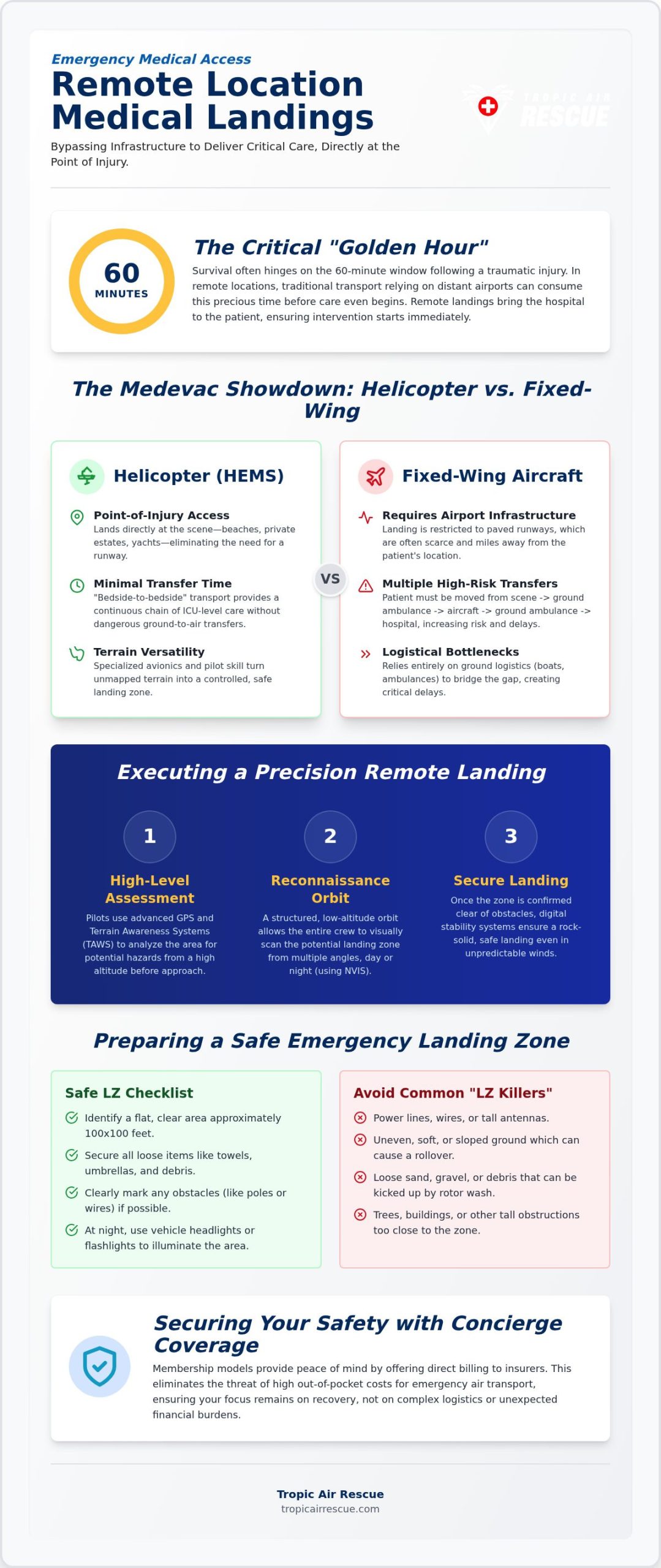
Survival often hinges on the “Golden Hour.” This is the sixty-minute window following a traumatic injury or medical crisis where immediate intervention significantly improves outcomes. Proximity to a runway shouldn’t dictate your life expectancy. Ground ambulances face severe limitations in island environments, often restricted by broken terrain or the lack of connecting roads. By eliminating the need for a traditional airport, specialized flight crews bring the hospital to the patient, ensuring that the clock doesn’t run out while waiting for a boat transfer or a ground transport team.
Why Traditional Airports Often Fail Patients
Relying on a distant runway creates a dangerous logistical chain. Every mile between the patient and the aircraft represents a delay. These delays are compounded by the need for multiple transfers: from the scene to a vehicle, and from that vehicle to a fixed-wing plane. Each transition increases the risk of high-acuity complications. In many parts of the Bahamas, paved runways are simply too scarce to provide a timely response. A remote location medical landing bypasses these bottlenecks entirely, offering a direct route to advanced care without the friction of ground logistics.
The Role of Specialized HEMS in Modern Rescue
Air medical services have evolved far beyond basic patient transport. Modern HEMS (Helicopter Emergency Medical Services) units function as mobile intensive care suites. These aircraft are equipped with advanced life-support technology and staffed by expert clinicians trained for high-stakes environments. There are clear advantages of helicopter medevac in the Bahamas, focusing on three core pillars:
- Clinical Continuity: Maintaining ICU-level care from the scene to the trauma center.
- Geographical Precision: Landing exactly where the emergency occurs, regardless of runway availability.
- Operational Speed: Eliminating the time-cost of ground-to-air-to-ground transfers.
This proactive approach ensures that the highest level of medical expertise is available from the moment the rotors touch the ground. It transforms a chaotic emergency into a controlled, clinical operation.
How Medical Helicopters Execute Remote Location Landings
Executing a remote location medical landing requires more than just a pilot; it demands a synergy of advanced technology and elite tactical skill. Unlike standard airport approaches, remote landings involve unmapped terrain and hidden hazards that aren’t visible on traditional charts. Pilots begin with a high-level assessment of the area before descending into a structured reconnaissance orbit at a lower altitude. During this multi-point orbit, the entire crew scans for obstacles like power lines, loose debris, or uneven ground that could cause a dynamic rollover. This methodical approach transforms an unpredictable field or beach into a controlled clinical environment, ensuring the safety of the patient, the medical team, and the aircraft.
Advanced Avionics and Precision Navigation
Precision is non-negotiable in the Bahamas archipelago. High-resolution GPS and Terrain Awareness and Warning Systems (TAWS) provide real-time data to prevent accidents in dark or isolated regions where ground lighting is non-existent. Digital stability systems allow helicopters to maintain a rock-solid hover even in the unpredictable crosswinds common near Bahamian cays. Synthetic Vision Systems provide a computer-generated 3D representation of the external environment to the pilot, ensuring clear situational awareness regardless of visibility. To ensure 24/7 readiness, aircraft are equipped with Night Vision Imaging Systems (NVIS). These tools allow crews to identify safe landing spots in total darkness, a capability that distinguishes elite medevac services from standard transport. This technology effectively turns the night into day, removing the blind spots that often delay traditional rescue efforts.
The Skill Set of a Remote Medevac Pilot
The cockpit of a medical helicopter is no place for a novice. Pilots must possess specialized training specifically for off-airport landings in austere environments. This often leads to a preference for pilots with military or mountain-rescue backgrounds, as they are accustomed to making rapid, high-stakes decisions when terrain is unforgiving. A pilot must constantly evaluate wind direction, weight limits, and escape routes during every approach. Adhering to strict helicopter landing zone safety protocols is the baseline for every mission. If conditions aren’t perfect, the pilot must have the professional composure to adjust the plan or select an alternate site instantly. This level of expertise is what allows us to execute a remote location medical landing where others cannot. For those frequenting isolated islands, securing a specialized air-medical membership ensures that this level of elite piloting and coordination is always on standby for your protection.
Comparing Landing Capabilities: Helicopter vs. Fixed-Wing
Choosing between fixed-wing and rotary aircraft is not merely a matter of preference; it’s a decision based on geographical reality. Fixed-wing air ambulances operate on a “runway-to-runway” model. This requires the patient to be stable enough to endure a ground ambulance trip to an airport, a transfer onto the plane, and a secondary ambulance trip upon landing. In contrast, helicopters provide a “bedside-to-bedside” solution. By executing a remote location medical landing, the aircraft reaches the patient directly. This eliminates multiple high-risk transfers and significantly reduces the total time spent outside of a definitive care facility.
Landing Site Requirements and Versatility
The physical requirements for these two platforms are vastly different. A fixed-wing aircraft typically requires at least 3,000 feet of paved, maintained runway to operate safely. In the remote island chains of the Bahamas, such infrastructure is often miles away or entirely non-existent. A helicopter requires only a 60×60 foot clearing. This compact footprint allows for landings on private yachts, resort helipads, or even secluded beaches. While pilots must account for “downwash”, the powerful downward air pressure from the rotors, the versatility of rotary flight remains unmatched. According to research on EMS Air Medical Transport, the ability to operate in these austere environments is the primary clinical advantage of rotor-wing assets over their fixed-wing counterparts.
Total Mission Time: A Reality Check
Speed in the air is often a deceptive metric. While a plane may have a higher cruising speed, the hidden time sinks of ground logistics often negate this advantage. Every minute spent loading a patient into a ground ambulance, navigating island roads, and idling on a tarmac is a minute lost in the fight for survival. A helicopter flies a direct path from the scene to the trauma center. There are no secondary transfers. This streamlined approach is critical for trauma cases where every second counts. For those visiting the islands, securing short term medevac coverage is the most effective way to ensure this direct, life-saving response is available without delay. While fixed-wing planes offer better range and fuel efficiency for long-distance international transfers, they cannot compete with the immediate, localized response of a helicopter in a remote crisis. Understanding how the industry is evolving can help you make smarter decisions; a detailed look at the future of Bahamas to Florida medical transport reveals how point-to-point helicopter logistics are redefining the gold standard for emergency evacuation.
Essential Safety Protocols for Emergency Landing Zones
A successful remote location medical landing depends on meticulous ground coordination. While the flight crew manages the descent, the safety of the operation is often determined by the preparation of the Landing Zone (LZ). Safety protocols are not mere suggestions; they are rigorous requirements designed to protect the patient and the aircraft from environmental hazards. Preparing a remote site requires a disciplined, five-step approach to ensure the terrain is viable for a high-stakes medical extraction.
- Survey: Identify a flat, firm area measuring at least 60 feet by 60 feet.
- Clear: Remove all “LZ Killers” such as loose debris, lawn furniture, or trash that could be sucked into the rotors.
- Identify: Locate overhead hazards, specifically power lines, tall trees, and antennas.
- Mark: Define the four corners of the LZ using weighted markers or vehicle lights.
- Communicate: Provide precise GPS coordinates and describe any nearby landmarks to the incoming crew.
Communication is the lifeline of a remote rescue. When relaying location data, use decimal degrees for GPS coordinates to ensure the highest level of accuracy. During twilight or night operations, ground markers become critical. Handheld lights or vehicle headlights should be pointed toward the center of the LZ, but never directly at the aircraft, as this can blind the pilot’s night-vision systems.
Selecting and Marking the Landing Site
The ideal LZ for a modern medical helicopter is a clear square of 60 feet by 60 feet. This space allows for the aircraft’s footprint and provides a buffer for the intense downwash created by the rotors. If using vehicles to mark the site, park them at the corners with low-beam headlights crossing in the middle. Pilots always prefer to land and take off into the wind. If possible, indicate the wind direction by standing with your back to the wind and pointing your arms toward the LZ. This “wind-aware” positioning helps the pilot calculate the safest approach angle for the remote location medical landing.
Ground Safety and Crowd Control
Discipline on the ground is mandatory. All non-medical personnel and curious bystanders must maintain a “Stay Back” distance of at least 100 feet from the landing site. This prevents injuries from flying debris or accidental contact with the aircraft. Never approach the helicopter until signaled by the flight crew. The rear of the aircraft is a “No-Go Zone” due to the high-speed tail rotor, which is often invisible when spinning. When the medical team is ready, the patient handover should be brief and clinical. Providing a clear, concise medical history to the flight paramedics ensures a seamless transition into the airborne ICU environment. To ensure your island estate or vessel is always prepared for these complex logistics, consider an annual air-medical membership for guaranteed professional oversight.
Securing Your Safety with Concierge Air-Medical Coverage
Traditional travel insurance policies often fail when a crisis occurs on a remote cay or a private vessel. These standard plans typically operate on a reimbursement basis, requiring the patient to pay tens of thousands of dollars upfront before seeking a claim. Additionally, many insurers only cover transport from established airports, ignoring the necessity of a remote location medical landing at the point of injury. Tropic Air Rescue eliminates these barriers through a dedicated membership model. We handle the complex logistics and provide direct billing to your health insurer, ensuring that members experience a “no out-of-pocket” evacuation process during life-threatening emergencies.
Our operational framework ensures a seamless transition from the isolated terrain of the Bahamas to elite Florida trauma centers. This isn’t a generic utility service; it’s a high-end guardian system designed for those who value meticulous preparedness. Much like how specialized brokers such as JT Memberships handle the acquisition and management of exclusive club assets, we manage every detail of your medical transport to ensure total peace of mind. This proactive approach guarantees that financial and logistical obstacles never interfere with clinical outcomes.
The Concierge Difference in Medical Aviation
Elite medical aviation requires more than just a flight; it demands personalized coordination between the aircraft, the patient, and the receiving hospital. Our concierge model provides a level of oversight that traditional services cannot match. Members benefit from a system that is always ready, regardless of whether they are short-term visitors or annual residents. This service level includes:
- Immediate dispatch of advanced life support helicopters to non-airport locations.
- Direct communication with Florida-based trauma specialists before the aircraft even lands.
- Comprehensive management of all international border and customs requirements.
- Zero-friction billing processes that prioritize patient care over paperwork.
This level of logistical oversight provides the peace of mind necessary for enjoying the most isolated regions of the archipelago. You aren’t just buying a transport service; you’re securing a private, elite partner that values safety and operational excellence above all else.
How to Join and Activate Coverage
Securing your safety requires proactive planning before you depart for remote island destinations. Activation is a straightforward, three-step process designed for immediate peace of mind. First, select a plan that matches your needs, choosing between a Short-term Membership for brief vacations or an Annual Membership for residents and frequent travelers. Second, complete the enrollment with your health insurance details to enable direct billing. Third, receive your membership credentials, which provide instant access to our dispatch center. Coverage is activated immediately upon enrollment. Don’t wait for a crisis to discover the limitations of your current insurance; establish your safety net today and ensure that elite rescue is always within reach.
Establishing Your Elite Safety Network
Survival in the isolated cays of the Bahamas shouldn’t depend on your proximity to a paved runway. A remote location medical landing provides the only definitive solution for high-stakes emergencies occurring on private estates, yachts, or secluded beaches. By prioritizing geographical precision and rapid clinical intervention, specialized helicopter teams ensure that hospital-grade care reaches you exactly where you are. This bedside-to-bedside model removes the dangerous logistical friction inherent in traditional fixed-wing transport.
Every mission features Advanced Life Support (ALS) equipment and elite crews trained for the most austere environments. Membership ensures you avoid the administrative failures of standard travel insurance through direct insurance billing and comprehensive logistical coordination. You deserve the confidence of knowing a private, elite partner is vigilant and ready to respond to any coordinate in the archipelago. Secure your peace of mind with a Tropic Air Rescue Membership today. Explore the furthest reaches of the islands with the certainty that expert protection is always on standby.
Frequently Asked Questions
Can a medical helicopter land on a private yacht at sea?
Yes, medical helicopters can land on private vessels provided there is a certified helideck or a sufficiently large, clear deck space. Pilots must evaluate the ship’s motion, wind conditions, and structural capacity before attempting a landing. If a direct deck landing is unsafe, crews coordinate a transfer at the nearest stable port. This capability ensures that maritime emergencies receive the same high-stakes response as those on land.
What is the minimum clearing size required for a remote medical landing?
A standard remote location medical landing requires a minimum clear area of 60 by 60 feet. This space must be flat, firm, and entirely free of obstacles like power lines, antennas, or loose debris. Larger zones are always preferred to account for intense rotor downwash and varying approach angles. Proper site preparation by ground personnel is essential to ensure the safety of the patient and the flight crew.
Does health insurance typically cover the full cost of a helicopter medevac?
Coverage varies significantly between providers and often involves high out-of-pocket deductibles or complex reimbursement delays. Many traditional policies don’t cover the full expense of specialized rotary transport from non-airport locations. Membership models solve this by offering direct billing to health insurers, which eliminates the need for patients to pay massive upfront fees. It’s vital to verify your specific policy’s air-medical provisions before a crisis occurs.
How do pilots find a remote location if there are no street addresses?
Pilots utilize high-precision GPS coordinates provided by ground personnel or emergency dispatchers. Modern avionics suites allow flight crews to navigate to specific latitude and longitude points with extreme accuracy in the archipelago. In the absence of coordinates, crews use visual landmarks and satellite-linked terrain awareness systems to identify the rescue site. This technological precision allows for successful extractions even in the most unmapped regions of the Bahamas.
What happens if the weather is too poor for a helicopter to land?
Safety is the absolute priority; if visibility or wind exceed operational limits, the pilot will seek the nearest safe alternate landing site. Medical teams then coordinate with ground or sea transport to bridge the gap to the patient. Constant communication between the cockpit and dispatch ensures that rescue efforts continue through the most viable secondary route. Crews are trained to adapt instantly to changing Bahamian weather patterns.
Are there weight limits for patients being transported from remote sites?
Yes, every aircraft has strict maximum takeoff weight limits that include the patient, medical crew, and life-support equipment. Pilots must calculate these limits precisely, especially in the high-temperature environments of the Bahamas which can affect lift performance. These calculations are performed before every mission to ensure a safe departure. If a patient’s weight exceeds the limit for a specific aircraft, alternative transport arrangements are immediately coordinated.
How long does it take for a medical helicopter to reach a remote island?
Response times depend on the aircraft’s current station and the distance to the emergency coordinates. Helicopters typically cruise at speeds that allow them to reach most remote cays in the Bahamas significantly faster than sea-based alternatives. Direct flight paths eliminate the delays associated with ground transport and multiple patient transfers. This speed is a critical factor in maintaining the “Golden Hour” for trauma patients.
What medical equipment is available on a remote rescue helicopter?
Every flight functions as an airborne ICU equipped with Advanced Life Support (ALS) technology. This includes cardiac monitors, ventilators, infusion pumps, and a full suite of emergency medications. The medical team is prepared to manage high-acuity patients from the moment of the remote location medical landing until they reach a specialized facility. This ensures clinical continuity and intensive care monitoring throughout the entire duration of the transport.