

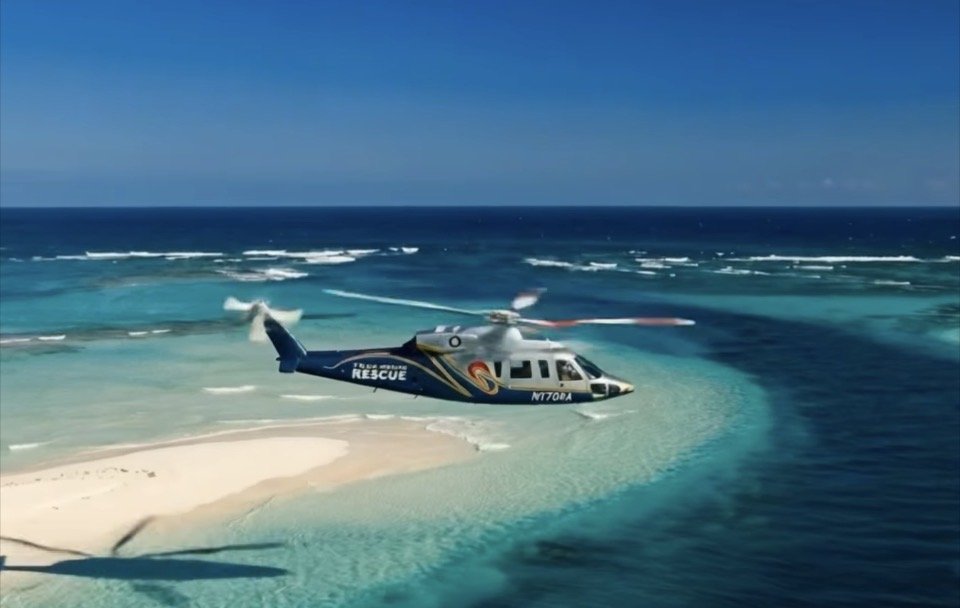
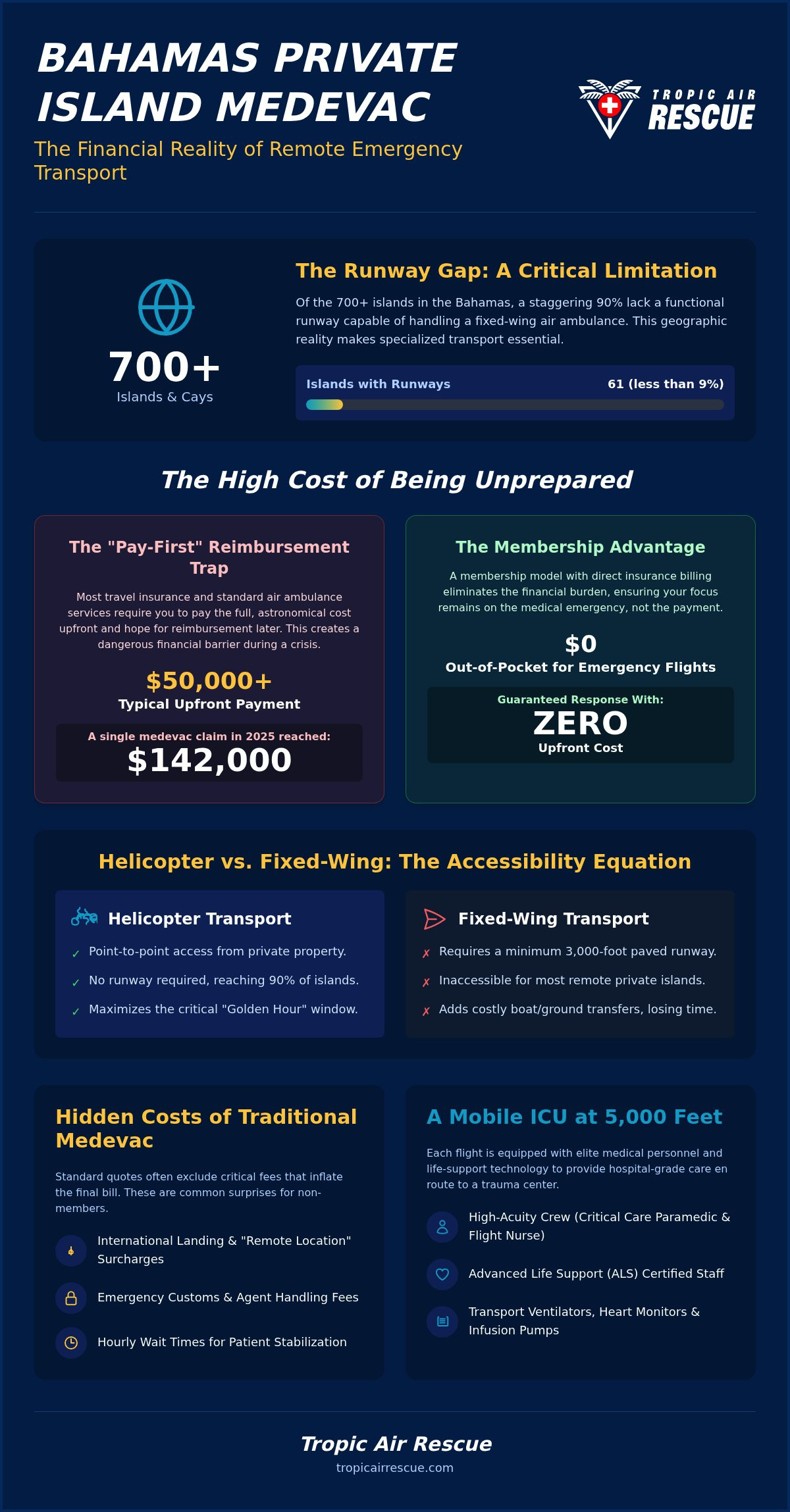
Out of more than 700 islands and cays in the Bahamas, only 61 possess a functional runway. For those on a remote private island, this geographic reality means a standard fixed-wing air ambulance isn’t just expensive; it’s often physically impossible to land. You likely understand that remote paradise comes with unique logistical risks. The fear of being stranded during a medical trauma is real, making reliable Bahamas private island medevac coverage an essential component of any safety plan. A single medevac claim in 2025 reached a staggering $142,000, illustrating the high stakes of being unprepared.
This guide breaks down the true 2026 costs of emergency transport and explains how to bypass the reimbursement trap that leaves many travelers with $50,000 bills. You’ll learn why a proactive membership model is the only way to guarantee a rapid response without the burden of upfront payments. We’ll examine the price drivers for point-to-point helicopter transport and how specialized coordination ensures you reach Florida trauma centers within the critical golden hour.
Key Takeaways
- Determine why helicopter transport is the only tactical solution for the 90% of Bahamian islands lacking functional runways.
- Learn how Bahamas private island medevac coverage via membership removes the “pay-first” requirement common in traditional air ambulance services.
- Break down the specific costs associated with Advanced Life Support (ALS) equipment and high-acuity medical staffing.
- Understand the financial advantage of direct billing to insurance to ensure zero out-of-pocket expenses for emergency flights.
- Evaluate the logistical benefits of point-to-point transport from private property directly to Florida’s leading trauma centers.
The Financial Reality of Remote Island Medical Emergencies
Medical evacuation from a private island is not a standard flight; it’s a high-stakes logistical operation requiring surgical precision. Unlike urban medical transport, Air medical services in this archipelago must account for extreme isolation and limited infrastructure. Traditional providers frequently apply a “remote location” surcharge. This fee reflects the complexity of reaching a destination that lacks a dedicated airfield or medical facility. For the owner or guest on a private cay, securing reliable Bahamas private island medevac coverage is the difference between a coordinated rescue and a chaotic financial event.
In trauma medicine, the “Golden Hour” represents the sixty-minute window where rapid intervention maximizes survival rates. In these waters, the clock starts in total isolation. Speed is the primary cost driver. Standard travel insurance often fails here because it operates on a reimbursement model. Most policies require you to pay the full cost of the flight upfront, often exceeding $50,000, before they even process a claim. This creates a dangerous “pay-first” barrier during a life-threatening crisis.
Why Geography Dictates the Price Tag
The nation consists of over 700 islands spread across 100,000 square miles of ocean. Positioning an aircraft for a rescue involves significant fuel and crew staging costs, especially when the flight originates from the mainland or major national hubs. Fueling logistics in remote cays are non-existent, meaning aircraft must carry enough reserve fuel for the entire mission. The “runway gap” means that while 61 islands have runways, the remaining hundreds require specialized vertical lift capabilities to reach a patient’s doorstep directly. This geographic reality makes Bahamas private island medevac coverage an operational necessity rather than a luxury.
The Hidden Costs of Traditional Air Ambulances
Fixed-wing providers often hide secondary costs in their final invoices. If your island doesn’t have a 3,000-foot paved runway, you’ll pay for a boat or ground ambulance transfer to the nearest airfield. These additional layers of transport add time and expense. Consider these common hidden variables:
- International landing fees: These vary by island and time of day, often increasing after sunset.
- Customs handling: Emergency clearances require specialized agents and rapid processing fees.
- Stabilization wait times: Providers charge by the hour if the crew must wait for a patient to be cleared for flight at a local clinic.
These variables quickly inflate a standard quote into a six-figure liability. Without a membership model, you’re left to navigate these technical fees while managing a medical emergency.
Breaking Down the Flight: Factors Influencing Medevac Costs
A medical flight is a mobile Intensive Care Unit (ICU) that operates in a high-vibration, high-altitude environment. The primary cost drivers are not fuel alone. They involve the integration of elite medical personnel and sophisticated life-support technology. Comprehensive Bahamas private island medevac coverage ensures these assets are prepositioned and ready for immediate deployment. This level of readiness requires significant capital investment in both human and technical resources. Membership models facilitate this by providing direct billing to your insurer, bypassing the typical $50,000 upfront requirement seen in traditional pay-per-flight models.
Specialized Medical Crew and Equipment
Standard transport crews lack the training required for maritime trauma events. Every flight requires a high-acuity team, typically consisting of a critical care paramedic and a flight nurse. These professionals maintain certifications in Advanced Cardiac Life Support (ACLS) and Pediatric Advanced Life Support (PALS). They provide hospital-grade care at 5,000 feet. The equipment they use, including transport ventilators, multi-lead heart monitors, and infusion pumps, must be flight-certified and resistant to the corrosive effects of the Bahamian salt air. Understanding Air Ambulance Insurance helps clarify why these specialized medical components drive the base cost of a mission upward. It’s a matter of maintaining a sterile, functional ICU in a compact, mobile frame.
Operational Readiness: The Price of 24/7 Availability
Safety in the Out Islands demands twin-engine aircraft and advanced avionics. Precision landings on private estates or yachts require 4-axis autopilot systems and night-vision capabilities. These technologies allow for safe operations when visibility is compromised. Behind the scenes, a dedicated dispatch team manages medical direction and hospital communication. They ensure a seamless handoff to Florida trauma centers. Rapid-launch protocols and fuel reserves are maintained around the clock to meet the demands of trauma air transport Bahamas infrastructure. This constant state of vigilance is a core component of the service. You can secure this level of protection for your family through a concierge membership plan that eliminates the financial friction of emergency response.
Helicopter vs. Fixed-Wing: The Cost of Accessibility
Fixed-wing aircraft are a staple of international medical transport, but they face a critical limitation across the archipelago: the runway gap. A standard air ambulance jet requires a minimum of 3,000 feet of paved, maintained runway. As previously noted, only a small fraction of Bahamian islands meet this criteria. Relying on fixed-wing service often results in a “double transfer.” This logistical chain involves a boat or ground ambulance to reach an airport, the flight itself, and a final ground transport to the hospital. Each transition increases the financial burden and consumes precious minutes of the Golden Hour. For those requiring Bahamas private island medevac coverage, understanding this infrastructure deficit is vital.
Helicopters eliminate these intermediate steps. They provide true point-to-point service, landing directly at a private residence, resort, or even a yacht. This accessibility is a core feature of premium medical rescue. By bypassing local airports, you avoid the delays of restricted operating hours and the hidden costs of multiple transport vendors. Efficiency in these scenarios isn’t just a matter of convenience; it’s a matter of clinical outcomes. Reducing handoffs reduces the risk of patient instability during transport.
Eliminating the Middleman in Island Transport
The ability to land on beaches, lawns, or private helipads transforms the rescue timeline. Traditional planes are tethered to infrastructure that simply doesn’t exist on most private cays. When you evaluate the advantages of helicopter medevac in the Bahamas, the primary benefit is the removal of the “middleman” transport. There’s no waiting for a boat to reach a mainland dock or a car to navigate island roads. The aircraft meets the patient at the point of injury. This streamlined approach ensures that high-acuity care begins immediately and continues without interruption until hospital arrival.
Point-to-Point Logistics to Florida Trauma Centers
A helicopter mission follows a direct flight path from the Out Islands to specialized trauma centers in Florida. These flights operate under pre-cleared customs protocols designed specifically for emergency medical missions. This ensures that international borders don’t become bottlenecks during a crisis. For patients who’ve been initially stabilized at a local clinic, a seamless inter-hospital transfer can be coordinated to move them to a higher level of care in the U.S. This direct logistical pipeline provides a level of security that fixed-wing services cannot match in a remote island environment. By choosing a membership-based helicopter service, you’re securing a dedicated corridor to world-class medical facilities.
Mitigating the $50,000+ Risk: Membership vs. Pay-per-Flight
The financial risk of a medical emergency on an isolated cay extends far beyond the clinical bill. Traditional air ambulance operators typically function on a “pay-first” basis. This means they often demand a valid credit card or a verified wire transfer before the aircraft even leaves the tarmac. When emergency flights regularly exceed $50,000, this requirement creates a massive barrier to life-saving care. Relying on standard travel insurance frequently leads to a reimbursement trap. You’re forced to pay the full amount out-of-pocket and then spend months navigating out-of-network claims with no guarantee of full recovery. Most U.S. health plans provide little to no support once you cross the maritime border.
Membership-based Bahamas private island medevac coverage shifts this entire burden. It replaces unpredictable, high-stakes invoices with a fixed, predictable subscription. A critical advantage of this model is the pre-certification process. By collecting your medical history and insurance data before an emergency occurs, the response team can launch immediately. There’s no delay for financial vetting or insurance verification during a crisis. This proactive approach ensures that the logistical machinery is already in motion while others are still searching for a credit card.
The Short-Term Solution for Visitors
For those visiting the archipelago on a limited itinerary, short term medevac coverage is a tactical necessity. This is especially true for yacht charters operating in remote maritime environments. These vessels are often hours away from any functional runway. A short-term membership fee is a small fraction of a potential $50,000+ invoice. It ensures that if a trauma event occurs, the focus remains on the medical evacuation, not the financial transaction. It’s a concierge level of protection tailored to the specific duration of your stay.
Annual Security for Residents and Expats
Second home owners and long-term residents require a more permanent safety net. An annual air rescue membership provides year-round peace of mind and eliminates the need to reassess coverage for every trip. For remote resorts, B2B plans offer a way to protect management and staff, ensuring that any medical crisis is handled with professional composure. This elite level of preparedness is the definitive standard for modern island living. Secure your family’s safety today by choosing a concierge membership plan that guarantees direct billing and zero out-of-pocket expenses.
Tropic Air Rescue: Eliminating Out-of-Pocket Expenses
Tropic Air Rescue operates as the definitive solution for high-net-worth individuals and remote island residents. While traditional providers leave you to navigate the complexities of insurance claims, our model prioritizes immediate clinical response and financial simplicity. We provide comprehensive Bahamas private island medevac coverage that functions as a seamless extension of your existing health insurance. By establishing a direct billing relationship with your provider, we eliminate the need for you to manage paperwork or negotiate rates during a crisis. Our administrative team handles the logistics so you can focus on the patient.
Our commitment is centered on a zero out-of-pocket experience for the flight itself. We accept the insurance reimbursement as full payment for our active members. This approach effectively dismantles the reimbursement trap and the need for $50,000 upfront payments. It positions our offering as the only concierge air medical service designed specifically for the logistical hurdles of the Bahamas. We manage every detail from the moment our helicopter touches down on your private property to the final handoff at a Florida trauma center.
The Pre-Certification Advantage
Administrative delays are a significant risk factor in emergency logistics. Our pre-certification process front-loads the necessary work before a trauma event occurs. We securely store your medical history, current medications, and primary insurance data. This preparation ensures that one call to our dispatch center launches the helicopter immediately. There’s no vetting of credit limits or verification of policy active dates in the heat of the moment. This disciplined approach saves vital minutes during the Golden Hour. It’s the difference between a rapid launch and a costly delay.
Coordination with Elite Florida Facilities
The mission doesn’t end when the aircraft crosses the Gulf Stream. We maintain direct communication lines with Level 1 trauma centers in Florida. Our flight crew provides real-time patient updates to receiving physicians while in transit. This coordination ensures that a specialized medical team is standing by upon our arrival at the heliport. By facilitating a seamless transition of care, we ensure that the high-acuity treatment started on your island continues without interruption in a world-class facility. This end-to-end management is the hallmark of a true concierge partner. You aren’t just buying a flight; you’re securing a dedicated medical corridor to the best care in the world.
Tactical Preparedness for Modern Island Living
Navigating the logistical complexities of the Bahamas requires more than just high-limit insurance; it demands a proactive operational partner. You’ve learned that the runway gap makes traditional fixed-wing transport a liability for private island owners. True point-to-point helicopter rescue is the only way to guarantee access to Florida’s Level 1 trauma centers within the critical Golden Hour. Securing Bahamas private island medevac coverage through a membership model replaces the anxiety of $50,000 upfront bills with the certainty of a pre-certified response.
Our concierge approach prioritizes your safety and financial peace of mind. We maintain 24/7 helicopter readiness and advanced life support capabilities to ensure elite care from the moment we land. By utilizing direct billing to health insurance, we eliminate out-of-pocket costs for members, handling every administrative detail on your behalf. Don’t leave your family’s safety to chance in a remote environment.
Secure Your Island Stay: Join Tropic Air Rescue Today
Prepare today to ensure a disciplined, expert response when every second counts.
Frequently Asked Questions
How much does a typical medical evacuation from the Bahamas cost without membership?
Private air ambulance flights from the Bahamas typically range from $20,000 to $90,000 on a pay-per-flight basis. In extreme cases, such as a documented claim in 2025, the total reached $142,000. These costs fluctuate based on the patient’s acuity and the aircraft’s positioning. Without Bahamas private island medevac coverage, providers often demand these funds via credit card or wire transfer before dispatching the aircraft to your location.
Will my standard US health insurance cover a medical flight from a private island?
Most standard U.S. health insurance plans, including Medicare, offer extremely limited or zero coverage for international medical evacuations. Even if a policy includes a medevac provision, it usually operates on a reimbursement basis. This requires you to pay the full five-figure invoice upfront. Membership models solve this by pre-certifying your insurance data and handling the complex billing process directly with your provider to ensure a rapid, coordinated response.
Does Tropic Air Rescue require payment before the helicopter launches?
Tropic Air Rescue doesn’t require a per-flight payment from active members before the helicopter launches. Because membership is established in advance, we already possess your insurance and medical data. This allows our crew to focus entirely on the clinical mission while our administrative team coordinates the financial logistics in the background. Our priority is the “Golden Hour,” ensuring that financial vetting never delays a life-saving rescue from a remote island.
What is the difference between travel insurance and a medevac membership?
Traditional travel insurance typically functions as a reimbursement tool, meaning you must pay for the flight yourself and seek a refund later. A medevac membership is an operational service that manages the entire rescue. It eliminates the “Reimbursement Trap” by providing direct billing to your health insurer. While travel insurance covers trip cancellations, a membership guarantees the physical assets and medical personnel are ready to deploy to your specific island location.
Can a medical helicopter land on a private island without a paved helipad?
Yes, our medical helicopters can land on any clear 60×60 foot area, including beaches, lawns, or clearings. Unlike fixed-wing aircraft that require a 3,000-foot paved runway, our fleet provides point-to-point transport directly from your private property. This capability is essential for the hundreds of Bahamian cays that lack functional airfields. It removes the need for a risky boat transfer or ground ambulance move to a distant airport during a trauma event.
How long does it take for a medevac helicopter to reach a remote island?
Response times vary depending on your specific location within the archipelago, but our rapid-launch protocols are designed to maximize the Golden Hour. By front-loading administrative work through our pre-certification process, we eliminate the delays associated with financial verification. Our helicopters are staged for immediate deployment, allowing us to reach remote islands significantly faster than fixed-wing services that require secondary ground transport coordination at both the departure and arrival points.
Are there any out-of-pocket costs for Tropic Air Rescue members?
There are no out-of-pocket costs for the flight itself for active Tropic Air Rescue members. We accept your health insurance reimbursement as full payment for our services. This commitment is a core benefit of our concierge model. By securing Bahamas private island medevac coverage through an annual or short-term membership, you ensure that a $50,000 medical flight doesn’t become a personal financial liability for your family or your estate.
Do you coordinate transfers directly to Florida trauma centers?
We coordinate all emergency transports directly to specialized Level 1 trauma centers in Florida, such as those in Miami or Fort Lauderdale. Our dispatch team maintains constant communication with receiving physicians to ensure a seamless transition of care. This direct logistical pipeline includes pre-cleared customs protocols for medical flights. It ensures that international borders don’t delay your access to world-class medical facilities once you leave the remote island environment.