

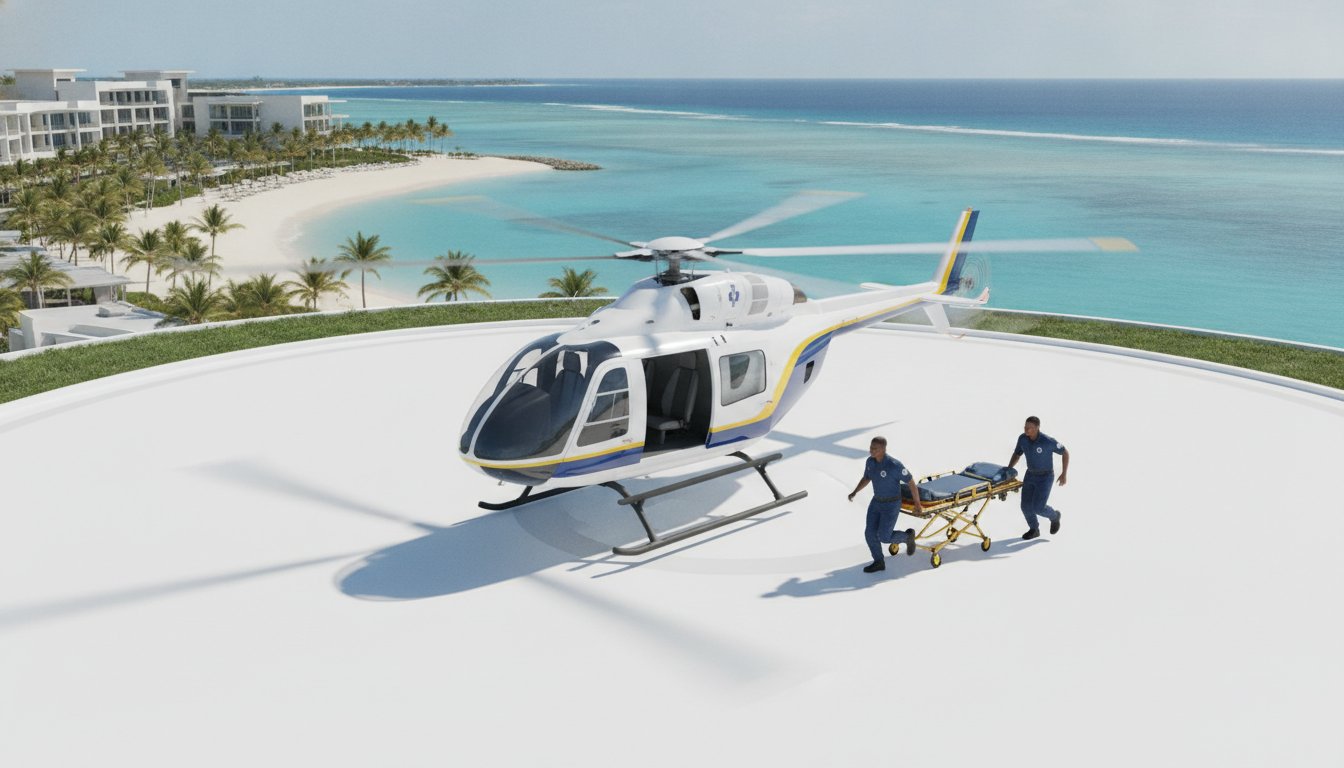
A sudden medical crisis on a remote island isn’t the time to wonder if help can reach you. When minutes define outcomes, the precision of your medical evacuation coordination determines everything from the speed of arrival to the level of care received mid-flight. You aren’t just looking for a transport provider; you’re looking for a synchronized lifeline that bridges the gap between a remote location and a specialized trauma center. It’s a high-stakes operation where every second counts and every detail must be perfect.
It’s natural to feel overwhelmed by the fear of logistical delays or the looming shadow of six-figure transport bills. We understand that in a life-threatening emergency, you need professional composure and immediate action, not administrative confusion. This guide provides the blueprint to master complex air medical logistics. You’ll learn how expert coordination secures seamless transit to critical care without the typical anxieties of unexpected out-of-pocket costs.
We’ll examine the fastest transport methods for remote island chains, the methodical step-by-step operational process, and the membership strategies that ensure your focus remains on recovery rather than logistics. From specialized equipment to direct insurance billing, discover how elite preparation transforms emergency response into a precision-engineered service.
Key Takeaways
- Understand how the synchronized management of aviation and clinical care creates a definitive lifeline for high-acuity patients in remote environments.
- Identify why helicopter logistics are essential for island rescues, providing access to remote resorts and vessels that traditional aircraft cannot reach.
- Master the complexities of medical evacuation coordination to ensure every detail, from flight clearances to hospital admissions, is executed with professional precision.
- Utilize a membership model to bypass administrative delays and secure direct insurance billing for a proactive approach to emergency safety.
- Learn the specialized protocols for seamless patient transfers to Florida trauma centers, including the critical management of US Customs and Border Protection logistics.
What is Medical Evacuation Coordination? Defining the Lifeline
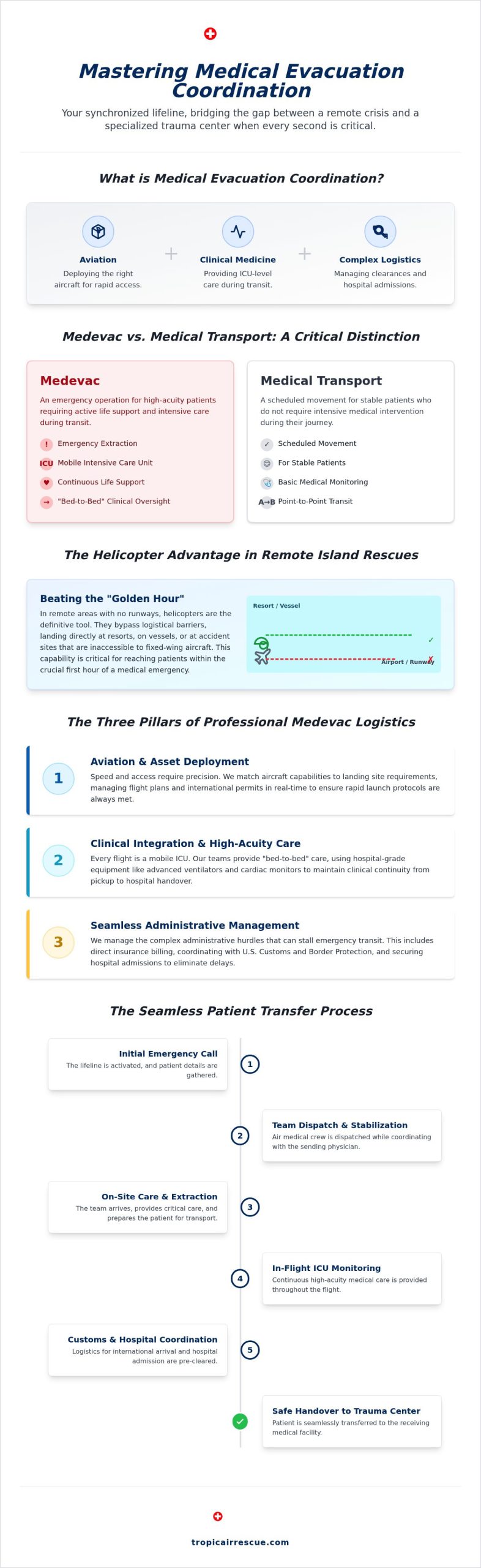
Medical evacuation coordination is the operational engine of emergency response. It isn’t just a flight. It’s a high-stakes synchronization of three distinct disciplines: aviation, clinical medicine, and complex logistics. While a standard transport moves a stable patient, Medical evacuation involves the rapid extraction of high-acuity individuals who require intensive care during transit. This process demands a level of oversight that goes far beyond a simple booking service.
Think of coordination as the central nervous system of the mission. It manages the variables that dictate survival. Flight clearances, medical staffing, and hospital admissions don’t happen in isolation. They’re orchestrated simultaneously to ensure the patient never experiences a gap in critical care. Timing is the ultimate metric. A 2024 analysis found the median time to transfer a patient from an emergency department to a trauma center was 78 minutes. Effective medical evacuation coordination works to compress these windows. It ensures every minute spent in transit is a minute spent receiving life-saving intervention.
The Difference Between Medevac and Medical Transport
The distinction lies in the level of clinical intervention. Medical transport is often a scheduled movement for stable patients. In contrast, a medevac is an emergency operation. It involves active life-support, specialized medical crews, and advanced equipment. Professional coordination ensures a “bed-to-bed” care philosophy. This means medical oversight begins the moment the team reaches the patient and continues until they’re safely admitted to the receiving facility. It’s a continuous chain of clinical responsibility that leaves no room for error.
Why Remote Environments Demand Specialized Coordination
Remote island chains present unique barriers to care. Traditional infrastructure is often absent. This makes the “Golden Hour”—the critical window where medical intervention is most effective—difficult to achieve without specialized aviation assets. Helicopters are the definitive tool here. They bypass the limitations of runways, landing directly at resorts, private vessels, or remote sites. Coordination in these environments requires precise geographical knowledge and the ability to mobilize assets that can navigate terrain fixed-wing aircraft cannot reach. For members, this medical evacuation coordination is the difference between a logistical stalemate and a successful recovery.
The Three Pillars of Professional Medevac Logistics
Professional medical evacuation coordination rests on three foundational pillars. It’s an integrated system where aviation, medicine, and administration operate as a single unit. Without this synergy, the mission risks critical delays. Efficiency isn’t just a goal; it’s a requirement for survival. Elite coordination ensures that these three elements move in lockstep, transforming a complex logistical puzzle into a streamlined rescue operation.
Aviation and Asset Deployment
Speed requires the right tool. Coordination centers must match aircraft capabilities to specific landing site requirements. In island chains, this often means choosing helicopters over fixed-wing assets to access remote resorts or private vessels. Dispatchers manage flight plans and international airspace permits in real-time. They ensure rapid launch protocols are met, moving from initial alert to lift-off with disciplined speed. Every second saved on the tarmac is a second gained for clinical intervention.
Clinical Integration and High-Acuity Care
Medicine in the air is a specialized discipline. Coordination starts with the sending physician to stabilize the patient before transport begins. Teams must adhere to high acuity medical flight standards. This involves standardizing hospital-grade equipment for air transit, including advanced ventilators and cardiac monitors. Every helicopter acts as a mobile intensive care unit. This ensures clinical continuity from the moment of contact until the final handover at a specialized facility.
The final pillar is administrative management. Coordination teams manage the complex hurdles that often stall emergency transit. This includes handling insurance authorizations and securing hospital admissions before the aircraft even leaves the ground. 24/7 dispatch centers provide real-time tracking and constant communication with receiving facilities. By managing direct billing to health insurers for members, the system eliminates financial friction during a crisis. For those living or traveling in remote areas, securing an annual membership ensures these pillars are ready to deploy at a moment’s notice.
Strategic Advantages of Helicopter Coordination in Island Chains
Geography often dictates the success of a rescue mission. In complex island chains, traditional medical transport faces a significant infrastructure deficit. Fixed-wing aircraft require paved runways, often located miles from the patient’s actual position. This creates a dangerous “last mile” gap where the patient must endure long, unstable ground ambulance transfers. Elite medical evacuation coordination eliminates this risk by prioritizing helicopter assets that function independently of airports. When a crisis occurs on a remote cay or a private vessel, the ability to land on-site is the definitive advantage.
Landing Where Others Cannot
The advantages of helicopter medevac in the Bahamas center on total accessibility. Professional coordination allows for direct landings at private resorts, beachside villas, or even the helipads of moving vessels. This capability is vital for yacht and cruise passengers who cannot be easily moved to a mainland facility. By landing directly at the point of injury, the coordination team removes the need for secondary transfers. This reduces the physical stress on high-acuity patients and ensures that intensive care begins the moment the team touches down. It’s a concierge approach to emergency medicine that treats the entire island chain as a viable landing zone.
Speed and Efficiency in Island Environments
Efficiency in 2026 is measured by the “response-to-bed” timeline. While a jet may fly faster between major hubs, the total mission time is often longer due to ground logistics. Helicopters provide superior point-to-point speed in inter-island environments. They utilize vertical takeoff and landing to bypass traffic, terrain, and the logistical bottlenecks of regional airports. This streamlined medical evacuation coordination is particularly effective for inter-hospital transfers where a patient needs a higher level of care immediately.
Data from 2024 suggests that the median time for inpatient transfers can reach 141 minutes when multiple transport modes are involved. Helicopter coordination compresses this window by providing a single, continuous transit solution. There’s no waiting for ground ambulances or airport security clearances. The mission moves from the origin to the receiving Florida trauma center with a singular, disciplined focus. This operational momentum is essential for managing time-sensitive conditions like head or spine injuries, which accounted for over 77% of trauma transfers in recent Florida studies.
Pre-Planning for Critical Care: The Membership Model
In a medical crisis, the primary obstacle to survival isn’t always distance. It’s administration. Effective medical evacuation coordination begins months before an emergency occurs. Waiting until a life-threatening event to arrange transport leads to catastrophic delays. For residents and expats in remote environments, a proactive approach is the only way to ensure a seamless transition to critical care. Establishing a pre-verified link between the patient, the medical team, and the insurer is a vital component of emergency readiness.
A membership model serves as the foundation for this preparation. It moves the complex logistical and financial hurdles from the moment of crisis to a period of calm. This ensures that when an alert is triggered, the focus remains entirely on clinical outcomes rather than paperwork or payment verifications. Membership isn’t just a service agreement; it’s a pre-activated rescue protocol designed for high-stakes environments where every second dictates the patient’s prognosis.
Eliminating Financial Friction
Financial logistics often stall emergency launches. In 2026, the average cost of a helicopter ambulance transport ranges between $25,000 and $60,000. Without a membership, providers may require proof of funds or extensive insurance verification before an aircraft is dispatched. Membership eliminates this friction entirely. It allows for immediate aircraft launch because the financial coordination is already established. For members, the provider manages direct billing to health insurers, ensuring no out-of-pocket expenses for covered services. Visitors to remote islands must prioritize short term medevac coverage to bypass these administrative bottlenecks and secure instant air medical response.
The Concierge Response Protocol
Elite medical evacuation coordination functions with the precision of a concierge service. Members gain access to a 24/7 dedicated rescue line, staffed by dispatchers who already possess the patient’s vital information. Pre-registering medical history allows clinical teams to prepare specialized equipment before the helicopter leaves the tarmac. This level of meticulous preparedness is essential for high-acuity patients who require specific life-support configurations. B2B membership plans extend this security to remote resorts and businesses, standardizing the rescue protocol for guests and employees alike. It creates a “ready-to-act” environment that significantly compresses the response timeline.
Secure your status as a priority patient by enrolling in an Annual Membership to ensure your emergency logistics are handled with professional composure.
Seamless Patient Transfer to Florida Trauma Centers
The final phase of a mission is the most logistically complex. Moving a patient across international borders into the United States trauma system requires a sophisticated level of medical evacuation coordination. It isn’t enough to simply land; the mission must integrate with federal authorities and high-level medical institutions simultaneously. This ensures that the patient’s arrival is expected, legally cleared, and clinically prepared. Professional composure during this stage is what separates a standard flight from an elite life-saving operation.
International Medical Flight Logistics
Managing a Bahamas to Florida helicopter transfer requires precise communication with US Customs and Border Protection (CBP). Medical arrivals are subject to strict repatriation protocols that must be handled with technical precision. Professional coordinators manage all documentation and clearances while the aircraft is still in flight. This proactive approach prevents delays on the tarmac that could compromise patient stability. Coordination also extends to receiving specialized hospitals, ensuring the facility is fully prepared for the patient’s specific acuity level upon touchdown.
The Final Mile: Hospital Admission
Clinical continuity is the priority during the patient transfer to Florida trauma centers. The flight coordinator acts as the vital bridge between the aircraft and the trauma team. They secure a receiving bed and provide a comprehensive clinical handover to specialist surgeons and ICU staff. This process follows strict inter-hospital transfer protocols to ensure no data or time is lost during the transition. It’s a disciplined handover designed to instill immediate confidence in the receiving medical team.
A 2025 study of a Florida Level 1 trauma center found that inter-facility transfers constituted 32.1% of all trauma admissions. This high volume necessitates an elite level of medical evacuation coordination to ensure the patient is directed to the most appropriate facility. By matching patient needs to the correct trauma level, coordinators help manage the risk of secondary overtriage. Once the handover is complete, the focus shifts to the patient’s family. We provide clear information on the next steps for care and recovery within the Florida medical system, ensuring a seamless experience from the island clinic to the hospital bed.
Master Your Emergency Readiness
Effective emergency response is a product of meticulous preparation rather than chance. You’ve seen how the integration of aviation logistics and clinical care creates a definitive lifeline for those in remote island environments. By prioritizing specialized helicopter assets, you eliminate the dangerous “last mile” ground transfers that often stall critical care. Professional medical evacuation coordination ensures that every variable, from international flight clearances to hospital admissions, is managed with disciplined precision. It’s a synchronized effort designed to protect your health when every second counts.
A membership model removes the administrative and financial friction that can delay a life-saving launch. Don’t wait for a crisis to navigate complex insurance hurdles or proof-of-fund requirements. Secure a concierge air-medical service that offers zero out-of-pocket expenses for members and direct coordination with elite Florida trauma centers. Our specialized helicopter fleet is engineered for remote island access, ensuring we reach you where others cannot. Take the proactive step to protect yourself and your family today. Secure your peace of mind with a Tropic Air Rescue Membership. Your safety is our primary mission; we’re always ready to respond.
Frequently Asked Questions
What is the role of a medical evacuation coordinator?
A medical evacuation coordinator acts as the mission’s central commander, synchronizing aviation, clinical care, and administrative logistics. They manage flight clearances, secure receiving hospital beds, and organize specialized medical crews. This role is essential for effective medical evacuation coordination, ensuring that every logistical hurdle is cleared before the aircraft touches down. Their primary objective is to maintain clinical continuity while compressing the timeline between the initial alert and hospital admission.
How long does it take to coordinate an emergency medical flight?
Coordination begins immediately upon receipt of an alert, with the goal of launching an aircraft within minutes. For members, pre-verified medical and insurance data allows for near-instant dispatch. While non-member transfers can face delays due to financial verification, elite coordination teams utilize standardized rapid-launch protocols to minimize downtime. The exact timeline depends on current asset location and weather conditions, but the process is engineered for high-stakes speed and operational efficiency.
Will my standard travel insurance cover medical evacuation coordination?
Standard travel insurance coverage varies significantly and often requires complex pre-authorizations that can delay emergency transit. Most policies cover some form of evacuation, but they rarely include the specialized medical evacuation coordination required for remote island extractions or direct helicopter landings. Membership models bypass these administrative bottlenecks by providing a pre-negotiated response protocol. This ensures that the coordination process starts immediately without waiting for a third-party adjuster to approve the flight.
Can a helicopter land at my remote location or private vessel?
Yes, helicopters are specifically selected for their ability to land at resorts, private villas, and the helipads of vessels at sea. Unlike fixed-wing aircraft, helicopters don’t require paved runways or airport infrastructure. This “point-to-point” capability is a core advantage in island chains, allowing medical teams to reach patients directly at the site of injury. Coordination teams verify landing zone safety in real-time to ensure a secure extraction from virtually any location.
What medical equipment is available during a coordinated evacuation?
Every helicopter is configured as a mobile intensive care unit, equipped with advanced life-support technology. This includes hospital-grade ventilators, cardiac monitors, defibrillators, and infusion pumps. The equipment is standardized to meet high-acuity medical flight requirements, ensuring that intensive care continues uninterrupted during transit. Coordination teams match the onboard equipment and medical staff to the patient’s specific clinical needs, providing a level of care equivalent to a modern trauma center.
How are inter-hospital transfers to Florida managed from the Bahamas?
Inter-hospital transfers are managed through a disciplined handover protocol that links the sending clinic with a Florida Level 1 trauma center. Coordinators handle all international flight clearances and US Customs and Border Protection documentation while the patient is in transit. This process ensures that a specialized trauma team is standing by upon arrival. By managing the clinical and legal logistics simultaneously, the coordination team maintains a seamless chain of care across international borders.
What is the difference between a medical flight and a private charter?
A medical flight is a specialized clinical operation, whereas a private charter is a standard transportation service. Medical flights include advanced life-support equipment and a dedicated team of flight nurses or paramedics trained in aerospace medicine. Private charters lack the clinical infrastructure and regulatory clearances required to transport high-acuity patients. Coordination for a medical flight involves intensive clinical oversight and hospital integration that a standard charter service cannot provide.
How does direct insurance billing work for medevac members?
Direct insurance billing is a concierge benefit that eliminates out-of-pocket expenses for members during a crisis. The coordination team works directly with your health insurer to handle all claims and authorizations on your behalf. Because your insurance data is pre-registered, the provider can verify coverage instantly and launch the mission without requesting a deposit. This financial synchronization is a critical component of the membership model, allowing you to focus entirely on medical recovery.