


Every day, 17 people lose their lives while waiting for a donor organ. In the high-stakes world of transplant surgery, the greatest enemy isn’t distance. It’s the “ischemic clock” that begins ticking the moment an organ is recovered. You understand that even the most skilled surgical team is limited by the viability of the tissue they receive. The logistical complexity of moving life-saving grafts across the Bahamas and into major trauma centers often feels like a race against an invisible, unforgiving deadline.
This article explores how elite helicopter organ transport services utilize point-to-point precision to eliminate the “last mile” delays inherent in traditional airport transfers. You’ll discover how specialized aviation technology and coordinated critical care logistics by providers like Tropic Air Rescue are redefining the standard for organ preservation in 2026. We’ll examine the technical protocols that minimize cold ischemia time, the advantages of rotary-wing aircraft in remote island environments, and the “always ready” fleet readiness required to bridge the gap between donor and recipient.
Key Takeaways
- Understand the clinical impact of Cold Ischemia Time and why minimizing the window between recovery and transplant is the primary factor in graft success.
- Identify why specialized organ transport services using helicopters provide a definitive advantage by landing directly at hospital helipads, bypassing ground traffic and airport bottlenecks.
- Compare transport modalities to determine when rotary-wing speed and point-to-point precision become non-negotiable for inter-island or cross-border missions.
- Establish a reliable protocol for coordinating with international trauma centers to ensure seamless customs clearance and immediate surgical readiness.
- Explore how membership-based logistics provide medical facilities with priority fleet access and simplified administrative processes through direct insurance billing.
The Critical Window: Why Timing Defines Organ Transport Success
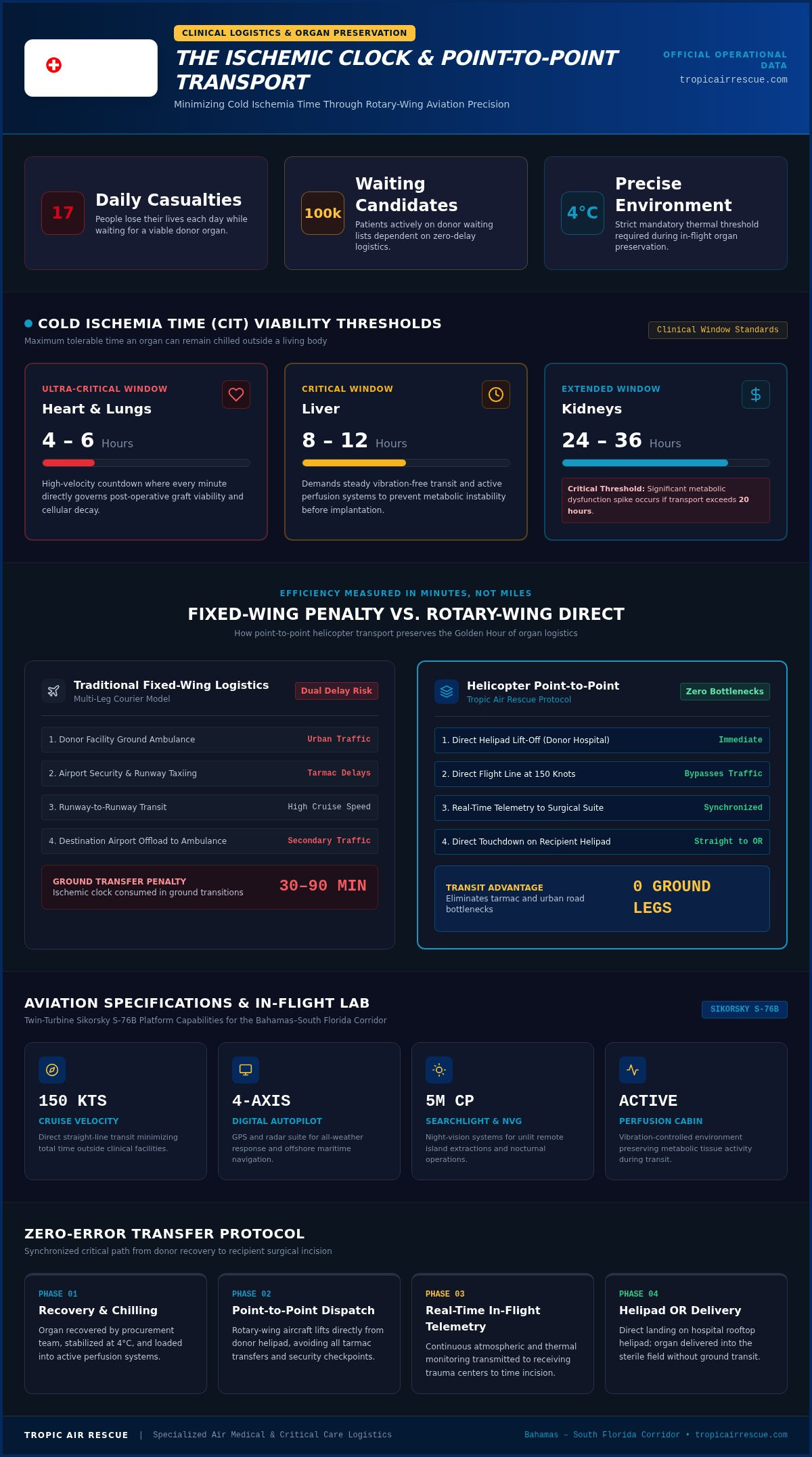
Every transplant mission is a race against cellular decay. When a donor heart is recovered, the surgical team enters a high-velocity countdown where every second of transit directly impacts post-operative survival rates. Success depends on the absolute minimization of the time an organ spends outside a living body. In this high-stakes environment, elite organ transport services don’t just provide transit; they manage a fragile biological timeline. Failure isn’t merely a logistical delay. It’s a discarded organ and a lost opportunity for one of the 100,000 candidates currently on waiting lists.
Cold Ischemia Time is the primary barrier to successful transplantation. This clinical window represents the duration an organ remains chilled and without a blood supply. According to 2026 standards, the thresholds for viability are unforgiving. Hearts and lungs require transplantation within 4 to 6 hours. Livers remain viable for 8 to 12 hours, while kidneys can last 24 to 36 hours. However, for donor kidneys, exceeding a 20-hour window results in a significant spike in metabolic dysfunction. The psychological weight of these numbers is felt by every member of the transplant chain, from the procurement team to the waiting recipient.
Managing Cold Ischemia Time in Transit
Modern logistics utilize more than just static cold storage. Advanced perfusion systems keep organs metabolically active during flight, but these machines require a stable, controlled environment. Helicopter transport provides a vibration-controlled cabin that protects sensitive equipment better than traditional ground vehicles. Flight crews monitor atmospheric pressure and internal temperatures constantly. Maintaining a precise 4°C environment is mandatory. Any deviation can lead to cellular damage that surgeons cannot repair in the operating room.
The Logistical Chain of Life-Saving Transfers
A zero-error process begins at the donor facility and ends in the recipient’s surgical suite. Traditional courier models often suffer from “hidden delays” such as airport security, runway taxiing, or urban traffic. These bottlenecks consume the “Golden Hour” of organ logistics. By utilizing point-to-point helicopter delivery, teams bypass the ground transfers that usually plague fixed-wing flights. Redundant communication suites allow pilots to provide real-time telemetry to the receiving hospital. This coordination ensures the recipient is prepped and ready the moment the aircraft touches down on the helipad.
Helicopter Logistics: Maximizing Efficiency in Life-Saving Deliveries
The efficiency of specialized organ transport services is measured in minutes, not miles. While fixed-wing aircraft offer high cruise speeds, they are tethered to runways. This creates a dual ground transfer penalty. An organ must be loaded into an ambulance, driven to an airport, transferred to the plane, and then undergo the same process at the destination. These transitions consume 30 to 90 minutes of the ischemic clock. Helicopters eliminate these bottlenecks by providing point-to-point delivery. Landing directly on a hospital helipad ensures the organ moves from the donor facility to the recipient surgical suite without ever touching a tarmac or a traffic jam.
The 2026 fleet utilizes advanced twin-turbine platforms like the Sikorsky S-76B to maintain operational reliability. These aircraft are equipped with 4-axis digital autopilot systems and comprehensive GPS/radar suites. This technology allows for all-weather response and offshore navigation, which is critical for the Bahamas-South Florida corridor. When every second counts, the ability to fly a direct line at 150 knots while bypassing urban congestion is the most effective way to protect organ viability. Facilities that prioritize speed often choose specialized air medical memberships to ensure priority fleet dispatch during time-sensitive procurement windows.
Onboard Technology for Organ Viability
Modern cabin configurations are designed as mobile laboratories. Climate-controlled storage units maintain a precise 4°C environment, while advanced telemetry systems provide real-time tracking to receiving surgical teams. This transparency allows hospitals to time recipient incisions with flight approach to the minute. On the flight deck, pilots utilize 5-million candlepower searchlights and night-vision systems to ensure safety during nocturnal missions or extractions from unlit remote locations. These tools ensure that the “Always Ready” status isn’t just a slogan but a technical reality.
Remote Landing Capabilities
Fixed-wing aircraft cannot reach the remote islands or clinics that often serve as procurement sites. Many of these locations lack paved runways or the infrastructure required for traditional medical jets. Helicopters bridge this gap. By landing in confined spaces or at small regional clinics, they bring elite organ transport services to underserved areas. This capability expands the donor pool by making it logistically feasible to recover organs from locations that were previously considered too distant or inaccessible. In the regional medevac network, the ability to land at the bedside and take off for a trauma center is a non-negotiable advantage.
Comparing Transport Modalities: When Helicopter Transit Is Non-Negotiable
Selecting the correct modality for organ transport services is a clinical decision as much as a logistical one. While ground transport is suitable for short distances under 50 miles in low-traffic conditions, it fails in the complex maritime corridors of the Bahamas. Similarly, fixed-wing aircraft appear faster on paper but fall victim to the “last mile” bottleneck. For transfers within a 150- to 200-nautical-mile radius, helicopters provide the only point-to-point solution that maintains the integrity of the ischemic clock. Elite organ transport services must prioritize this direct access to ensure the highest probability of graft success.
Fixed-Wing vs. Helicopter: The Speed Paradox
Airspeed is often a deceptive metric. A light jet may cruise at 450 knots, but it requires a 60- to 90-minute ground transport penalty on each end of the flight. This includes ambulance loading, airport security, and runway taxiing. In contrast, a helicopter launches directly from a hospital helipad and lands at the receiving trauma center. This eliminates the dual ground legs and typically saves 30 to 90 minutes of total transit time. For thoracic organs like the heart or lungs, this saved time is the difference between a successful transplant and graft failure. You can review a detailed analysis of these factors in our guide on helicopter vs fixed wing medevac.
Regional Logistics and Geographic Barriers
Ground ambulances cannot cross open water. In the Bahamas, where medical facilities are spread across an archipelago, air medical assets are the primary link in the national transplant network. Helicopters provide the unique ability to land at remote clinics or offshore locations where no runway exists. This “Direct-to-Trauma-Center” advantage is essential for international transfers into Florida. It ensures that organs and surgical teams clear customs and reach the operating theater without the delays of a commercial airport terminal. Understanding the nuances of trauma air transport is vital for facility coordinators managing these high-acuity missions.
The cost-benefit analysis of helicopter logistics favors the clinical outcome. Rotary-wing assets are significantly more efficient than chartering jet aircraft for short-haul distances under 150 miles. This efficiency stems from the elimination of secondary ground ambulance fees and airport handling charges. More importantly, the reduction in cold ischemia time protects the long-term viability of the graft. Precision is the ultimate economy in critical care logistics.
Operational Protocols: Coordinating Seamless Organ Transfers Between Facilities
Precision in organ transport services relies on a unified operational briefing that begins long before the Sikorsky S-76B leaves the pad. Before the rotors turn, the flight crew aligns with transplant surgeons and Organ Procurement Organization (OPO) teams to synchronize timelines. This coordination ensures the flight plan accounts for specific clinical requirements, such as altitude restrictions for certain perfusion systems or specialized cabin temperatures. Every mission follows a rigid, modular checklist designed to eliminate human error during high-stress transitions between facilities. It’s this level of preparation that allows a team to respond within minutes of a procurement call.
During the most critical phases of transit, the crew maintains a “Sterile Cockpit” protocol. This aviation standard restricts all non-essential communication, ensuring absolute focus on flight safety and the continuous monitoring of organ telemetry. The medical crew remains vigilant, tracking the environment within the climate-controlled storage units. Once the delivery is complete, the team finalizes meticulous chain-of-custody documentation. This post-delivery reporting provides the receiving surgical team with a transparent record of the organ’s environment, including temperature logs and vibration data, throughout the entire journey.
Inter-Hospital Coordination Framework
The hand-off between local medical staff and the flight crew is a critical vulnerability point in the transplant chain. Standardized protocols are essential to manage these transitions without consuming the ischemic clock. The flight nurse and paramedic take over clinical responsibility at the bedside or in the procurement suite, maintaining high-acuity care standards throughout the transfer. For a deeper look at these procedures, see our guide to coordinating inter-hospital medical transfers. This framework ensures that the “Always Ready” status doesn’t just remain a slogan but translates into a seamless movement of life-saving tissue.
International Logistics and Trauma Centers
Moving organs across maritime borders into Florida requires pre-cleared logistics with international trauma centers and customs agencies. Direct insurance billing is a vital component of this framework, as it removes the administrative friction that could otherwise stall a time-sensitive mission. In 2026, the standard protocol for international medical flight coordination requires real-time digital customs pre-clearance integrated with flight telemetry to bypass traditional terminal delays. This ensures that the aircraft moves directly from the island procurement site to the specialized US trauma center helipad. To secure these advanced logistics for your medical facility, consider establishing a B2B membership plan to guarantee priority response and streamlined administrative processing during emergency events.
Tropic Air Rescue: Elite Specialized Organ Delivery and Critical Care
Tropic Air Rescue operates at the intersection of aviation precision and clinical excellence. The mission is defined by a single objective: the safe, rapid delivery of life-saving organs across the Bahamas-Florida corridor. In the high-stakes environment of 2026, specialized organ transport services require more than just speed. They demand a disciplined, “always ready” approach to logistics. Every mission utilizes twin-turbine Sikorsky S-76B helicopters, which are configured as mobile critical care suites. These aircraft carry advanced life-support equipment specifically tailored to maintain organ viability, ensuring that the biological integrity of the graft is protected from take-off to touchdown.
The operational philosophy centers on a concierge model. This isn’t a generic utility; it’s an elite partnership designed for medical facilities and families who require the highest standards of care. Membership provides a definitive advantage through priority dispatch. When a procurement window opens, members receive immediate fleet allocation. Administrative delays are eliminated through direct insurance billing. This protocol ensures that the focus remains entirely on the clinical mission rather than financial logistics. It’s a specialized solution for those who value meticulous preparedness and operational excellence.
A Concierge Approach to Medical Aviation
Positioning a service as the elite choice for regional medical logistics requires more than just advanced hardware. It requires a dedicated commitment to the patient experience. For second-home owners and expats, a concierge air medical service provides a vital safety net. It guarantees that high-acuity transport is available without the friction of traditional medical charters. The membership model ensures that the fleet is staged and ready for rapid deployment to remote island locations, bridging the gap between isolated clinics and specialized trauma centers.
Securing Future Readiness
Medical facilities often partner with Tropic Air Rescue for recurring organ transport services to establish a reliable emergency protocol. This proactive approach minimizes the complexity of coordinating multiple jurisdictions during a crisis. An annual air rescue membership offers long-term security for organizations and individuals alike. It transforms reactive emergency response into a managed, professional operation. To secure specialized logistics for your facility or family, contact Tropic Air Rescue for membership inquiries and priority fleet access.
Securing the Future of Regional Organ Logistics
Precision in organ transport services is a clinical necessity that demands more than just speed. It requires the elimination of every avoidable delay. By bypassing the airport bottlenecks typical of fixed-wing transit, point-to-point helicopter delivery protects the fragile viability of donor organs. You’ve seen how advanced avionics and disciplined coordination with Florida trauma centers ensure that life-saving tissue reaches the recipient within the critical ischemic window. Operational excellence is the only standard that matters when lives are on the line.
Our advanced 2026 helicopter fleet is staged and ready to respond to the most complex procurement missions. Through direct insurance billing and professional logistics management, we provide a seamless bridge between regional medical facilities. It’s time to elevate your emergency readiness with a dedicated partner that values meticulous preparedness above all else. Take the proactive step to protect your facility and family. Secure Priority Medical Logistics with a Tropic Air Rescue Membership today. Meticulous preparation ensures that when the call comes, you’re ready to act with absolute confidence.
Frequently Asked Questions
How fast can an organ transport service be dispatched?
Dispatch occurs within minutes of a procurement notification for established members. The fleet maintains an “always ready” status to ensure priority response during time-sensitive windows. Because organ viability depends on minimizing cold ischemia time, the coordination process is streamlined to bypass administrative delays. This rapid activation is a core benefit of the membership model, allowing surgical teams to synchronize their schedules with the flight’s arrival.
What is the primary advantage of using a helicopter for organ transport over a plane?
The primary advantage is point-to-point precision that eliminates the “last mile” delay. Unlike fixed-wing aircraft that require secondary ground ambulance transfers at both ends, helicopters land directly on hospital helipads. This saves between 30 and 90 minutes of total transit time. In the context of organ transport services, this reduction in the ischemic clock significantly improves the long-term success rates of the transplant.
Can organ transport services operate across international borders?
Yes, these services specialize in international transfers between the Bahamas and Florida trauma centers. The coordination involves pre-cleared customs protocols and direct communication with receiving facilities to ensure a seamless transition. By utilizing advanced avionics and offshore navigation suites, the flight crew maintains a direct line of transit. This ensures that life-saving organs bypass commercial airport terminals and move directly to the surgical theater.
How is organ viability maintained during a medical flight?
Viability is maintained through climate-controlled storage units and advanced perfusion systems that keep organs metabolically active. The helicopter cabin is configured to provide a stable environment with continuous temperature monitoring. Medical crews track telemetry in real-time, ensuring the internal environment remains at a precise 4°C. These technical safeguards protect the biological integrity of the tissue throughout the high-velocity transit across the regional corridor.
Who coordinates the logistics between the donor and recipient hospitals?
Logistics are managed through a unified coordination framework involving the flight crew, Organ Procurement Organizations, and hospital surgical teams. The process begins with a comprehensive pre-flight briefing to align all parties on the clinical timeline. This collaborative approach ensures that every transition is managed with zero-error precision. The flight crew takes clinical responsibility at the bedside, maintaining high-acuity care standards until the hand-off is complete.
Does insurance cover the cost of specialized organ transport services?
Insurance typically covers these costs when managed through a concierge membership model. The service utilizes direct insurance billing, which means members incur no out-of-pocket expenses for emergency transfers. By accepting insurance payouts as full payment, the administrative friction that often stalls critical missions is removed. This allows medical facilities to focus on the clinical success of the transplant rather than the financial logistics of the flight.
What happens if weather conditions are poor during an organ transfer?
Advanced avionics and 4-axis digital autopilot systems allow for reliable all-weather response. The fleet is equipped with comprehensive radar and GPS suites designed for complex maritime environments. While safety is always the primary concern, these technological capabilities ensure that missions can proceed in conditions that would ground less specialized aircraft. This technical readiness is essential for maintaining the “Always Ready” status required for emergency organ logistics.
Are organ transport services available for private individuals or only hospitals?
These organ transport services are available to both medical facilities and private individuals through various membership plans. Annual and short-term subscriptions are tailored to provide peace of mind for residents, second-home owners, and expats. While hospitals use these services for inter-hospital transfers, individuals secure priority access to ensure they can be moved to specialized trauma centers if an emergency arises. This dual-access model strengthens the regional medical network.