

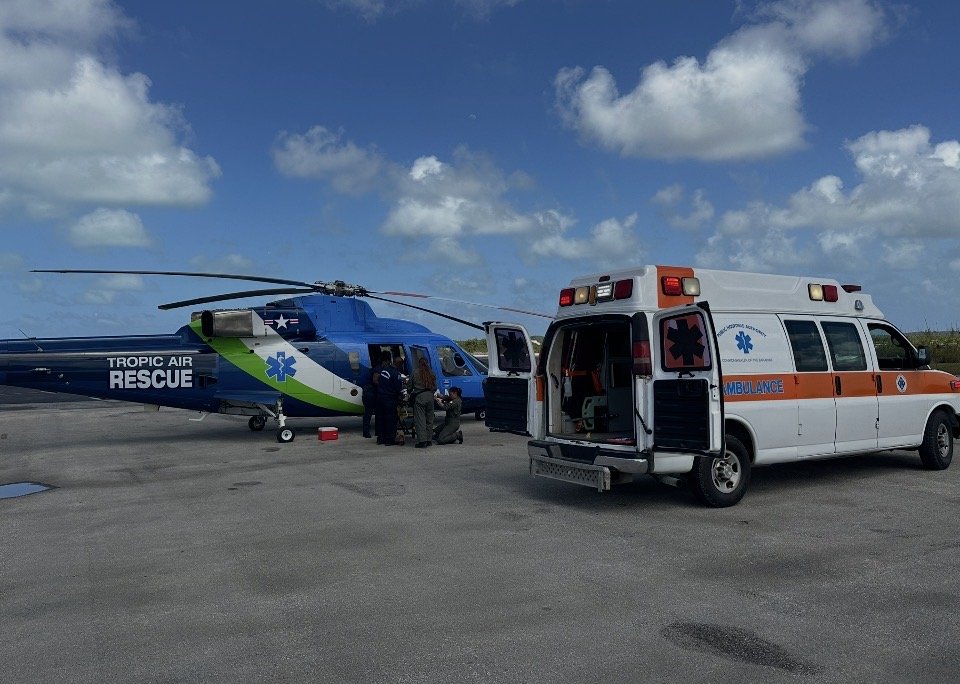
Imagine you’re on a remote island when your child suffers a sudden, critical injury. In that moment, the distance between a Bahamian beach and a Florida Level I trauma center feels like an ocean of impossible logistics. Securing a pediatric medical evacuation Bahamas shouldn’t depend on whether the nearest island has a functional runway or if you can manage a massive upfront wire transfer. Speed is the only currency that matters during the Golden Hour. Traditional fixed-wing planes often require time-consuming ground transfers that a critically ill child simply can’t afford.
You’re likely feeling the weight of these variables. You’re worried about the limitations of local specialized care and the staggering costs of emergency air transport. In a crisis, you need professional composure and precise execution, not administrative hurdles. This 2026 guide explains how to navigate the complex logistics of emergency pediatric air transport from the Bahamas to specialized US centers. We’ll preview how membership-based helicopter services provide point-to-point speed, expert medical care during transit, and a path to zero out-of-pocket expenses through coordinated insurance billing.
Key Takeaways
- Helicopters provide the fastest bedside-to-bedside solution, bypassing the ground ambulance delays and airport requirements associated with fixed-wing aircraft.
- Specialized flight crews utilize Advanced Life Support (ALS) systems specifically configured for pediatric physiology and critical care stabilization during transit.
- Securing a membership is essential for a pediatric medical evacuation Bahamas to ensure immediate dispatch and eliminate the need for massive upfront wire transfers.
- The concierge membership model facilitates direct billing to your health insurer, removing financial stress through a no out-of-pocket expense framework.
- Seamless logistical coordination ensures your child is transported directly from remote Bahamian locations to specialized Level I pediatric trauma centers in Florida.
Understanding Pediatric Medical Evacuation in the Bahamas
Pediatric medical evacuation Bahamas refers to the specialized air-medical transport of infants and children who require urgent, higher-level care unavailable at their current location. This isn’t a standard flight. It involves mobile intensive care units specifically configured for pediatric physiology. In the Bahamas, geography dictates the logistics. Many islands lack functional runways for fixed-wing aircraft, making helicopter transport the only viable link between a remote location and a Florida-based Level I trauma center.
This service is a critical component of air medical services in the region. The “Golden Hour” represents the critical period following a traumatic injury where immediate surgical or medical intervention significantly improves survival rates. For children, this window is even more narrow. Common triggers for an emergency dispatch include severe physical trauma, acute respiratory distress, or the need for specialized neonatal surgery.
Why Local Care May Require a US Transfer
While local facilities in the Bahamas offer pediatric emergency care, they may lack the specific sub-specialists or advanced surgical equipment required for complex cases. For children with complex needs, specialized practices like Blue Cactus Neurology provide the expert diagnosis and management that families rely on when local resources are insufficient. Florida-based pediatric trauma centers act as the regional standard for care. When a pediatric medical evacuation Bahamas is initiated, we prioritize the fastest bedside-to-bedside solution. An inter-hospital transfer becomes necessary when a child is stable enough for flight but requires resources only available in the United States. Our service coordinates these transfers directly with receiving Florida hospitals, ensuring a seamless handoff between medical teams.
A medical crisis involving a child is a high-stakes event. We maintain professional composure to provide reassurance through expert preparation. Our concierge model prioritizes family unity. Whenever weight and balance regulations permit, one parent is encouraged to fly with their child. We establish clear communication protocols between the flight crew and the family to ensure you’re informed of every clinical development during transit. This elite, specialized approach treats the evacuation as a mission-critical operation rather than a simple utility. Membership is required to access these full benefits, including direct insurance billing and the logistical coordination that removes the administrative burden from the family during their most stressful moments.
Specialized Care: Equipment and Pediatric Flight Teams
A generic air ambulance is insufficient for the unique needs of a child. Pediatric medical evacuation Bahamas requires a mobile intensive care unit (ICU) specifically tailored for smaller patients. Standard adult equipment often lacks the precision sensors and calibrated settings necessary for pediatric physiology. Our aircraft are equipped with Advanced Life Support (ALS) systems that function as an extension of a hospital’s pediatric unit. This ensures that expert medical care begins the moment your child is secured on the aircraft, rather than waiting until they reach a Florida trauma center.
Hospital-Grade Technology in the Air
Medical transport for infants requires specialized ventilators and cardiac monitors calibrated to detect subtle changes in a child’s vital signs. For the youngest patients, temperature-controlled neonatal environments are essential to maintain stability during transit across the Gulf Stream. For a pediatric medical evacuation Bahamas, specialized ventilators must manage smaller tidal volumes to prevent lung injury. Following the U.S. Embassy guidance on medical evacuations, parents should verify that their chosen provider uses aircraft capable of sustaining high-acuity care throughout the flight. Pediatric Advanced Life Support (PALS) certification ensures that medical flight crews are trained in the specific physiological and pharmacological protocols required to treat children during critical medical emergencies.
The Role of the Pediatric Flight Medic
Flight medics in these missions possess expertise far beyond basic emergency services. They manage high-acuity cases, including respiratory failure and neurological trauma, while maintaining professional composure in a high-pressure environment. These experts coordinate directly with receiving trauma surgeons in Florida to provide real-time clinical updates before landing. Managing a child’s pain and stress at high altitudes is a priority; it requires both pharmacological precision and a disciplined approach to patient comfort. This level of expert medical care during transit is a hallmark of our elite service. To ensure your family is protected against the logistical hurdles of such a crisis, consider the security offered by an annual membership.
Helicopter vs. Fixed-Wing for Pediatric Emergencies
The choice of aircraft determines the speed of clinical recovery. While jets offer high cruise speeds, they are tethered to infrastructure. In the context of a pediatric medical evacuation Bahamas, helicopters provide a definitive advantage by eliminating the airport-to-hospital delay. Fixed-wing transport requires multiple patient handoffs: from the site of injury to a ground ambulance, then to an airport, and finally another ground transfer upon arrival in Florida. Every handoff increases the risk of clinical instability for a critically ill child. We prioritize a bedside-to-bedside solution that keeps the patient in a controlled environment from the point of pickup to the trauma center helipad.
Helicopters offer a point-to-point capability that jets cannot match. This is critical considering only 61 of the 700 islands in the Bahamas possess functional runways. Our aircraft land directly at remote resorts, private residences, or even on private vessels. This flexibility ensures that specialized medical care is never interrupted by logistical gaps. By bypassing the need for traditional airports, we maintain a continuous chain of care that focuses entirely on the patient’s physiological needs rather than regional infrastructure limitations.
The ‘Last Mile’ Problem in the Out Islands
Fixed-wing aircraft lose significant time during ground transfers. A child injured on a remote island might face a 45-minute ambulance ride to the nearest runway before a jet can even begin its mission. Helicopters solve this “last mile” problem by landing at the point of injury. This efficiency is explored further in our guide on Helicopter vs Fixed Wing Medevac: The Critical Choice. By removing the ground ambulance variable, we dramatically shorten the total time to a Florida trauma center. This speed is essential for maintaining the integrity of the Golden Hour.
Speed and Stability for Critical Patients
Total transit time is the only metric that matters in a pediatric medical evacuation Bahamas. While a jet flies faster in the air, the helicopter often reaches the destination hospital sooner because it lands directly on the hospital helipad. Modern rotorcraft also utilize advanced vibration-dampening technology to reduce patient stress and maintain monitor accuracy during flight. We employ advanced avionics to maintain safe operations across the island chain, even in challenging maritime conditions. This precision ensures that the transit is both rapid and stable. Our pilots and medical teams operate with the disciplined focus of an elite unit, prioritizing the safety and stability of your child above all else.
Step-by-Step: Coordinating a Pediatric Evacuation
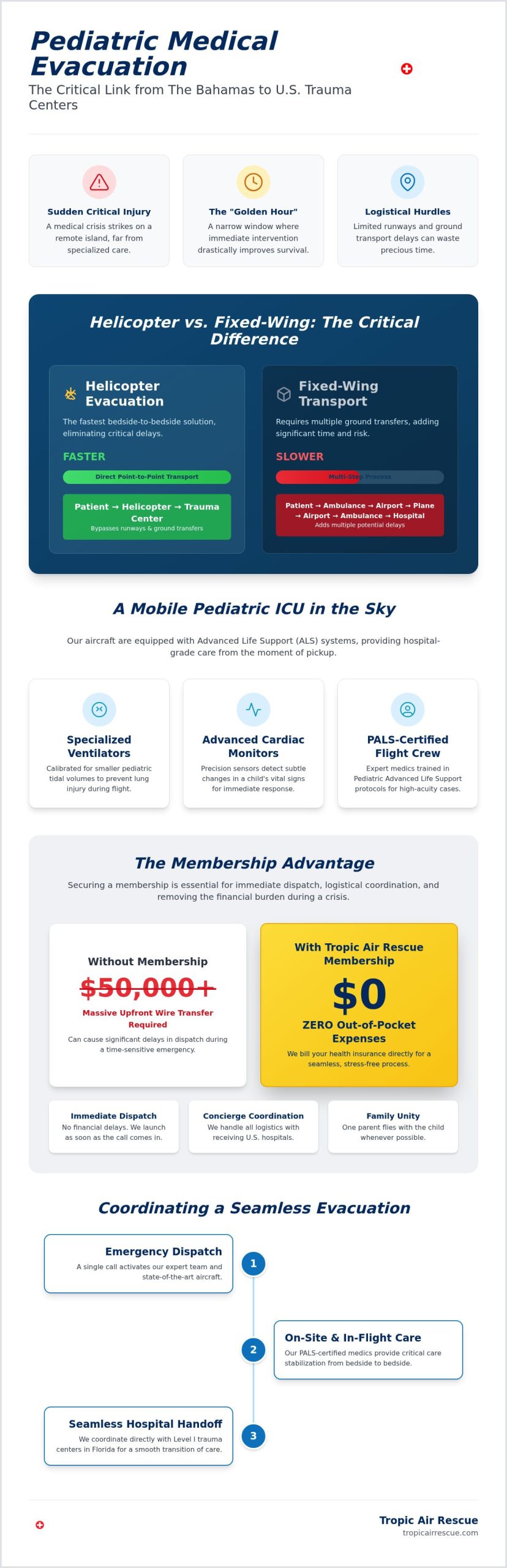
Initiating a pediatric medical evacuation Bahamas is a high-stakes logistical operation that begins with a single point of contact. Once the emergency call reaches our 24/7 dispatch center, a clinical assessment is conducted immediately to determine the child’s acuity level. While the flight crew prepares for takeoff, the logistical team begins coordinating with receiving Florida trauma centers. We utilize a “scoop and run” protocol for pediatric trauma, where stabilization occurs within the hospital-grade environment of the helicopter during transit. This method ensures that the child reaches definitive surgical care without unnecessary delays on the ground.
Immediate Actions for Parents
Parents play a vital role in the initial minutes of coordination. You should have the child’s medical history, approximate weight, and insurance details ready for the dispatch team. Preparing a child for the flight environment involves staying calm; your composure helps regulate their physiological response to stress. For a deeper look at the operational side of these missions, refer to our Trauma Air Transport: The 2026 Emergency Guide. Having these details prepared allows the flight crew to focus entirely on clinical intervention and geographical precision.
Navigating International Medical Logistics
Crossing international borders during a medical crisis requires meticulous preparedness. Flight crews handle customs and immigration clearance mid-flight, communicating directly with U.S. Customs and Border Protection to ensure a priority landing. This proactive approach eliminates administrative bottlenecks upon arrival in Florida. Our dispatch team maintains constant communication with Florida trauma centers to ensure a surgical bay is ready upon the helicopter’s landing. If ground transport is required from a landing pad to a specific hospital wing, we coordinate that transition before the aircraft even leaves Bahamian airspace.
The arrival at a U.S. pediatric trauma center is a disciplined handover. The flight medic provides a comprehensive clinical briefing to the receiving trauma team, ensuring no data is lost during the transition. This elite level of coordination is only possible through a structured membership model that removes the need for insurance verification or payment delays during the mission. To secure this level of protection for your family, you can apply for an annual membership today.
Securing Your Family: Medevac Membership Benefits
Emergency pediatric medical evacuation Bahamas is a logistical feat that requires immediate financial clearance. For non-members, the industry standard often requires an upfront payment or wire transfer ranging from $50,000 to over $100,000 before an aircraft is dispatched. This administrative hurdle creates a dangerous delay during the Golden Hour. Membership eliminates this barrier. It functions as a prerequisite for our elite air medical access, ensuring that clinical necessity, not financial verification, dictates the speed of our response.
Eliminating Financial Uncertainty
The core benefit of membership is our “No Out-of-Pocket” framework. This concierge model allows us to bill health insurers directly on behalf of our members. While competitors may claim to limit costs, our structure is designed to remove the financial variable entirely from the emergency equation. This coordination prevents the massive upfront expenditures typical of non-member flights, where families are often forced to pay out-of-pocket and seek reimbursement later. For those visiting the islands temporarily, we offer specialized coverage detailed in our Short-Term Medevac Guide for Island Travelers. By securing a membership, you ensure that the focus remains on expert medical care rather than administrative hurdles.
Peace of Mind for Bahamas Residents and Visitors
We provide a range of membership tiers to suit different residency profiles. Annual plans are tailored for residents, second-home owners, and expatriates who require year-round vigilance. For visitors, short-term plans provide the same elite protection for the duration of their stay. Our concierge support extends to B2B partnerships with luxury resorts and family offices, offering a seamless layer of protection for high-net-worth individuals and their guests. This proactive approach to safety provides a definitive solution for complex logistical challenges in the region.
A membership is more than an insurance supplement; it’s a commitment to meticulous preparedness. It guarantees that a pediatric-configured helicopter and a PALS-certified crew are available the moment they are needed. This level of exclusivity ensures that your child receives the fastest bedside-to-bedside transport to a Florida trauma center. Don’t wait for a crisis to navigate these logistics. Secure your family with a Tropic Air Rescue membership today to ensure immediate transport without financial stress.
Securing Immediate Access to Pediatric Trauma Care
The distance between a Bahamian island and a Florida trauma center is measured in minutes, not miles. Relying on traditional airport-based logistics during a crisis introduces unnecessary risk. A successful pediatric medical evacuation Bahamas requires a point-to-point helicopter solution that bypasses infrastructure delays. By prioritizing bedside-to-bedside transport, you ensure your child remains under the care of PALS-certified flight crews throughout the entire transit.
Membership provides the definitive solution to the logistical and financial hurdles of emergency air transport. We maintain an advanced life-support equipped fleet and coordinate directly with premier Florida trauma centers to ensure a seamless clinical handover. Our concierge model includes direct insurance billing for members, eliminating the stress of massive upfront wire transfers during a medical emergency. You can travel with confidence knowing that an elite medical guardian is always ready. Protect your family with an elite air rescue membership today.
Frequently Asked Questions
Is pediatric medical evacuation covered by standard travel insurance?
Standard travel insurance policies vary significantly and often only cover transport to the nearest “appropriate” facility. They may require you to pay tens of thousands of dollars out-of-pocket before seeking reimbursement. A membership with Tropic Air Rescue removes this financial barrier by facilitating direct billing to your health insurer. This ensures that a pediatric medical evacuation Bahamas is initiated based on clinical urgency rather than your ability to fund a wire transfer during a crisis.
Can parents fly in the helicopter with their child during the evacuation?
Yes, we prioritize keeping families together whenever possible. Our helicopters are configured to accommodate one parent alongside the medical flight crew and the patient. This is subject to the pilot’s final assessment of aircraft weight and balance to ensure safety during the transit across the Gulf Stream. Maintaining parental presence helps stabilize the child’s emotional state, which is a critical component of high-acuity pediatric care during high-stakes emergency operations.
What specialized equipment is available for infants and neonates?
Our fleet functions as a mobile intensive care unit equipped with Advanced Life Support (ALS) systems specifically calibrated for small children. This includes neonatal-capable ventilators, cardiac monitors with pediatric sensors, and temperature-controlled environments to maintain stability for infants. These tools allow our PALS-certified crews to manage respiratory distress or trauma with the same precision found in a US hospital. This specialized equipment is a core part of our elite concierge medical service.
How long does it take to get from the Bahamas to a Florida trauma center?
Total transit time depends on your specific island location, but helicopters provide the fastest bedside-to-bedside solution. By landing directly at your location and flying straight to a Florida trauma center helipad, we eliminate the hours lost to ground ambulance transfers and airport logistics. Our aircraft are designed for speed and geographical precision, ensuring your child reaches definitive care within the critical Golden Hour window required for the best possible clinical outcomes.
What happens if my child doesn’t have a passport during an emergency?
Flight crews coordinate directly with U.S. Customs and Border Protection (CBP) mid-flight to manage emergency entry requirements. While having a passport is ideal, medical emergencies are treated with priority. We provide CBP with the necessary clinical and biographical data before the aircraft enters U.S. airspace. This proactive coordination ensures a seamless transition to the receiving trauma center without administrative delays at the border, allowing the medical team to remain focused on the patient.
How do I activate a pediatric medevac if I am a member?
Members have access to a 24/7 dedicated emergency dispatch line. Upon receiving your call, our team immediately initiates a clinical assessment and flight planning. You should be prepared to provide the child’s medical history, current condition, and your precise location. Because membership details are already on file, we bypass the financial verification stage. This allows for the immediate dispatch of a pediatric medical evacuation Bahamas mission to your specific island location.
Which Florida hospitals do you coordinate with for pediatric cases?
We maintain direct coordination with premier Level I and Level II pediatric trauma centers in Florida. Our dispatch team communicates with the receiving hospital’s clinical staff to ensure a surgical bay or ICU bed is prepared before the helicopter lands. This seamless transition between our flight crew and the hospital’s trauma surgeons is a hallmark of our concierge service. We prioritize facilities that offer the highest level of specialized pediatric sub-specialty care available.
Is a helicopter safer than a jet for a sick child?
Safety is measured by the reduction of clinical risk during transit. For a sick child, every patient handoff between ambulances and aircraft increases the risk of instability. Helicopters are the definitive choice for the Bahamas because they provide a single, continuous environment from the point of injury to the hospital helipad. This eliminates the vibration and stress of multiple ground transfers. Our aircraft utilize advanced avionics and vibration-dampening technology to ensure a stable and safe flight environment.