

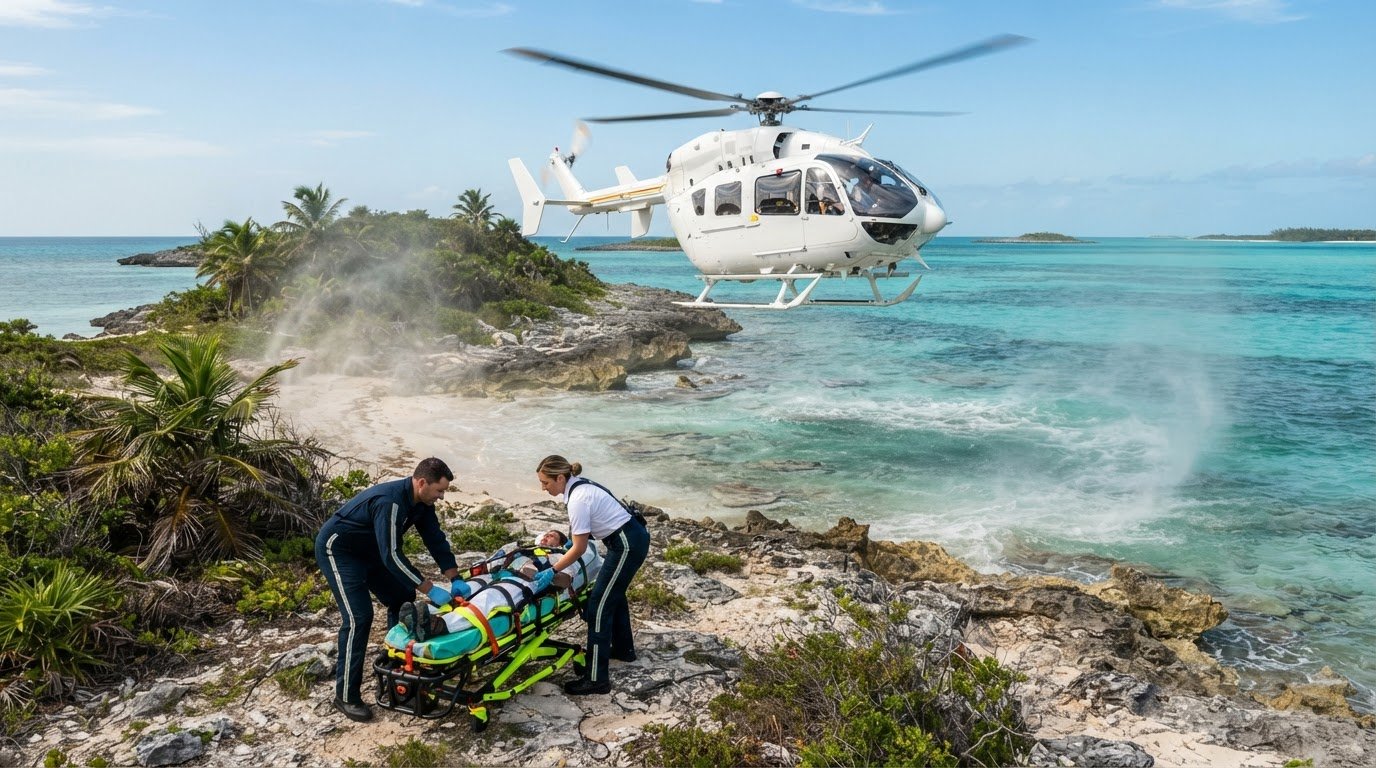
When a critical trauma strikes an isolated shoreline, the nearest local clinic is rarely your safest destination. Survival hinges on pre-cleared, point-to-point air medical extraction rather than improvised transit. Effectively managing medical emergencies in remote locations demands disciplined execution long before the alarm sounds. You already recognize the severe risks: catastrophic transit delays that exhaust the critical golden hour, austere environments with limited life-support monitoring, and complex maritime logistics that stall evacuation when minutes matter most.
This guide delivers the definitive framework to master the critical protocols, stabilization tactics, and emergency evacuation logistics needed to survive medical crises in isolated environments. We examine standardized field triage to stabilize patients on scene, explore runway-independent helicopter pathways directly to tertiary trauma centers, and detail proactive membership models that secure direct-billing coverage before an incident unfolds.
Key Takeaways
- Mastering standardized MARCH PAWS triage creates the vital stabilization window needed when managing medical emergencies in remote locations.
- Point-to-point helicopter transports eliminate multi-hour ground transfers by landing directly at private compounds, vessels, and remote shorelines.
- Establishing pre-surveyed landing zones and precise coordinate protocols minimizes aviation transit intervals to advanced trauma centers.
- Dedicated emergency membership plans resolve administrative friction, deploying hospital-grade flight ICUs with direct-billing coordination.
Understanding the Realities of Managing Medical Emergencies in Remote Locations
Remote medical emergency management entails delivering high-acuity clinical care far beyond municipal response grids. In isolated settings, distance amplifies clinical risk. A routine fracture, localized infection, or acute abdominal distress escalates quickly when municipal emergency services cannot respond. When managing medical emergencies in remote locations, logistical friction dictates patient outcomes. Offshore vessels, private estates, and isolated maritime compounds lack standard hospital infrastructure. Survival depends entirely on prompt on-scene intervention, clear operational command, and rapid point-to-point evacuation pathways.
The Golden Hour Window in Austere Environments
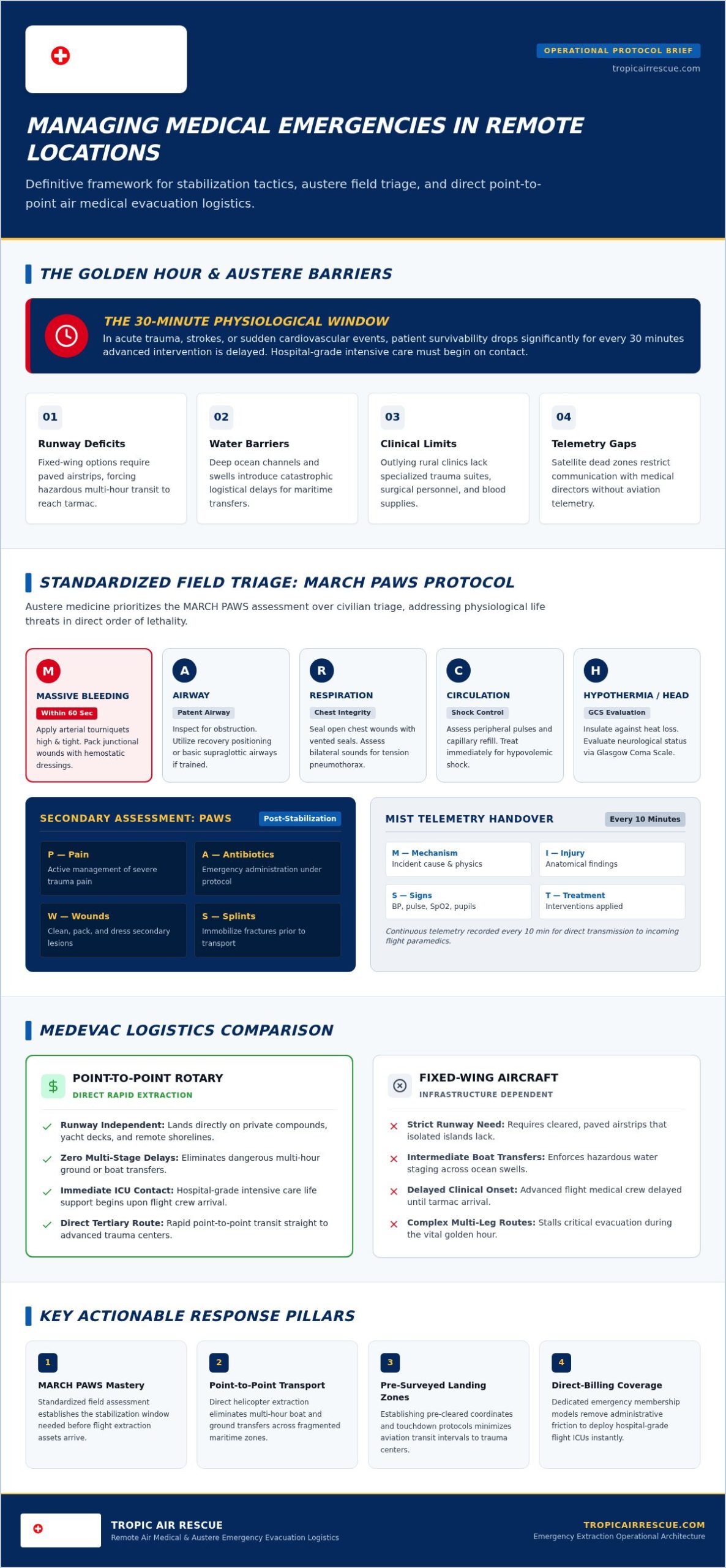
Physiological shock does not wait for logistical coordination. In acute trauma, strokes, or sudden cardiovascular events, patient survivability drops significantly for every thirty minutes advanced intervention is delayed. Established Wilderness medicine principles stress that definitive care must begin long before hospital arrival. In remote island outposts, basic medical kits prove insufficient against internal hemorrhaging or severe neurological deficits. Patients require hospital-grade intensive care units configured directly inside high-performance aircraft, ensuring advanced life support commences the moment flight medical crews make contact.
Geographic and Logistical Isolation Barriers
Fragmented archipelagos and maritime boundaries create severe operational barriers that ground-based emergency services cannot bridge:
- Runway deficits: Fixed-wing transport requires cleared, paved airstrips, enforcing hazardous multi-hour boat transfers just to reach an operational tarmac.
- Water barriers: Deep channels and open ocean swells introduce catastrophic delays for maritime vessel transfers.
- Clinical limitations: Outlying rural clinics rarely possess specialized trauma suites, surgical personnel, or continuous blood product stores.
- Telemetry gaps: Satellite dead zones restrict continuous contact with topside medical directors unless specialized aviation systems are deployed.
Circumventing these structural hurdles requires eliminating multi-stage transfers. Point-to-point helicopter aviation extracts patients directly from private compounds, beaches, or yacht decks, converting complex geographic delays into a single, swift survival corridor.
Immediate Protocols: On-Site Triage and Stabilization When Isolated
Panic compounds trauma. When managing medical emergencies in remote locations, surviving the first twenty minutes requires strict execution of an algorithmic sequence. You cannot wait for an aircraft to land before initiating advanced stabilization. Field responders must manage catastrophic physiological threats immediately, gather critical baseline telemetry, and activate private emergency extraction assets in parallel.
Step-by-Step Triage and Patient Assessment
Austere medicine prioritizes the MARCH PAWS assessment protocol over conventional civilian triage. Responders must methodically address life threats in order of lethality:
- Massive hemorrhage: Apply arterial tourniquets high and tight; pack junctional wounds with hemostatic dressings within sixty seconds.
- Airway: Inspect for obstruction; establish a patent airway using recovery positioning or basic supraglottic airways if trained.
- Respiration: Seal open chest wounds with vented chest seals; assess for bilateral breath sounds to detect tension pneumothorax.
- Circulation: Assess peripheral pulses, capillary refill, and internal bleeding signs; treat immediately for systemic hypovolemic shock.
- Hypothermia and Head: Insulate the patient against environmental heat loss and evaluate neurological responsiveness using the Glasgow Coma Scale.
- PAWS: Address secondary concerns: manage Pain, administer emergency Antibiotics under protocol, dress Wounds, and immobilize Splinted fractures.
Document vital signs every ten minutes. Record oxygen saturation, radial pulse quality, blood pressure, and pupil reactivity to construct a clear MIST report (Mechanism, Injury, Signs, Treatment) for incoming flight paramedics.
Deploying Topside Medical Direction and Telemedicine
Austere stabilization requires expert oversight. Activate dedicated satellite voice or broadband data networks to link on-site personnel directly with emergency medicine physicians. Transmit real-time high-fidelity biometric data, photographic wound documentation, and cardiac rhythms to medical direction teams.
Receiving flight physicians provide direct clinical control, authorizing emergency prescription administration, fluid resuscitation strategies, and specific stabilization tactics while flight assets mobilize. Securing rapid launch clearance through a short-term or annual membership ensures advanced life support flight crews mobilize instantly while on-scene personnel focus entirely on the patient.
Evaluating Medevac Solutions: Point-to-Point Helicopters vs Fixed-Wing Aircraft
Aviation platform selection dictates clinical survival. When managing medical emergencies in remote locations, assuming all air ambulance options perform equally is a catastrophic planning error. Fixed-wing airframes offer range and cruising velocity, but their operational rigidity introduces severe handicaps in island environments. Paved runways do not exist on isolated beaches, private compounds, or marine vessels. Understanding the structural advantages of helicopter medevac transforms an unpredictable crisis into a streamlined clinical transfer directly to advanced surgical facilities.
The Elimination of Double-Transport Delays
Fixed-wing medevac inevitably introduces a cumbersome, four-stage journey. Responders must load an unstable patient into a ground ambulance or boat, navigate unpaved terrain to a regional airstrip, load the patient into the aircraft, land at a distant airport, and reload the patient into another ambulance for final hospital delivery. This multi-stage transfer doubles handling frequency and exposes patients with fragile hemodynamic status or spinal trauma to dangerous mechanical jolts.
Point-to-point helicopter transport eradicates this operational drag:
- Direct extraction: Rotors touch down directly on estate grounds, manicured clearings, or coastal sandbars.
- Zero vehicle handoffs: Patients are secured onto the flight stretcher once, remaining stabilized inside the cabin until arrival at a hospital helipad.
- Bypassed infrastructure: Flight trajectories cut directly across ocean barriers and traffic congestion, preserving vital minutes during evolving neurological crises.
Advanced Life Support (ALS) Flight Configurations
A helicopter interior is not merely a transport vehicle; it is an airborne intensive care unit. Critical patients require sophisticated interventions while airborne. Modern rotary air medical cabins house transport ventilators capable of invasive pressure-control settings, multi-channel infusion pumps for vasoactive drips, and comprehensive point-of-care blood chemistry analyzers.
Aviation medical teams mirror this technological standard. Every mission deploys dual-clinician crews consisting of experienced critical care flight nurses and flight paramedics trained in surgical airway management and cardiac pacing. When coordinating an inter-hospital transfer across international corridors, this level of clinical capability ensures patient stability remains continuous as flight coordinators streamline cross-border customs declarations and receiving trauma center clearances.
Designing an Actionable Remote Emergency Medical Response Plan
Crisis response fails when procedures are improvised under pressure. For private estates, maritime compounds, and luxury vessels, managing medical emergencies in remote locations requires an institutionalized emergency action plan. Survival rests on transforming unpredictable geography into mapped operational coordinates. Pre-identifying physical evacuation corridors, stocking advanced trauma supplies like automated external defibrillators and arterial tourniquets, and establishing explicit team responsibilities ensure rapid reaction when seconds count.
Helicopter Landing Zone (LZ) Preparation
Rotary aircraft require clear, hazard-free touchdown environments meeting civil aviation parameters. Designating and maintaining an emergency landing zone before an incident occurs prevents aborted approaches and ground delays. Follow these core site specifications:
- Dimensions and clearance: Secure a flat, level area measuring at least 100 by 100 feet. Ensure the area remains free of power lines, trees, masts, and standing water.
- Surface integrity: Select firm turf, reinforced concrete, or packed sand capable of supporting multi-ton airframes with a maximum ground slope of under five degrees.
- Debris mitigation: Clear the entire perimeter of loose patio furniture, covers, and foreign object debris that powerful rotor downwash can launch into projectiles.
- Visual guidance: Position non-blinding perimeter illumination or chemical light sticks at four corners. Angle vehicle headlamps across the surface rather than up toward incoming flight crews, and deploy a windsock or secure streamer to indicate instant wind velocity.
Emergency Communications and Command Chain
Fragmented communication paralyzes emergency operations. Austere environments require dedicated redundant satellite terminals loaded with direct flight-operations hotlines. Appoint a single on-site incident commander to speak directly with incoming flight coordinators, eliminating conflicting reports from multiple bystanders.
Assign separate personnel to direct patient care and perimeter security. Run bi-annual operational drills to test satellite links, review medical gear inventories, and walk LZ perimeters. To integrate immediate rotary extraction into your private estate or vessel protocol, enroll in an annual membership or B2B membership plan to ensure dedicated flight assets deploy the moment an alert sounds.
Securing Comprehensive Air Medical Coverage Before Crisis Strikes
Administrative friction can be just as dangerous as physical isolation. When managing medical emergencies in remote locations, relying on conventional travel insurance policies introduces unacceptable risk. Standard insurance underwriters often require real-time pre-authorization from adjusters operating thousands of miles away before releasing medical evacuation assets. Negotiating coverage parameters while a patient decompensates is an unviable strategy. Pre-arranged aeromedical memberships eliminate administrative hesitation completely, ensuring immediate dispatch based strictly on clinical need.
Why Standard Travel Insurance Fails in Air Crises
Commercial travel policies are engineered to minimize underwriter liability rather than expedite rapid clinical extraction. During emergencies, claims adjusters demand extensive medical documentation, local physician attestations, and proof of domestic facility inadequacy before authorizing transport. This bureaucratic delay routinely squanders critical hours.
Policy language often contains restrictive fine print:
- Terrain exclusions: Policies frequently exclude direct rotary evacuations from private compounds, remote coastlines, or offshore vessels.
- Reimbursement barriers: Families are routinely forced to wire massive upfront cash sums before an aircraft mobilizes, leaving them to navigate exhausting claims processes later.
- Secondary approvals: Underwriters often insist on stabilizing patients in substandard outlying clinics rather than funding direct transfer to a comprehensive trauma center.
Tropic Air Rescue: Dedicated Concierge Aeromedical Security
Tropic Air Rescue eliminates the gap between medical emergency and critical care transport. Operating specialized helicopters configured with hospital-grade intensive care units, our flight teams launch without waiting for commercial insurance authorizations. Direct communication channels between dispatchers and field personnel bypass traditional insurance bottlenecks.
Our model safeguards your financial security alongside your physiological survival. We operate a direct billing structure that negotiates directly with your health insurance provider after the evacuation. We do not issue direct patient invoicing, accepting insurance recoveries as full payment for emergency transports.
Securing the right coverage depends on your operational profile. Leisure visitors and seasonal guests can activate short term medevac coverage aligned with specific travel itineraries. Estate owners, expatriates, and frequent travelers maintain continuous readiness with an annual air rescue membership. Commercial operations and maritime charter fleets leverage custom B2B membership plans to secure seamless emergency protection across their entire workforce.
Commanding Remote Medical Readiness
When vast geography separates a critical patient from specialized surgical intervention, disciplined preparation determines survival. Successfully managing medical emergencies in remote locations requires replacing improvised transit with rapid, institutionalized aviation protocols. Standardizing on-scene MARCH PAWS triage and establishing pre-surveyed landing zones safeguard vital physiological stability when every second counts.
True operational security pairs rigorous field stabilization with dedicated rotary response. Point-to-point helicopter extractions eliminate hazardous ground transfers by landing directly at private compounds, shorelines, and marine vessels. En route, hospital-grade intensive care units operated by dedicated critical care flight paramedics deliver continuous advanced life support directly to the receiving trauma helipad. With direct billing negotiated straight with your health insurance provider, you gain elite aeromedical protection without the risk of direct patient invoicing. Take decisive control of your safety profile before setting out. Secure Your Air Rescue Membership Today and ensure world-class emergency extraction is always within reach.
Frequently Asked Questions
How does a medical helicopter land at a remote location without an airport runway?
Specialized medical helicopters operate with vertical takeoff and landing flexibility, requiring only an unobstructed 100-by-100-foot clearing. Flight crews evaluate aerial hazards, surface firmness, and wind direction before touching down directly on beaches, private lawns, or vessel helipads. By eliminating the necessity for paved airport infrastructure, point-to-point rotary aircraft bypass treacherous maritime transfers and bring advanced critical care assets straight to the patient’s exact coordinates.
Can commercial travel insurance guarantee immediate helicopter medical evacuation?
No. Standard travel insurance policies rarely guarantee rapid dispatch. Adjusters usually require exhaustive clinical reviews, local doctor approvals, and proof of municipal facility failure before authorizing payment. When managing medical emergencies in remote locations, these bureaucratic hurdles waste vital hours. Dedicated aeromedical memberships remove administrative interference, guaranteeing flight mobilization based purely on clinical triage rather than delayed insurance approvals.
What medical equipment is maintained onboard an advanced life support rescue helicopter?
Advanced rescue helicopters function as flying intensive care units. Cabins house multichannel smart infusion pumps, transport ventilators with invasive ventilation modes, multi-parameter vital sign monitors, and advanced cardiac defibrillators. Crews carry emergency blood administration equipment, specialized trauma management supplies, and comprehensive pharmacotherapy. This clinical configuration ensures critical care nurses and flight paramedics maintain hospital-grade life support continuously while airborne.
How much time is saved by choosing direct helicopter medevac over fixed-wing planes?
Direct helicopter medevac saves hours by cutting out secondary ground transit legs. Fixed-wing transport mandates an initial ground or boat ambulance ride to an airport, aircraft staging, flight time, and an additional road ambulance ride to the trauma hospital. Helicopters lift off directly from the incident scene and land straight on the receiving tertiary hospital helipad, compressing complex multi-stage transfers into a single swift flight corridor.
What happens if a patient requires an emergency transfer directly to a trauma center?
When clinical needs exceed local island facility resources, coordinated interhospital transfer services take over immediately. Flight coordination specialists handle flight plans, cross-border customs clearances, and receiving trauma facility acceptance simultaneously. Experienced flight medical crews assume continuous ICU-level bedside monitoring, transferring the patient smoothly into the receiving hospital surgical team without transitional delays or gaps in resuscitation.
Is an emergency medevac membership necessary if I already carry comprehensive health insurance?
Yes. Standard health insurance doesn’t coordinate complex remote aviation logistics or guarantee upfront aircraft deployment. Managing medical emergencies in remote locations requires immediate asset dispatch without credit holds or wiring large deposits. A dedicated membership eliminates operational hesitation, deploying aircraft immediately. Tropic Air Rescue bills your health insurance provider directly following transport and accepts insurance recoveries as payment in full, preventing direct patient invoicing.