


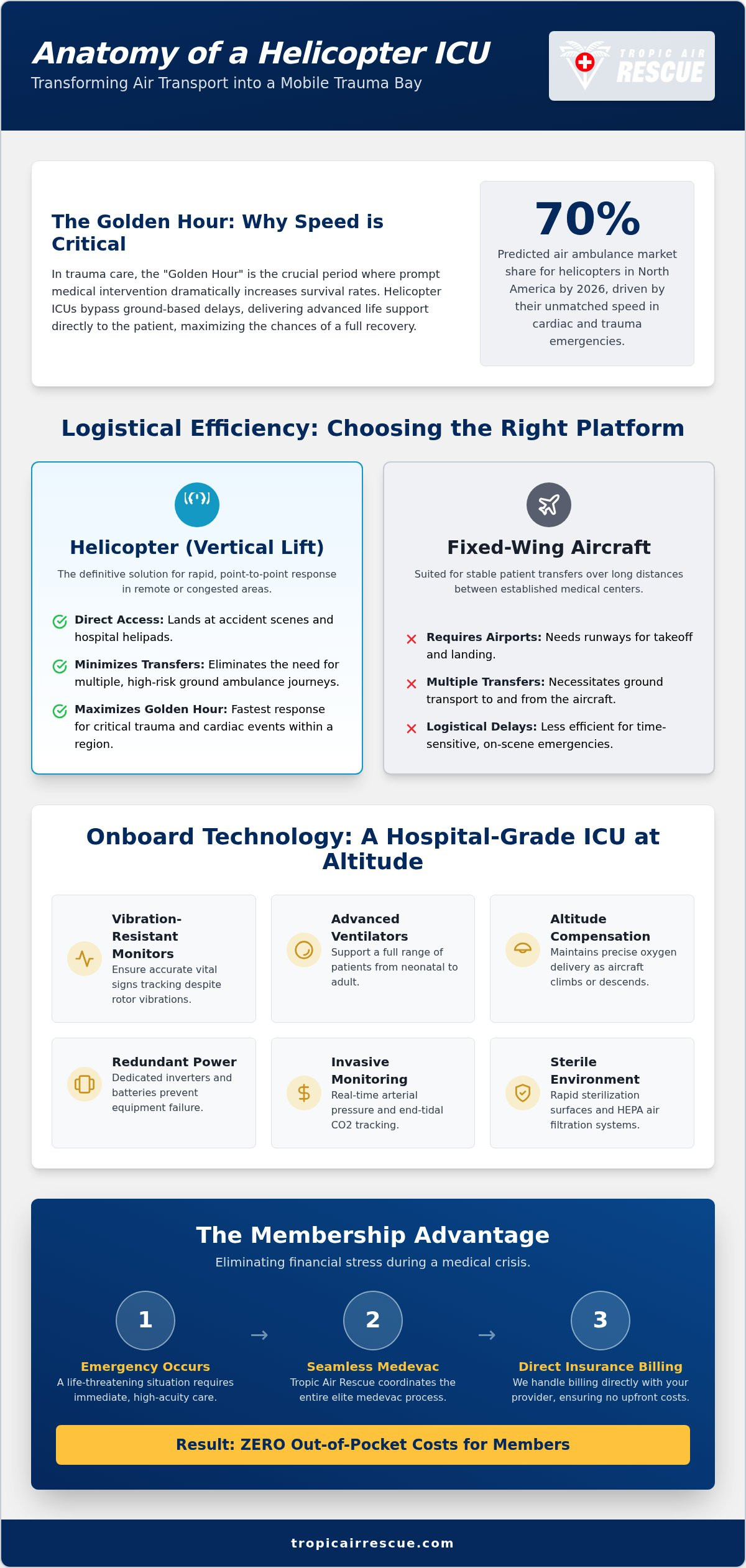
What if the critical difference between a tragic outcome and a full recovery isn’t the skill of the surgeon, but the technology available at 2,000 feet? In a remote emergency, the realization that local facilities can’t handle a complex trauma is a heavy burden. A helicopter intensive care unit serves as a mobile trauma bay, bringing the life-saving capabilities of a hospital directly to the patient’s side. These aircraft are sophisticated clinical environments designed to stabilize and treat patients during high-stakes transit to specialized trauma centers. With helicopters predicted to hold 70% of the air ambulance market share in 2026, they’ve become the definitive solution for rapid medical response.
You’re right to feel that every second counts when advanced life support is required. This guide explores how modern flight technology and specialized medical equipment have transformed air transport into a seamless extension of the ICU. We’ll break down the logistical speed of helicopters compared to fixed-wing alternatives and explain how membership programs ensure you’re never faced with out-of-pocket costs during a crisis. By the end, you’ll understand the elite coordination required to turn a helicopter into a vigilant, high-end guardian for your health.
Key Takeaways
- Identify the advanced medical suite required to maintain a helicopter intensive care unit, including altitude-compensated life support and vibration-resistant monitoring systems.
- Compare the logistical efficiency of vertical lift versus fixed-wing transport to maximize the “Golden Hour” of trauma response in remote regions.
- Review the procedural requirements for high-acuity interhospital transfers, ensuring seamless coordination between local medical teams and Florida trauma centers.
- Learn how membership-based models eliminate financial stress by facilitating direct insurance billing for elite medevac services.
The Anatomy of a Helicopter Intensive Care Unit
A helicopter intensive care unit is a specialized Advanced Life Support (ALS) platform. It functions as a mobile clinical environment, designed to provide continuous, high-acuity care during the most critical phases of medical transit. Standard medical transport often focuses on moving stable patients between facilities. In contrast, a helicopter intensive care unit is equipped to handle life-threatening emergencies where physiological stability is not guaranteed. These units are essential for remote air rescue operations because they deliver the clinical sophistication of a tertiary care center to environments where traditional infrastructure is absent. Elite aircraft are configured to house a full medical crew and an array of life-sustaining technology, ensuring that the transition from the scene to the hospital doesn’t compromise patient safety.
Defining Advanced Life Support (ALS) in the Air
International aviation standards define ALS in the air as the ability to provide invasive monitoring, mechanical ventilation, and advanced pharmacological interventions. Integrating hospital-grade monitoring systems within a compact airframe requires meticulous engineering and logistical precision. Modern Air Medical Services rely on specialized equipment that remains accurate despite the vibrations and pressure changes inherent in flight. This ensures that the patient’s vitals are monitored with the same accuracy found in a stationary ward. An airborne ICU is a seamless extension of the hospital trauma bay.
The Golden Hour: Why Vertical Lift Matters
The “Golden Hour” is the critical window where prompt medical intervention significantly increases survival rates. Helicopters bypass the logistical delays of traditional runways. They land directly at the scene of an accident or on a specific hospital helipad. This vertical lift capability eliminates the need for multiple ground ambulance transfers, which are often the most dangerous part of a journey for a fragile patient. Rapid stabilization at the scene allows the medical crew to manage the patient’s physiology before transport begins. Speed saves lives. Precision sustains them. Industry data confirms that helicopters are predicted to hold a 70% market share in North American air ambulance services by 2026. This dominance is driven by their superior speed in cardiac and trauma events, where every minute saved reduces the risk of long-term morbidity. Specialized aircraft offer the cabin space and power required to maintain these intensive care standards in challenging geographic conditions, bridging the gap between remote locations and world-class trauma centers.
Onboard Medical Technology: Hospital-Grade Systems at Altitude
Maintaining clinical stability at altitude requires more than standard emergency gear. A helicopter intensive care unit utilizes hospital-grade technology specifically hardened for the flight environment. Standard ICU monitors often fail or provide inaccurate data due to rotor vibration frequencies. To counter this, elite aircraft use vibration-resistant mounting systems and altitude-compensated electronics. These devices adjust automatically to changes in barometric pressure, ensuring that oxygen delivery and pressure readings remain precise as the aircraft climbs or descends. It’s a level of technical precision that turns a cabin into a reliable trauma bay.
Power management is equally critical. Flight engineers modify helicopter electrical systems to support a heavy load of life-saving electronics. This involves dedicated power inverters and redundant battery arrays to prevent even a momentary loss of monitoring. The cabin environment is also optimized for safety. Every surface is designed for rapid sterilization, and HEPA filtration systems maintain high air quality. This structured approach creates a disciplined clinical space where medical teams can focus entirely on the patient. For those traveling in remote island chains, securing a Tropic Air Rescue membership ensures this elite medical technology is available the moment a crisis occurs.
Monitoring and Ventilation Capabilities
The core of the airborne ICU is its monitoring suite. Multi-parameter monitors provide real-time tracking of vitals, invasive arterial pressures, and end-tidal CO2. This data is vital for managing patients with complex trauma or cardiac conditions. Advanced mechanical ventilators are a standard requirement. These systems support a full range of patients, from neonatal to adult, providing sophisticated modes like pressure-regulated volume control. Portable blood gas analyzers allow the crew to conduct lab work mid-flight. They make immediate clinical decisions, adjusting medications and ventilator settings based on real-time pH and electrolyte levels.
The Specialized Flight Crew: Physicians and Trauma Nurses
Advanced technology is only effective when managed by experts. A high-acuity helicopter intensive care unit typically utilizes a double-clinician team. This elite configuration often pairs a flight-certified physician with a specialized trauma nurse. Their training is rigorous, focusing on the physiological effects of flight and altitude-based emergencies. This team provides a concierge level of medical attention, coordinating directly with receiving specialists at Florida trauma centers. Safety is the priority. Providers strictly adhere to FAA Regulations for Air Ambulance to ensure crew readiness and operational excellence. This combination of human expertise and hospital-grade hardware ensures that the quality of care remains uncompromising, regardless of the aircraft’s position.
Helicopter vs. Fixed-Wing: Choosing the Right Life Support Platform
Choosing the correct medical platform is a decision that dictates clinical outcomes. While fixed-wing aircraft excel at long-distance, stable transfers, the helicopter intensive care unit is the definitive choice for time-sensitive emergencies. Fixed-wing flights require established airport infrastructure, necessitating two additional ground ambulance transfers at either end of the journey. This “triple-handling” increases patient risk and adds hours to the total transit time. In contrast, the advantages of helicopter medevac in the Bahamas center on the ability to land exactly where the patient is located, providing a direct link to advanced trauma centers.
Logistical precision is the hallmark of elite air rescue. Helicopters operate as a self-contained medical environment that moves with the patient. This eliminates the “dead time” spent waiting for ground transport at a remote airstrip. For high-acuity patients, the physiological stress of being moved between multiple vehicles can cause dangerous spikes in intracranial or blood pressure. By utilizing a helicopter intensive care unit, medical teams maintain a constant clinical environment from the point of injury to the hospital bed. This seamless transition is not just a convenience; it’s a critical safety protocol for the most fragile patients.
Landing Precision in Remote Environments
Helicopters operate independently of paved runways. They land on helipads, beaches, or private clearings directly adjacent to the medical crisis. This “Bed-to-Bed” advantage is vital for patients in remote island chains where airports may be miles away or inaccessible after sunset. Vertical lift also facilitates medevac from yacht Bahamas scenarios. It allows for direct extraction from a vessel’s deck or a nearby support boat, bypassing the need for a slow maritime transfer to shore. This capability ensures that even those at sea have immediate access to world-class medical stabilization.
Speed of Mobilization for Critical Acuity
Response time is measured from the moment of dispatch. Helicopter pre-flight protocols are streamlined for immediate departure. Unlike fixed-wing aircraft, which often require complex flight filing and airport slot coordination, a helicopter can mobilize within minutes. This rapid response is critical for stroke or myocardial infarction, where neuro-protective and cardiac-saving interventions are time-dependent. In inter-island medical transfers, helicopters provide a tactical advantage by leaping over geographic barriers. They turn a three-hour boat journey into a twenty-minute flight. Every minute saved in mobilization translates directly to a better clinical prognosis, making the helicopter the superior choice for acute life support transport.
Navigating the Logistics of High-Acuity Interhospital Transfers
Moving a patient from a local clinic to a specialized trauma center involves more than flight hours. It requires a sophisticated logistical framework. A concierge air medical service manages every variable, from international flight permits to bed-side coordination. This process begins in the communications center. Specialists there coordinate with receiving physicians to ensure the patient’s specific needs are met upon arrival. This proactive approach minimizes delays during an inter-hospital transfer. The goal is a seamless transition that prioritizes clinical safety.
The helicopter intensive care unit serves as the vital link between facilities. It provides a level of monitoring and intervention that matches a stationary ICU, preventing physiological decline during transit. Operations are fast-paced and methodical. Every step follows an operational briefing format to ensure precision. The deployment of a helicopter intensive care unit eliminates the clinical “blind spot” often associated with traditional medical transport. The crew is prepared for high-acuity needs, maintaining a disciplined focus on patient stability.
Coordination with International Trauma Centers
International transfers add layers of complexity. For flights entering the United States, pre-clearing patients with Florida trauma centers is mandatory for immediate admission. This ensures a specialized bed and surgical team are ready the moment the rotors stop. Logistics also include customs and immigration clearance for the crew and patient. Elite providers handle these protocols in real-time, preventing administrative bottlenecks at the border. During the flight, the medical crew utilizes satellite data transmission to send live vitals to the receiving ER. This allows hospital staff to prepare for the specific acuity of the patient before they arrive. Coordination is constant. Response is proactive.
Continuity of Care from Remote Site to Bedside
Maintaining clinical momentum requires a disciplined “handshake” protocol. This involves a formal transfer of care where the flight crew briefs the hospital staff on every intervention performed at altitude. This ensures no information is lost between the remote site and the final bedside. Managing specialized medications and life-support infusions is a core competency of the flight team. They use hospital-grade pumps to maintain precise dosages throughout the journey. It’s vital to maintain zero-gap clinical monitoring during the entire transfer process. This level of vigilance is what defines a high-end medical guardian. Each transition is handled with professional composure to ensure the patient’s safety remains the singular priority.
Ensure your safety by utilizing an inter-hospital transfer protocol designed for elite medical oversight.
Securing Concierge Medevac: The Tropic Air Rescue Advantage
Accessing a helicopter intensive care unit shouldn’t be a financial burden during a life-threatening crisis. While industry data shows that a single 50-mile medevac flight can cost between $25,000 and $40,000, members bypass these staggering costs. Tropic Air Rescue membership benefits center on a “No Out-of-Pocket” model. This system relies on direct billing to health insurance providers, where the service accepts the insurance payment as payment in full. It’s a concierge approach that prioritizes immediate clinical response over administrative delays. Preparation is the only defense against the unpredictable nature of remote emergencies.
Residents and visitors alike require this security. Short-term memberships cater to seasonal travelers, while annual plans provide year-round protection for residents and vessel owners. This proactive preparation ensures that a helicopter intensive care unit is always within reach. In an emergency, members call a dedicated dispatch line to activate a response. There’s no negotiation, no upfront payment, and no confusion. The focus remains entirely on the logistical coordination of life-saving care. You’re securing the services of a vigilant, high-end guardian before the need arises.
Direct Insurance Billing and Membership Security
The direct reimbursement model is a critical safeguard against surprise medical bills. Without membership, patients often face invoices exceeding $50,000 for high-acuity air transport. Membership eliminates this risk by establishing a pre-authorized relationship between the provider and the member. This aligns with federal protections like the No Surprises Act, ensuring that emergency services don’t result in financial ruin. This is especially vital for businesses operating in remote regions. A pre-arranged employee medical evacuation plan Bahamas provides peace of mind for staff and management. It ensures that every team member has a clear path to elite medical facilities without financial liability.
Rapid Response Protocols for Members
Speed is the primary metric of success. Members have access to a 24/7 dedicated dispatch line, ensuring immediate communication with the flight operations center. Because membership data, including medical history and insurance details, is already on file, the triage and deployment process is significantly faster. Dispatchers don’t need to gather basic information during a crisis. They move straight to operational coordination. This commitment to elite medical aviation standards ensures that the aircraft is airborne and en route to the remote site within minutes. It’s a disciplined, methodical approach to safety that values every second of the “Golden Hour.” Membership turns a complex logistical challenge into a streamlined, life-saving response.
Operational Readiness for the Unpredictable
Navigating remote environments requires more than just transport. It demands a mobile clinical environment that maintains hospital standards at altitude. This guide has detailed how the helicopter intensive care unit bridges the gap between isolated sites and specialized trauma centers through advanced technology and elite flight crews. The integration of vertical lift and hospital-grade monitoring ensures that your care begins the moment the team arrives. This eliminates the dangerous delays often associated with traditional airport logistics and multiple ambulance transfers.
True security comes from meticulous preparation. By choosing a membership model, you eliminate the financial anxiety of emergency logistics through direct insurance billing and zero out-of-pocket costs. This elite coordination with Florida trauma centers provides a seamless, disciplined path to recovery during high-stakes medical events. You don’t have to face a crisis alone when a vigilant guardian is already standing by. Professional composure and technical excellence are just one call away.
Secure your peace of mind with a Tropic Air Rescue membership today
Frequently Asked Questions
What equipment is standard in a helicopter intensive care unit?
A standard helicopter intensive care unit carries multi-parameter monitors for real-time tracking of invasive pressures and end-tidal CO2. Advanced mechanical ventilators support patients from neonatal to adult stages. Portable blood gas analyzers allow for mid-flight lab work. Every device is vibration-resistant and altitude-compensated to ensure accuracy during flight. Redundant power systems and specialized inverters support this life-saving electronics suite, maintaining a sterile, organized clinical environment at 2,000 feet.
Can a medical helicopter transport a patient directly to a US hospital?
Yes, elite services coordinate directly with Florida trauma centers for immediate admission. This process includes pre-clearing patients with hospital staff and managing international customs and immigration protocols in real-time. By landing on a hospital helipad, the aircraft bypasses the need for secondary ground ambulance transfers. This direct “bed-to-bed” approach is essential for high-acuity cases where every minute saved in transit directly impacts the clinical outcome.
How does the membership model eliminate out-of-pocket medevac costs?
The membership model utilizes a direct billing system where health insurance providers are billed for the transport. Tropic Air Rescue accepts the insurance payout as payment in full for its members. This eliminates the risk of receiving surprise medical bills that can be financially devastating. By establishing this pre-authorized relationship, members don’t face financial negotiations during a medical crisis. It’s a proactive approach that ensures elite care without out-of-pocket liability.
Is a helicopter faster than a fixed-wing plane for medical evacuation?
For remote emergencies and inter-island transfers, helicopters are significantly faster than fixed-wing planes. They don’t require traditional runways or airport slot coordination, which can add hours to a mission. Helicopters land directly at the scene or on private helipads, eliminating the time-consuming process of moving patients between multiple ground ambulances. Their pre-flight protocols are streamlined for immediate dispatch, providing a tactical advantage in time-sensitive conditions like stroke or cardiac events.
Can a helicopter intensive care unit land on a private yacht or remote island?
Yes, the primary advantage of a helicopter intensive care unit is its ability to land in locations inaccessible to fixed-wing aircraft. This includes private yacht decks, beaches, and remote islands without paved airstrips. This capability allows for direct patient extraction from the point of injury. By bypassing the need for maritime transfers to shore, helicopters provide a faster, safer route to specialized medical facilities for those in isolated maritime or island environments.
What medical personnel are on board during a life support air transport?
High-acuity air transport typically utilizes a double-clinician team to manage complex patient needs. This elite crew often consists of a flight-certified physician and a specialized trauma nurse. Both professionals undergo rigorous training focused on flight physiology and advanced life support protocols. This team provides continuous medical oversight, managing specialized medications and life-support infusions throughout the flight. Their expertise ensures that the level of care matches a stationary hospital ICU during the entire transit.
Does health insurance typically cover the full cost of a medical helicopter?
Health insurance coverage for air medical services varies significantly. While many plans cover a portion of the cost, patients often face substantial out-of-network balances or surprise bills. Membership programs solve this by accepting whatever the insurance company pays as the final amount. This protects members from the financial burden of the remaining balance. It’s a concierge benefit that ensures you don’t have to worry about coverage gaps during a high-stakes emergency.
What is the difference between ALS and BLS air transport?
Basic Life Support (BLS) is designed for stable patients requiring non-invasive monitoring and simple oxygen therapy. Advanced Life Support (ALS) involves a specialized helicopter intensive care unit equipped for high-acuity needs. ALS platforms carry advanced mechanical ventilators, invasive monitoring systems, and a full suite of emergency medications. While BLS focuses on safe transport, ALS provides active clinical intervention and stabilization for patients with life-threatening conditions or complex trauma during the flight.