


In a medical emergency at sea, your yacht’s location is your greatest liability. While the Bahamian waters offer unparalleled isolation, that same distance becomes a fatal barrier when every second counts. You know that local island clinics aren’t equipped for major trauma. Relying on a fixed-wing aircraft that requires a distant runway can waste the critical Golden Hour. Executing a seamless medevac from yacht Bahamas requires more than just a satellite phone; it demands a pre-coordinated strike plan.
This guide provides the definitive operational protocol for yacht captains and owners to bridge the gap between remote turquoise waters and US trauma centers. We’ll outline how to bypass the logistical delays of ground transport and the massive out-of-pocket costs typical of private charters. You’ll learn the specific advantages of helicopter-based extraction, the necessity of membership-based direct insurance billing, and the precise steps to ensure your crew is never stranded without elite medical support. This is the professional standard for maritime safety in the Family Islands.
Key Takeaways
- Master the tactical advantages of helicopter extraction over fixed-wing aircraft to protect the “Golden Hour” in remote maritime environments.
- Learn how to coordinate a medevac from yacht Bahamas by establishing direct communication with a dedicated dispatch center and specialized medical crews.
- Prepare your vessel for rapid response by implementing standardized landing zone protocols and aviation radio procedures.
- Secure a proactive safety standard through short-term or annual memberships that provide a concierge bridge to US trauma centers.
- Eliminate the stress of six-figure upfront costs by utilizing membership-based direct insurance billing for all emergency flights.
Understanding Emergency Airlift Logistics in Bahamian Waters
The geography of the Bahamas presents a unique paradox for yacht owners. While the crystalline waters of the Out Islands offer ultimate privacy, they also create a dangerous gap in medical infrastructure. In a critical event, the distance to a US trauma center isn’t just measured in miles; it’s measured in minutes. This is the reality of the Golden Hour in maritime medicine. Survival and recovery outcomes depend on the speed at which a patient can be stabilized and transported to advanced care. When a vessel is miles from the nearest deep-water port, the only viable solution is a proactive, airborne response.
The Critical Role of Helicopter Medevac
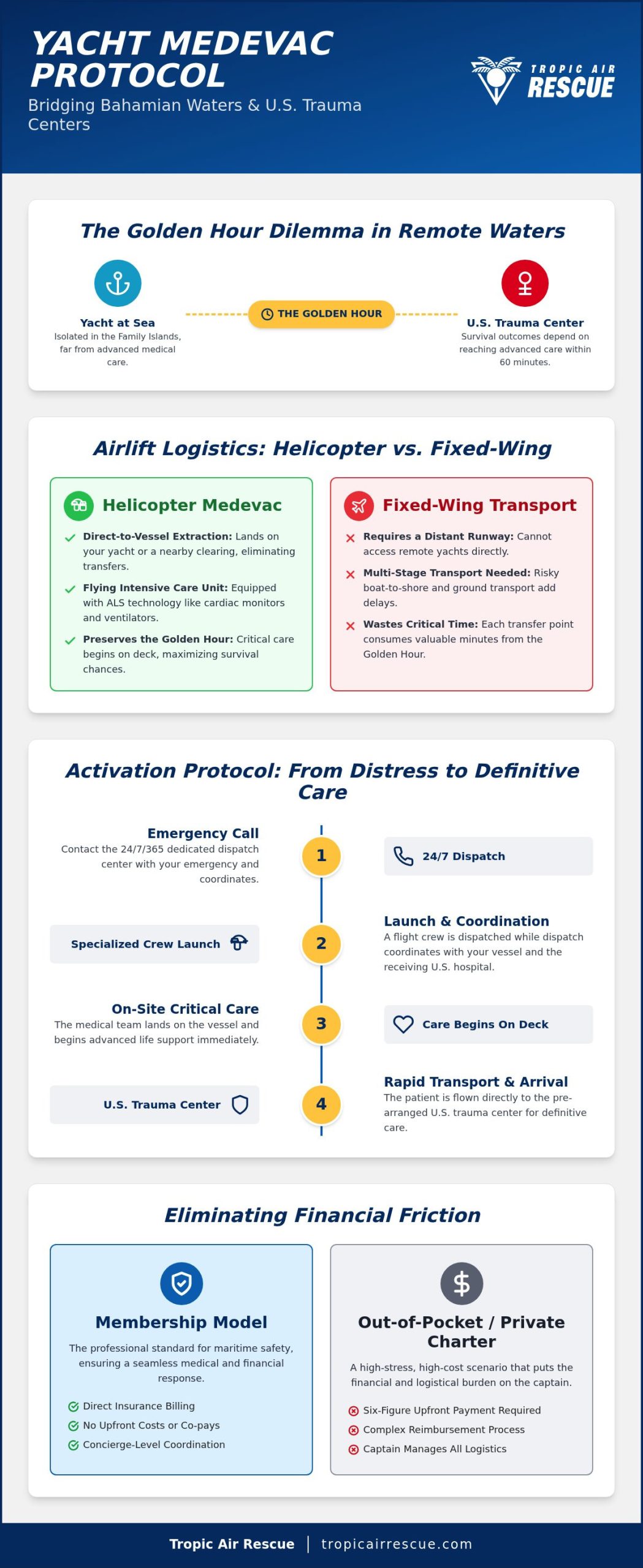
Standard Air medical services often rely on fixed-wing aircraft. However, for a yacht at anchor, fixed-wing transport is a secondary, slower option because it requires a functional airstrip. This often necessitates a risky boat-to-shore transfer and ground transport, consuming valuable time that a patient doesn’t have. Helicopter medevac eliminates these steps by landing directly on the vessel’s helipad or at a nearby clearing. These aircraft aren’t mere transports; they’re flying intensive care units. They come equipped with Advanced Life Support (ALS) technology, including cardiac monitors, ventilators, and specialized medication. Emergency airlift is a hospital-grade bridge between remote vessels and trauma centers. This capability ensures that critical care begins the moment the flight crew touches the deck.
Challenges of Remote Medical Extraction
Coordinating a medevac from yacht Bahamas involves navigating a complex logistical landscape. The Family Islands lack the ground support systems found in mainland regions. There are no sirens or immediate ambulances waiting on remote shorelines. Successful extraction requires a 24/7/365 dedicated dispatch call center that understands maritime coordinates and aviation weather patterns. It’s not just about the flight; it’s about the coordination of trauma air transport Bahamas protocols that ensure a receiving hospital is ready for arrival. Specialized flight crews, consisting of critical-care paramedics and nurses, must manage the patient in a high-stakes environment while the pilot navigates remote landing zones. A concierge air medical service acts as a vigilant guardian, bridging the gap between a yacht’s onboard medical kit and a level-one trauma center. Membership provides the framework for this response, ensuring the logistical burden never falls on the captain during a crisis.
Pre-Planning: The Captain’s Guide to Medevac Readiness
Readiness is not a suggestion; it’s a professional standard. While the turquoise horizons of the Exumas provide an idyllic backdrop for guests, the logistical reality of a medical crisis in these remote waters demands a rigorous, pre-established framework. An effective response begins long before a distress signal is ever sent. A captain’s primary duty includes verifying that every soul on board is covered for a potential medevac from yacht Bahamas. This preparation ensures that when an emergency occurs, the focus remains on the patient rather than the logistics of payment or aircraft availability.
Securing Comprehensive Coverage
Standard travel and health insurance policies often fail in the Out Islands. They typically operate on a reimbursement model, which is fundamentally useless when a private air ambulance requires immediate payment before dispatch. An annual air rescue membership eliminates this financial friction by providing direct insurance billing. For vessels with high guest turnover, short-term memberships provide the same elite protection for charter guests and temporary crew. Every manifest should be cross-referenced with your membership status to ensure there are zero gaps in coverage. Proactive captains often secure an annual membership to guarantee their vessel’s safety standard.
Medical Data Management
Seconds are lost when a crew is forced to search for allergy lists or passport copies during a crisis. The U.S. Embassy medical guidance for The Bahamas highlights the limitations of local facilities, making rapid, coordinated extraction to the US essential. A concierge service maintains these critical records in advance. This proactive approach includes coordinating with a patient’s personal physician to ensure the incoming critical-care team has a complete clinical picture before they even touch the deck. Maintaining a digital “emergency binder” with the following data is vital:
- Membership credentials: Instant access to account numbers and the 24/7 dispatch hotline.
- Current vitals: Pre-formatted templates for recording heart rate, blood pressure, and oxygen saturation.
- Insurance details: Front and back copies of primary health insurance cards for all passengers.
Integrating these protocols into the vessel’s Safety Management System (SMS) is mandatory for professional maritime operations. Don’t wait for a real-world crisis to test your communications. Conduct regular crew drills specifically for medical evacuation scenarios. Verify that your team can establish direct radio contact on aviation frequencies and knows exactly what information to provide to a 24/7/365 dedicated dispatch center. This builds the muscle memory required to maintain composure when the stakes are highest. A well-prepared yacht is more than a luxury vessel; it is a fortified platform for safety. Yacht management companies operating with professional crew should also review a comprehensive employee medical evacuation plan Bahamas framework to ensure all staff members are protected under a standardized protocol.
How to Prepare Your Yacht for a Helicopter Medevac
A successful medevac from yacht Bahamas operations relies on the captain’s ability to transform a recreational vessel into a tactical landing zone. This transition must be rapid and precise. The downwash from a heavy-lift helicopter can exceed 100 knots, turning unsecured deck furniture into lethal projectiles. Preparation is not just about the patient; it’s about the safety of the flight crew and your own team. When the aircraft is inbound, your vessel becomes a dynamic part of the aviation environment.
Securing the Landing Zone (LZ)
Identify the largest clear area, typically the sun deck or a dedicated helipad. If your vessel lacks a landing pad, designate a hoist area clear of masts, antennas, and rigging. Remove every loose item to prevent Foreign Object Debris (FOD) from being sucked into the helicopter’s intake. This includes:
- Deck Gear: Remove seat cushions, decorative pillows, and life rings.
- Canvas: Fold down and secure all bimini tops, awnings, and umbrellas.
- Tenders: Ensure all covers are lashed down or moved to a lower deck.
Crew members must remain low and outside the LZ perimeter until the aircraft has landed or the hoist is complete. Never approach the helicopter from the rear. Wait for a clear signal from the flight crew before attempting to transfer the patient.
Aviation Communications and Signaling
Establish direct contact with the pilot on the designated aviation frequency or VHF Channel 16. Clear communication is the foundation of a safe approach. Provide the aircraft with your exact GPS coordinates and the vessel’s current heading and speed. You’ll need to manage the yacht’s movement to optimize wind conditions. Maintain a steady course that puts the relative wind 30 degrees off the port or starboard bow, depending on the pilot’s request. This creates a stable pocket of air for the approach and keeps the flight crew clear of the vessel’s exhaust.
For night operations, illuminate the deck to provide the pilot with depth perception. However, keep all high-intensity spotlights aimed at the deck surface, never at the aircraft. Blinding the pilot’s night vision equipment can cause an immediate mission abort. Use smoke or flares only if requested by the pilot to verify wind direction. A briefed hand-signal protocol between the bridge and the deck team ensures everyone moves in unison. This level of coordination ensures a seamless transition from maritime environment to critical care flight.
The Activation Protocol: From Dispatch to US Trauma Center
A maritime medical crisis is a race against geography. When the decision is made to initiate a medevac from yacht Bahamas, the speed of the activation protocol determines the patient’s outcome. The process begins with a high-priority call to the 24/7 dedicated dispatch center. You must provide your precise GPS coordinates, the nature of the illness or injury, and the patient’s current stability. This information allows the flight team to configure the aircraft’s life-support systems before takeoff, ensuring they arrive ready for immediate intervention. Once the aircraft is airborne, the logistical machinery of an international medical transfer begins to move in parallel with the flight.
The Critical-Care Handover
Upon arrival, a specialized four-person team, consisting of two pilots and two critical-care medical professionals, will execute the transfer. This isn’t a simple pickup; it’s a clinical transition. The medical team utilizes onboard Advanced Life Support (ALS) equipment to stabilize the patient on your deck before moving them to the helicopter. This level of care mirrors the standards found in a guide to coordinating inter-hospital medical transfers, maintaining a continuous chain of intensive care from the yacht to the air. The flight crew manages all clinical monitoring and interventions during the transit, allowing the yacht’s crew to return to vessel operations with the confidence that the patient is in expert hands.
International Logistics and US Admission
Crossing international borders with a critically ill patient involves significant regulatory complexity. Air ambulances cannot simply land at a US hospital without prior authorization and formal acceptance from the receiving facility. The concierge service manages these high-stakes logistics, including US Customs and Border Protection (CBP) notifications and medical manifest filings. They streamline the process for inter-hospital transfer by coordinating directly with South Florida trauma centers. This ensures that a specialized surgical or medical team is waiting on the helipad the moment the aircraft touches down. By handling the administrative red tape and securing hospital acceptance in advance, the service allows the patient to bypass the delays of standard emergency room intake. To ensure your vessel has this level of logistical support and guaranteed admission, secure your membership protection today.
Membership and Insurance: Eliminating Financial Friction
In a medical crisis, financial logistics shouldn’t dictate the speed of care. Most private air ambulance providers operate on a pay-in-full model, requiring significant funds to be cleared before an aircraft even leaves the tarmac. For a captain coordinating a medevac from yacht Bahamas, this creates a dangerous delay during the Golden Hour. A concierge membership removes this obstacle entirely. It transforms a high-stakes financial transaction into a streamlined operational deployment. This ensures that medical necessity, not credit limits, remains the priority for your crew and guests. The same principles that apply to yacht-based emergencies are equally critical for those seeking an emergency flight for cruise passengers, where ship infirmaries serve only as stabilization points before transfer to a mainland trauma center.
Direct Insurance Billing Explained
Membership provides a “no out-of-pocket” advantage through a sophisticated direct-billing model. Instead of the patient paying upfront and battling for reimbursement later, the service provider bills the health insurer directly on behalf of the member. This eliminates the “pay-and-claim” headache that defines standard travel insurance. Because the financial vetting is completed during the membership enrollment phase, dispatch is immediate. The 24/7 call center focuses on flight logistics and medical stabilization while the administrative team handles the paperwork with your insurance carrier in the background. This proactive approach supports immediate aircraft activation without the need for financial vetting during an emergency.
Choosing the Right Membership Tier
Selecting the appropriate coverage level is a critical component of vessel preparedness. For owners and long-term crew, an annual plan provides a year-round safety net across the entire archipelago. If you’re hosting charter guests or temporary staff, short-term medevac coverage offers the same elite protection for the duration of their stay. Yacht management companies often utilize B2B membership plans to standardize safety protocols across a charter fleet, and those operating with professional crews should consider implementing a formal employee medical evacuation plan Bahamas to eliminate the financial unpredictability of emergency flights for their workforce. Use this final checklist to secure your vessel’s air rescue coverage for the 2026 season:
- Verify Manifest: Ensure every guest and crew member is registered under a current plan.
- Update Records: Confirm that primary health insurance data is on file for all members to facilitate direct billing.
- Dispatch Integration: Place the membership ID and 24/7 hotline number at the helm and in the medical locker.
Relying on a 100% dedicated Bahamian helicopter service means you aren’t waiting for an aircraft to clear customs in Florida before it can fly to your location. It means you have a vigilant, high-end guardian already positioned within the islands. Membership is the definitive proactive safety standard. It provides the quiet confidence that, should an emergency occur, the bridge to US trauma care is already built. This elite service model preserves both the health of the patient and the financial security of the yacht owner.
Fortify Your Vessel’s Safety Standard
Preparation is the only defense against the logistical isolation of the Family Islands. By prioritizing tactical deck readiness and establishing direct communication with elite flight crews, you ensure that medical intervention begins long before arrival at a US trauma center. We’ve outlined why helicopter extraction is the superior choice for remote vessels and how a proactive membership eliminates the dangerous friction of upfront payments. Executing a successful medevac from yacht Bahamas shouldn’t be a test of your vessel’s limits; it should be a seamless transition to a higher level of care.
Don’t leave your crew’s safety to chance or the reimbursement delays of standard insurance. Leverage the power of an FAA-Certified Helicopter Air Ambulance with 24/7 Dedicated Emergency Dispatch. With Direct Insurance Billing and no out-of-pocket costs for members, you can focus on navigation while we manage the crisis. Secure Your Concierge Air Medical Membership for the Bahamas today and ensure your next voyage is backed by the definitive standard in maritime aeromedical response. Your safety is our constant mission.
Frequently Asked Questions
Can a medical helicopter land on my yacht in the Bahamas?
Yes, a medical helicopter can land on your yacht if it has a certified helipad or a sufficiently cleared sun deck. If the vessel lacks a safe landing zone, the flight crew can perform a hoist extraction or coordinate a transfer from a nearby beach or clearing. Captains must ensure the area is free of Foreign Object Debris (FOD) and that all canvas is secured before the aircraft makes its final approach.
How do I activate an emergency airlift if there is no cell service?
You should utilize satellite communication systems, such as a satphone or Starlink, to reach the 24/7 dedicated dispatch call center. In areas with zero cellular reception, VHF Channel 16 can be used to relay coordinates to nearby vessels or shore stations. Providing precise GPS coordinates and patient vitals immediately is essential for a successful medevac from yacht Bahamas. Rapid communication is the foundation of a coordinated rescue.
Does my standard health insurance cover helicopter medevac from a boat?
Standard health insurance typically operates on a reimbursement model and rarely covers the immediate upfront costs of a private air ambulance. While some policies may eventually cover the flight, most providers require payment before dispatching an aircraft. A medevac membership eliminates this financial barrier by providing direct insurance billing. This ensures that the patient receives critical care without the delay of financial vetting or massive out-of-pocket expenses.
What happens if a patient needs to be transferred to a US trauma center?
The concierge service manages the entire logistical chain, including US Customs and Border Protection notifications and hospital acceptance. Moving a patient from Bahamian waters to a US trauma center requires formal acceptance from the receiving facility in Florida. The flight team remains with the patient during the transition, providing continuous critical care until the handover to the specialized surgical or medical team at the trauma center is complete.
Is a medevac membership required for all guests on the yacht?
Yes, membership is required for each individual to access the full suite of benefits, including direct insurance billing. Yacht owners can secure an annual membership for permanent crew while utilizing short-term membership plans for charter guests and temporary staff. This ensures that every person on the manifest is protected. Without a membership, the patient or the vessel owner may be responsible for the full cost of the flight.
How quickly can a helicopter reach a remote location in the Bahamas?
Response times vary based on your vessel’s distance from the aircraft’s base, but a local Bahamian helicopter service reaches remote locations significantly faster than aircraft flying from the US mainland. US-based aircraft must clear international customs before entering Bahamian airspace, adding hours to the mission. A dedicated local service bypasses these delays, protecting the Golden Hour by launching an FAA-certified helicopter air ambulance as soon as dispatch is confirmed.
What medical equipment is available on a Tropic Air Rescue flight?
Every flight is configured as a mobile intensive care unit equipped with Advanced Life Support (ALS) technology. The aircraft carries cardiac monitors, ventilators, defibrillators, and a comprehensive suite of emergency medications. This medical infrastructure is managed by a team of critical-care paramedics and nurses on every flight. This ensures that the patient receives hospital-grade stabilization during the transit from the yacht to the receiving trauma center in South Florida.
Can a helicopter perform a hoist rescue if my deck is too small for landing?
Yes, specialized helicopters can perform a hoist extraction if your deck is too small or obstructed for a safe landing. This capability is vital for coordinating a medevac from yacht Bahamas when operating in remote island chains. The flight crew will brief the captain on the necessary vessel heading and speed to provide a stable hoist environment. This ensures that even vessels without helipads can access rapid emergency airlift services.