

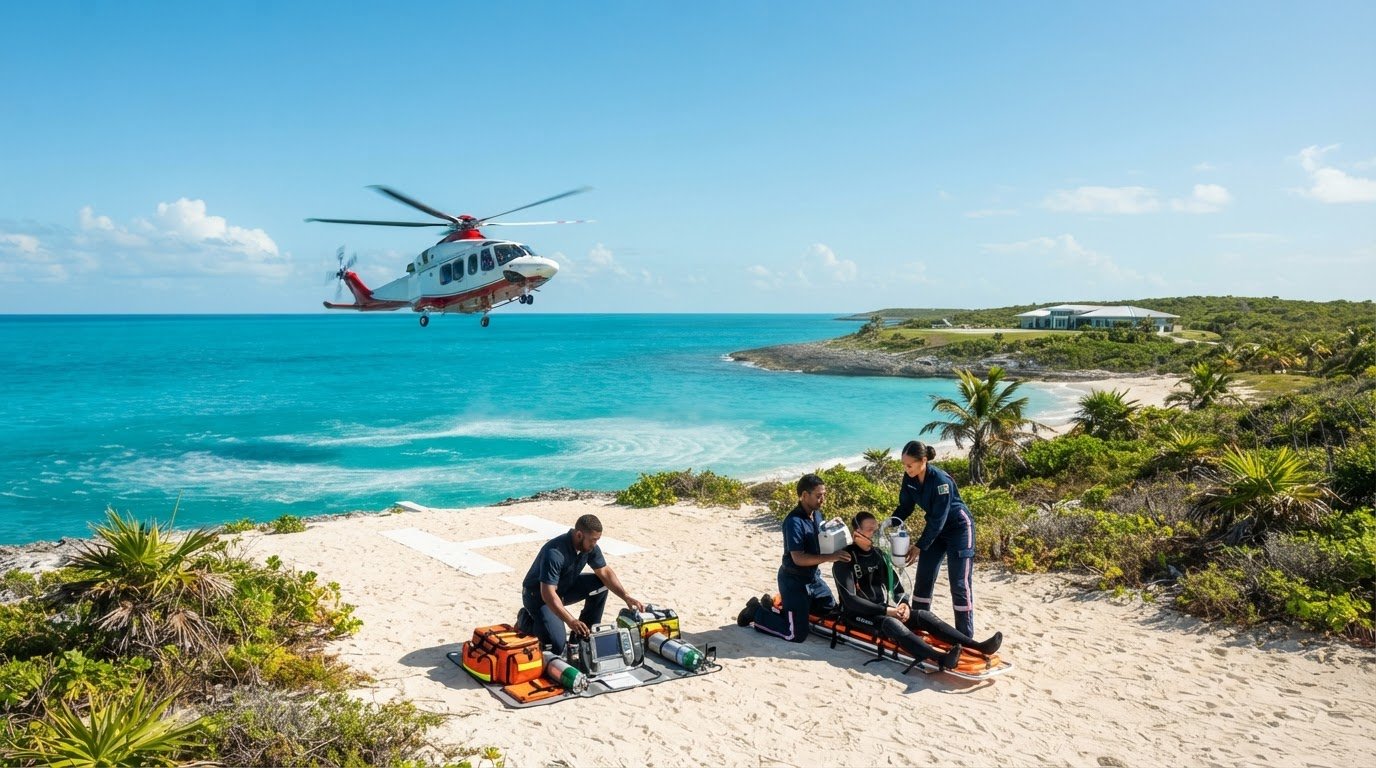
Ascending to standard cruising altitude can turn a treatable diving injury into permanent paralysis within minutes. While most medical flights prioritize climb rate and speed, altitudes as low as 5,000 feet cause residual nitrogen bubbles to expand aggressively under Boyle’s Law. Managing decompression sickness air transport is not a standard medevac routine; it is an exacting science of barometric containment, specialized flight profiles, and rapid bedside coordination.
When an offshore emergency strikes, you shouldn’t have to weigh the risk of flight-induced bubble expansion against crippling evacuation delays from isolated shorelines. In this guide, you’ll master the aeromedical protocols, critical cabin altitude limits, and emergency evacuation procedures required to safely transport decompression sickness patients to hyperbaric chambers. We examine low-altitude rotary profiles below 1,000 feet, high-flow oxygen delivery standards, and streamlined point-to-point transfer strategies that eliminate ground-transit delays.
Key Takeaways
- Understand how barometric pressure drops trigger rapid bubble expansion and why maintaining sea-level equivalent cabin pressure is critical to preserving neurological function.
- Master the essential clinical interventions for decompression sickness air transport, including uninterrupted normobaric oxygen delivery and aggressive isotonic fluid management.
- Discover why low-altitude rotary-wing flight profiles below 1,000 feet offer distinct barometric advantages over high-altitude transfers.
- Learn the operational requirements for secure remote landing zones and accurate dive-profile handoffs to eliminate treatment delays.
- Explore how point-to-point air evacuation bypasses intermediate ground transfer bottlenecks to place divers directly inside specialized hyperbaric chambers.
Understanding Decompression Sickness and the Risks of Aeromedical Evacuation
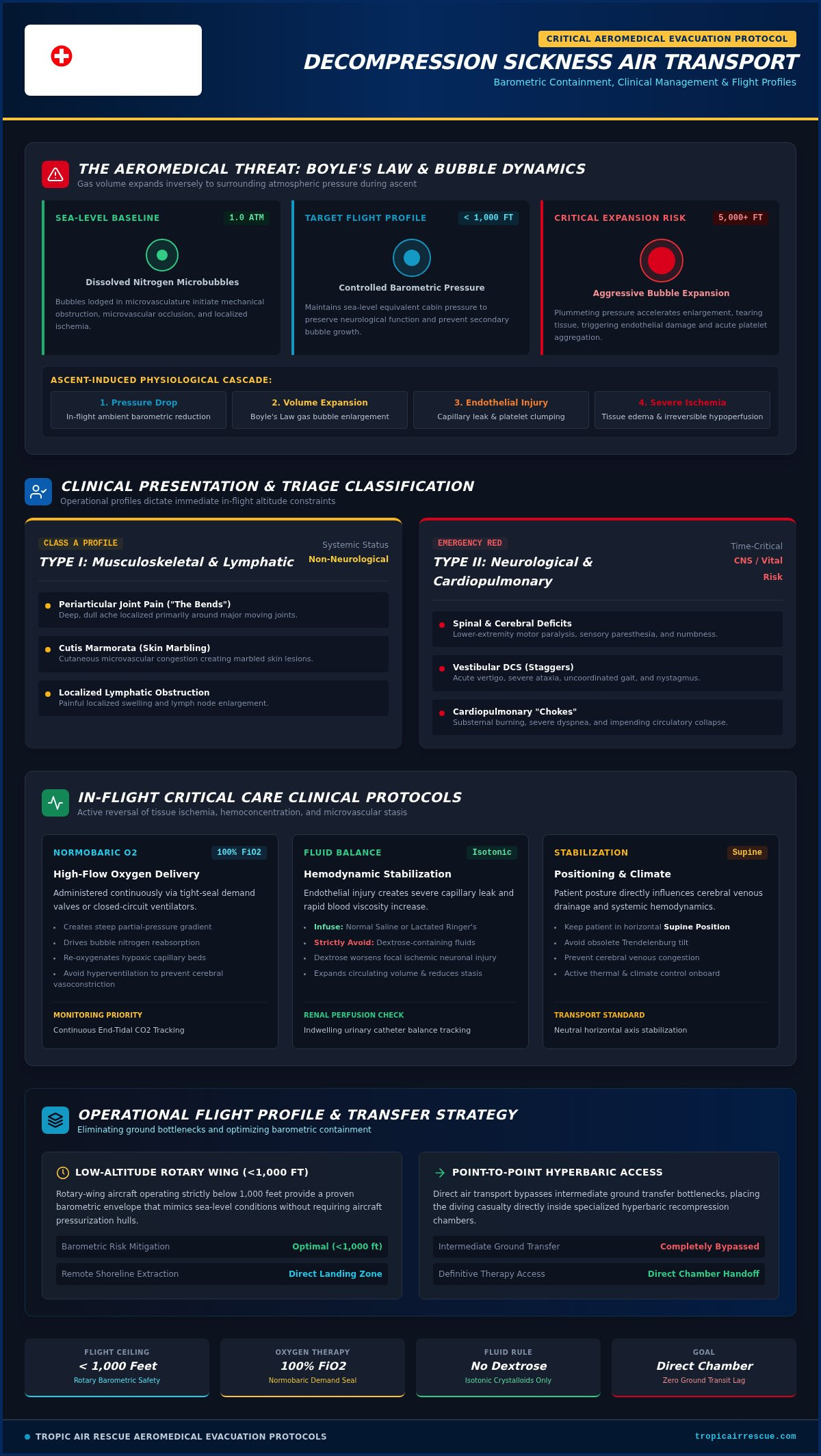
Decompression sickness occurs when ambient pressure drops too fast, causing dissolved inert nitrogen in human tissue to come out of solution as gas microbubbles. At sea level, these bubbles initiate mechanical obstruction, microvascular occlusion, and localized ischemia. When an affected patient enters unpressurized airspace or standard aeromedical ascent profiles, ambient barometric pressure plummets rapidly. That pressure drop accelerates bubble enlargement and triggers acute tissue tearing. Standard medevac protocols don’t automatically protect a diving casualty; specialized decompression sickness air transport requires exacting barometric containment to reach definitive recompression therapy without causing catastrophic secondary injury.
Boyle’s Law and In-Flight Bubble Dynamics
Boyle’s Law dictates that gas volume expands inversely to surrounding atmospheric pressure. Even a minor unpressurized climb compromises the diver. Microbubbles lodged in spinal pathways or cerebral microvasculature expand immediately as cabin pressure decreases. This physical expansion doesn’t just block blood flow; larger bubble surface areas trigger severe endothelial damage, secondary platelet aggregation, and inflammatory cascades. Cellular permeability breaks down, leading to rapid tissue edema and accelerated hypoperfusion during flight.
Type I vs. Type II Decompression Sickness Clinical Presentation
Clinical triage categorizes diving casualties into two operational profiles:
- Type I (Musculoskeletal and Lymphatic): Manifests as periarticular joint pain, cutaneous marbling (cutis marmorata), and localized lymphatic obstruction. While painful, these cases lack immediate central nervous system involvement.
- Type II (Neurological and Cardiopulmonary): Involves acute spinal or cerebral deficits, lower-extremity motor paralysis, sensory paresthesia, vestibular vertigo, and cardiopulmonary choke.
Type II presentations represent time-critical emergencies where unmanaged flight altitudes cause immediate, irreversible deficits. Safe decompression sickness air transport requires rapid field recognition of these neurological markers, allowing flight teams to enforce low-altitude flight paths before tissue ischemia becomes permanent.
Critical In-Flight Protocols for Diving Emergencies
Executing decompression sickness air transport requires aggressive in-flight clinical intervention from the moment the patient is secured. Bubble mechanical obstruction rapidly triggers systemic inflammation, microvascular sludging, and severe plasma loss. In-flight teams cannot simply monitor vitals passively; they must actively reverse tissue ischemia through advanced oxygenation, targeted fluid resuscitation, and precise physical stabilization.
High-Flow Normobaric Oxygenation Management
Administering a continuous 100% fraction of inspired oxygen (FiO2) is the primary medical priority. Pure oxygen eliminates inhaled nitrogen, creating a steep partial-pressure gradient between the lungs and tissues. This gradient drives bubble reabsorption back into solution while oxygenating hypoxic, underperfused capillary beds. Crews avoid loose-fitting masks in favor of tight-seal demand valves or closed-circuit ventilators with intensive monitoring systems. In-flight teams track end-tidal carbon dioxide carefully; hyperventilation causes cerebral vasoconstriction, which impairs cerebral blood flow when the brain needs perfusion most.
Fluid Resuscitation and Hemodynamic Stabilization
Endothelial injury from circulating bubbles provokes systemic capillary leak, pulling plasma from the vascular space into tissues. This rapid shift causes severe hemoconcentration and elevates blood viscosity, accelerating vascular stasis. Aeromedical crews manage circulation through strict hemodynamic interventions:
- Isotonic Crystalloids: Rapid infusion of normal saline or lactated Ringer’s expands circulating volume and lowers blood viscosity.
- Dextrose Exclusion: Solutions containing dextrose are strictly avoided because hyperglycemia exacerbates focal ischemic neuronal injury.
- Perfusion Monitoring: Placement of an indwelling urinary catheter provides objective measurement of ongoing renal perfusion and fluid balance.
Patient positioning and climate management represent the final elements of stabilization. Casualties remain supine; Trendelenburg positioning is obsolete because it increases intracranial pressure and promotes cerebral edema. Flight crews maintain active thermal blankets to avoid hypothermia, which causes peripheral vasoconstriction and slows inert gas elimination. For comprehensive coverage during offshore operations, securing an annual membership ensures that intensive-care aeromedical response is mobilized immediately when critical diving emergencies occur.
Flight Profile Strategies: Helicopter Low-Altitude Operations vs. Fixed-Wing Pressurization
Transporting a diver with severe bubble load requires a deliberate aviation strategy. The primary flight objective during decompression sickness air transport is maintaining the patient as close to sea-level atmospheric pressure as possible. Aircraft that climb expose compromised tissues to ambient pressure drops, prompting immediate bubble growth. Achieving near-sea-level pressure requires choosing between two opposing aeromedical platforms: flying unpressurized rotorcraft at low altitudes or relying on pressurized fixed-wing aircraft.
Rotorcraft Low-Altitude Terrain-Following Envelopes
Helicopters offer precise altitude control. Operating within coastal flight corridors, rotary-wing aircraft fly low-altitude profiles below 1,000 feet above ground level. At these minimum safe operating limits, the airframe stays immersed in dense, sea-level atmospheric conditions. This low-altitude envelope eliminates the hypobaric triggers that expand microvascular bubbles. Rotorcraft bypass mechanical hull pressurization systems entirely, allowing flight crews to follow maritime coastlines while providing uninterrupted critical care.
Pressurized Hull Constraints and Logistical Transfer Latency
Fixed-wing airframes rely on pressurized hulls to manage cabin barometric pressure. Standard commercial or aeromedical turboprops and jets routinely hold cabin altitudes between 6,000 and 10,000 feet. For diving casualties, that pressure drop causes dangerous gas expansion. To prevent this, fixed-wing pilots must maintain a sea-level cabin profile. Holding that profile places structural strain on the aircraft fuselage, burning excess fuel and capping cruise altitudes to low levels where fixed-wing fuel burn spikes sharply.
Beyond aerodynamics, fixed-wing aircraft introduce compounding logistical delays:
- Airstrip Dependencies: Fixed-wing planes require rated runways, excluding remote beaches, private docks, and rural clinic access points.
- Ground Relays: Patients endure an initial ground ambulance transit to the departure strip, a tarmac handoff, flight time, a secondary tarmac transfer, and a final road ambulance leg to the hyperbaric facility.
- Handoff Vulnerability: Multiple patient moves increase hemodynamic instability and disrupt continuous oxygen therapy.
Point-to-point rotary medevac cuts these logistical transfer delays by landing directly on shorelines, vessels, or clinic pads. To evaluate how these operational differences alter transport outcomes across maritime territories, review our helicopter vs fixed wing medevac analysis. Choosing an aircraft capable of maintaining sea-level pressures while eliminating secondary vehicle transfers directly dictates patient recovery before hyperbaric recompression.
Pre-Flight Triage, Communication & Ground-to-Air Handoff
Safe decompression sickness air transport depends as much on ground execution as it does on flight physics. The transition window from an incident site to the aircraft cabin is where valuable minutes are often wasted. Field triage teams must bridge the gap between initial surface rescue and clinical aeromedical care by gathering precise dive telemetry and establishing direct communication with hyperbaric physicians long before skids touch down.
Dive Profile Data Extraction and Field Triage
Hyperbaric doctors cannot select the correct recompression table without verifiable dive data. Field responders must extract dive computer logs and interview dive buddies before the patient is loaded. Responders should record specific telemetry points immediately:
- Depth and Exposure: Maximum depth reached, total bottom time, and planned versus actual decompression stops.
- Ascent Dynamics: Ascent rate violation warnings and missed safety stops recorded by the computer.
- Gas Mixture: Exact fraction of oxygen in breathing gas (air, nitrox, or trimix).
- Symptom Chronology: Time elapsed from surfacing to the first onset of pain or neurological deficit.
Always tape physical dive computers to the patient’s stretcher rather than passing them between loose luggage. This prevents data loss during transfer. Leading dive operations such as Diving Around Hurghada prioritize strict profile logging and safety stop tracking so that critical telemetry is immediately accessible if emergency care is required.
Landing Zone Coordination and Direct Transfer
Rotary-wing aircraft eliminate intermediate tarmac handoffs by landing close to the victim. However, improvised extraction points on beaches, docks, or resort pads require strict preparation. Ground coordinators must clear a 100-foot by 100-foot landing footprint free of loose canvas, dive gear, and overhead utility lines. In maritime environments, boat operators must secure loose bimini tops and communicate wind headings to approaching flight crews.
When the aircraft touches down, the medical handoff must be seamless. The receiving aeromedical team connects the diver directly to the aircraft’s onboard intensive monitoring equipment and ventilator systems. Standardized transfer models like SBAR ensure that the flight crew receives vital trend updates without interrupting 100% oxygen delivery. While the aircraft is inbound to the extraction point, flight dispatchers coordinate directly with the receiving hyperbaric facility, confirming that the recompression chamber is pressurized, staffed, and ready for immediate loading upon arrival.
Operating in remote island regions demands a coordinated logistics network that launches without administrative friction. To ensure your vessels and remote dive teams maintain instant access to point-to-point evacuation, enroll in a short-term membership before heading offshore.
Emergency Evacuation Infrastructure: Securing Rapid Air Medical Rescue
Clinical expertise and low-altitude flight physics mean nothing if administrative red tape grounds the aircraft. In acute diving emergencies, neurological recovery depends on pure speed of execution. Establishing an organized aeromedical framework ensures that decompression sickness air transport functions as an unbroken chain of custody, connecting isolated maritime sites directly to specialized hyperbaric facilities.
Direct-to-Chamber Transport and Interhospital Transfers
Outlying clinics across remote island territories excel at initial field stabilization, but they rarely house therapeutic recompression chambers. Transferring a neurological casualty through intermediate outpatient facilities creates dangerous delays while tissue ischemia progresses. Point-to-point rotary retrieval bypasses intermediary clinics entirely. Critical-care flight teams take custody of the patient directly at the shoreline or local medical station, sustaining advanced monitoring and normobaric oxygen without interruption. Review our comprehensive inter-hospital transfer guide for detailed coordination protocols between regional clinicians and flight crews.
The Membership Advantage in High-Stakes Diving Emergencies
Standard aeromedical dispatches often stall over payment authorizations, insurance verifications, or upfront wire requirements before rotors turn. In cases of spinal or cerebral decompression sickness, administrative friction causes permanent functional loss. Pre-established evacuation memberships remove these logistical hurdles before an emergency occurs.
- Immediate Launch Authority: Flight teams mobilize without waiting for pre-flight financial verification or credit guarantees.
- Direct Insurance Billing: Specialized billing teams submit claims directly to private health insurers, eliminating out-of-pocket flight expenses for members.
- Direct-to-Chamber Trajectory: Dispatch teams notify destination hyperbaric units while the aircraft is inbound, ensuring medical staff and chambers are ready the moment skids touch down.
Safe, rapid decompression sickness air transport requires disciplined operational infrastructure. Maritime travelers and expedition leaders can protect transient dive teams with short term medevac coverage, while island residents maintain continuous year-round readiness through an annual air rescue membership.
Executing Flawless Aeromedical Rescue When Minutes Count
Managing severe diving trauma demands an immediate, disciplined response. Preserving neurological function relies on flying terrain-following profiles below 1,000 feet, sustaining uninterrupted normobaric oxygen, and eliminating the dangerous delays of multi-leg ground transfers. Safe decompression sickness air transport is ultimately defined by how fast a diver moves from the point of injury directly into a pressurized hyperbaric chamber.
Don’t leave emergency logistics to chance when operating offshore. Tropic Air Rescue deploys hospital-grade advanced life-support helicopters built for remote point-of-injury landings on isolated shorelines and vessels. Our operations team maintains direct patient coordination with regional trauma centers and specialized hyperbaric facilities, while streamlined direct billing to private health insurers guarantees zero out-of-pocket expenses for members. Secure immediate medevac protection with Tropic Air Rescue today, and dive with complete confidence knowing elite aeromedical care stands ready behind every mission.
Frequently Asked Questions
Can a diver with decompression sickness be flown in an aircraft safely?
Yes, divers can be evacuated safely if the aircraft maintains a strict sea-level barometric pressure profile. Safe decompression sickness air transport requires low-altitude flight paths below 1,000 feet in rotary aircraft or specialized sea-level cabin pressurization in medical airplanes. Close coordination with diving physicians ensures the flight team manages gas dynamics, administers continuous pure oxygen, and prevents hypobaric bubble growth during transit.
What is the maximum allowable flight altitude when transporting a decompression sickness patient?
Aeromedical protocols mandate that unpressurized aircraft remain below 1,000 feet above ground level to avoid bubble expansion. Even modest climbs to 5,000 feet can trigger acute symptom flare-ups or permanent nerve injury under Boyle’s Law. Pressurized aircraft must calibrate their systems to maintain a sea-level equivalent cabin altitude, strictly capping cabin pressure well below the standard 6,000-to-8,000-foot commercial thresholds.
Why is continuous normobaric oxygen therapy critical throughout air medical transport?
Continuous 100% normobaric oxygen creates an aggressive partial-pressure gradient across pulmonary membranes. By eliminating inhaled ambient nitrogen, oxygen accelerates the washout of inert gas from vascular circulation and cellular compartments. This biochemical gradient encourages bubbles to dissolve back into surrounding plasma. At the same time, it re-oxygenates ischemic capillary beds threatened by vascular obstruction, preserving spinal cord and brain tissue while en route.
How do helicopters differ from fixed-wing aircraft when transporting divers with the bends?
Rotary-wing aircraft fly low terrain-following routes under 1,000 feet, keeping ambient pressure near sea level without structural hull strain. Helicopters also land directly on beaches, private vessel decks, and remote clinics, providing true point-to-point transfer. In contrast, fixed-wing aircraft require long runways, forcing patients into multiple ground ambulance transfers that cause severe transit latency and risk patient instability before reaching recompression.
What happens if a diver is transported in an unpressurized aircraft at standard flight altitudes?
Ascending in an unpressurized aircraft causes ambient barometric pressure to drop rapidly. Under Boyle’s Law, trapped nitrogen bubbles expand inversely to pressure, worsening mechanical vascular blockages. Microbubbles lodged in spinal or cerebral tissue swell, causing immediate endothelial tearing, secondary platelet clumping, and widespread ischemia. This rapid physical expansion can quickly convert mild joint pain into irreversible paraplegia, cerebral infarction, or fatal arterial gas embolisms.
How quickly must a patient reach a hyperbaric chamber after symptom onset?
Recompression therapy within the first two to four hours of symptom onset produces the highest recovery rates. Clinical research demonstrates that roughly 65% to 78% of divers achieve complete recovery after a single session of US Navy Treatment Table 6 when treated rapidly. Every hour of transport delay allows microvascular inflammation, tissue hypoxia, and edema to establish irreversible damage across neurological structures.
Does commercial health insurance cover emergency air transport for diving accidents?
Most private international and commercial health insurance plans provide coverage for medically necessary emergency evacuations and interhospital transfers. However, authorization bottlenecks and out-of-pocket billing risks can complicate dispatch. Dedicated membership programs resolve this obstacle by coordinating directly with regional hyperbaric facilities and billing private insurers directly. This protocol ensures rapid flight launches while shielding members from out-of-pocket flight costs during critical diving emergencies.