

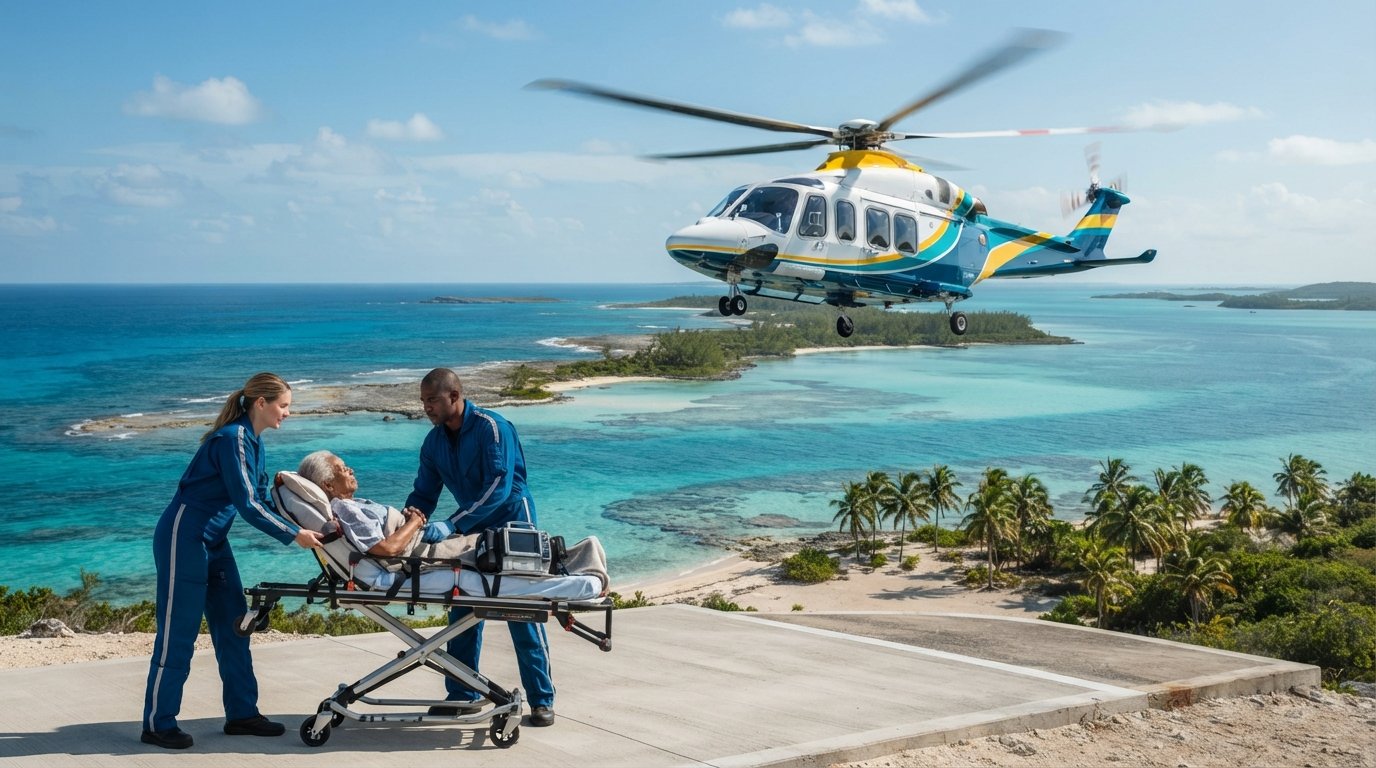
Less than nine percent of the hundreds of islands across the Bahamas feature operational runways capable of landing conventional aircraft. When a sudden stroke, cardiac event, or severe orthopedic fall strikes an aging loved one, relying on traditional fixed-wing logistics means enduring traumatic ground transfers and catastrophic delays just to reach an airstrip. Arranging dedicated air medical transport for elderly parents in Bahamas requires a decisive, point-to-point response rather than waiting on complex airfield handoffs.
You already recognize the dread of managing acute emergencies far from major medical centers, especially when faced with the threat of massive upfront charter invoices during a crisis. This guide shows you how to secure rapid, point-to-point aeromedical transport and zero out-of-pocket coverage for aging parents in the Bahamas. We examine how specialized rotorcraft bypass runway infrastructure limitations, maintain continuous geriatric intensive care directly into leading Florida trauma centers, and eliminate out-of-pocket liability through pre-arranged membership billing.
Key Takeaways
- Discover why securing specialized air medical transport for elderly parents in Bahamas requires dedicated point-to-point rotorcraft capable of bypassing missing airfield infrastructure during critical emergencies.
- Identify the non-negotiable geriatric clinical standards required in flight, including mobile intensive care unit equipment and specialized flight-physician oversight.
- Learn how direct physician-to-physician coordination ensures seamless bedside-to-hospital transit directly into leading Florida trauma centers.
- Examine the critical differences between reactive private charter models and pre-arranged memberships that eliminate catastrophic upfront wire transfer delays.
- Determine how to select the appropriate coverage framework, aligning short-term or annual membership tiers with your family’s travel schedule.
Evaluating Air Medical Transport for Elderly Parents in the Bahamas
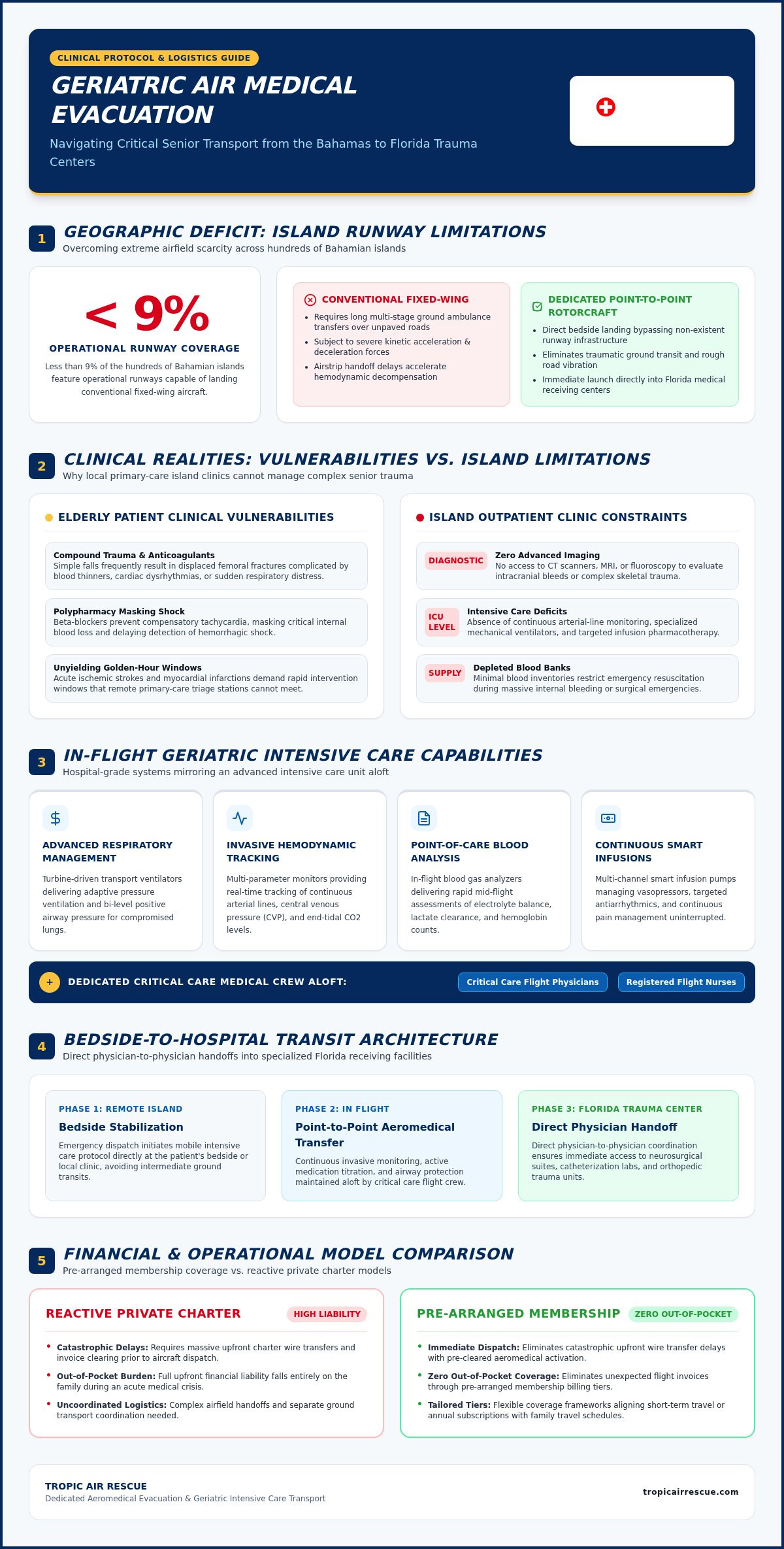
Arranging dedicated air medical transport for elderly parents in Bahamas requires specialized operational planning that accounts for complex geriatric physiology. Geriatric patients rarely face isolated injuries. A simple ground-level slip frequently results in a displaced femoral fracture complicated by anticoagulant therapy, cardiac dysrhythmias, or sudden respiratory distress. When an acute event occurs offshore, local island clinics simply lack the advanced diagnostic imaging, catheterization laboratories, and neurosurgical capabilities needed to stabilize vulnerable seniors. In these high-stakes scenarios, the speed and clinical caliber of evacuation to comprehensive Florida trauma centers directly determine long-term survival and functional recovery.
Unique Geriatric Clinical Vulnerabilities in Remote Island Environments
Frail physiology tolerates little physiological disruption. Polypharmacy significantly compounds emergency risks; a patient taking beta-blockers cannot exhibit normal compensatory tachycardia during hemorrhagic shock, masking critical blood loss. Similarly, acute ischemic strokes and myocardial infarctions operate on unyielding golden-hour treatment windows that remote island environments cannot meet. Transporting an elderly patient across unpaved roads and multiple ground transfers causes severe physical stress, acceleration-deceleration forces, and prolonged pain. These kinetic stresses accelerate hemodynamic decompensation. Established air ambulance transfer protocols emphasize continuous hemodynamic stability, advanced airway control, and aggressive pressure-injury prevention, bypassing traumatic multi-stage ground transits altogether.
Critical Limitations of Standard Island Medical Infrastructure
Most outpatient clinics scattered throughout remote island territories operate as primary-care triage stations rather than acute care centers. Their structural constraints present immediate barriers to geriatric emergency management:
- Diagnostic shortfalls: Zero access to computed tomography (CT) scanners, magnetic resonance imaging (MRI), or fluoroscopy to evaluate intracranial bleeds or complex fractures.
- Intensive care deficits: Absence of continuous arterial-line monitoring, specialized mechanical ventilators, and targeted infusion pharmacotherapy.
- Resource depletion: Minimal blood bank inventories, restricting immediate resuscitation during massive internal hemorrhage.
Because local stations cannot manage multi-organ failure or high-acuity surgical emergencies, pre-arranging international air medical transport for elderly parents in Bahamas is essential. Relying on makeshift island handoffs risks compounding clinical degradation, whereas direct aeromedical intervention ensures continuous intensive care from the moment of dispatch straight into advanced receiving facilities.
Essential Features: What Seniors Require in Aeromedical Evacuation
Executing safe air medical transport for elderly parents in Bahamas demands specialized equipment that mirrors a hospital intensive care unit. Standard charter aircraft cannot handle complex geriatric emergencies. Frail patients facing acute cardiopulmonary failure or traumatic fractures require continuous invasive monitoring, active medication titration, and experienced clinical providers throughout flight.
Mobile Intensive Care Capabilities and Advanced Life Support
Dedicated air-medical aircraft feature hospital-grade systems engineered for high-acuity patients aloft. These configurations include:
- Advanced respiratory management: Turbine-driven transport ventilators delivering adaptive pressure ventilation and bi-level positive airway pressure for compromised lungs.
- Invasive hemodynamic tracking: Multi-parameter monitors tracking real-time arterial lines, central venous pressure, and end-tidal CO2 levels.
- Clinical laboratory analysis: Point-of-care blood gas analyzers providing immediate electrolyte, lactate, and hemoglobin assessments mid-flight.
- Continuous pharmacotherapy: Multi-channel smart infusion pumps managing vasopressors, antiarrhythmics, and pain protocols without interruption.
A specialized medical crew consisting of critical care flight physicians and registered flight nurses must oversee every phase of care. Families often assume standard domestic policies follow seniors abroad, but official statutory restrictions on Medicare coverage outside the U.S. leave international aeromedical transport completely unfunded. Clinical competence aloft cannot depend on basic emergency medical technician protocols.
Point-to-Point Helicopter Access vs. Traditional Runway Transfers
Fixed-wing aircraft require functioning, paved runways, forcing patients to endure multiple ground ambulance transfers over rough roads. Each physical transition between stretchers, vehicles, and aircraft cabins introduces profound kinetic shock to an unstable geriatric patient. Rotorcraft fundamentally transform this dynamic by landing directly at clinics, resorts, or open fields.
Direct rotorcraft extractions eliminate hours of ground transit and avoid the logistical friction of unstaffed or unlit airstrips. Review our guide on the advantages of helicopter medevac in the Bahamas for transport insights on overcoming these airfield hurdles. Choosing dedicated rotorcraft delivers rapid bedside-to-hospital evacuation directly to advanced Florida trauma facilities. You can safeguard your family’s travel plans by reviewing concierge aeromedical membership options before your parents depart.
Air Ambulance: Bedside-to-Hospital Logistics to Florida
Executing rapid medical repatriation requires complex logistical choreography behind the scenes. When organizing air medical transport for elderly parents in Bahamas, flight operations must mesh with clinical and regulatory requirements long before rotor blades spin. A true bedside-to-hospital transfer guarantees continuous patient care from island clinics straight into advanced Florida receiving facilities.
Direct Interhospital Transfers to Specialized Florida Trauma Centers
Securing rapid hospital admission begins with dedicated physician-to-physician communication. Florida trauma specialists review diagnostic charts with island medical staff to confirm an accepting physician and verify receiving bed availability before dispatch. Learn how to streamline operations with our inter-hospital transfer protocol.
Direct trauma coordination avoids unnecessary delays through structured handoffs:
- Real-time clinical telemetry: In-flight vital streams transmit directly to receiving trauma teams to prepare specialized treatment suites ahead of arrival.
- Direct-to-bed placement: Patients transition immediately to intensive care units or surgical suites, bypassing crowded emergency room queues.
- Physician handoffs: Dedicated aeromedical teams deliver verbal and digital diagnostic records directly to the accepting clinical staff.
Navigating International Border Clearances and In-Flight Customs
Transporting an acute geriatric patient across international borders introduces strict regulatory compliance demands. Concierge flight coordinators manage the entire administrative clearance process so families can focus entirely on their loved one’s recovery.
Operational coordination handles critical border protocols:
- Electronic passenger filings: Flight teams submit international passenger manifests electronically while airborne to secure immediate entry permissions.
- Priority aeromedical routing: Aircraft dispatchers coordinate directly with aviation authorities to establish unrestricted flight vectors into Florida airspace.
- Ramp-side customs processing: Border control agents clear non-ambulatory seniors airside, preventing delays in high-traffic commercial terminals.
Families only need to ensure their parents’ valid passports, medical power of attorney records, and detailed medication schedules remain readily accessible. This meticulous administrative oversight makes international air medical transport for elderly parents in Bahamas swift, compliant, and clinically seamless.
Membership Subscriptions vs. Traditional Air Charter Fee Models
The standard charter model breaks down when minutes decide clinical recovery. Families seeking reactive private jet charters during an emergency run into administrative roadblocks before an aircraft ever leaves the hangar. In contrast, pre-arranged memberships establish clear operational protocols in advance, ensuring instant deployment without financial roadblocks. Review comprehensive options using our short term medevac coverage travel guide to see how proactive protection functions in practice.
The Financial Perils of Unplanned Emergency Medical Flight Charters
Traditional private charter brokers operate strictly on a pay-first basis. When an unexpected crisis strikes, this reactive approach introduces dangerous operational delays:
- Pre-flight payment demands: Flight coordinators require cleared funds before activating flight crews or filing international flight plans.
- Banking hour gridlock: High-value wire transfers hit clearing delays outside regular business hours, over weekends, or on bank holidays.
- Card limit bottlenecks: Massive emergency authorizations routinely trigger fraud holds on family credit cards, wasting valuable treatment time on bank phone queues.
These financial hurdles leave families deeply exposed during moments of acute stress. Rather than managing emergency medical care, relatives spend hours brokering quotes and navigating authorization forms.
Zero Out-of-Pocket Direct Insurer Billing Through Active Membership
Pre-arranged membership completely transforms emergency response protocols. By handling all administrative and clinical underwriting before travel, active subscription plans allow immediate aircraft activation the moment a call comes in. There are no price negotiations, no payment holds, and no frantic bank calls during an emergency.
The billing mechanics operate cleanly for enrolled members. The provider bills qualifying private health insurance carriers directly, accepting the eventual insurance reimbursement as payment in full. This model completely eliminates surprise balances, out-of-pocket deductibles, and retroactive billing disputes for the transport flight. Securing reliable air medical transport for elderly parents in Bahamas means removing financial friction before an emergency occurs. To protect your family against sudden logistical and financial gridlock, enroll in an emergency membership plan before your parents travel.
Securing Bahamas Air Medical Evacuation Coverage for Aging Parents
Establishing comprehensive aeromedical safeguards before departure replaces emergency chaos with coordinated clinical execution. Proactive planning ensures that all administrative, financial, and clinical clearances exist long before your family boards their flight. For non-emergency situations where an elderly traveler is stable enough to fly commercially, you can discover RN MEDflights for specialized in-flight clinical assistance. However, when securing air medical transport for elderly parents in Bahamas during acute crises, matching your coverage framework to the exact rhythm of your stay guarantees continuous operational readiness.
Selecting Between Short-Term and Annual Subscription Tiers
Every itinerary demands a tailored protection model. Evaluating the length and frequency of your family’s travel determines the proper membership path:
- Short-term Membership: Tailored specifically for distinct vacation itineraries, family holidays, or temporary island retreats. It provides immediate, full-scope aeromedical coverage across exact arrival and departure dates.
- Annual Membership: Designed for seasonal winter residents, second-home owners, or frequent travelers making multiple trips throughout the year. It delivers continuous, round-the-calendar dispatch eligibility across the entire country.
Explore comprehensive protection with our annual air rescue membership for seasonal travel to keep multi-month stays completely protected without renewing paperwork between island visits.
Pre-Trip Clinical Onboarding and Emergency Activation Protocols
Speed during an actual emergency relies heavily on information gathered ahead of time. The pre-trip onboarding process builds a complete clinical dossier for each parent before travel begins.
Completing your pre-flight onboarding requires three straightforward operational steps:
- Digital clinical profiles: Submit active medication schedules, known drug allergies, primary care physician contact details, and documented baseline vitals directly into the flight management system.
- Direct insurance integration: Store primary commercial healthcare policy numbers and supplemental plan details on file to guarantee pre-authorized zero out-of-pocket processing.
- Family credential distribution: Save dedicated direct-dispatch contact numbers, member ID cards, and intake authorization pins across the mobile phones of every traveling relative.
When an emergency arises, pre-enrolled members do not navigate complex call centers or fill out emergency intake questionnaires. A single call activates pre-cleared flight coordinators, mobilizing rapid air medical transport for elderly parents in Bahamas directly to your location while flight physicians review the patient’s existing clinical profile en route.
Secure Seamless Aeromedical Protection Before Island Departure
When severe clinical emergencies strike offshore, an immediate point-to-point response eliminates dangerous runway delays. Arranging dependable air medical transport for elderly parents in Bahamas requires dedicated preparation rather than reactive charter negotiations. By deploying hospital-grade critical care rotorcraft configured with advanced life-support equipment, specialized flight teams maintain continuous intensive care while bypassing traditional airstrip bottlenecks entirely.
Pre-arranged membership establishes seamless direct interhospital coordination with leading Florida trauma centers, securing swift bed-to-bed admissions without procedural stalls. Direct insurer billing completely eliminates financial surprises, delivering zero out-of-pocket costs for members so your family can focus exclusively on clinical recovery. Don’t leave your loved ones’ safety to chance during their island stay. Secure Your Family Membership with Tropic Air Rescue Today and enjoy your travel with complete confidence, knowing an elite medical transport network is always prepared to protect them.
Frequently Asked Questions
Can an air ambulance land directly at a private villa or remote island resort in the Bahamas?
Yes, specialized aeromedical rotorcraft can land directly on open grounds, private helipads, beaches, or clearings adjacent to remote villas and resorts across the Bahamas. Unlike conventional planes that rely exclusively on operational paved airstrips, point-to-point helicopters eliminate multi-stage ground transport. This capability ensures your elderly family members receive bedside extraction immediately at their accommodation, avoiding jarring ambulance transfers across unimproved island roads.
How does medical transport for elderly parents differ from standard air ambulance flights?
Specialized air medical transport for elderly parents in Bahamas focuses heavily on fragile physiology, baseline comorbidities, and multi-medication protocols. Standard flights often provide basic life support, whereas geriatric aeromedical care deploys mobile intensive care equipment aloft. Dedicated critical care flight physicians manage continuous blood pressure regulation, delicate airway controls, pressure-relieving transport mattresses, and active cardiac infusions to shield compromised seniors from flight-induced hemodynamic stress.
Will our private US health insurance cover international emergency air medical evacuation?
Original Medicare provides zero coverage for emergency international aeromedical evacuation back to the United States. While select comprehensive private commercial insurance plans provide foreign emergency benefits, navigating offshore approvals during a crisis proves daunting. Active membership solves this hurdle completely. The service files directly with your qualified private insurance provider, accepting the resulting insurance reimbursement as payment in full so your family avoids unexpected out-of-pocket bills.
How quickly can an emergency medical helicopter dispatch to remote locations across the Bahamas?
Dispatch occurs rapidly once emergency clinical coordination begins, especially for pre-registered members whose clinical baselines and insurance profiles already reside securely in the dispatch database. Pre-authorization eliminates typical administrative holds, price negotiations, and payment confirmations. Concierge flight teams immediately file international flight clearances, mobilize critical care medical crews, and launch rotorcraft directly to the patient’s remote Bahamian coordinates to execute time-critical rescue missions.
What medical equipment and clinical personnel are on board during emergency air transit?
Every emergency transport aircraft functions as an airborne intensive care unit. Onboard medical suites feature invasive multi-parameter monitors, transport mechanical ventilators, biphasic defibrillators, smart multi-channel infusion pumps, and blood gas laboratory analyzers. Patient care is delivered directly by specialized flight physicians and critical care registered nurses trained in advanced trauma life support and complex geriatric emergency medicine throughout the entire flight corridor.
Are elderly patients transported directly to Florida hospitals or local Bahamian medical centers?
Patients are transported directly to advanced receiving facilities and level-one trauma centers in Florida. While local island clinics provide initial stabilization, they lack specialized subspecialties required for complex geriatric emergencies. Direct aeromedical flights bridge this gap through pre-arranged bedside-to-bedside coordination. Island medical teams hand over clinical documentation directly to receiving American hospital specialists, ensuring seniors transition seamlessly into specialized surgical, cardiac, or neurovascular suites upon arrival.
Do members incur any out-of-pocket expenses when emergency medical air transport is activated?
Enrolled members incur zero out-of-pocket expenses for emergency flights. Arranging air medical transport for elderly parents in Bahamas through an active membership eliminates the predatory pay-first charter model. The operations team manages insurance billing directly, accepting the eligible carrier reimbursement as final settlement in full. Families face no balance billing, co-pays, or upfront wire demands during catastrophic medical emergencies.