

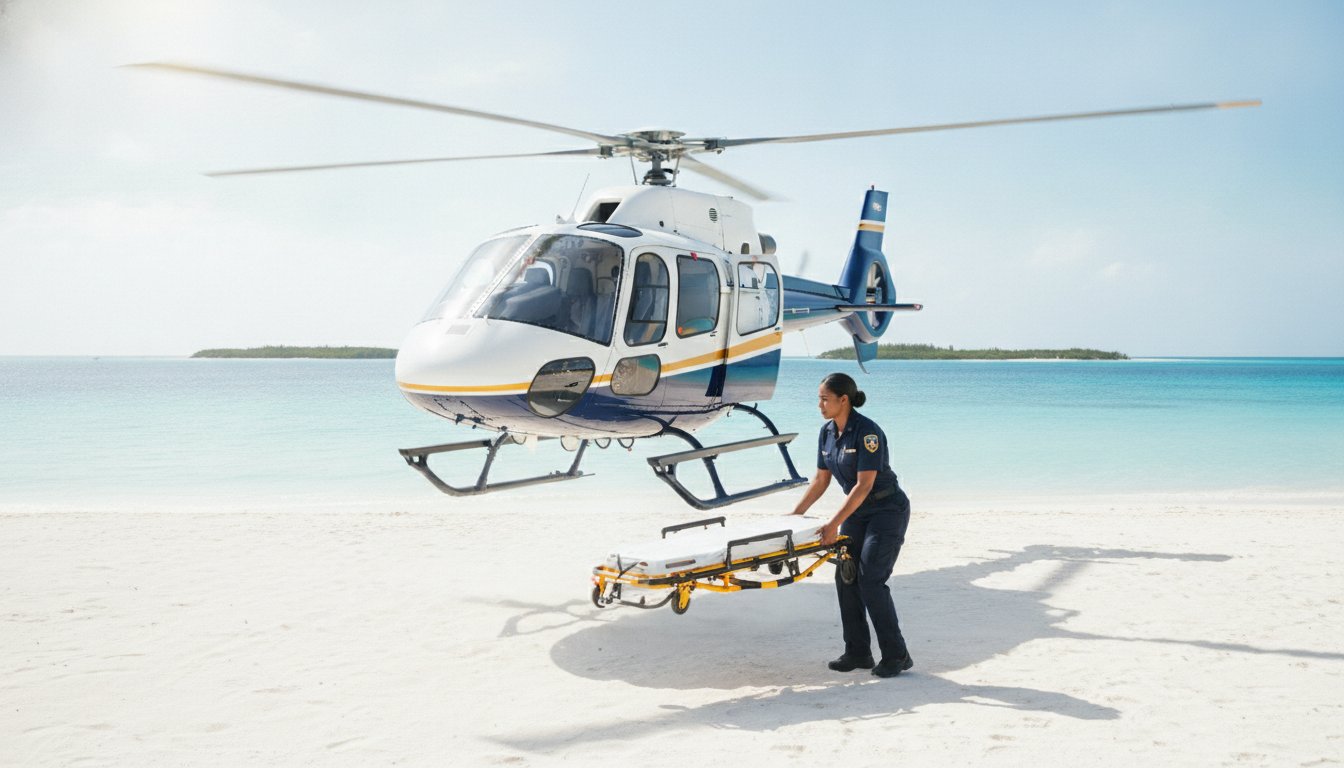
When a medical emergency strikes on a remote island, a runway is the biggest obstacle to survival. Most islands in the archipelago lack the infrastructure for fixed-wing aircraft, forcing patients into dangerous delays involving ground ambulances and multiple transfers. Securing a helicopter ambulance to Florida from Bahamas provides a direct clinical bridge that bypasses these logistical hurdles. It’s the difference between waiting for a flight and launching a life-saving response within minutes.
You know that in high-stakes situations, professional composure and speed are non-negotiable. This 2026 guide reveals how specialized helicopter medevac serves as the fastest route to Florida trauma centers, ensuring active members face zero out-of-pocket financial burden. We’ll detail the point-to-point operational advantages over fixed-wing alternatives, the seamless coordination between island clinics and US hospitals, and how membership eliminates the anxiety of international insurance pre-certification. Discover why elite, agile transport is the definitive solution for those who prioritize meticulous preparedness and rapid clinical access.
Key Takeaways
- Understand why “Total Mission Time” is the most critical metric when bypassing traditional airport transfers and ground ambulance delays.
- Learn how a helicopter ambulance to Florida from Bahamas accesses remote island locations that are entirely unreachable for fixed-wing aircraft.
- Explore the “Direct-to-Heliport” protocol that eliminates standard ER intake wait times through elite coordination with Florida trauma centers.
- Discover how active membership facilitates direct insurance billing to ensure zero out-of-pocket financial burden for patients.
- Master the simple activation process to launch a concierge medical response the moment an emergency is identified in the Bahamas.
The Critical Role of Helicopter Medevac for Florida Transfers
Helicopter medevac represents a specialized tier of Air medical services. It functions as a direct-to-hospital clinical intervention rather than a simple transport utility. This model prioritizes the “Golden Hour,” the critical sixty-minute window following a traumatic injury or acute medical event where rapid intervention significantly improves survival rates. Utilizing a helicopter ambulance to Florida from Bahamas eliminates the friction of traditional logistics. It’s a “Ready, Agile, Direct” approach designed for high-acuity patients who cannot afford the wait times inherent in multi-modal transfers. Every minute saved in the air translates directly to improved clinical outcomes.
Bypassing Airport Logistics and Ground Delays
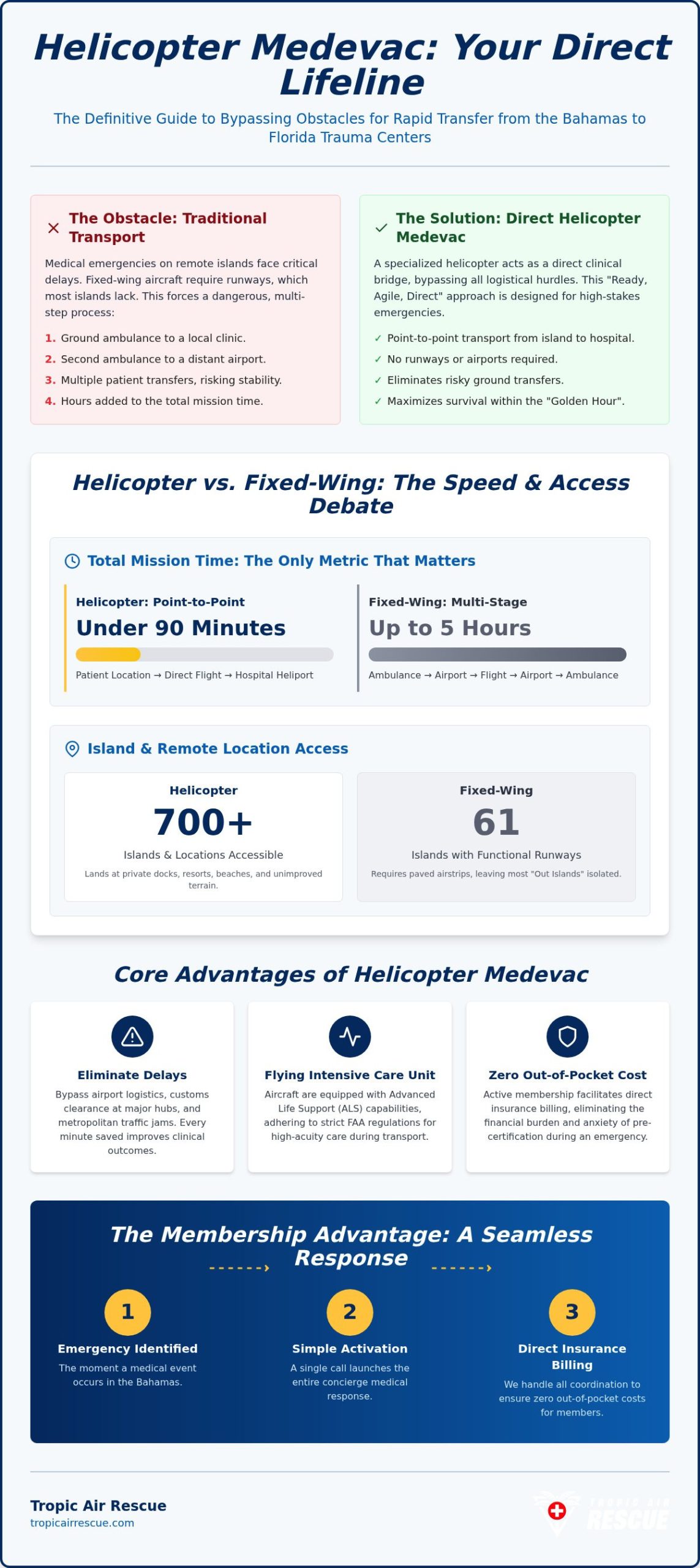
Traditional air ambulances rely on fixed-wing aircraft. These require paved runways and two separate ground ambulance legs. One leg moves the patient from the island clinic to the airport; another moves them from the Florida airport to the trauma center. Each transfer increases the risk of clinical instability and adds hours to the total mission time. Helicopters eliminate these “middle miles” by landing directly at medical facilities or emergency scenes. By removing the need for airport staging, we bypass customs delays at commercial hubs and avoid heavy metropolitan traffic. This direct flight path ensures advanced trauma care begins the moment the patient is secured on the aircraft.
Reaching Remote Bahamas Locations
The Bahamas archipelago consists of 700 islands, yet only 61 possess functional runways for fixed-wing aircraft. This leaves the majority of the “Out Islands” isolated during medical emergencies. A helicopter ambulance to Florida from Bahamas bypasses this infrastructure gap entirely. Our fleet maneuvers into tight landing zones that fixed-wing planes cannot touch, providing a lifeline to areas without paved support.
- Private docks and marinas: Direct extraction from maritime vessels or waterfront properties.
- Resort clearings: Immediate response to guest emergencies at remote vacation sites.
- Unimproved terrain: The ability to land on beaches or island clearings when local roads are impassable.
Precise Access is the ability to reach any location day or night. This capability transforms the entire archipelago into a single, accessible catchment area for Florida’s elite medical network. It ensures that your geographical location never dictates the quality of your emergency care.
Helicopter vs. Fixed-Wing: The Speed and Access Debate
Speed is often misunderstood in air medical logistics. While a fixed-wing jet boasts higher cruising speeds, it’s tethered to infrastructure that helicopters simply ignore. For a helicopter ambulance to Florida from Bahamas, the advantage lies in the Total Mission Time (TMT). A jet requires a 3,000 foot paved runway; a helicopter requires only a cleared hospital pad or a resort lawn. This versatility allows us to bypass the two most dangerous phases of medical transport: the ground ambulance transfers at either end of the flight. By landing directly at the destination facility, we eliminate the clinical risks associated with repeated patient handling.
Total Mission Time Efficiency
Fixed-wing missions follow a fragmented “ground-air-ground” pattern. This involves loading the patient into a ground ambulance, driving to a regional airport, offloading into the jet, flying, offloading into another ground ambulance in Florida, and finally arriving at the trauma center. Each hand-off introduces clinical risk and logistical delay. In contrast, a point-to-point helicopter mission follows a single, uninterrupted path. It’s a more disciplined approach to the “Golden Hour.”
Consider a hypothetical transfer from a remote island. A fixed-wing mission might take five hours when accounting for airport staging and customs clearance at a major hub. A helicopter mission can complete the same transfer in under 90 minutes. You can read a deeper analysis of these differences in our guide on Helicopter vs Fixed Wing Medevac: The Critical Choice for Bahamas Emergencies in 2026.
Advanced Life Support (ALS) Onboard Capabilities
Speed doesn’t come at the expense of clinical sophistication. Our specialized medical helicopters operate as flying intensive care units. Every aircraft adheres to strict FAA regulations for helicopter air ambulances, ensuring a platform that supports high-acuity care during international transit. This setup allows for continuous monitoring without the interruptions caused by vehicle swaps.
The cabin is outfitted with hospital-grade equipment:
- Multi-parameter heart monitors and 12-lead ECGs.
- Advanced transport ventilators and integrated oxygen systems.
- Automated external defibrillators (AED) and pacing capabilities.
- Critical care medication formulary for immediate intervention.
A dedicated critical care paramedic team manages these systems. Their focus remains entirely on the patient’s stability throughout the flight. This level of oversight ensures that a helicopter ambulance to Florida from Bahamas is not just a transport; it’s a continuous clinical bridge. If you’re planning travel, it’s wise to secure your membership before an emergency occurs.
Direct Coordination with Florida Trauma Centres
Coordination is the invisible backbone of a successful medical evacuation. For a helicopter ambulance to Florida from Bahamas, the mission’s success depends on the synchronization between the aircrew and the receiving trauma center. This isn’t a standard taxi service; it’s a mobile intensive care unit that requires precise integration with Florida’s elite medical network. This process ensures that the transition from island stabilization to US trauma care is instantaneous and efficient.
Our Medical Director spearheads this integration. They evaluate the patient’s acuity and match them with the facility best equipped for their specific pathology, whether it involves neurosurgery, advanced cardiac intervention, or orthopedic trauma. This level of clinical governance adheres to CAMTS accreditation standards, providing a framework for safety and quality that exceeds basic transport requirements. It establishes a high-end guardian model for every member in transit.
The Role of the Medical Director
The Medical Director serves as the clinical liaison between the island facility and the US surgeon. While in flight, the crew transmits real-time vitals and diagnostic data directly to the hospital. This allows the receiving team to prepare specialized equipment or operating rooms in advance of the aircraft’s arrival. Trauma Coordination is the seamless handoff from flight crew to hospital staff. It ensures that definitive care begins the second the patient leaves the aircraft cabin, eliminating the standard waiting periods found in traditional emergency admissions. This commitment to patient outcomes is mirrored in post-acute settings, where specialized providers like aviancare.hu offer the home nursing and physiotherapy necessary for a full recovery.
Landing at an FBO or private jet terminal creates a “last mile” bottleneck. It requires an additional transfer to a ground ambulance and a drive through potential Florida traffic. Our “Direct-to-Heliport” protocol bypasses this entire phase. By landing 50 feet from the trauma bay, we maintain a sterile, controlled environment and minimize the physical stress of transport. This is vital for patients with spinal injuries, neurological emergencies, or unstable cardiac conditions where every vibration or delay carries clinical consequences.
Administrative readiness is just as important as clinical preparation. We manage the pre-certification process and ensure all international transfer documents are finalized before arrival. This proactive approach prevents logistical friction in the ER. To understand the complexities of these moves, review our Guide to Coordinating Inter-Hospital Medical Transfers. Meticulous planning is the only way to guarantee a frictionless transition to life-saving care in the United States.
Eliminating Out-of-Pocket Costs via Membership
Financial hurdles often represent the most significant delay in emergency medicine. Without a membership, securing a helicopter ambulance to Florida from Bahamas typically requires an immediate and substantial financial commitment. Industry data indicates that non-membership services often demand $30,000 to $50,000 in upfront payments before dispatching an aircraft. For many, this logistical friction creates a dangerous gap in the critical response window. Membership eliminates this barrier entirely. Our system shifts the focus from financial clearance to clinical response, ensuring that the rotors turn the moment the Medical Director approves the mission. It is a disciplined approach to emergency finance that mirrors our operational precision.
Direct Insurance Billing Protocols
We operate on a sophisticated direct-to-insurer model designed to protect members from the high costs of international medical flights. Active members benefit from a “No Out-of-Pocket Costs” guarantee. This means we accept the insurance reimbursement as payment in full for the specialized transport services provided. Pre-enrolment is a mandatory step in this process. Verification allows our administrative team to confirm your health insurance details and establish direct billing protocols long before an emergency occurs. This proactive verification is what enables our “Ready, Agile, Direct” philosophy. If you’re visiting for a limited duration, consult our Short-Term Medevac Guide for Island Travelers 2026 to ensure your coverage is active before you depart.
Coverage Tailored to Your Stay
Every visitor and resident in the Bahamas has unique requirements for emergency readiness. We provide flexible plans designed to fit specific island profiles and stay durations. This concierge-level protection ensures that your clinical route to Florida’s trauma centers is never blocked by administrative hurdles. Meticulous planning provides a proactive approach to safety that values exclusivity and preparedness.
- Short-term memberships: Designed for yacht guests and resort vacationers who need coverage for the exact duration of their stay.
- Annual plans: Structured for residents and second-home owners who require constant, year-round readiness.
- B2B membership plans: Specialized options for resort staff or corporate groups operating in remote locations.
Join our membership program to guarantee immediate medical dispatch with zero financial friction.
Securing Your Transfer to Florida: Next Steps
Meticulous preparation is the final link in the chain of survival. Securing a helicopter ambulance to Florida from Bahamas isn’t a task for the moment of crisis; it’s a strategic decision made during the planning phase of your travel. This proactive approach ensures that your clinical profile and insurance data are already integrated into our command system. When an emergency occurs, our dispatchers don’t ask for credit cards or policy numbers. They focus entirely on launching the aircraft and coordinating with the receiving trauma surgeons in Florida. It’s a disciplined model that prioritizes life over paperwork.
Enrolment and Pre-Certification
The enrolment process is designed for speed and clarity. By completing these steps before you depart, you activate a concierge-level safety net that remains on standby throughout your stay. Our “Ready” database serves as an elite registry for members, facilitating near-instantaneous mission approval.
- Step 1: Choose Your Membership Tier. Select a plan that matches your length of stay, whether it’s a short-term tourist option or an annual residency plan.
- Step 2: Submit Credentials. Provide your identity and insurance information. This allows our administrative team to pre-verify your coverage for direct billing.
- Step 3: Receive Emergency Protocols. You’ll be issued specific contact instructions and activation codes to use if a medical event occurs in the Bahamas.
The Concierge Advantage
High-stakes travel requires a dedicated medical partner with specialized expertise. Our teams possess decades of Air MedEvac experience, specifically navigating the unique maritime environment between the islands and the mainland. This isn’t a general charter operation. It’s a professional medical wing equipped with advanced avionics, such as 4-axis autopilot systems, designed for stability and precision. This technology allows our pilots to maintain optimal flight paths while the medical team manages high-acuity care in the cabin. Utilizing a helicopter ambulance to Florida from Bahamas ensures you have access to the most sophisticated transport platform available in the region.
Helicopter transport remains the definitive choice for Florida-bound emergencies because it solves the “last mile” problem that fixed-wing aircraft ignore. By landing directly at the hospital heliport, we provide an uninterrupted clinical bridge from the island to the operating room. This speed, combined with our direct insurance billing model, provides the ultimate peace of mind for travelers who refuse to compromise on safety. Secure your Bahamas-to-Florida coverage today to ensure your route to world-class trauma care is always open.
Secure Your Direct Route to Advanced Trauma Care
The logistical gap between a remote island and a Florida trauma bay shouldn’t be a barrier to survival. Utilizing a helicopter ambulance to Florida from Bahamas ensures you bypass the dangerous delays of airport transfers and multi-vehicle ground transport. You’ve seen how elite coordination with receiving surgeons and a fleet equipped with advanced life-support systems provide a seamless clinical bridge. Most importantly, membership transforms a high-stakes financial burden into a managed safety net with zero out-of-pocket costs for members. Our “Ready, Agile, Direct” philosophy is designed for those who value meticulous preparedness and professional composure. Don’t wait for a crisis to navigate complex insurance pre-certifications or upfront fees. Establish your pre-certified status now to ensure your medical response is prioritized and immediate.
Join Tropic Air Rescue to Secure Your Florida Medevac Coverage and travel with the confidence that an elite, high-end guardian is always on standby to protect your health and your peace of mind.
Frequently Asked Questions
Is a helicopter ambulance faster than a fixed-wing plane to Florida?
A helicopter ambulance to Florida from Bahamas is significantly faster when measuring Total Mission Time. While fixed-wing planes have higher cruise speeds, they require time-consuming ground ambulance transfers to and from airports. Helicopters provide point-to-point transport, landing directly at the origin medical facility and the destination hospital heliport. This eliminates the “last mile” delays that often double the transit time of fixed-wing missions.
How much does a helicopter ambulance from the Bahamas to Florida cost?
Industry rates for international medevac missions typically range between $25,000 and $60,000 depending on mileage and clinical acuity. However, Tropic Air Rescue members are protected from these high costs through our direct insurance billing protocol. Active membership ensures that the transport is coordinated without the requirement for upfront payments or personal invoicing. We accept the insurance reimbursement as the full payment for our specialized services.
Will my health insurance cover the cost of a medical helicopter?
Many major health insurance plans include provisions for emergency air medical transport, but international coordination is often complex. Tropic Air Rescue simplifies this by acting as a concierge bridge between your insurer and the medical response. We pre-verify your insurance information during the enrolment process to ensure a seamless billing cycle. This proactive verification allows us to provide life-saving transport with no out-of-pocket financial burden for active members.
Can a medical helicopter land on a private yacht or remote island?
Precision access is a core capability of our fleet. We can land at remote island clearings, private resorts, and specialized maritime vessels where fixed-wing aircraft cannot operate. This is essential in the Bahamas, where only 61 of the 700 islands have functional runways. Our pilots utilize advanced avionics to secure safe landing zones in unimproved terrain, ensuring that your location never dictates your access to emergency care.
What medical equipment is available on a Tropic Air Rescue flight?
Each aircraft functions as a flying intensive care unit equipped with hospital-grade Advanced Life Support (ALS) systems. This includes multi-parameter heart monitors, transport ventilators, defibrillators, and advanced oxygen delivery systems. Our fleet also features advanced avionics with 4-axis autopilot to ensure maximum stability during high-acuity clinical procedures. Every mission is staffed by a dedicated critical care paramedic team focused on maintaining patient stability throughout the flight.
Is membership required for all medical helicopter transfers?
Membership is mandatory to access the full suite of benefits provided by Tropic Air Rescue. This requirement allows us to maintain a “Ready, Agile, Direct” operational posture and pre-verify insurance details for direct billing. By enrolling before an emergency occurs, you ensure that our command center can launch a response immediately without the delays associated with financial clearance or upfront payment collections.
Can family members fly with the patient to Florida?
We typically accommodate one family member or companion to accompany the patient, provided that weight and balance requirements for the aircraft are met. The companion must have a valid passport and all necessary travel documents to clear U.S. Customs upon arrival in Florida. Our coordination team manages these logistical details alongside the medical transfer to ensure the family remains informed and supported during the transition to a US facility.
Which Florida hospitals do you coordinate with for trauma transfers?
We coordinate directly with major Level 1 and Level 2 trauma centers across Florida. Our Medical Director selects the most appropriate facility based on the patient’s specific clinical needs, such as neurological, cardiac, or orthopedic specialization. This direct-to-hospital protocol ensures that the receiving surgical team is briefed and ready before the helicopter lands. This seamless handoff eliminates the standard ER intake delays often found in traditional medical repatriations.