

In a critical medical emergency, the distance between the Bahamas and Florida isn’t measured in miles; it’s measured in minutes. Choosing an air ambulance from Nassau to Miami is a high-stakes decision where every second of logistical delay carries heavy consequences. You deserve a transition that’s both immediate and clinically superior. This isn’t just about transport. It’s about securing an elite, concierge-level bridge to life-saving care.
We understand the anxiety that comes with navigating international medical evacuations. You’re likely worried about the coordination of care, the speed of the aircraft, and the potential for massive out-of-pocket bills. It’s a stressful environment where you need a steady, expert hand to manage the complexity while you focus on your loved one’s recovery. You need a solution that prioritizes medical precision over administrative hurdles.
This 2026 guide provides the essential roadmap for a seamless medical transfer. We’ll detail the logistics of bedside-to-bedside care and the medical standards required for trauma center admissions. You’ll discover how a membership-based approach eliminates financial surprises by coordinating directly with your insurance provider. We’ll also preview the critical advantages of point-to-point helicopter transport for reaching specialized Florida facilities without the delays of ground ambulance transfers or airport runways.
Key Takeaways
- Understand the critical role of the “Golden Hour” and how high-acuity mobile ICU services bridge the gap to Florida trauma centers.
- Learn why point-to-point helicopter transport offers a speed advantage over fixed-wing aircraft by bypassing airport logistics and ground transfers.
- Discover the logistical requirements for coordinating an air ambulance from Nassau to Miami, including clinical data exchange and hospital bed acceptance.
- Explore how a membership program acts as a financial shield, ensuring zero out-of-pocket costs through direct insurance coordination.
- Identify the medical standards and specialized flight crew compositions necessary for maintaining hospital-grade care during international transit.
Understanding Emergency Patient Transport from the Bahamas to Miami
Emergency patient transport is more than a logistical maneuver; it’s a high-acuity mobile ICU service designed for patients requiring critical intervention. Unlike standard medical repatriation, which focuses on moving stable patients back to their home country, an emergency medevac prioritizes immediate stabilization and rapid transit. When organizing an air ambulance from Nassau to Miami, every minute counts toward the “Golden Hour.” This critical window represents the time after a traumatic injury or cardiac event where prompt medical treatment most effectively prevents death or long-term disability. The Bahamas-to-Florida corridor serves as a vital lifeline for patients who require advanced surgical or specialized care that exceeds local capabilities.
Effective air medical services bridge the gap between initial stabilization and definitive treatment. This process involves sophisticated concierge logistics to manage international medical borders, customs clearance, and flight coordination. It’s a disciplined operation that transforms a complex international crossing into a seamless clinical event. Expert preparation ensures that the transition between countries doesn’t interrupt life-saving treatment.
The Need for Specialized Inter-Hospital Transfer
Local facilities in the Bahamas provide essential emergency stabilization. However, complex trauma, neurological emergencies, or advanced cardiac cases often necessitate Interhospital Transfer Services to Level 1 trauma centers in Florida. These specialized US facilities offer 24/7 access to surgical subspecialists and advanced diagnostic technology not always available in island clinics. High-acuity care must remain constant during the transit window. The goal is to maintain a strict continuum of care from the patient’s bedside in Nassau directly to the receiving facility in Miami. This requires:
- Advanced life-support equipment capable of managing ventilated patients.
- Continuous hemodynamic monitoring and pharmacological support.
- Specialized flight crews trained in high-stakes critical care protocols.
Regulatory Standards for International Medical Flights
Operating an air ambulance from Nassau to Miami requires rigorous adherence to both aviation and medical protocols. Providers must maintain compliance with FAA Part 135 regulations and the Bahamas Civil Aviation Department to ensure safety during overwater flights. Operational readiness must be absolute. Nighttime transfers present unique challenges, requiring advanced avionics and experienced crews capable of executing complex missions, such as the first nighttime helicopter air ambulance trauma transfers in Bahamas history. In 2026, medical flight compliance is defined by the integration of real-time clinical data streaming with international aeronautical safety standards to ensure zero-gap patient monitoring across borders.
Critical Components of a Mobile ICU Flight
A mobile ICU flight represents the pinnacle of aeromedical engineering and clinical expertise. When deploying an air ambulance from Nassau to Miami, the cabin environment must mirror the capabilities of a high-end trauma center. This isn’t a simple transport; it’s a continuous clinical intervention. Every piece of equipment and every crew member is selected for their ability to function under the unique stressors of flight. The integration of hospital-grade monitoring within a rotor-wing aircraft ensures that the standard of care never drops during the transition from island to mainland. Precision and speed define every aspect of this elite service.
The composition of the medical flight crew is a critical safety factor. These teams typically consist of highly trained flight nurses and critical care paramedics who specialize in high-acuity scenarios. They operate with a disciplined, “always ready” demeanor, managing complex pharmacological interventions and hemodynamic stabilization in real-time. Their expertise allows for a seamless handover at Florida trauma centers, providing a detailed clinical briefing that maintains the patient’s care trajectory. This professional composure instills immediate confidence during high-stakes situations.
Advanced Life Support (ALS) Capabilities
Maintaining physiological stability requires rigorous Critical Components of a Mobile ICU Flight, including advanced ventilator management and continuous cardiac monitoring protocols. Altitude changes significantly impact gas expansion and oxygenation, requiring the crew to adjust ventilation parameters dynamically. For a deeper look at the technical specifications of these systems, consult our Mobile ICU Flight: The 2026 Guide. These systems ensure that even the most fragile patients remain stable during the cross-border flight, providing a hospital-grade environment in the air.
Operational Excellence: Nighttime and Remote Readiness
The Bahamas presents unique logistical challenges, particularly after sunset. Nighttime medical evacuations require specialized avionics and pilots trained in night-vision imaging systems. Historically, these transfers were limited to daylight hours, but advancements in aviation technology now allow for 24/7 responsiveness. Our operational history includes the first nighttime helicopter air ambulance trauma transfer in Bahamas history, a milestone that redefined emergency access for the region. Specialized rotor-wing aircraft can land in remote locations where fixed-wing runways are absent, eliminating the need for hazardous ground ambulance transfers. This point-to-point capability is essential for maximizing the chances of survival. You might consider an annual membership to ensure these elite resources are always standing by for your family.
Helicopter vs. Fixed-Wing: The Critical Choice for Bahamas Emergencies
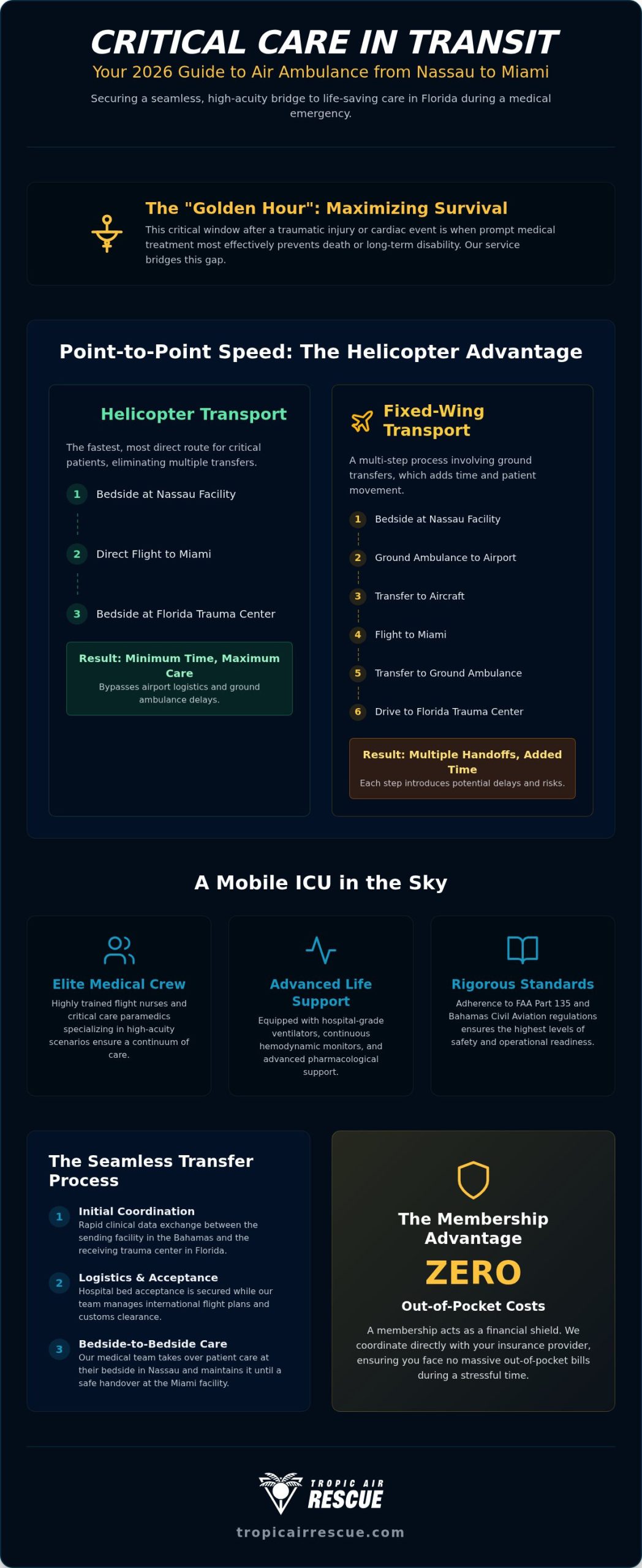
Selecting an air ambulance from Nassau to Miami requires a strategic understanding of aircraft logistics. While many providers rely on fixed-wing planes, these are “Airport-to-Airport” solutions. They require a functional runway at the origin and destination, necessitating at least two ground ambulance transfers. In contrast, helicopter transport operates on a “Point-to-Point” model. This approach eliminates the “tarmac delay” where a patient must be moved from a hospital bed to a ground unit, then to an aircraft, and then repeat the process upon arrival in Florida. For critical patients, reducing these transitions is a medical necessity, not just a convenience.
The geography of the Bahamas makes this choice even more impactful. Many islands lack the infrastructure for traditional jets, leaving patients stranded without rotor-wing intervention. By utilizing advanced helicopters, medical teams can land directly at a local clinic or even a remote resort. This capability ensures that the high-acuity care described in previous sections begins immediately, rather than after a long drive to a regional airport. It’s a concierge-level approach to logistics that prioritizes clinical speed above all else.
Speed of Response in Remote Locations
Rotor-wing aircraft are essential for navigating the “Out Islands” where infrastructure is limited. For a patient at a remote resort, a helicopter provides a direct lifeline that bypasses the need for local ground transport entirely. This method drastically reduces “patient touches,” which are the physically demanding transfers between different medical stretchers and vehicles. Each touch represents a moment of risk for a fragile patient. To understand how these factors influence the safety of your evacuation, you can review our full comparison of Helicopter vs Fixed Wing Medevac. Minimizing transit steps preserves patient stability and accelerates the total time to definitive care.
The Logistics of Direct Hospital Landing
The most profound advantage of helicopter transport is the ability to land directly on hospital helipads in Miami. While fixed-wing flights must land at major airports and wait for ground ambulance clearance, a helicopter bypasses the urban congestion of South Florida. This direct access is vital for time-critical conditions like stroke or cardiac events, where every second of delay results in the loss of viable tissue. Operating under strict FAA air ambulance safety guidelines, these flights utilize precision navigation to transition from the open ocean to the hospital roof in one continuous motion. Direct helipad access transforms the arrival process from a multi-stage logistical hurdle into a seamless clinical handover. This efficiency directly correlates with improved patient outcomes by ensuring immediate access to specialized trauma surgeons and neurological suites.
Coordinating a Seamless Patient Transfer to Florida
Executing an air ambulance from Nassau to Miami is a multi-disciplinary operation that requires surgical precision. It’s not merely a flight; it’s a meticulously timed sequence of clinical and logistical events. The process begins with an immediate medical assessment where flight physicians review the patient’s current status and diagnostic data. This initial triage ensures the aircraft is configured with the specific life-support systems required for the case. Coordination moves rapidly from medical data gathering to the critical task of securing bed acceptance at a Florida trauma center. A flight cannot depart until a receiving physician in Miami confirms they have the specialized resources and space to take over care immediately upon arrival.
Once medical acceptance is confirmed, the focus shifts to international flight logistics. This involves filing expedited flight plans and coordinating with US Customs and Border Protection (CBP) for medical clearance. During the flight, the medical crew maintains continuous monitoring, adjusting interventions in real-time. The mission concludes with a formal clinical handover at the receiving hospital. This bedside-to-bedside protocol ensures that the receiving surgical or neurological team has a comprehensive understanding of the patient’s status during transit. Each step is designed to eliminate friction and maximize the speed of delivery to definitive care.
International Medical Repatriation Protocols
Navigating the legal requirements for US entry during a medical crisis is a complex task. Flight coordinators manage all necessary manifests and medical declarations to ensure the aircraft receives priority handling from air traffic control and customs officials. In 2026, these protocols utilize digital pre-clearance systems to minimize time spent on the tarmac. Beyond the paperwork, the coordinator serves as a vital link for the patient’s family, providing real-time updates on the mission’s progress. For a detailed breakdown of these requirements, refer to our Bahamas to Florida Patient Transfer Guide. Clear communication reduces the emotional burden on loved ones during high-stakes evacuations.
Inter-Hospital Coordination
Seamless care requires a direct bridge between the sending physician in Nassau and the receiving specialist in Miami. Our air rescue teams facilitate this high-level exchange of clinical data, ensuring that the continuum of care isn’t interrupted by the international border. This streamlined “bed-to-bed” protocol means the patient is never left in a logistical vacuum. The receiving facility is fully briefed on the patient’s hemodynamic status and pharmacological needs well before the helicopter touches down on the helipad. You can secure this level of expert coordination for your family by choosing an Annual Membership today.
The Membership Advantage: Eliminating Out-of-Pocket Costs
A medical crisis isn’t the time to negotiate financial terms or verify insurance coverage limits. For many, the logistical success of an air ambulance from Nassau to Miami is overshadowed by the fear of a massive medical bill. A medevac membership serves as a critical financial shield, transforming a potentially ruinous expense into a managed service. This model positions the provider as an elite partner rather than a transactional utility. It ensures that the focus remains entirely on clinical outcomes while the administrative complexities of international billing are handled by experts.
This concierge approach provides a dedicated rescue partner on constant standby. Whether you’re a resident or a visitor, having a pre-established relationship with a medical flight team eliminates the friction of emergency booking. It provides a level of meticulous preparedness that standard insurance policies can’t match. You aren’t just buying a flight; you’re securing an elite logistical guardian for your family’s safety. Meticulous planning today prevents operational delays during the “Golden Hour” tomorrow.
No Out-of-Pocket Air Ambulance Services
Members benefit from a system designed to eliminate patient invoicing. Traditional air medical flights often require substantial upfront payments or leave patients with large balance bills after insurance pays only a portion. Our membership model accepts the insurance reimbursement as payment in full. This proactive approach to insurance coordination ensures that members face zero out-of-pocket costs for their transport. You can review the full details of this financial protection in our Annual Air Rescue Membership Guide. It’s a disciplined strategy to protect your assets during a medical emergency.
Securing Peace of Mind for Travelers and Expats
Standard travel insurance often includes restrictive clauses that delay or deny emergency air rescue. These policies may require patients to be transported to the “nearest capable facility,” which might not be the Level 1 trauma center you require in Florida. A dedicated Annual Membership or Short-term Membership provides a direct line to a helicopter resource capable of landing in remote locations. This is especially vital for those on the Out Islands where fixed-wing access is non-existent. Don’t leave your medical transit to chance; secure your coverage today to ensure hospital-grade care is always within reach.
Secure Your Elite Medical Bridge to Florida
Navigating a medical crisis in the Bahamas requires more than just a flight; it demands a disciplined, point-to-point clinical operation. By prioritizing rotor-wing transport, you eliminate the tarmac delays and multiple patient transfers inherent in traditional aviation. This specialized approach ensures that your journey via air ambulance from Nassau to Miami remains a seamless extension of hospital-grade care. From remote island landings to direct helipad access at Florida trauma centers, every logistical detail is managed with professional composure.
A medevac membership serves as your ultimate financial shield. It replaces the anxiety of massive out-of-pocket bills with the certainty of direct insurance billing and 24/7 emergency coordination. You gain an elite, “always ready” guardian that values meticulous preparedness and proactive safety. Don’t leave your family’s critical care to chance or administrative hurdles. Secure your peace of mind with a Tropic Air Rescue membership today.
Expert preparation is the foundation of survival. Take the decisive step now to ensure that when seconds matter, the most advanced medical resources are already standing by for you.
Frequently Asked Questions
Is an air ambulance from Nassau to Miami covered by insurance?
Coverage depends on your specific policy and the provider’s billing practices. For our members, we utilize a direct insurance billing model that accepts the insurer’s payment as payment in full, which eliminates out-of-pocket costs. Non-members often face significant balance billing or requirements for massive upfront payments. A membership acts as a financial shield, ensuring that the focus remains on clinical care rather than administrative hurdles or unexpected medical debt.
What is the fastest way to transport a patient from the Bahamas to Florida?
Point-to-point helicopter transport is the fastest method because it bypasses the logistical delays inherent in fixed-wing transfers. While planes require airport runways and multiple ground ambulance moves, a helicopter lands directly at the sending facility and the receiving Florida trauma center. This “bed-to-bed” protocol maximizes the “Golden Hour” for critical patients. It ensures the fastest possible transition to specialized surgical intervention by eliminating unnecessary transitions and urban traffic.
Can a helicopter fly a patient directly from a Bahamas hospital to a Miami trauma center?
Yes, helicopters provide specialized inter-hospital transfer services that function independently of traditional airport infrastructure. This capability allows the medical team to load the patient at the Nassau facility and land directly on a hospital helipad in Miami. This method drastically reduces the number of physical transitions and “patient touches.” It’s a concierge-level solution that maintains a continuous, high-acuity ICU environment throughout the entire international air ambulance from Nassau to Miami.
What medical staff are on board during an emergency patient transport?
Every mission is staffed by an elite medical team typically consisting of flight nurses and critical care paramedics. These professionals are experts in high-acuity care, including advanced ventilator management and continuous hemodynamic monitoring. They maintain a disciplined, “always ready” demeanor while managing complex pharmacological interventions in flight. This specialized crew composition ensures that hospital-grade care is never interrupted during the transit window, providing a seamless clinical handover to US specialists.
How do I coordinate an inter-hospital transfer to the United States?
Coordination is a multi-step process managed by a dedicated flight coordinator to ensure operational excellence. We begin by gathering patient data for an immediate medical assessment and then secure bed acceptance from a receiving Florida trauma center. Our team handles all international flight plans and customs clearance with US authorities simultaneously. This streamlined approach allows families and local physicians to focus on the patient while we manage the complex logistics of the international crossing.
Do I need a membership for emergency air medical services in the Bahamas?
While emergency transport is available, a membership is the only way to guarantee zero out-of-pocket costs and immediate concierge-level response. Membership plans provide a financial shield by billing your health insurance directly and accepting their payment as full compensation. Without this protection, patients often face complex invoicing or the need for immediate payment. Having a dedicated rescue partner on standby is vital for residents and visitors in remote island locations.
What happens if a medical emergency occurs at night in the Bahamas?
Nighttime emergencies require specialized aircraft and crews trained in night-vision imaging systems. We achieved the first nighttime helicopter air ambulance trauma transfer in Bahamas history, establishing a new standard for 24/7 operational readiness. Our teams remain prepared for immediate deployment regardless of the hour, utilizing advanced avionics to navigate safely. This capability is essential for trauma patients who require immediate air ambulance from Nassau to Miami services and cannot wait for daylight.
Can air ambulances land at remote resorts or private yachts?
Advanced helicopters can land in remote locations where fixed-wing aircraft cannot operate, including resort helipads or cleared areas near private yachts. This flexibility is a primary advantage of rotor-wing transport within the Bahamas archipelago. It allows for immediate medical extraction without the need for a secondary ground or sea transfer to a regional airport. This point-to-point capability is a critical component of our elite, high-end guardian service for those in isolated areas.