

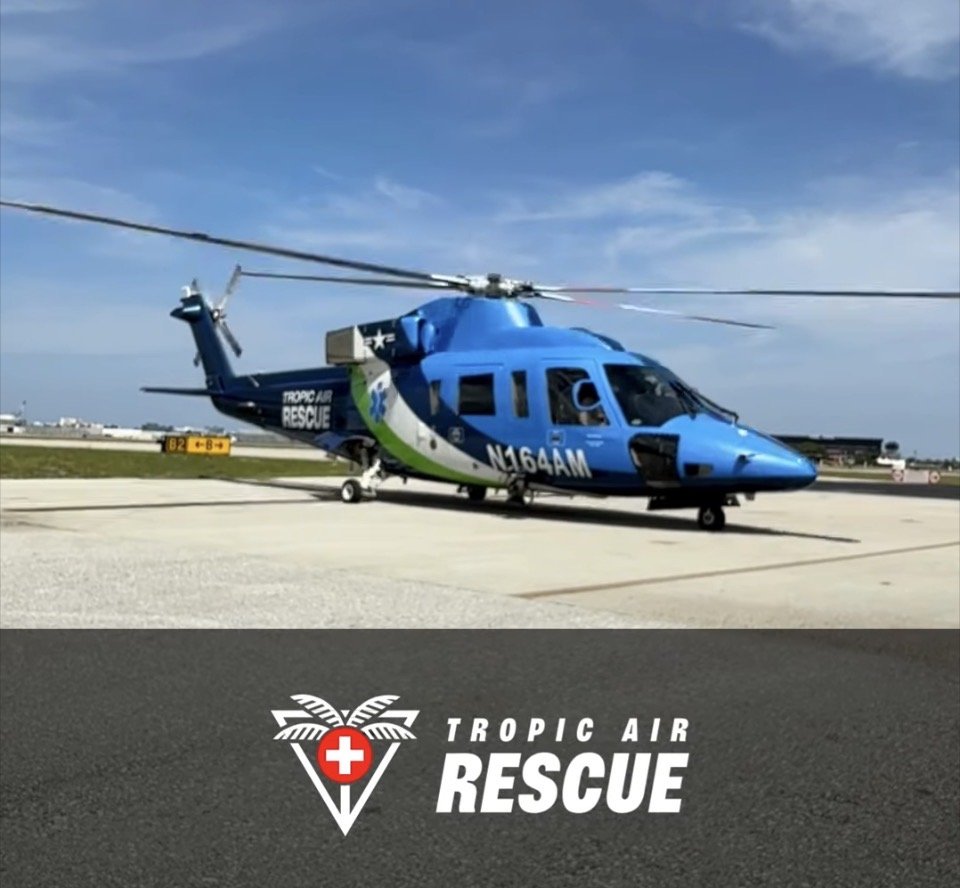
A single medical evacuation from the remote Out Islands can cost upwards of $142,000, yet many captains still rely on standard travel policies that only offer reimbursement weeks after the crisis has passed. Designing a true emergency medical plan for boaters in Bahamas requires more than just a financial safety net. It demands a dedicated logistical strike team capable of landing where fixed-wing aircraft cannot reach. You understand the inherent risk of being stranded in a remote anchorage with limited medical facilities. The anxiety of potential six-figure out-of-pocket air ambulance costs is a heavy weight on any international voyage.
This 2026 guide provides the roadmap to securing elite medical flight coverage that bridges the gap between your vessel and U.S. trauma centers. You’ll discover how a membership model eliminates financial exposure through direct insurance billing, effectively removing the need for massive upfront payments. We will analyze the critical differences between basic travel insurance and specialized medevac logistics, ensuring you have direct access to the highest level of care. From updated 2026 cruising regulations to the specialized advantages of helicopter transport, here is how to protect your crew with professional precision and quiet confidence.
Key Takeaways
- Understand why helicopter medevac is the only viable solution for remote vessel rescue, bypassing the logistical delays and runway requirements of fixed-wing aircraft.
- Learn how to avoid the $50,000 upfront “reimbursement trap” by choosing a membership model that utilizes direct insurance billing for zero out-of-pocket exposure.
- Audit your current health and marine policies for international air medical exclusions to build a comprehensive emergency medical plan for boaters in Bahamas.
- Discover the concierge advantage of a dedicated logistical strike team that coordinates every detail of your transfer directly to elite U.S. trauma centers.
Why Boaters in the Bahamas Need a Specialized Emergency Medical Plan
The “Golden Hour” is a physiological deadline. In the Bahamas, this window is often closed by the archipelago’s geography. While main population centers offer hospital facilities, the majority of the 700+ islands and cays lack the critical care equipment necessary for stabilization. If a medical crisis occurs at a remote anchorage, your vessel’s distance from a trauma center becomes your greatest liability. Relying on local clinics for life-threatening events is a gamble. These facilities are designed for basic care, not advanced surgical intervention or neurological emergencies. Without a specialized emergency medical plan for boaters in Bahamas, you’re forced to manage a high-stakes logistical puzzle while your crew’s health hangs in the balance.
The financial risk is as significant as the medical one. Most air medical services require payment confirmation before the aircraft even leaves the tarmac. Without a pre-arranged membership, you face the prospect of wiring six-figure sums in the middle of the night. Professional preparation means eliminating these variables before you weigh anchor.
The Logistical Gap in Standard Boat Insurance
Captains often assume their hull and liability policies cover medical emergencies. They don’t. These policies focus on the vessel’s integrity, not the crew’s survival. There’s also a dangerous confusion between “Search and Rescue” (SAR) and medical evacuation. SAR, often provided by government entities, focuses on locating a vessel and bringing individuals to the nearest shore. It doesn’t include the sophisticated clinical transport required to reach a U.S. hospital. Most travel policies also contain “reimbursement only” clauses. This means you must pay the full cost upfront and fight for a refund later. It’s a financial trap that can stall a rescue when minutes matter most.
Medical Flight Coverage vs. Standard Health Insurance
Standard U.S. health insurance, including Medicare, rarely extends coverage to international waters or foreign soil. Even if your policy has an international rider, it won’t coordinate the complex logistics of a cross-border flight. You’re left to navigate international customs, flight clearances, and hospital admissions on your own. A dedicated plan manages this international bureaucracy on your behalf. An emergency medical plan for boaters in Bahamas serves as a dedicated logistical bridge between a remote vessel and a trauma centre. It ensures that the focus remains on clinical outcomes rather than administrative hurdles.
Comparing Coverage: Travel Insurance vs. Medevac Memberships
Many captains rely on comprehensive travel insurance, believing it covers every contingency. It doesn’t. Standard insurance operates on a reimbursement model. If an air ambulance provider demands a massive upfront deposit, the financial burden falls on you. This is the industry-standard “reimbursement trap.” You’re expected to pay $50,000 or more before the aircraft even leaves the hangar. In contrast, an elite emergency medical plan for boaters in Bahamas functions as a service agreement. It ensures that medical flight costs are handled through direct billing to your health insurer, protecting your liquidity when it matters most.
Insurance companies are financial entities. They are not logistical experts. They often provide a capped payout, leaving you to manage the complex coordination of pilots, international flight permits, and hospital admissions. According to U.S. Embassy guidance on medical assistance, medical evacuations from the Bahamas are private transactions that must be arranged by the patient or their family. A membership model removes this burden. It provides a logistical strike team rather than a capped dollar amount, managing the entire chain of survival from the moment of dispatch.
Key Features of an Elite Medevac Membership
An elite membership prioritizes speed and financial security. Direct billing capabilities ensure you never face a six-figure bill during a medical crisis. These plans also specialize in inter-hospital transfer protocols. This is critical for moving patients from stabilized Bahamian clinics to specialized U.S. trauma centers. 24/7 concierge medical dispatch centers act as your central command, handling every detail of the international transfer and ensuring your medical records precede your arrival.
What to Look for in a 2026 Buying Guide
When evaluating options, verify if the provider owns their fleet. Brokers often add layers of delay and cost. Ensure the plan specifically includes vessel-to-hospital logistics, as some services only cover airport-to-airport transfers. For those planning shorter voyages, reviewing a Short-Term Medevac Guide for Island Travelers 2026 can help tailor coverage to your specific itinerary. Selecting a partner like Tropic Air Rescue ensures you have a dedicated guardian for every nautical mile of your journey.
Helicopter Logistics: The Critical Advantage for Remote Vessel Rescue
Runways are the logistical enemy of a rapid rescue. While fixed-wing aircraft offer speed over long distances, they’re tethered to the few paved airstrips scattered across the islands of the Bahamas. For a captain anchored in the remote Exumas or the Berry Islands, a fixed-wing evacuation requires a multi-stage transfer: vessel to shore, shore to ground ambulance, and ambulance to a distant runway. Each transition adds risk and consumes time you don’t have. A helicopter eliminates these layers. It offers the precision to land at remote resorts, private docks, or helipads directly adjacent to your anchorage, providing a seamless bridge to care.
Navigating the maritime environment of the Bahamas demands advanced avionics and specialized flight training. Our fleet utilizes high-precision navigation systems designed for over-water operations, ensuring rapid deployment regardless of the island’s isolation. This technical edge is a core component of a robust emergency medical plan for boaters in Bahamas. It transforms a complex international rescue into a coordinated, direct-to-hospital operation. The goal is simple: reduce the number of patient transfers and maximize the speed of clinical intervention.
Why Helicopters Win in the Bahamas
The primary advantage of helicopter transport is the elimination of the ground ambulance “middle man.” In a traditional medevac, the patient is moved multiple times between different vehicles. This increases the potential for clinical instability. Helicopters provide a single, continuous environment of care from the point of pickup to the trauma center’s helipad. For a detailed breakdown of these operational differences, consult our guide on Helicopter vs Fixed Wing Medevac: The Critical Choice for Bahamas Emergencies in 2026. The ability to land in areas inaccessible to traditional aircraft isn’t just a convenience; it’s a life-saving necessity in the Out Islands.
Trauma-Grade Equipment Onboard
Our cabin configurations mirror the capabilities of a high-acuity hospital unit. Each aircraft is equipped with Advanced Life Support (ALS) technology, including cardiac monitors, ventilators, and infusion pumps. This allows for the continuous management of critical patients during international transit. We utilize specialized medical staffing, including flight-certified nurses and paramedics trained in maritime rescue protocols. Helicopter medevac is a mobile ICU, not just a transport vehicle. This level of clinical sophistication ensures that your emergency medical plan for boaters in Bahamas provides more than just a flight; it provides a survival advantage.
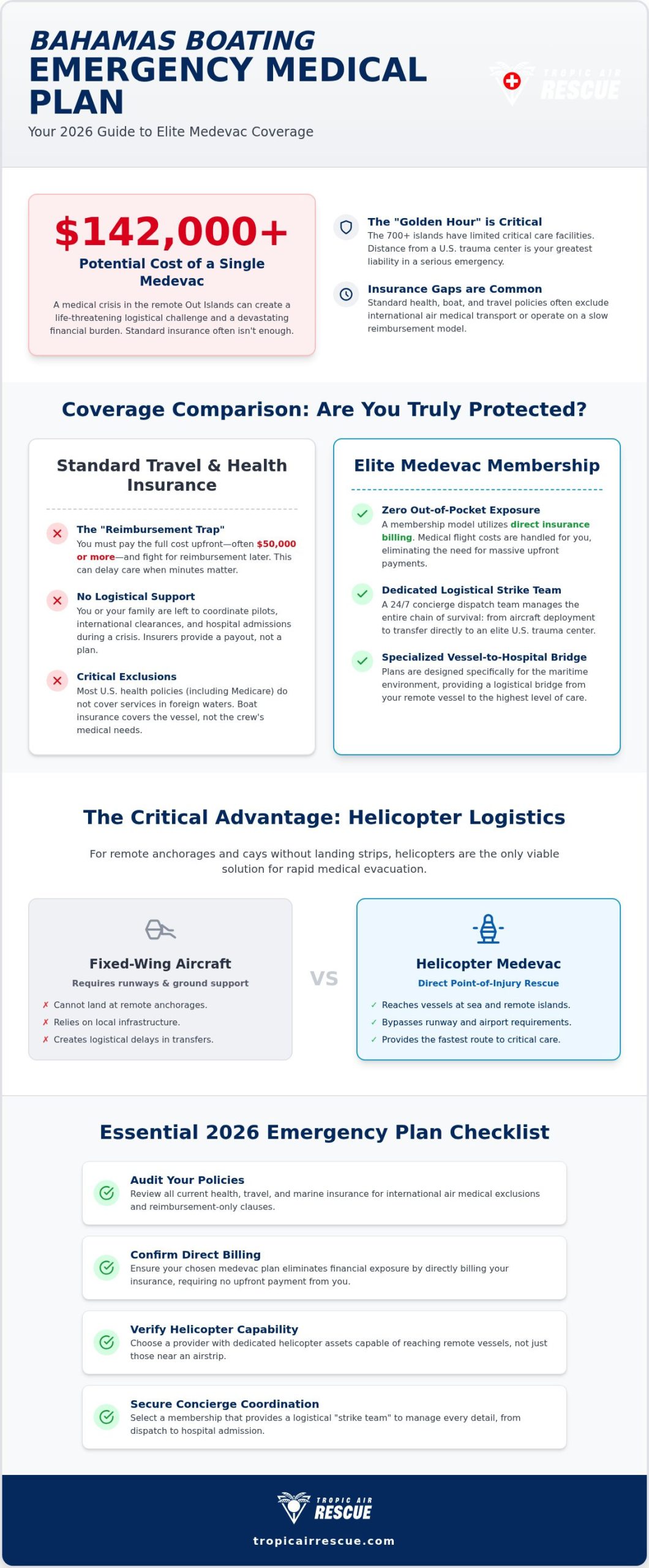
Essential Checklist for Your 2026 Bahamas Boating Emergency Plan
Preparation is the only defense against the logistical chaos of a maritime crisis. An effective emergency medical plan for boaters in Bahamas isn’t a vague set of instructions; it’s a verified operational checklist. Comprehensive preparation begins at your home port—for captains staging out of South Florida, you can explore Boat Slip Rentals and Residential Leasing to secure a dependable base before crossing over. From there, you must move beyond general safety apps and implement a protocol that guarantees immediate clinical intervention and financial protection. Use the following steps to audit your readiness before you clear customs.
- Step 1: Audit for Exclusions. Review your current health and boat insurance policies specifically for “international air medical” exclusions. Many standard plans stop coverage at the border or exclude aerial transport entirely.
- Step 2: Secure Direct Billing. Verify that your membership provider offers direct billing to insurance. This is the only way to avoid the massive out-of-pocket exposure that can stall a rescue.
- Step 3: Confirm Inter-Hospital Transfer. Ensure your plan covers the entire journey from a remote Bahamian clinic to a specialized U.S. trauma center.
- Step 4: Distribute Protocols. Brief every crew member and passenger on the dispatch process. Safety is a collective responsibility.
- Step 5: Verify Fleet Capability. Confirm your provider operates a specialized helicopter fleet capable of landing near your vessel rather than relying on distant runways.
Communication Protocols on the Water
Satellite communication is your primary lifeline when you’re beyond cellular range. Your emergency medical plan for boaters in Bahamas must be integrated with your satellite hardware, such as Starlink or InReach. In a crisis, your rescue provider needs precise GPS coordinates and a preliminary medical brief to prepare the aircraft. Rapid data sharing allows the flight team to stabilize the patient the moment they arrive. For a deeper technical analysis of these rescue chains, consult Trauma Air Transport in the Bahamas: The 2026 Emergency Guide.
Documentation and Readiness
Physical readiness is as critical as your digital comms. Keep your membership cards and insurance documentation in a waterproof “ditch bag” that’s easily accessible during an evacuation. You should also pre-authorize family members for emergency medical decisions to prevent legal delays when every second counts. Finally, match your membership type to your itinerary. Short-term memberships are perfect for 30-day cruising permits, while annual plans offer the best value for those with 6-month or 12-month re-entry permits. Don’t leave your safety to chance; contact Tropic Air Rescue to finalize your 2026 safety protocol today.
Tropic Air Rescue: Concierge Air Medical Solutions for Yacht Owners
Tropic Air Rescue positions itself as the definitive guardian for the yachting community. While generic travel protection plans offer broad, non-specific coverage, we provide a specialized emergency medical plan for boaters in Bahamas that focuses on operational excellence in maritime environments. Our fleet is purpose-built for the unique geography of the archipelago. We don’t just facilitate transport; we manage the entire clinical and logistical chain from your vessel to a Florida trauma center. This concierge approach ensures that every detail, from international flight clearances to hospital admission, is handled with professional composure and quiet confidence.
Our membership model is engineered to protect your financial liquidity. By utilizing direct insurance billing, we eliminate the need for massive out-of-pocket payments during a crisis. This is a critical distinction for yacht owners who require immediate action without the administrative delay of upfront wire transfers or complex reimbursement paperwork. Whether you’re navigating the popular Abacos or the remote reaches of the southern Out Islands, our service operates as a seamless, high-end extension of your vessel’s safety protocols. We bridge the gap between isolation and elite medical care.
A Private Elite Partner for Your Safety
Our medical flight crews maintain an “always ready” demeanor, standing by to respond with high-stakes urgency. We maintain a disciplined focus on speed, geographical precision, and technological advancement. This balance is essential when performing complex transfers from remote anchorages where every minute dictates the medical outcome. For yacht owners who value exclusivity and meticulous preparation, we serve as a private, elite partner. Review The Elite Guide to Concierge Air Medical Service in 2026 to understand how our specialized staffing and equipment set the standard for Bahamian medevac.
Securing Your Membership Today
We offer flexible membership options designed for the unique rhythms of the boating community. Short-term memberships provide robust protection for specific voyages, while annual plans offer year-round security for residents, expats, and seasonal cruisers. The signup process is streamlined to ensure you can secure coverage before your next departure. This is a “set it and forget it” emergency medical plan for boaters in Bahamas that provides direct access to U.S. trauma centers with zero out-of-pocket financial exposure. Don’t wait for a crisis to test the limitations of your existing coverage. Secure your Bahamas air rescue membership today and ensure your crew has the protection they deserve.
Command Your Safety in the Bahamas
The difference between a routine cruise and a catastrophic medical event often comes down to the quality of your emergency medical plan for boaters in Bahamas. Standard travel insurance often fails at the point of impact, leaving you to manage complex logistics and massive upfront costs. True protection requires a dedicated logistical partner with a specialized helicopter fleet capable of reaching your vessel in the remote Out Islands. This elite approach ensures you bypass the reimbursement trap entirely.
Our membership model provides direct billing to your insurer, eliminating out-of-pocket financial exposure during a crisis. We manage every detail, from the point of rescue to seamless coordination with U.S. trauma centers. Professional preparation isn’t just about safety; it’s about maintaining command over your environment. Secure Your Concierge Air Medical Membership and navigate your next voyage with absolute confidence.
Frequently Asked Questions
Does standard boat insurance cover medical flight coverage for boat owners in Bahamas?
Standard boat insurance typically excludes international medical flight coverage. While these policies address vessel damage or liability, they rarely manage or fund the complex logistics of a medical evacuation. Captains often find that “reimbursement” clauses in travel riders require massive upfront payments. A dedicated emergency medical plan for boaters in Bahamas is necessary to bridge this specific gap and ensure immediate aerial response without financial delay.
How does a medevac membership differ from traditional travel insurance?
Traditional travel insurance is a financial safety net that often operates on a reimbursement basis, requiring you to pay for the flight before filing a claim. In contrast, a medevac membership is a logistical strike team. It provides immediate aircraft deployment and direct insurance billing. This model eliminates the need for members to produce tens of thousands of dollars during a crisis, focusing on clinical outcomes rather than administrative paperwork.
Can a medical helicopter land directly on my yacht or a remote beach?
Helicopters provide the unique capability to land at remote resorts, private docks, or cleared areas near your anchorage that are inaccessible to fixed-wing aircraft. While landing directly on a moving yacht is rarely feasible for civilian medical operations, our pilots specialize in “vessel-to-shore” logistics. This allows us to meet your crew at the nearest safe landing zone, significantly reducing the transit time and the number of patient transfers required.
What happens if I need an inter-hospital transfer from the Bahamas to the US?
We specialize in interhospital transfer services for patients requiring higher levels of care at Florida trauma centers. Our team manages the entire international coordination process, including flight clearances, medical records transfer, and hospital admission. This seamless transition ensures that critical care continues uninterrupted from the moment you leave a Bahamian clinic until you arrive at a specialized U.S. facility equipped for your specific medical needs.
How does direct insurance billing work for emergency air medical services?
Direct insurance billing is a core benefit of our membership model designed to protect your liquidity. When an emergency occurs, we bill your health insurance provider directly for the cost of the transport. For members, this means zero out-of-pocket exposure for the flight. We accept the insurance payout as full payment, removing the common requirement for patients to wire large sums of money before an aircraft is dispatched.
Is there a waiting period after signing up for a medevac membership?
Most memberships are active shortly after the signup process is completed, but it’s essential to secure coverage before you clear customs. We recommend finalizing your emergency medical plan for boaters in Bahamas at least 24 to 48 hours before your voyage begins. This ensures all member data is integrated into our dispatch system, allowing our “always ready” flight crews to respond instantly if a crisis occurs on the water.
What medical equipment is typically available on a Tropic Air Rescue helicopter?
Our helicopters function as mobile intensive care units. Each aircraft is equipped with hospital-grade life-support technology, including Advanced Life Support (ALS) monitors, ventilators, and infusion pumps. This equipment allows our specialized medical flight crews to maintain high-acuity care during international transit. We also utilize advanced avionics for precise over-water navigation, ensuring we can reach remote Out Island locations with maximum speed and geographical precision.
Why is helicopter transport preferred over fixed-wing for Bahamas boaters?
Helicopter transport is preferred because it eliminates the need for paved runways and the ground ambulance “middle man.” Fixed-wing aircraft are restricted to specific airports, often requiring a traumatic and time-consuming ground transfer from your vessel to the strip. Helicopters provide direct access to remote anchorages and resorts. This reduces the number of patient transfers, which is a critical factor in maintaining clinical stability during a high-stakes medical emergency.