

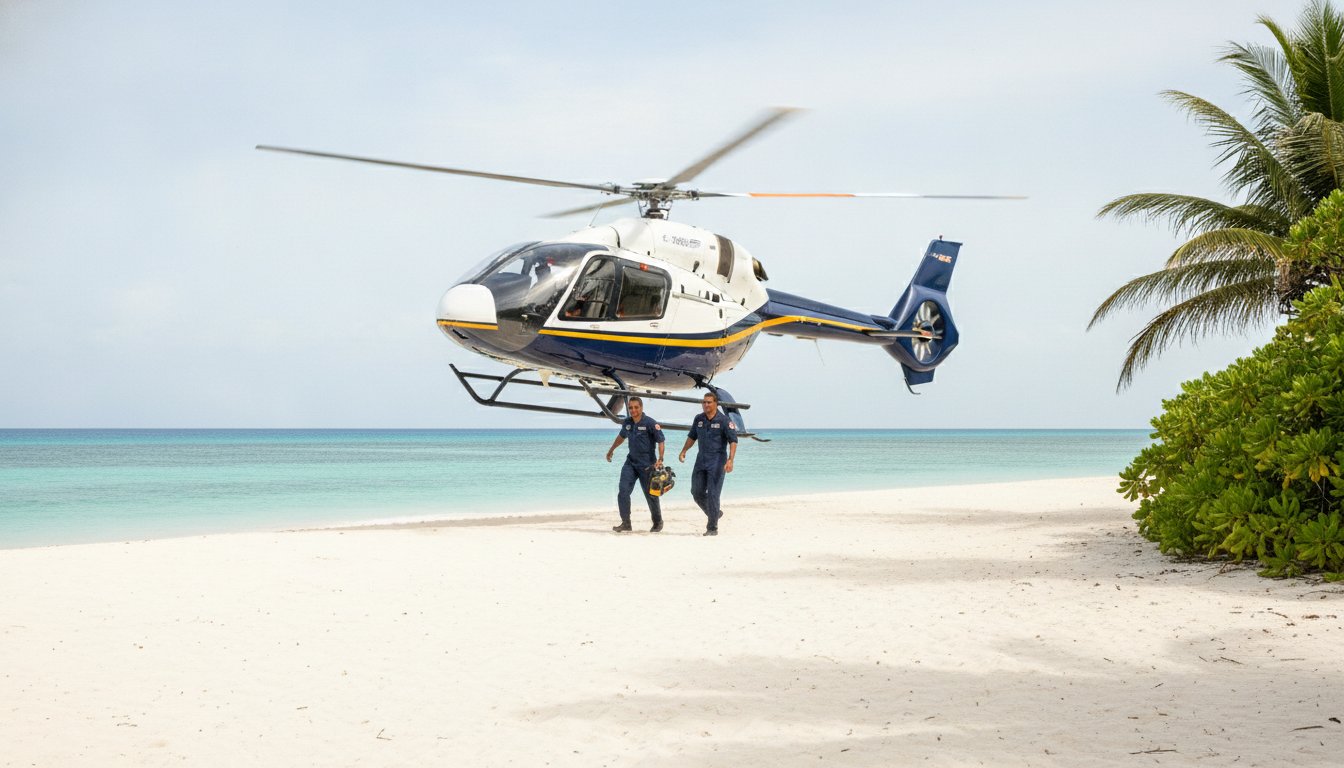
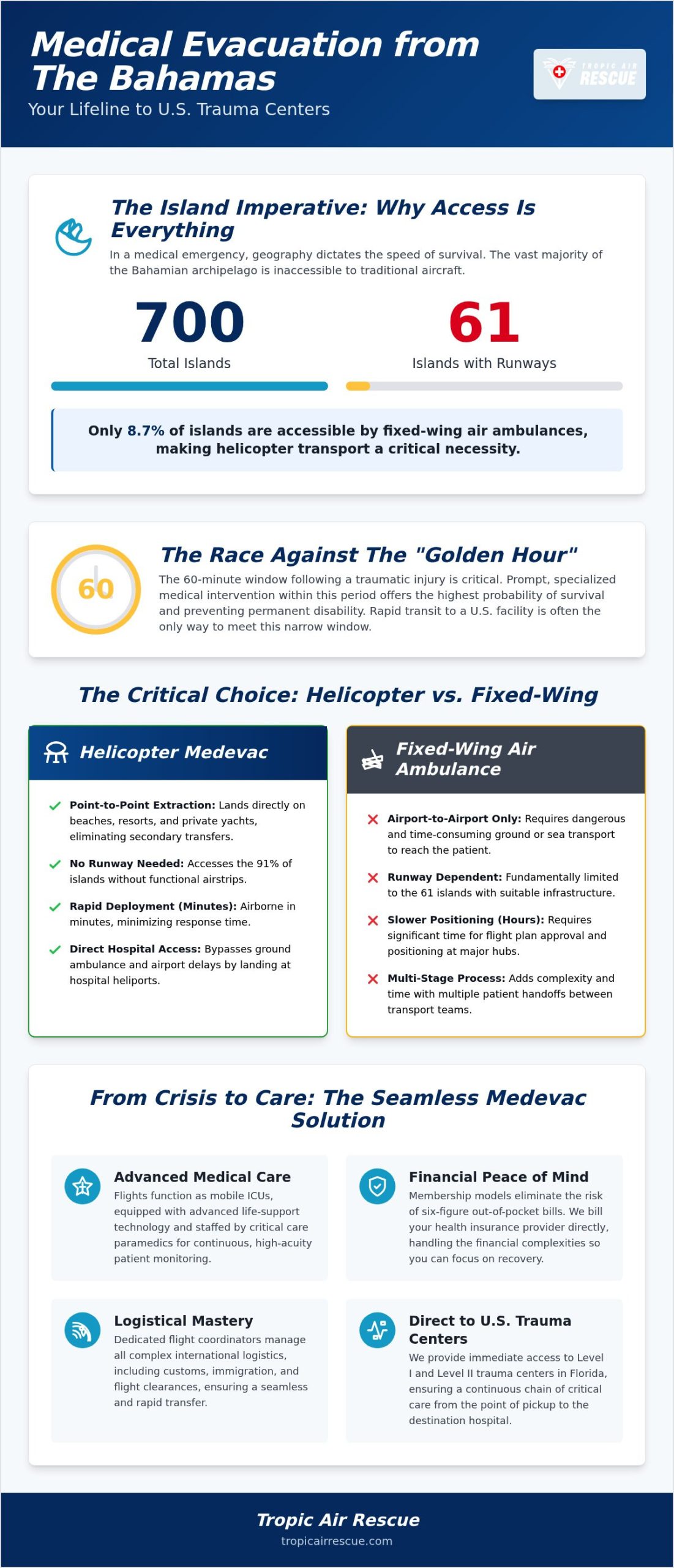
Only 61 of the 700 islands in the Bahamas have functional runways. This geographical reality means that for the vast majority of travelers, a standard fixed-wing aircraft simply cannot reach you during a life-threatening crisis. When a serious injury occurs, the logistics of a medical evacuation from Bahamas to USA become a high-stakes race against the “Golden Hour.” You might fear being stranded in a remote location or facing an overwhelming bill that your standard insurance won’t cover. These concerns are common for those navigating the complexities of international healthcare and emergency aviation.
This 2026 guide provides the operational clarity you need to secure your safety. We’ll examine the critical logistics of international medical transfers, the true costs of emergency transport, and the elite options that guarantee direct access to US trauma centers. You’ll discover how specialized helicopter memberships eliminate out-of-pocket expenses and provide rapid response from even the most secluded cays. We’re breaking down the current standards for seamless medical repatriation so you can focus on recovery instead of logistical hurdles.
Key Takeaways
- Secure immediate access to Florida trauma centers by understanding the logistical requirements of a medical evacuation from Bahamas to USA.
- Recognize the critical advantage of helicopter transport in a region where only 61 islands possess the runways necessary for fixed-wing aircraft.
- Eliminate the risk of six-figure air ambulance bills through membership models that offer direct billing to your health insurance provider.
- Learn how the “Golden Hour” is preserved through point-to-point transfers that bypass ground ambulance delays and airport logistics.
- Discover how elite concierge services provide advanced life-support equipment and critical care paramedics on every emergency flight.
Understanding the Logistics of Medical Evacuation from the Bahamas
A medical evacuation is a highly specialized international patient transfer. It’s not just a flight; it’s a coordinated critical care mission. For patients in the archipelago, a medical evacuation from Bahamas to USA serves as a vital bridge to advanced healthcare. The process involves mobilizing air medical services equipped with ICU-level technology to move patients who require immediate, high-acuity intervention. This transition requires a seamless blend of aviation precision and clinical expertise.
Time is the most critical variable in emergency medicine. The “Golden Hour” refers to the sixty-minute window following a traumatic injury. During this period, prompt surgical or medical treatment offers the highest probability of preventing death or permanent disability. In the Bahamas, where local facilities may lack specialized trauma equipment, rapid transit to a US facility is often the only way to meet this narrow window. Every minute spent in transit must be utilized for stabilization and monitoring.
The Complexity of International Patient Repatriation
Moving a patient across borders requires meticulous logistical planning. Flight coordinators must manage customs and immigration protocols for both the flight crew and the patient simultaneously. Unlike commercial travel, emergency medical flights operate under strict international regulatory requirements that prioritize speed without compromising safety. A dedicated flight coordinator manages multi-agency logistics, ensuring that flight paths are cleared and ground support is ready upon arrival.
Maintaining medical stability during transit is paramount. Medical teams must monitor vitals continuously while managing the physiological effects of pressure changes on the patient’s condition. This involves using advanced life-support equipment, such as transport ventilators and invasive monitoring tools, to ensure the patient’s status doesn’t deteriorate during the journey. The goal is to deliver the patient in a stable, or improved, condition compared to when they were first reached.
Why US Trauma Centers are the Primary Destination
Florida medical facilities offer access to specialized surgical teams and diagnostic tools unavailable on most islands. These centers provide Level I or Level II trauma care, which includes 24-hour in-house coverage by trauma surgeons and specialists. Direct heliport access is a significant advantage for a medical evacuation from Bahamas to USA. It allows the medical team to bypass ground ambulance delays and move the patient directly from the aircraft to the emergency department. This ensures a continuous chain of critical care from the moment of pickup until the final transition of care to the hospital staff.
Helicopter vs. Fixed-Wing: The Critical Advantage in Island Rescues
In the Bahamian archipelago, geography dictates the speed of survival. While fixed-wing jets offer high-velocity transit over long distances, they are fundamentally limited by runway availability. Only 61 of the 700 islands in the Bahamas possess the asphalt infrastructure required for traditional aircraft to land. If a medical emergency occurs on a remote cay or a private vessel, a fixed-wing air ambulance remains grounded at a major airport, necessitating a dangerous and time-consuming ground or sea transfer for the patient. Helicopters eliminate this logistical bottleneck through point-to-point extraction. Agile Response defines the operational capacity of medical helicopters to execute immediate, point-to-point extractions from remote island environments where traditional aviation infrastructure is absent.
The launch sequence also favors rotary-wing aircraft. A medical helicopter can often be airborne in minutes, whereas a jet frequently requires hours for positioning and flight plan approval at international hubs. For a medical evacuation from Bahamas to USA, this difference in response time can be the deciding factor in patient outcomes. Modern helicopters utilized for these missions feature advanced avionics, including night-vision technology and terrain-awareness systems, ensuring safe operations during high-stakes night-time rescues when visibility is compromised.
Reaching Remote Locations Without Runways
Helicopters provide the unique ability to land directly on beaches, resort helipads, or even the aft decks of private motor yachts. This capability removes the “last mile” problem that plagues island logistics. By landing at the patient’s side, the medical team eliminates the need for a secondary ground ambulance transfer to an airport. This reduction in handling is vital for patients with spinal injuries, cardiac distress, or multi-system trauma. Every minute saved by bypassing ground logistics directly expands the window for successful intervention at a US trauma center. Travelers should consider a specialized rescue membership to ensure these assets are immediately available without the delays of third-party dispatch.
Hospital-Grade Care in the Air
The interior of a dedicated medical helicopter is a compact, sterile ICU. These aircraft are outfitted with advanced life-support systems, including multi-parameter heart monitors, transport ventilators, and integrated oxygen delivery. Every flight is staffed by critical care paramedics and pilots trained specifically for high-acuity island operations. This ensures that the level of care remains consistent from the moment of pickup through the entire flight. According to Johns Hopkins advice for traveling abroad, the financial and logistical responsibility for these high-cost transfers rests solely on the traveler, as standard insurance rarely covers the full scope of a medical evacuation from Bahamas to USA. Maintaining a high-acuity environment during transit is not just about equipment; it is about the elite coordination of medical and aviation expertise.
Navigating the Costs: Travel Insurance vs. Medevac Membership
The financial impact of a sudden medical crisis in the islands can be as devastating as the injury itself. A single private air ambulance charter often results in a bill exceeding $100,000. For many travelers, this cost comes as a shock during an already high-stress event. Standard travel insurance typically operates on a “pay and reclaim” model. This requires the patient or their family to secure the funds upfront; often through massive credit card holds; before the flight is even dispatched. Relying on this reactive approach leads to dangerous delays in a medical evacuation from Bahamas to USA.
A concierge membership functions as a proactive financial safeguard. By establishing a relationship with a provider before an emergency occurs, you initiate a pre-certification process. This coordination ensures that your medical and insurance data are already on file. When a crisis is triggered, the focus remains entirely on patient stabilization and transport logistics rather than financial negotiations. This structured preparation streamlines the emergency response, allowing for an immediate launch when every second counts.
The “No Out-of-Pocket” Membership Model
The primary benefit of an elite membership is the shift to direct insurance billing. Instead of forcing the member to manage complex reimbursement cycles, the rescue service bills the health insurance provider directly. This model eliminates the need for large, immediate out-of-pocket payments. It provides a level of financial predictability that standard insurance cannot match. Whether you utilize a short-term membership for a brief vacation or an annual membership for seasonal residency, the protection remains consistent. This “safety net” ensures that high-acuity transport is accessible without the burden of liquidating assets or maxing out credit lines during a life-threatening event.
Why Standard Insurance Often Falls Short
Standard travel policies frequently include restrictive clauses that limit your care options. Most insurance companies only cover transport to the “nearest appropriate facility.” In the Bahamas, this might mean a local clinic that lacks the specialized surgical teams required for complex trauma. A dedicated medevac membership prioritizes your transfer to a US trauma center, ensuring you reach the highest level of care regardless of local proximity.
Insurance providers also pose a risk of claim denials for transfers they deem “not medically necessary.” This subjective criteria can leave families stranded or facing total financial responsibility for the flight. For a deeper look at protecting your trip, consult the Short-Term Medevac Guide for Island Travelers 2026. Understanding these limitations is essential for anyone planning a medical evacuation from Bahamas to USA, as it highlights the gap between basic coverage and guaranteed emergency response.
Coordinating Your Transfer to a US Trauma Center
Activating a medical evacuation from Bahamas to USA requires more than just an available aircraft. It involves a synchronized response between aviation logistics and clinical oversight. The process begins the moment an emergency call is received. Dispatchers immediately alert the flight crew and the Medical Director. This physician-led oversight is critical for facility selection; ensuring the patient is directed to a trauma center specifically equipped for their injury profile. Unlike generic air ambulance services, this concierge approach manages every variable of the transport chain.
Inter-hospital transfer coordination is the backbone of a successful mission. It requires constant communication between the originating facility in the Bahamas and the receiving trauma center in the United States. The Medical Director facilitates this physician-to-physician handoff, ensuring that the patient’s clinical status is understood by the US surgical teams long before the aircraft touches down. This proactive management prevents delays in the emergency department and ensures a seamless transition of care.
The Pre-Certification and Enrollment Advantage
Survival often depends on the speed of information. Having identity, medical history, and insurance data on file through a membership eliminates the “administrative lag” that usually occurs during the first hour of a trauma. In a standard emergency, hours are lost verifying coverage and collecting patient records. For members, this data is already secured. This allows the rescue team to focus entirely on the flight launch and patient stabilization. To understand the complexities of moving patients between facilities, review our Guide to Coordinating Inter-Hospital Medical Transfers.
Direct Link to Florida Medical Facilities
The final phase of coordination involves securing a bed at a specialized Florida trauma center. Elite rescue services maintain direct communication channels with these facilities to coordinate bed-to-bed transfers. This means the patient is not simply dropped off at an airport; they are delivered directly to the hospital heliport where a trauma team is already scrubbed and waiting. This level of precision is a standard feature of Tropic Air Rescue memberships, which prioritize the elimination of ground ambulance delays. Every logistical detail, from clearing US Customs to landing on the hospital roof, is managed to preserve the critical window of recovery. This integrated approach ensures that a medical evacuation from Bahamas to USA is a continuous life-support mission rather than a series of disconnected steps.
Tropic Air Rescue: Elite Concierge Air Medical Services
Tropic Air Rescue operates as the region’s only concierge helicopter medical service. It is a specialized solution designed for the unique logistical hurdles of the archipelago. By focusing on rotary-wing aviation, the service provides point-to-point extraction from locations where fixed-wing aircraft cannot operate. Every mission is a high-stakes operation managed with professional composure and technical precision. This is the definitive choice for a medical evacuation from Bahamas to USA, ensuring that patients reach Florida trauma centers without the delays of ground ambulance transfers or airport positioning.
The operational core consists of elite pilots and critical care paramedics trained for high-acuity missions. Every flight utilizes advanced life-support equipment, maintaining a sterile ICU environment from the moment of pickup. This team is always ready; they provide a proactive response that eliminates the administrative lag common in traditional air ambulance charters. Membership is the gateway to this elite protection. It offers a direct path to safety for those who value meticulous preparedness and exclusivity.
Coverage Matched to Your Length of Stay
Tropic Air Rescue provides tiered membership options to suit different operational needs. Vacationers can secure a Short-term Membership, providing essential coverage for the duration of a specific trip. For expatriates and second-home owners, the Annual Air Rescue Membership serves as a permanent safety net for year-round residency. Organizations also benefit from custom B2B Membership Plans designed specifically for luxury resorts and private yacht fleets. These plans ensure that guests, residents, and crew have immediate access to the highest level of care during a medical evacuation from Bahamas to USA.
Securing Your Peace of Mind
The concierge experience means every detail is managed by experts. From the initial dispatch call to the final bed-to-bed transfer at a US facility, the rescue team handles all multi-agency logistics. This includes direct insurance billing, which removes the financial pressure of six-figure out-of-pocket costs for members. For a comprehensive overview of these specialized offerings, consult The Elite Guide to Concierge Air Medical Service in 2026. This guide outlines the meticulous standards of our operation. Don’t leave your safety to chance in a remote island environment. Join today to ensure an immediate, expert response tomorrow.
Secure Your Path to Advanced Care
Navigating the geography of the Bahamas requires a proactive approach to emergency safety. Relying on traditional aviation often means facing delays due to runway limitations and complex ground logistics. A medical evacuation from Bahamas to USA demands the precision of rotary-wing assets and the clinical oversight of dedicated trauma specialists. By choosing an elite membership model, you eliminate the risk of massive out-of-pocket expenses and administrative lag during the “Golden Hour.”
Effective emergency preparation involves more than just insurance; it’s about guaranteed access to advanced life-support equipment and specialized paramedics. Our fleet executes precision helicopter landings at remote island locations, ensuring you aren’t stranded when time is your most valuable asset. Members benefit from direct insurance billing, which removes the burden of financial negotiation during a crisis. Don’t leave your recovery to chance in a remote island chain. Secure your Bahamas medevac coverage today to ensure that you’re always prepared for the unexpected. Your safety is our priority, and we’re always ready to respond with professional composure and technical excellence.
Frequently Asked Questions
Is a medical evacuation from the Bahamas to the USA covered by travel insurance?
Standard travel insurance often provides limited coverage for a medical evacuation from Bahamas to USA. Most policies operate on a “pay and reclaim” basis, requiring significant upfront payment from the patient. They frequently only cover transport to the nearest appropriate facility, which may not be a US trauma center. A dedicated membership ensures direct billing to your health insurer, eliminating out-of-pocket costs and providing a guaranteed path to specialized care in Florida.
Can a medical helicopter land at a remote resort or on a private yacht?
Yes, medical helicopters are designed for point-to-point extraction from locations lacking traditional runways. Our fleet can land directly on resort helipads, beaches, or the aft decks of private motor vessels. This capability eliminates the need for a secondary ground ambulance transfer, which is critical for stabilizing trauma patients. By landing at the patient’s side, the rescue team preserves the “Golden Hour” and accelerates the transition to a US medical facility.
What is the difference between a helicopter and a fixed-wing air ambulance?
The primary difference lies in landing agility and launch speed. Fixed-wing aircraft require asphalt runways, which are only available on 61 of the 700 Bahamian islands. Helicopters provide point-to-point transport, landing directly at the scene of an injury. While jets are faster over long distances, helicopters often launch more quickly and bypass the logistical delays of ground ambulance transfers to international airports. This makes rotary-wing assets superior for remote island rescues.
How much does an air ambulance from the Bahamas to Florida cost without membership?
Without a specialized membership, a private medical evacuation from Bahamas to USA can range from $20,000 to over $100,000. One recorded claim in 2025 reached $142,000. These costs typically require immediate payment via credit card or wire transfer before an aircraft is dispatched. Membership models eliminate these surprise bills by coordinating directly with your health insurance provider, accepting their reimbursement as payment in full for the emergency flight.
What medical equipment is available on a Tropic Air Rescue helicopter?
Every mission is executed with a mobile intensive care unit. The aircraft are equipped with advanced life-support systems, including multi-parameter heart monitors, transport ventilators, and integrated oxygen delivery. Critical care paramedics staff every flight to manage high-acuity patients during transit. This hospital-grade environment ensures that clinical stability is maintained from the moment of pickup until the final handoff at a Florida trauma center.
Can I request a specific US hospital for my medical transfer?
The Medical Director oversees facility selection to ensure the receiving hospital matches the patient’s injury profile. While medical necessity and trauma level are the primary drivers, the service maintains direct coordination with major Florida trauma centers. This physician-led process ensures that a bed is secured and a surgical team is ready upon arrival. Membership allows for pre-coordinated transfers, streamlining the transition to your preferred high-acuity medical network in the United States.
What happens if I need medical evacuation but am not a member?
Membership is strictly required to access the benefits of the concierge rescue service. Individuals who are not members at the time of an emergency do not have access to the direct insurance billing model or the guaranteed rapid-response fleet. Securing a short-term or annual plan before your stay is the only way to ensure immediate activation and eliminate the risk of overwhelming out-of-pocket air ambulance expenses during a crisis.
How long does the coordination process take for an international medical flight?
For members, the coordination process is significantly accelerated because identity and insurance data are already on file. This reduces administrative lag, allowing for a launch in minutes. The process involves clearing US Customs, coordinating with the originating clinic, and securing a bed at a US trauma center. Without a membership, a medical evacuation from Bahamas to USA can take several hours to coordinate as financial verification and data collection create a bottleneck during the critical “Golden Hour.”