

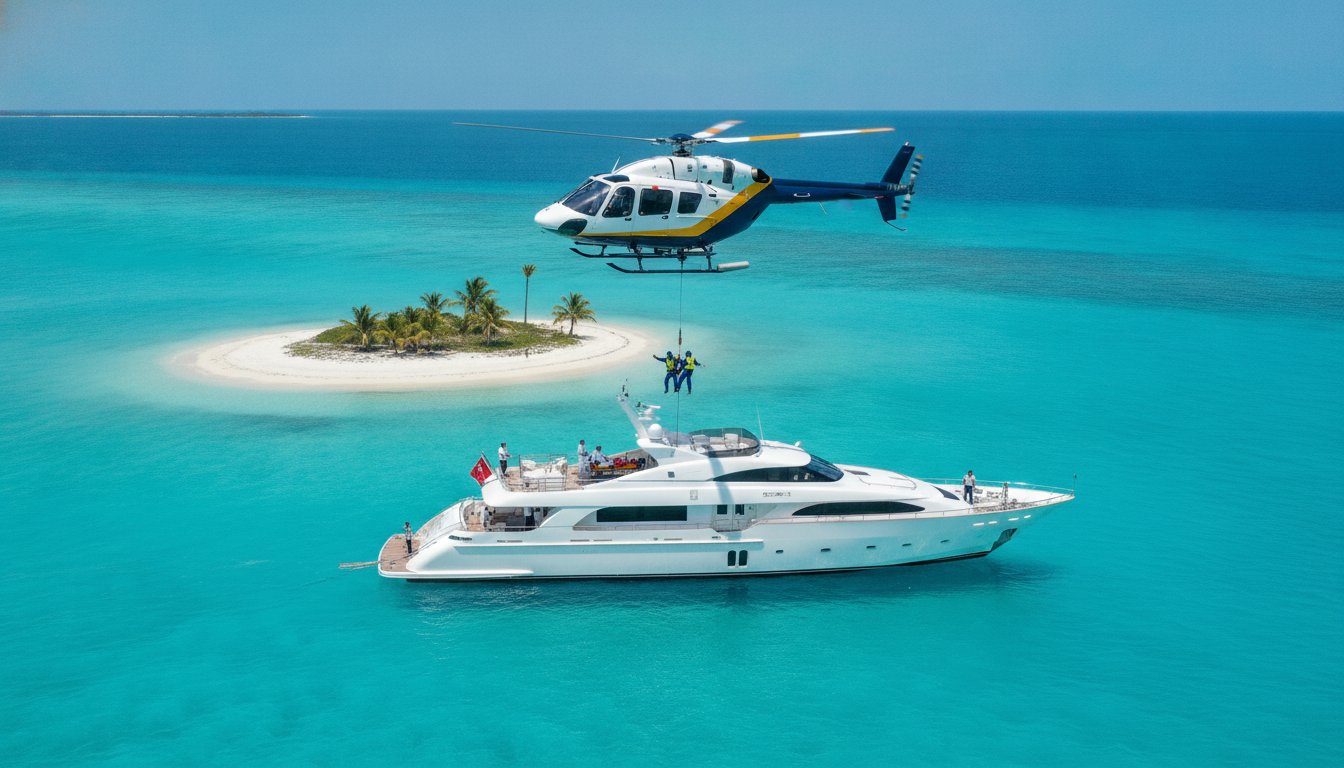
What if your luxury yacht charter in the remote Exumas suddenly turns into a race against time, and your standard travel insurance only offers a helpline and a promise of reimbursement? You’ve invested heavily in your 2026 itinerary, yet the reality of the Bahamas’ geography remains a silent risk. It’s a common anxiety for those navigating these 700 islands; the fear of being stranded far from a trauma center with limited local facilities is a valid concern. Most travelers believe their general policy is enough, but a dedicated medical plan for Bahamas yacht charter needs is a survival strategy, not just a financial safety net.
You deserve the peace of mind that comes with elite, hospital-grade care that reaches you wherever you’ve dropped anchor. This guide explains how to secure medical evacuation coverage that eliminates the threat of $100,000 air-medical bills. You’ll learn how to ensure direct transport to a US trauma center with zero out-of-pocket liability. We’ll examine the 2026 maritime requirements, the logistical failures of standard insurance, and the specific membership models that provide a private, high-end guardian for your voyage.
Key Takeaways
- Understand why local medical infrastructure in the Bahamas Out Islands is insufficient for critical care and why the “Golden Hour” requires rapid air extraction.
- Identify the financial risks of the “reimbursement trap” where standard insurance policies force you to pay for emergency flights upfront.
- Learn how to secure a dedicated medical plan for Bahamas yacht charter voyages that provides direct insurance billing and eliminates out-of-pocket costs.
- Discover the logistical superiority of helicopter medevac for point-to-point transport from remote yachts directly to US trauma centers.
- Evaluate the benefits of short-term memberships that offer 24/7 emergency coordination and concierge-level medical protection for your 2026 charter.
The Reality of Medical Care on a Bahamas Yacht Charter
The Bahamas archipelago presents a unique medical challenge for the yachting community. While developed hubs offer baseline services, the vast majority of the island chains rely on local clinics designed for primary health needs. These facilities are rarely equipped to manage high-acuity trauma, stroke, or cardiac events. A thorough understanding of the healthcare infrastructure in the Bahamas is vital for every captain and charterer. Most remote clinics lack 24/7 physician availability or advanced diagnostic imaging technology. In a life-threatening maritime emergency, the Golden Hour remains the definitive metric for survival. This sixty-minute window represents the critical timeframe where immediate medical intervention most likely prevents irreversible damage or death.
Coordinating a rescue from a moving vessel introduces variables that local emergency services are not prepared to handle. A yacht is a mobile platform, often positioned in shallow cays or navigating deep water channels. A robust medical plan for Bahamas yacht charter safety must address these specific logistical barriers. You cannot rely on non-existent local ambulances or slow boat-to-shore transfers. Proactive preparation is the only method to mitigate the risks inherent in remote island travel and ensure the safety of everyone on board.
The Isolation Factor in the Out Islands
The geography of the island chains defines their medical isolation. Many popular anchorages are hours away from the nearest functional landing strip. If a medical crisis occurs on deck, a standard yacht medical kit offers only basic stabilization. These kits are first-aid tools, not comprehensive life-support systems. Without a specialized extraction strategy, you are effectively isolated from advanced care. Proximity to a scenic beach does not equate to medical readiness. The distance between a remote cay and a trauma center is the primary threat to passenger safety when minutes matter most.
Bridging the Gap to US Trauma Centers
Survival frequently depends on reaching a Level 1 trauma center in Florida. Local stabilization serves only as a temporary measure; definitive care requires US-based facilities. An effective medical plan for Bahamas yacht charter requirements prioritizes rapid helicopter transport over traditional sea-to-land logistics. This strategy ensures point-to-point transfer directly from your vessel to a specialized medical facility. Peace of mind for Caribbean travel 2026 begins with a logistical plan that connects a remote deck to a Florida emergency room. Interhospital transfer services provide the necessary link, moving patients once they are stabilized for the final stage of specialized care.
Why Standard Travel Insurance Falls Short for Yachting
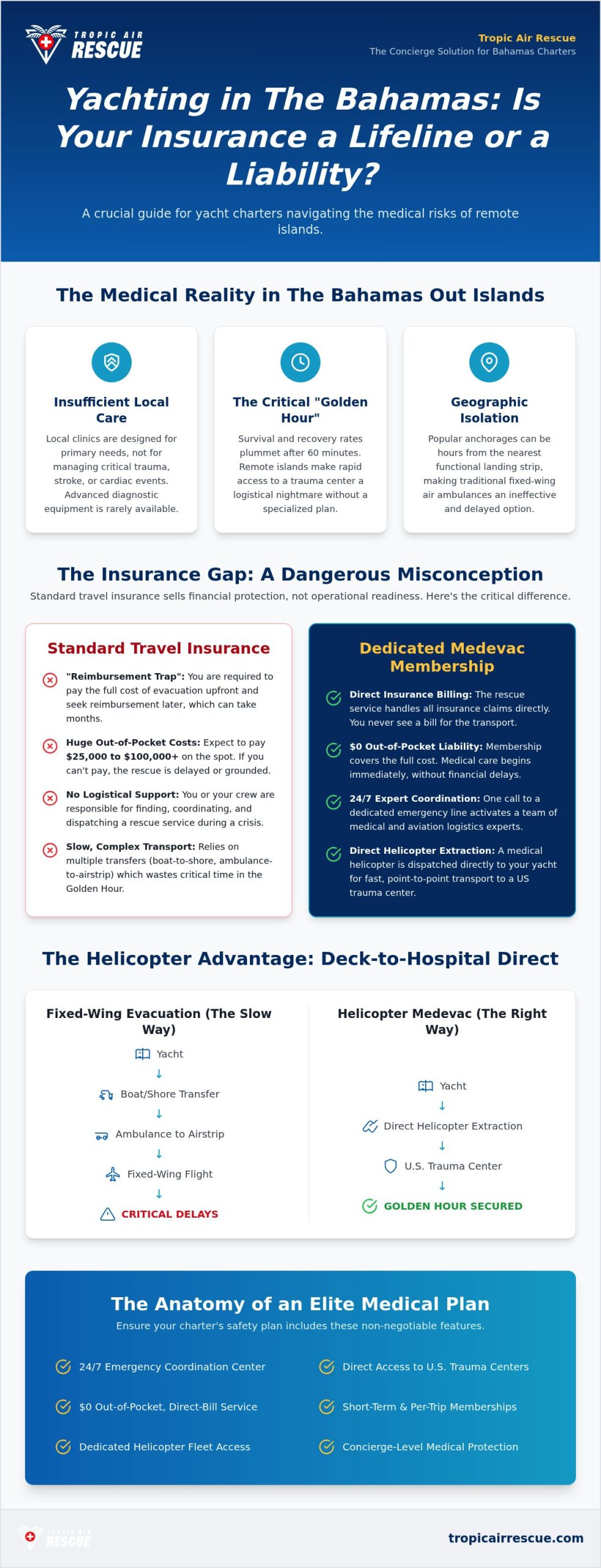
Standard travel insurance is often marketed as a comprehensive safety net. For the yachting community, this is a dangerous misconception. These policies are designed for commercial travelers in urban centers, not for those navigating the remote Exumas or Abacos. Most generic plans operate on a reimbursement basis. In a crisis, you’re expected to secure your own transport and pay the bill upfront. With helicopter missions typically ranging from $25,000 to $60,000 and fixed-wing evacuations exceeding $100,000, this “reimbursement trap” creates an immediate financial barrier to life-saving care. If you can’t produce a $50,000 deposit on the spot, the rescue remains grounded.
Financial Safety vs. Operational Readiness
Insurance companies find the money, eventually. A specialized membership finds the helicopter. Traditional brokers often overlook the logistical reality of the Bahamas medevac landscape. They sell financial protection, but they don’t provide the assets to perform a deck-to-hospital extraction. Direct billing is the gold standard for 2026 travel. This model ensures the rescue service handles the health insurance claim directly, removing the need for a massive cash deposit during a trauma. It shifts the burden of proof from the patient to the provider, allowing medical teams to focus on the patient instead of the payment. Relying on a standard medical plan for Bahamas yacht charter safety that lacks this feature is a significant operational risk.
Avoiding Out-of-Pocket Crisis
Many high-net-worth travelers assume their premium credit cards provide sufficient coverage. This is rarely the case. These cards typically offer medical referrals rather than guaranteed transport. They don’t have a dedicated medical plan for Bahamas yacht charter logistics in place to manage a maritime rescue. A professional membership acts as a proactive, secondary layer to your primary health insurance. It provides 24/7 coordination that a credit card call center cannot match. It’s the difference between calling a general helpline and activating a specialized rescue asset.
If you want to ensure your family isn’t negotiating wire transfers while a patient is in critical condition, you need a service-based solution. You can review membership options to see how this operational layer integrates with your existing yacht safety protocols. Following expert advice for medical emergencies at sea means moving beyond simple financial policies toward active, ready-to-deploy rescue assets. Meticulous preparation is the only way to eliminate financial stress during a medical crisis in Bahamian waters.
The Helicopter Advantage: Remote Extraction vs. Fixed-Wing
Helicopter medevac is defined by its ability to provide point-to-point transport from remote maritime locations directly to hospital receiving bays. While fixed-wing aircraft are efficient for long-distance city-to-city transfers, they’re functionally useless for an emergency occurring in a remote cay. A fixed-wing mission requires a stabilized patient to be moved by boat to shore, then by ground ambulance to an airstrip. This multi-modal chain introduces delays and physical stress that a critical patient cannot afford. In the context of a medical plan for Bahamas yacht charter, the helicopter isn’t a luxury; it’s the only operational tool capable of meeting the demands of the geography.
Landing Where Planes Cannot
Most Bahamas yacht charters explore areas miles from the nearest paved runway. Helicopters are the only viable choice for “off-airport” emergencies because they can extract patients directly from a yacht deck or a nearby beach. This eliminates the need for a bumpy, slow ground ambulance transfer that often exacerbates traumatic injuries or cardiac distress. Every transition between vehicles increases the risk of clinical instability. By landing at the site of the injury, the flight team initiates intensive care immediately. Reviewing the nuances of Helicopter vs Fixed Wing Medevac: The Critical Choice for Bahamas Emergencies in 2026 highlights why rotor-wing assets are the baseline for maritime safety.
Advanced Life Support at Sea
Modern medical helicopters are essentially flying ICUs equipped with onboard avionics and medical technology comparable to a stationary critical care unit. They carry advanced life support (ALS) technology, including ventilators, invasive cardiac monitors, and specialized pharmacology. Flight crews consist of highly trained paramedics and nurses who specialize in high-stakes maritime environments. These professionals are accustomed to the unique challenges of shipboard extractions and offshore coordination. Direct helipad-to-helipad transport eliminates intermediate vehicle transfers and delivers the patient straight to the trauma center’s surgical suite. This direct flight path maximizes the efficiency of the “Golden Hour” and provides the highest probability of a positive clinical outcome. A dedicated medical plan for Bahamas yacht charter ensures these specialized crews are dispatched the moment a crisis is identified.
Key Components of a Comprehensive Yacht Medical Plan
A professional medical plan for Bahamas yacht charter safety must be operational, not just administrative. It requires 24/7 emergency dispatch capable of immediate coordination with the yacht’s bridge. This is not a standard call center experience. It’s a high-stakes aviation briefing. Direct billing capabilities with major international insurers are equally vital. This feature removes the financial friction that often delays critical missions. It ensures that the focus remains on clinical stabilization and rapid transport rather than wire transfers. By eliminating the $50,000 deposit requirement mentioned earlier, direct billing saves lives.
Repatriation to a US trauma center is the ultimate goal of any maritime rescue. Interhospital transfer services provide the necessary bridge for patients who have been stabilized at a local facility but require definitive care in Florida. This protocol ensures a seamless chain of medical custody from the initial extraction to the final hospital bed. Without these pre-arranged transfer protocols, a patient might remain stuck in a local clinic long after their condition has been stabilized for flight.
Short-Term vs. Annual Coverage
Flexibility is essential for charterers. You should choose a plan based on your specific length of stay in the Bahamas. Short-term memberships provide dedicated coverage for the exact duration of your voyage, protecting guests, crew, and family members alike. These plans are specifically designed for the 2026 travel season to provide maximum value for seasonal visitors. If you frequent the islands throughout the year, annual plans offer constant readiness. Refer to the Short-Term Medevac Guide for Island Travelers 2026 to determine which tier fits your itinerary.
The Concierge Coordination Experience
Elite service goes beyond the flight itself. It involves meticulous liaising between the yacht captain, Bahamian authorities, and US receiving hospitals. This level of coordination is critical for managing complex logistics like organ transport or the delivery of time-critical medications to a remote vessel. High-net-worth individuals require professional medical aviation standards that prioritize discretion and precision. A robust medical plan for Bahamas yacht charter needs must include this proactive layer of protection to be truly effective. It positions the service as a private, elite partner rather than a generic utility.
To secure this operational readiness for your next trip, view membership plans today.
Tropic Air Rescue: The Concierge Solution for Bahamas Charters
The core of our service is a membership model that eliminates the logistical and financial friction of a crisis. By securing a medical plan for Bahamas yacht charter safety through Tropic Air Rescue, you gain access to direct insurance billing. We coordinate directly with major health insurers to ensure zero out-of-pocket costs for our members, bypassing the $50,000 deposits typical of non-member flights. Our aircraft are equipped with advanced avionics and life-support technology that transforms the cabin into a mobile intensive care unit. For a deeper look at our operational standards, consult The Elite Guide to Concierge Air Medical Service in 2026. This membership ensures that when the “Golden Hour” begins, the focus remains entirely on the patient’s clinical needs.
Preparing for Your 2026 Charter
Secure your coverage before your vessel leaves the dock to ensure seamless protection throughout your voyage. Integrating Tropic Air Rescue into your yacht’s emergency protocols is a straightforward process that provides your captain with a direct line to specialized rescue assets. Whether you require a short-term membership for a single crossing or an annual plan for frequent cruising, our team provides the oversight necessary for complex maritime logistics. A comprehensive medical plan for Bahamas yacht charter needs is the final, most critical component of your 2026 safety checklist. You shouldn’t leave your safety to chance while navigating the Out Islands. Secure your peace of mind and ensure your guests have access to the highest standard of emergency care today.
Operational Readiness for Your 2026 Bahamas Voyage
Navigating the Out Islands requires a safety strategy that accounts for the reality of Bahamian geography. Standard travel insurance often fails at the moment of impact, leaving you trapped in a reimbursement cycle while facing six-figure evacuation costs. True security comes from a dedicated medical plan for Bahamas yacht charter travel that prioritizes operational speed over administrative delays. You now understand how helicopter medevac provides the only point-to-point solution for remote maritime extractions, bypassing the logistical hurdles of ground transfers and fixed-wing runways.
Tropic Air Rescue delivers this elite level of protection through our “always ready” posture and specialized medical fleet. Our members benefit from direct insurance billing and Advanced Life Support helicopters, ensuring no out-of-pocket costs during a crisis. Don’t leave your maritime safety to chance in the year ahead. Secure your Bahamas yacht charter membership for 2026 and ensure your voyage is backed by professional medical aviation expertise. Your peace of mind is the ultimate luxury on the water.
Frequently Asked Questions
Do I need a medical plan if I already have travel insurance for my Bahamas yacht charter?
Yes, you should secure a dedicated medical plan for Bahamas yacht charter safety even if you carry travel insurance. Standard insurance typically functions as a financial reimbursement policy; it doesn’t guarantee a rescue asset. Tropic Air Rescue provides the operational logistics and helicopter dispatch required for remote maritime extractions. Our membership ensures you aren’t forced to pay tens of thousands of dollars upfront while waiting for a reimbursement claim to process during a medical crisis.
Can a medical helicopter land directly on my yacht?
Yes, our advanced helicopters are capable of landing directly on yacht decks that meet specific structural requirements. If a deck landing isn’t feasible, our pilots utilize their ability to land in remote locations, such as nearby beaches or clearings, that are completely inaccessible to fixed-wing aircraft. This point-to-point capability ensures that medical teams reach the patient wherever the vessel is anchored, significantly reducing the time to definitive care and professional stabilization.
What happens if a guest on my yacht has a medical emergency in a remote area?
A medical emergency in a remote area triggers an immediate operational response. Upon notification, our dispatch team coordinates the flight path and liaises with Florida trauma centers for patient reception. The flight crew initiates advanced life support protocols as soon as they reach the yacht. This proactive approach bridges the gap between the isolated Out Islands and high-level medical facilities, managing all logistics from the initial extraction to the final hospital transfer.
How much does a medical evacuation from the Bahamas to Florida cost without membership?
Without a membership, a medical evacuation from the Bahamas to Florida is a massive financial liability. Industry data from 2026 indicates that helicopter missions typically range from $25,000 to $60,000, while fixed-wing flights can exceed $100,000. Most providers require these funds as an upfront deposit before the aircraft leaves the ground. Membership with Tropic Air Rescue eliminates this burden, as we accept insurance reimbursement as full payment for all covered emergency transports for our members.
Does Tropic Air Rescue bill my insurance company directly?
Yes, Tropic Air Rescue bills your health insurance provider directly for all emergency transport services. This “no out-of-pocket” model is a core benefit for our members. We handle the complex claims process and accept the insurance payout as full payment for the mission. This ensures that you and your family don’t face the stress of direct patient invoicing or the administrative burden of filing for reimbursement after a traumatic event has occurred in Bahamian waters.
Is there a short-term membership for a one-week yacht charter?
Yes, we offer a Short-term Membership specifically designed for the duration of a single voyage or a one-week yacht charter. This tier provides the same elite level of protection as our annual plans, including direct insurance billing and advanced life support transport. It’s an essential component of a robust medical plan for Bahamas yacht charter safety, offering peace of mind for guests and crew without the requirement of a long-term commitment.
What medical equipment is available on a Tropic Air Rescue helicopter?
Every Tropic Air Rescue helicopter is equipped with a suite of advanced life-support technology comparable to a stationary intensive care unit. The onboard medical equipment includes ventilators, cardiac monitors, and specialized pharmacology for high-acuity trauma or cardiac events. Our flight crews are trained to manage complex clinical cases in high-stakes maritime environments. This ICU-grade capability ensures that critical care begins the moment the patient is stabilized on the helicopter deck or at the remote extraction site.
How fast can a helicopter reach a remote yacht in the Bahamas?
Our helicopters provide the fastest possible response times by flying point-to-point directly to your coordinates. Unlike fixed-wing aircraft that require inland airports and ground ambulance transfers, our rotor-wing assets move across the archipelago with geographic precision. The flight time depends on your exact location within the Bahamas, but our “always ready” posture ensures that the dispatch and launch sequence is handled with professional urgency to maximize the effectiveness of the Golden Hour and patient outcomes.