

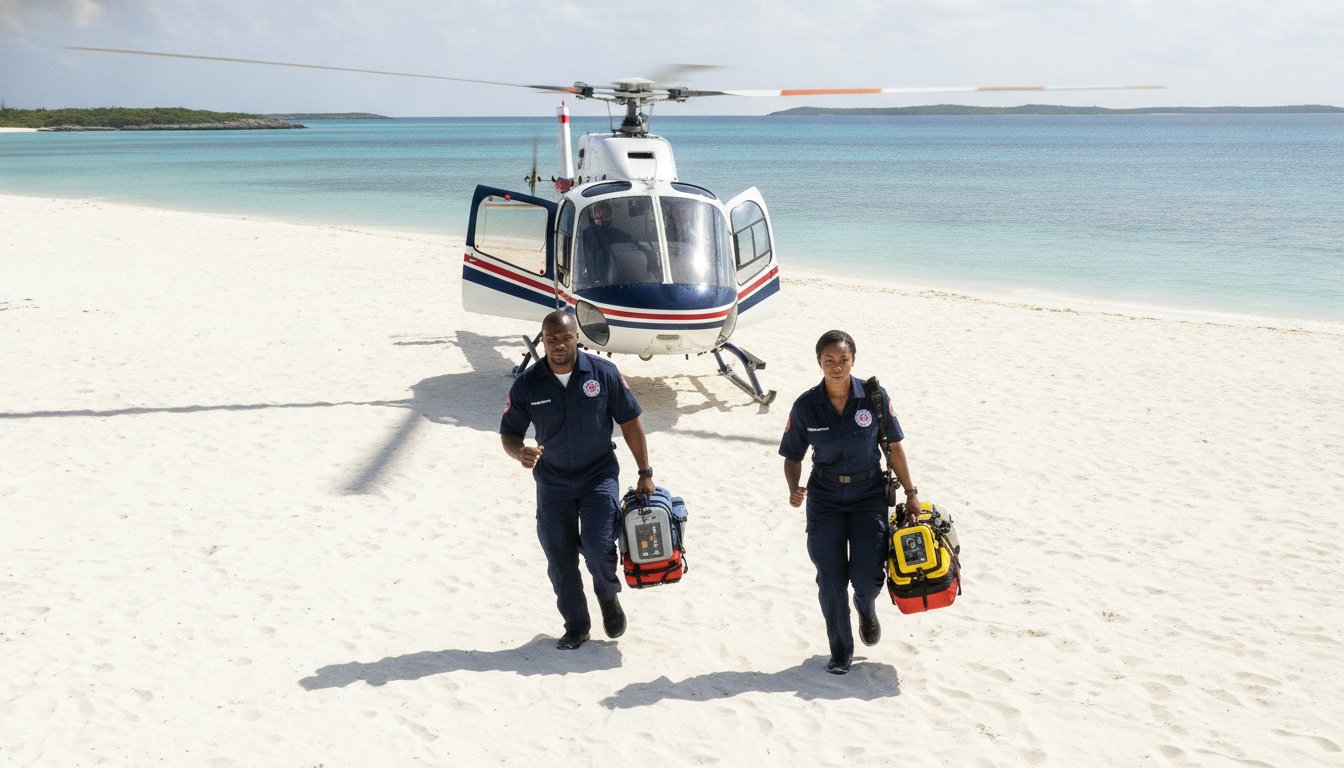
Did you know that an emergency medical jet from the Bahamian islands to Miami can cost upwards of $100,000 without a specialized membership? Most international visitors don’t realize that U.S. domestic health insurance and Medicare are not accepted by Bahamian medical providers. If you are exploring remote cays, securing a reliable air ambulance for visitors to these islands isn’t just a luxury; it’s a critical safety requirement. You expect a paradise vacation, but the reality of a remote island emergency can quickly become a logistical and financial nightmare.
Tropic Air Rescue understands the anxiety of being stranded in a location with limited clinical resources. You need more than just a standard insurance policy. You need a tactical plan that guarantees vertical lift from a remote beach directly to a Florida trauma center. This 2026 checklist provides a professional, actionable protocol to ensure you have elite medical coordination and total financial protection during your stay. We will examine the specific steps to bypass local bottlenecks, eliminate out-of-pocket costs, and establish a "ready-to-launch" emergency status before you even land in the Bahamas.
Key Takeaways
- Understand the critical “Golden Hour” protocols and why local island clinics are reserved for stabilization rather than high-acuity trauma care.
- Audit your current health insurance for international air medical exclusions to ensure your coverage aligns with 2026 Bahamian emergency regulations.
- Master the on-island emergency response protocol, including the immediate activation of an air ambulance for Exuma visitors through a dedicated membership hotline.
- Evaluate the logistical advantages of helicopter transport, which provides direct point-to-point access from remote yachts and beaches to Florida trauma centers.
- Eliminate the $20,000+ upfront payment requirement by utilizing membership-based direct billing to your health insurer.
Why Every Bahamas Visitor Needs a Medical Emergency Plan
Time is the most critical variable in any medical crisis. The "Golden Hour" refers to the narrow window following a traumatic injury or cardiac event where prompt medical intervention significantly increases survival rates. In the Out Islands, this window closes rapidly. If an emergency occurs on a remote beach or a private yacht, the clock doesn’t wait for local logistics to catch up. You must have a strategy to move from the point of injury to a specialized facility without delay.
Geography creates a unique barrier. The Bahamas archipelago consists of over 700 islands and cays, many of which are isolated by miles of open water. Traditional ground ambulances are confined to the few paved roads on larger islands and cannot bridge the gap between islands. This makes an air medical services protocol an essential component of any travel itinerary. Without a pre-arranged flight plan, you are at the mercy of local availability and regional infrastructure.
Limitations of Local Specialized Care
Local clinics in the Out Islands are designed for primary care and initial stabilization. They lack the high-acuity infrastructure found in major metropolitan hospitals. You won’t find advanced cardiac catheterization labs, specialized neurosurgery suites, or 24/7 MRI capabilities in a remote clinic. If a visitor suffers a complex emergency, the local facility’s primary role is to keep the patient alive long enough for an international transfer. Waiting for a fixed-wing aircraft to coordinate with a ground ambulance and find a cleared runway can create a fatal delay in treatment.
The Logistical Bottleneck of Remote Islands
Many high-end villas and yachting destinations in the Exumas are hours away from the nearest municipal airport. This distance creates a dangerous bottleneck for traditional rescue efforts. Securing a reliable air ambulance for Exuma visitors requires more than just a phone number; it requires vertical lift capability. Helicopters bypass the need for paved runways and ground transfers by landing directly at the scene of the emergency. This point-to-point transport is the difference between immediate care and hours of logistical friction.
Financial exposure is the final, often overlooked risk. Most U.S. health insurance plans, including Medicare, carry no weight with Bahamian providers. Local clinics and flight operators typically demand payment in full before services are rendered. Without a pre-established membership that offers direct billing, you may face a "pay-before-flight" requirement that exceeds $20,000. A proactive emergency plan ensures that medical decisions are driven by clinical need, not the speed of a credit card authorization or wire transfer.
Preparation for a tropical getaway often starts with ensuring your home is in order. For those who want to verify their climate control systems are functioning perfectly before departure, Caribbean Heating & Cooling offers comprehensive residential HVAC maintenance and repair.
The Pre-Travel Medical Readiness Checklist
Elite travel requires elite preparation. Before you depart for the Exumas, you must audit your medical infrastructure as meticulously as your itinerary. This mindset of protection should extend to your home base; for those in the Oklahoma area, you can visit Rescue Roofing Tulsa to ensure your property is secure before you leave. A medical crisis in a remote archipelago is not the time to discover that your domestic health insurance excludes international air medical transport. Most U.S. based plans, including Medicare, do not cover the logistical costs of specialized evacuation. You must verify if your policy includes "international air medical" coverage or if it classifies such services as out-of-network expenses.
Reviewing the CDC health information for The Bahamas confirms that serious medical problems often require evacuation to the United States. This reality makes securing an air ambulance for Exuma visitors a logistical necessity rather than an optional safeguard. Your checklist should begin with a definitive confirmation of how your medical bills will be handled in a high-stakes scenario. Relying on standard travel insurance alone often leads to significant delays because these policies typically operate on a reimbursement basis.
Insurance vs. Membership: The Critical Distinction
The primary flaw in standard insurance is the "pay-then-claim" requirement. Many air medical providers demand proof of payment or a massive upfront deposit before a flight is dispatched. In contrast, a medical evacuation membership shifts the burden of proof. It ensures that service is provided first, with the membership organization handling all direct billing and insurance coordination. This concierge approach eliminates the liquidity barrier that often stalls emergency response. Choosing a short-term membership plan provides the specific protection needed for the duration of your stay.
Preparing Your Emergency Digital Kit
Information access is vital during the "Golden Hour." You should digitize your medical history, including current medications, known allergies, and chronic conditions. Store these documents in a secure, shared cloud folder accessible to everyone in your travel party. This ensures that even if you are incapacitated, your medical team has the data required for safe treatment. Your digital kit should also include:
- Scanned copies of all passports for rapid customs clearance.
- Membership ID cards and direct hotline numbers.
- A designated "First Call" contact who understands your emergency protocol.
Ensuring your emergency contact has the direct hotline for your medevac provider is essential. This single point of coordination prevents confusion and accelerates the launch of an air ambulance for Exuma visitors. When every second counts, a pre-verified digital kit is your most valuable asset.
Executing Your Emergency Response: On-Island Protocols
When a medical crisis occurs, the transition from leisure to emergency response must be instantaneous. Every second lost to indecision or bureaucratic delays compromises the patient’s recovery. Your first priority is immediate stabilization. Utilize on-site Automated External Defibrillators (AEDs) and advanced first aid kits while simultaneously initiating the rescue sequence. Clear communication within your party is essential to manage the scene effectively.
Speed is the primary objective. You must activate your private medevac membership hotline immediately. This bypasses the typical delays associated with local government dispatch systems. For those requiring an air ambulance for Exuma visitors, this direct line is the fastest path to advanced life support. Once the call is initiated, the coordination for your international transfer begins in real time.
Precision matters. Provide exact GPS coordinates from your smartphone or vessel navigation system. This data is critical for maritime extractions or remote villa locations where standard street addresses don’t exist. Designate a specific person as the Landing Zone (LZ) Officer. This individual is responsible for clearing the area of debris, securing loose items, and keeping bystanders away, ensuring the incoming helicopter has a safe approach.
The Advantage of a Direct Medevac Hotline
Calling a private concierge dispatcher ensures that coordination with Florida trauma centers begins while the aircraft is still in the air. These specialized dispatchers manage the complex logistics of international flight plans and medical handoffs. It’s much faster than navigating local multi-agency networks. Have the patient’s acuity level, precise location, and membership details ready for the operator to accelerate the launch sequence.
Preparing for Remote Island Extractions
Extracting a patient from a remote cay or a private estate requires specialized vertical lift capabilities. Most traditional medical jets require a paved runway, which may be miles away from your actual location. This is why medevac for remote resorts relies on helicopters that can land directly at the scene. This eliminates the need for a secondary ground ambulance transfer, which can add $2,000 to $5,000 in extra costs and hours of delay. Safety remains paramount during the extraction; keep all bystanders at a significant distance from the landing site and follow all instructions from the flight crew upon arrival. Securing an air ambulance for Exuma visitors through a membership ensures these tactical details are handled by experts, not left to chance.
Choosing Your Evacuation Method: Helicopter vs. Fixed-Wing
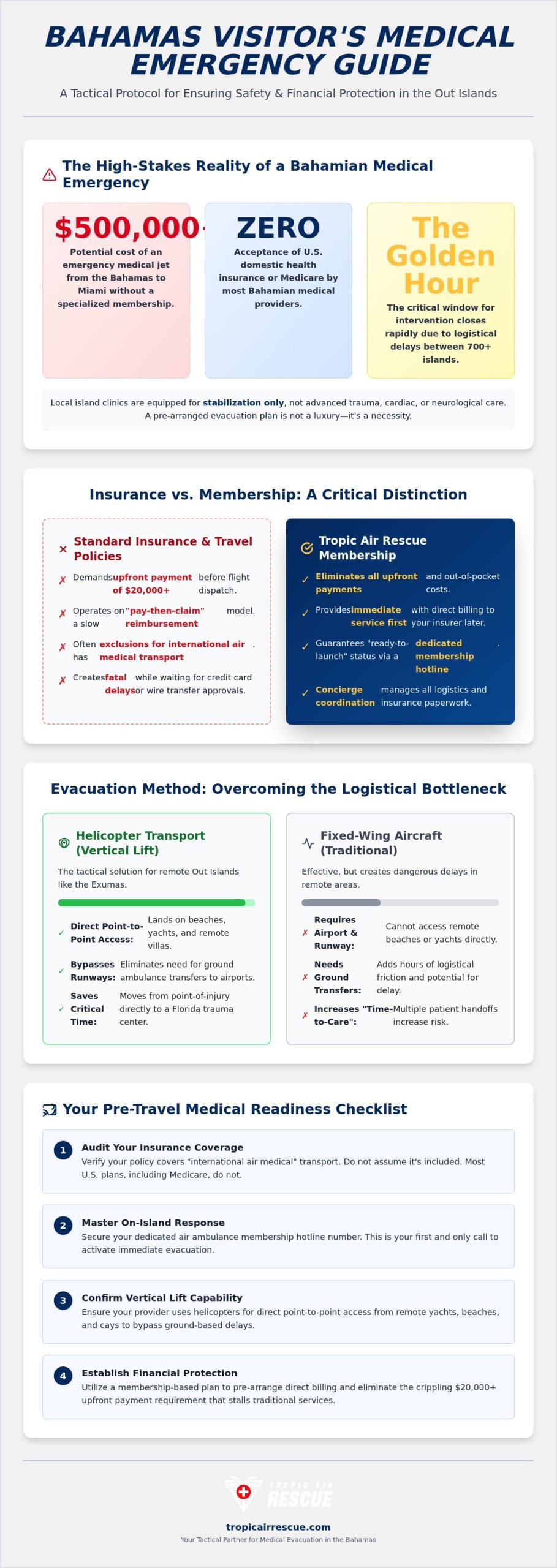
The choice between fixed-wing and rotary-wing aircraft is a tactical decision that determines the speed and quality of your recovery. While fixed-wing medical jets are capable of long-haul transport, they are fundamentally restricted by airport infrastructure and runway availability. For those requiring an air ambulance for Exuma visitors, these restrictions often translate into dangerous delays. A medical jet cannot land on a beach, a private estate, or a yacht deck. It requires a paved runway, which may be miles away from your actual location, necessitating a slow ground ambulance transfer across island terrain.
Helicopters bypass these logistical bottlenecks entirely. They offer vertical lift capability, allowing for a direct launch from the point of injury. This "launch-to-patient" efficiency is critical when navigating the 365 cays of the Exuma chain. Specialized helicopter fleets are equipped with Advanced Life Support (ALS) systems that mirror the capabilities of a modern ICU. To make an informed decision based on your specific travel profile, consult the short term medevac guide for island travelers 2026.
The Efficiency of Point-to-Point Transport
Traditional medical flights often suffer from the "double transfer" problem. This involves moving a patient from their villa to a ground ambulance, then from the ambulance to a plane, and finally from the plane to another ground ambulance upon arrival in Florida. Each transfer increases patient stress and consumes valuable minutes. Rotary-wing transport eliminates these middle steps. By providing direct delivery to hospital helipads at Florida trauma centers, helicopters save critical time during high-stakes cardiac or trauma events. This concierge medical aviation approach ensures that the transition from a remote island to a specialized U.S. facility is seamless and rapid.
Just as concierge medical aviation provides a seamless transition in an emergency, professional ground transport ensures a smooth start to any international trip. For travelers departing from the UK, you can visit Brighton Airport Taxis to book a reliable and punctual airport transfer.
High-Acuity Care at High Altitudes
The medical capabilities within a specialized rescue helicopter are sophisticated. These aircraft carry ICU-grade equipment, including ventilators, multi-parameter monitors, and advanced emergency pharmacology. Flight medical teams are trained to maintain patient stability during high-speed transit, performing interventions that were previously only possible within a hospital setting. This level of care is maintained through direct coordination with receiving physicians in Florida. The trauma center is briefed on the patient’s status in real-time, ensuring the surgical or cardiac team is ready for immediate intervention the moment the helicopter touches down. You can secure this level of professional protection by selecting a membership plan tailored to your stay.
Financial Protection: Direct Billing and Membership Benefits
The most significant barrier to emergency care in the Bahamas isn’t just distance; it’s liquidity. Most air medical operators require a $20,000+ payment before an aircraft is even fueled. This "pay-before-flight" mandate leaves many travelers stranded, regardless of their medical urgency. A membership model eliminates this financial roadblock by establishing a pre-verified payment protocol. When you secure an air ambulance for Exuma visitors through a membership, you ensure that medical decisions are prioritized over credit card authorizations.
Direct-to-insurer billing is the cornerstone of this financial protection. Instead of requiring the patient to pay upfront and seek reimbursement later, the provider works directly with your health insurer. They accept the insurance reimbursement as full payment for covered services, resulting in a no out of pocket air ambulance experience. This tactical advantage allows you to preserve your capital during a crisis. Whether you select a short-term visitor plan for a single trip or an annual membership for frequent island travel, the protection remains absolute.
Bypassing the Reimbursement Headache
Traditional travel insurance often forces families to wait months for claim processing. This administrative burden is a secondary trauma you don’t need. Membership coordination handles the paperwork while you focus on recovery. Beyond the flight itself, these plans ensure seamless admission to Florida trauma centers by managing the complex medical handoffs and facility requirements. It’s a concierge approach to high-stakes logistics that guarantees you aren’t just flown to the U.S., but admitted to the right level of care.
Finalizing Your 2026 Emergency Plan
Your preparation concludes with selecting the membership tier that aligns with your specific itinerary. Frequent travelers benefit from the continuity of an annual plan, while vacationers can opt for short-term coverage. Once secured, conduct a final briefing with your travel party. Ensure every member knows how to activate the protocol and where to find your digital medical IDs. Don’t leave your safety to the mercy of a local clinic’s billing department or a slow insurance reimbursement cycle. Secure your Bahamas visitor medical emergency plan today with Tropic Air Rescue and guarantee your access to elite medical evacuation.
Tactical Readiness for Your 2026 Bahamian Escape
Your Bahamian itinerary is incomplete without a tactical response plan for the unexpected. True luxury is the confidence that comes from meticulous preparation, whether you are securing your physical well-being or consulting with Hummingbird Executive to access exclusive off-market asset opportunities. By prioritizing vertical lift over runway-dependent jets, you eliminate the dangerous delays of ground transfers. You also bypass the financial burden of upfront medical costs through a membership model that utilizes direct insurance billing for zero out-of-pocket liability.
Securing a reliable air ambulance for Exuma visitors is the bridge between a remote emergency and a Florida trauma center. Our fleet is equipped with Advanced Life Support (ALS) systems and specializes in complex extractions from private yachts and remote cays. It’s the only way to ensure your safety isn’t compromised by island geography. Don’t leave your recovery to chance or local logistical bottlenecks. Secure your peace of mind with a Tropic Air Rescue membership today. You’ve built the perfect vacation; now ensure you have the elite protection required to enjoy it with total composure.
Frequently Asked Questions
Does my standard travel insurance cover helicopter medevac in the Bahamas?
Standard travel insurance rarely covers the full cost of helicopter evacuation without specific, high-limit riders. Most policies operate on a reimbursement basis, meaning you’re often required to pay the provider upfront and file a claim later. This can lead to dangerous delays during a crisis. It’s essential to verify your policy limits and confirm if it covers "vertical lift" services from remote island locations.
What is the difference between a medical evacuation membership and travel insurance?
The primary difference lies in the financial and operational response. Travel insurance is a financial product that reimburses costs after the event occurs. A medical evacuation membership is a service-based agreement that guarantees an immediate response and handles all logistics. Memberships prioritize service delivery and direct billing, whereas insurance often requires you to manage the coordination and massive upfront costs yourself.
How quickly can a helicopter reach me on a remote island?
Response times depend on your specific coordinates, but helicopters are significantly faster than fixed-wing aircraft for remote extractions. By bypassing municipal airports and ground ambulance transfers, a helicopter lands directly at your villa or yacht. This point-to-point capability is essential when securing an air ambulance for Exuma visitors, as it eliminates the logistical bottlenecks that typically delay traditional rescue planes.
Will I have to pay anything out-of-pocket if I am a member?
Members don’t face out-of-pocket costs for covered emergency evacuations. We utilize a direct-to-insurer billing model, where we accept the insurance reimbursement as full payment for our services. This eliminates the need for the $20,000+ upfront deposits typically required by private flight operators. You can focus entirely on medical recovery while we manage the administrative and financial coordination with your health provider.
Can a medevac helicopter take me directly to a hospital in Florida?
Yes, our helicopters provide direct point-to-point transport from the Bahamas to Florida trauma centers. This specialized service bypasses the "double transfer" common with fixed-wing aircraft, where patients must move from a ground ambulance to a plane and then back to another ambulance. We deliver you directly to hospital helipads, ensuring you receive advanced care in the United States as quickly as possible.
What information do I need to provide when calling for an emergency medical flight?
You must provide precise GPS coordinates, the patient’s current medical status, and your membership details. Precise location data is critical for maritime or remote island extractions where street addresses don’t exist. Our dispatchers also require a brief description of the injury or illness to ensure the flight medical team is fully prepared with the necessary Advanced Life Support equipment upon arrival.
Are the helicopters equipped with ICU-grade medical equipment?
Our fleet is equipped with Advanced Life Support (ALS) systems that mirror ICU-grade environments. Each aircraft carries specialized medical technology, including ventilators, multi-parameter monitors, and emergency pharmacology. This ensures that high-acuity patients receive continuous, sophisticated care during transit. Our flight medical teams are trained to maintain stability and perform critical interventions while en route to specialized trauma facilities in Florida.
Is a membership required for inter-hospital transfers between islands?
Inter-hospital transfer services are a core benefit of our membership plans. If a patient is stabilized at a local Bahamian clinic but requires a higher level of care, we coordinate the transfer to a specialized facility. This service is available for both short-term and annual members. Having this protocol in place ensures that your medical journey is managed by experts from the initial stabilization to the final hospital admission.