

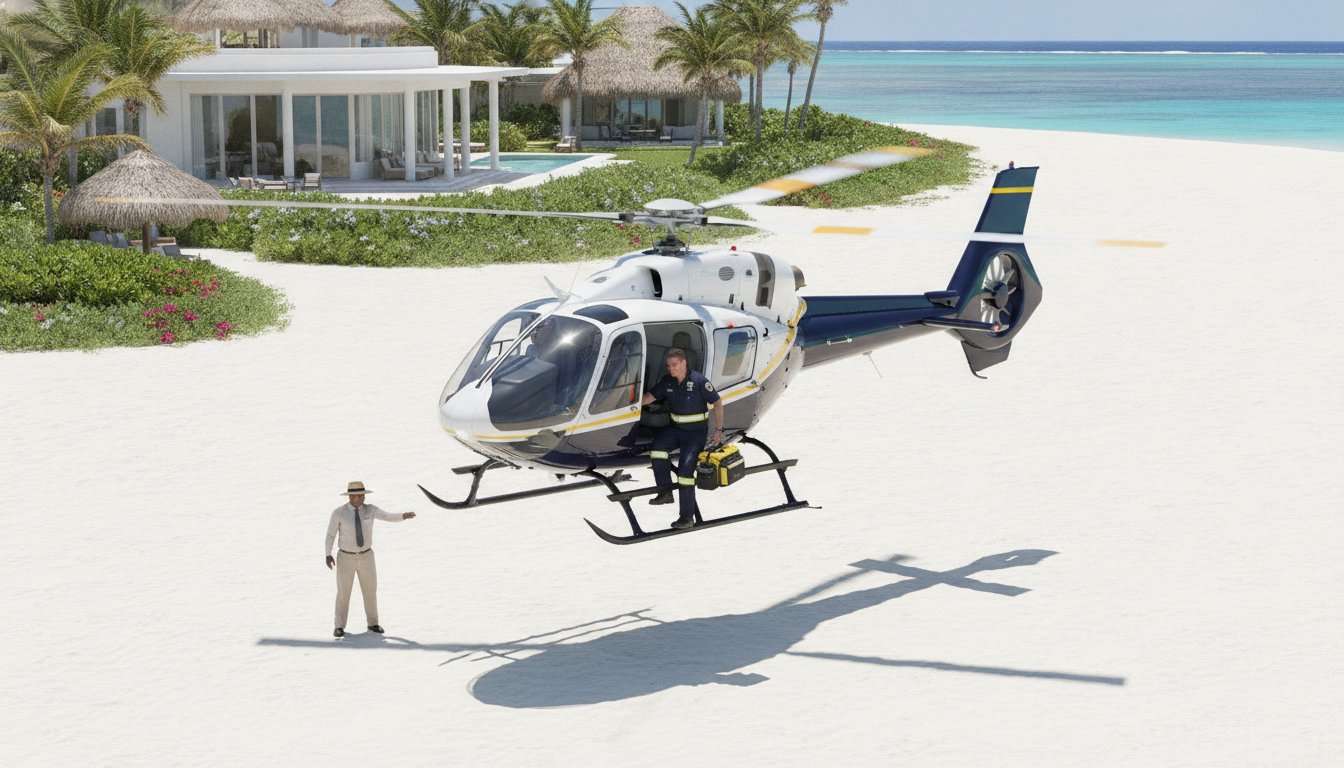
What if your dream vacation in a remote island paradise suddenly requires a Level 1 trauma center? For many travelers, the luxury of seclusion becomes a liability the moment a medical crisis strikes. You’ve likely felt that underlying anxiety: the fear of being stranded on an island without a runway while minutes matter. Relying on standard travel insurance or slow-moving ground transfers isn’t a strategy; it’s a gamble. Securing reliable medevac for remote resorts is the only way to ensure that paradise doesn’t mean inaccessible when every second counts.
The anxiety over the staggering costs of private air ambulances is real, especially when standard travel insurance often fails to cover specialized evacuation. This guide demonstrates how specialized helicopter services from Tropic Air Rescue bridge the gap between secluded island stays and critical trauma care in the United States. You’ll learn how their concierge membership model provides immediate access to Florida hospitals with no out-of-pocket expenses at the time of service. We’ll also examine the logistical superiority of point-to-point transport, which bypasses the need for airports to deliver you directly from the resort to a specialized medical facility.
Key Takeaways
- Understand how specialized medevac for remote resorts overcomes the logistical barriers of the “Golden Hour” in isolated island environments.
- Evaluate the technical advantages of helicopter transport for direct resort access compared to the runway limitations of fixed-wing aircraft.
- Recognize why traditional travel insurance often fails during real-time crises and how membership ensures immediate, guaranteed mobilization.
- Implement precise emergency protocols for communicating GPS coordinates and site-specific landing zone details to dispatch.
- Eliminate the burden of high-cost medical transport through membership plans that prioritize direct insurance billing for members.
The Logistics of Emergency Response at Remote Island Resorts
Medical evacuation, or medevac, is the rapid, specialized air transport of patients from isolated locations to advanced medical facilities. In the context of the Bahamas, medevac for remote resorts represents a critical lifeline. It transforms a logistical nightmare into a streamlined medical intervention. While a resort may offer world-class luxury, it rarely possesses the surgical suites or cardiac labs required for life-threatening emergencies. True safety in these environments is defined by the speed of extraction, not just the quality of on-site first aid.
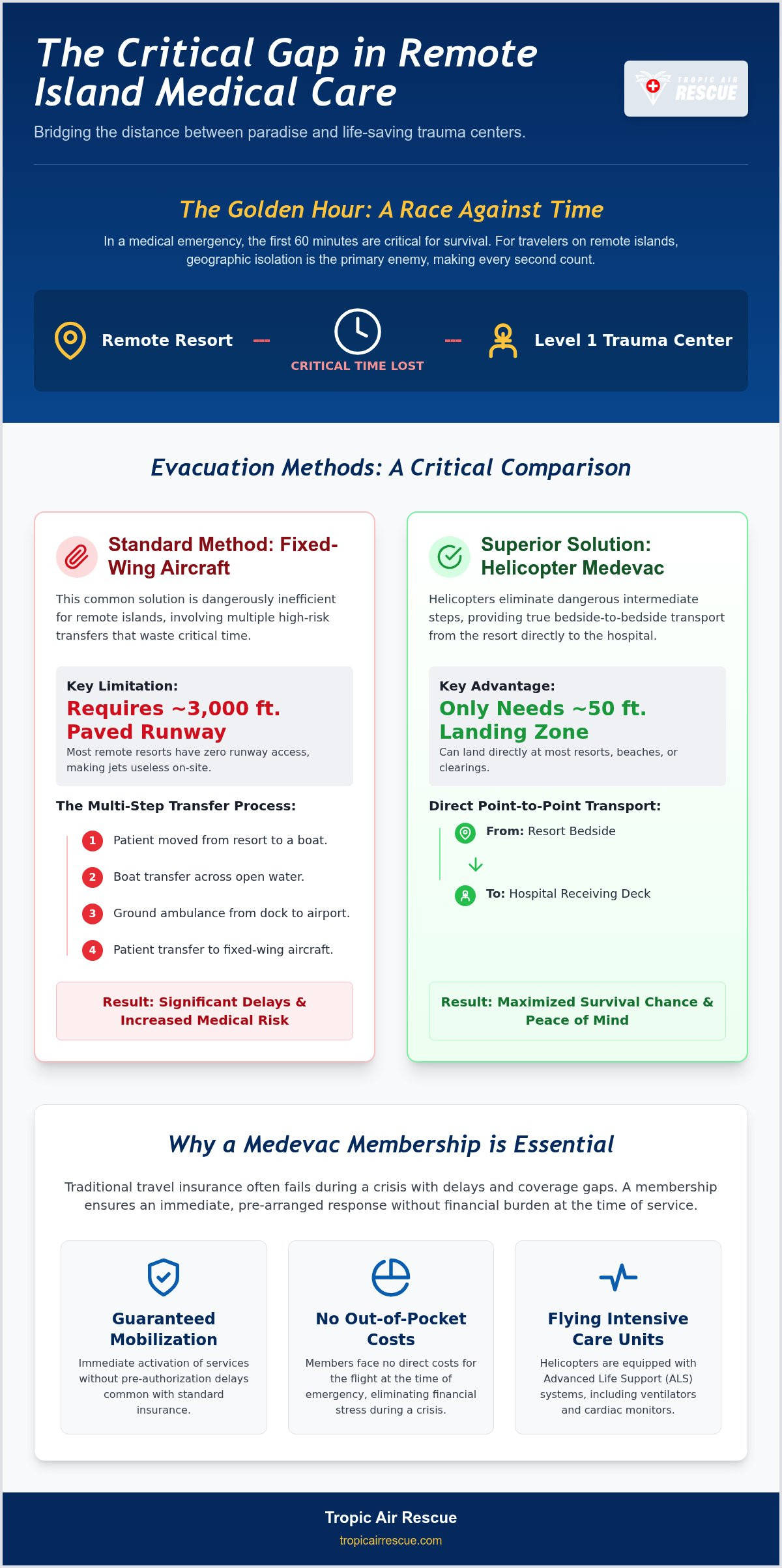
The “Golden Hour” is a cornerstone of emergency medicine. It dictates that survival rates for trauma or cardiac patients increase significantly if they receive definitive care within sixty minutes. In an island environment, this window is severely compressed. Water barriers, limited infrastructure, and the absence of high-speed road networks mean that every minute spent on a boat or a slow-moving ground ambulance is a minute lost to the clock. When a crisis occurs miles from a major hub, the standard response time of traditional services often exceeds this critical window.
Local island clinics serve an essential role for primary care and minor injuries. However, they are not equipped for high-acuity trauma or complex cardiac events. These facilities often lack advanced imaging, blood banks, and specialized surgeons. Relying solely on local stabilization without a clear path to a US-level trauma center creates a dangerous bottleneck in patient care. The goal is not just to reach a doctor; it’s to reach the right doctor with the right equipment.
There is often a significant logistical gap between a secluded resort and the nearest international airport. This distance can span miles of rough water or unpaved roads. Without a specialized response, a patient must endure multiple transfers before even reaching a fixed-wing aircraft. This gap is where many emergency plans fail, as they don’t account for the difficulty of the initial extraction from the resort property itself.
The ‘Last Mile’ Challenge in Island Medicine
Ground transport on remote islands is frequently insufficient or entirely non-existent. Moving a patient involves a high-risk sequence of transfers: from a resort bed to a boat, from a boat to a vehicle, and finally from a vehicle to a distant runway. Each transfer increases the risk of medical instability and logistical delay. Point-to-point evacuation is the gold standard for remote resorts, utilizing helicopters to land directly at the patient’s side and fly them straight to a hospital.
Geographic Isolation and Survival Outcomes
Distance from specialized care directly impacts recovery outcomes. In time-sensitive emergencies like strokes or heart attacks, geographic isolation is the primary enemy. Survival requires more than just a fast flight; it necessitates stabilized transport with onboard life support. Advanced medical crews must provide continuous care during the transit to Florida trauma centers to ensure the patient arrives in the best possible condition for surgery or intervention.
Helicopter vs. Fixed-Wing: The Critical Difference for Resort Access
Fixed-wing air ambulances are often marketed as the primary solution for international medical transport. This is a dangerous oversimplification for travelers in the Bahamas. A standard medical jet requires approximately 3,000 feet of paved runway to operate safely. Most private island resorts offer zero feet of runway. According to Johns Hopkins Medicine, the financial and medical risks of traveling without adequate, specialized coverage are severe. When you’re stationed at a remote resort, a jet is useless if it’s sitting at an airport two islands away.
Helicopters provide the only viable solution for medevac for remote resorts because they require a landing footprint of only 50 feet. While a jet has a higher cruise speed, its total mission time is often much longer due to the “wing-to-wing” transfer process. This involves moving a patient from a resort to a boat, then a ground ambulance, and finally to the airport. A helicopter eliminates these intermediate steps. It provides superior bedside-to-bedside times by flying directly from the resort property to the hospital receiving deck.
Modern medical helicopters aren’t just transport vehicles; they’re flying intensive care units. They feature Advanced Life Support (ALS) capabilities that mirror a hospital’s emergency room. This includes high-end ventilators, cardiac monitors, and a full suite of critical care medications. Establishing a proactive safety plan with an annual membership ensures these elite assets are mobilized the moment a crisis is declared.
Landing Where Planes Cannot
Helicopters excel in the varied and restrictive terrains typical of the Bahamas. They routinely land on sandy beaches, wooden docks, or small garden clearings that would be inaccessible to any other craft. By landing on-site, we avoid the dangerous “wing-to-wing” transfer. This refers to the physical move of a patient between different transport modes. Every time a patient is moved, the risk of dislodging medical lines or causing physical trauma increases. Direct extraction from the resort eliminates this variable entirely.
Equipment Standards for Remote Extraction
Operating safely across the Bahamian archipelago requires more than basic flight skills. It demands advanced avionics suites designed for precise inter-island navigation and low-altitude over-water operations. These systems allow pilots to maintain orientation in challenging weather or night conditions. Inside the cabin, the equipment must meet rigorous critical care standards. This ensures that the medical team can maintain patient stability through every phase of the flight, from the initial lift-off at the resort to the final landing at a Florida trauma center.
Evaluating Medevac Memberships for Island Travelers
Many travelers assume their standard travel insurance is sufficient for a high-stakes emergency extraction. This assumption is often corrected at the worst possible moment. Standard travel insurance is primarily a financial reimbursement product; it doesn’t guarantee the immediate arrival of a specialized aircraft. A membership for medevac for remote resorts, conversely, is an operational guarantee. It ensures that the logistical assets required for a life-saving flight are mobilized instantly, without the delay of financial vetting or extensive upfront documentation.
In a crisis, the most common objection – “I already have travel insurance” – often fails under pressure. Most insurance providers require you to pay for the evacuation out-of-pocket before you can even file a claim for reimbursement. In the Bahamas, a private air ambulance transit to the United States can cost between $20,000 and $90,000. Few families have $50,000 in liquid capital ready for an immediate wire transfer during a cardiac event or trauma. Membership removes this financial friction. It allows the focus to remain on the clinical outcome rather than the credit card limit. Before your next trip, reviewing a comprehensive air ambulance for Exuma visitors checklist can help ensure you have a complete tactical plan in place before you arrive.
A professional membership must include 24/7 dedicated dispatch, direct insurance billing, and seamless international coordination. This includes managing the complex customs and immigration requirements for patients entering the United States for urgent care. Coordination with Florida-based trauma centers is a non-negotiable requirement. These facilities must be ready to receive the patient the moment the aircraft touches down, ensuring a seamless transition from the island resort to the surgical suite.
Direct Insurance Billing vs. Reimbursement
The primary difference between a generic policy and a concierge membership lies in the cash flow and administrative burden. The reimbursement model forces the patient to bear the initial financial weight of the flight. A specialized membership utilizes a “zero out-of-pocket” model. The service provider handles the complex paperwork and bills the health insurer directly. This concierge approach eliminates the administrative stress for the family, ensuring that financial logistics never delay a critical launch.
Short-Term vs. Annual Coverage Plans
Coverage options should reflect your specific risk profile and duration of stay. Vacationers typically benefit from a Short-term Membership designed specifically for the length of their island visit. Residents or frequent visitors should secure an Annual Membership to ensure year-round protection across the archipelago. For resort management, implementing B2B Membership Plans provides a critical safety layer for all guests. This proactive approach positions the property as a premier, safety-conscious destination that prioritizes guest welfare in any scenario.
Emergency Protocols for Remote Resort Guests
Precision in communication often determines the speed of the response. When a medical crisis occurs at a remote property, the first sixty seconds are foundational. You must alert resort management immediately to initiate local safety protocols while simultaneously contacting your specialized dispatch center. This dual-track approach ensures that ground support and air assets move in tandem. Providing medevac for remote resorts requires exact geographic data. Don’t rely on descriptive directions like “near the beach.” Instead, provide decimal degree GPS coordinates from a smartphone to ensure the flight crew can lock onto your position without ambiguity.
Resort staff play a vital role as the forward-deployed element of your rescue team. They manage the immediate environment and provide the initial clinical report to our flight surgeons. However, the system only reaches peak efficiency if you have completed pre-arrival registration. This allows dispatch to skip administrative verification and proceed directly to mobilization. If your medical history and insurance data are already on file, the aircraft can be in the air while others are still searching for their passports. Don’t leave your safety to chance during your next Bahamas stay; register for a short-term membership to ensure your emergency protocol is already in place.
Preparing for the Unexpected
Keep a digital and physical folder containing your government-issued ID, health insurance cards, and a summary of current medications. In a high-stress environment, memory is unreliable. Relying on a “tail number” or a specific pilot is a common mistake; you need a dedicated dispatch center that manages air traffic control, customs clearance, and hospital coordination simultaneously. This infrastructure is what separates a private charter from a professional medical evacuation. Ensure every member of your party knows the location of these documents to prevent delays during the extraction window.
Landing Zone Safety and Coordination
Preparing a landing zone (LZ) is a methodical process. Resort teams are trained to clear a 50-foot diameter area of loose debris, patio furniture, and overhead hazards. During night operations, they utilize vehicle high-beams or specialized lighting to mark the perimeter. Once the helicopter arrives, the flight crew integrates with ground-based medical providers to ensure a seamless clinical handoff. This coordination is the hallmark of elite medevac for remote resorts, ensuring the patient is stabilized and loaded with the precision required for a high-altitude transit.
Securing Peace of Mind with Tropic Air Rescue
Tropic Air Rescue is the definitive specialist for helicopter medevac for remote resorts across the Bahamas. Since our launch in March 2024, our teams have completed over 35 successful rescues, proving our operational readiness in the most challenging island environments. We don’t just provide medical transport; we deliver a comprehensive medical bridge to elite Florida trauma centers. Our mission is to eliminate the logistical and financial barriers that typically stall emergency responses in the archipelago. We operate with the understanding that in a remote crisis, precision and speed are the only metrics that matter.
The core of our service is the “no out-of-pocket” member benefit. We understand that a $50,000 upfront payment is an impossible hurdle during a life-threatening crisis. By utilizing direct insurance billing, we handle the complex administrative coordination with your health provider on your behalf. This allows you to focus entirely on what matters: the health and recovery of your loved one. Our reach extends to every corner of the national territory, from the northernmost cays of the Abacos to the most secluded reaches of the Exumas and beyond. We ensure that geographic isolation never dictates a patient’s survival outcome.
The Concierge Air Medical Advantage
We maintain an elite, specialized posture that generic air ambulances simply cannot match. Our flight teams remain in a state of constant, meticulous preparedness, reflecting our role as a high-end guardian for island travelers. Every mission is executed with professional composure and a disciplined focus on clinical excellence, maintaining the same high standards that travelers expect from Grand Limousine for their ground transportation needs. We utilize advanced avionics and life-support systems to manage complex logistical challenges with quiet confidence. This service is designed for those who value exclusivity and proactive safety, ensuring world-class medical assets are dedicated to your protection the moment a crisis is declared.
Similarly, for those planning travel in the Netherlands where premium ground logistics are equally vital, you can visit The Hague Taxi for professional transportation services that mirror these high standards.
Membership Options for Every Traveler
Safety shouldn’t be a variable in your travel plans. We provide modular plans tailored to your specific risk profile and duration of stay. Our memberships ensure that the financial and operational logistics of an evacuation are pre-authorized and ready for immediate activation. It’s the difference between waiting for a wire transfer to clear and being in the air within minutes.
- Short-term Membership: Perfect for vacationers and yacht guests visiting the Bahamas for a specific duration.
- Annual Membership: Essential for residents, expats, and frequent travelers who require year-round protection across the islands.
- B2B Membership Plans: Strategic coverage for resort management and corporate entities to protect their guests and staff.
Don’t wait for an emergency to discover the limitations of standard travel insurance. Secure your Bahamas medevac membership today to ensure that your access to US-level trauma care is guaranteed before your next island arrival.
Ensuring Safe Extraction from the Bahamian Archipelago
Geographic isolation is a luxury until it becomes a medical liability. Relying on slow boat transfers or distant runways during a cardiac or trauma event is a risk no traveler should take. You now understand how specialized medevac for remote resorts provides the only direct link between a secluded beach and a Florida trauma center. By landing bedside and bypassing the need for functional airports, helicopter flights preserve the critical Golden Hour when minutes matter most.
Our fleet is equipped with Advanced Life Support (ALS) technology to maintain patient stability during over-water transits. We coordinate directly with US facilities to ensure a seamless clinical handoff. Most importantly, our membership model utilizes direct insurance billing. This eliminates the burden of out-of-pocket expenses, allowing you to focus on recovery instead of unexpected financial logistics. Elite protection is the ultimate travel essential for your next island escape. Secure your peace of mind with a Tropic Air Rescue membership before your next departure. Your safety in paradise is our primary mission.
Frequently Asked Questions
Does standard travel insurance cover medevac from remote resorts?
Standard travel insurance often fails to provide immediate medevac for remote resorts because it typically operates on a reimbursement model. Most policies only cover transport to the “nearest adequate facility,” which may still lack the specialized trauma care required for high-acuity events. Membership ensures direct mobilization to US trauma centers. It bypasses the requirement for you to secure $20,000 to $50,000 in liquid funds for an upfront payment during a crisis.
How quickly can a medevac helicopter reach a remote island?
Response times are optimized through a “ready-now” posture and strategic positioning within the archipelago. Unlike fixed-wing aircraft that require airport coordination and ground transfers, helicopters launch directly to your GPS coordinates. This eliminates the hours wasted on boat or road transit. Since launching in March 2024, the service has successfully completed over 35 rescues, demonstrating a disciplined commitment to the “Golden Hour” of emergency medicine in the Bahamas.
Will I have to pay for the flight upfront if I am a member?
Members do not pay for the flight upfront due to our specialized direct insurance billing model. This concierge service eliminates out-of-pocket costs at the time of the emergency. Our administrative team coordinates directly with your health insurer to manage the financial logistics. This allows your family and the flight crew to focus entirely on clinical stability and rapid transit to a Florida-based trauma center without financial friction.
Can a medevac helicopter land directly at my resort?
Yes, our helicopters are designed to land in restricted environments that are inaccessible to fixed-wing aircraft. We require only a 50-foot diameter clearing, such as a beach, a wooden dock, or a resort garden. This capability provides true bedside-to-bedside service. It removes the high-risk “wing-to-wing” transfer process, where patients must be moved multiple times between boats and ambulances before reaching a distant international runway.
What medical equipment is available on a Tropic Air Rescue flight?
Every flight utilizes a fleet equipped with Advanced Life Support (ALS) technology and advanced avionics. The cabin functions as a mobile intensive care unit, featuring high-end ventilators, multi-parameter cardiac monitors, and a full suite of emergency medications. This equipment allows our medical teams to maintain patient stability during the high-altitude transit from the Bahamas to specialized surgical suites and trauma centers in the United States.
Is medevac available for non-emergency inter-hospital transfers?
Yes, we provide professional Interhospital Transfer Services for patients who require relocation between medical facilities. This is essential when a local island clinic cannot provide the high-acuity care needed for a full recovery. While our primary focus is emergency response, these transfers ensure that stabilized patients reach specialized centers or facilities closer to their home network with continuous medical supervision throughout the flight.
How do I activate a medevac response from a remote location?
Activation is handled through a dedicated 24/7 dispatch center that coordinates with aviation and medical authorities simultaneously. You should provide decimal degree GPS coordinates to ensure the flight crew can lock onto your exact position. Pre-arrival registration is highly recommended. It allows our team to skip the administrative vetting process and launch the aircraft immediately once a crisis is declared from your remote location.
Are memberships available for short-term vacation stays?
Yes, we offer a Short-term Membership specifically designed for tourists and yacht guests visiting the Bahamas. These plans provide full coverage for the duration of your island stay, ensuring elite protection is in place before you arrive. Annual Membership options are also available for residents and frequent visitors, while B2B Membership Plans allow resort management to extend this high-end safety net to their entire guest population.