

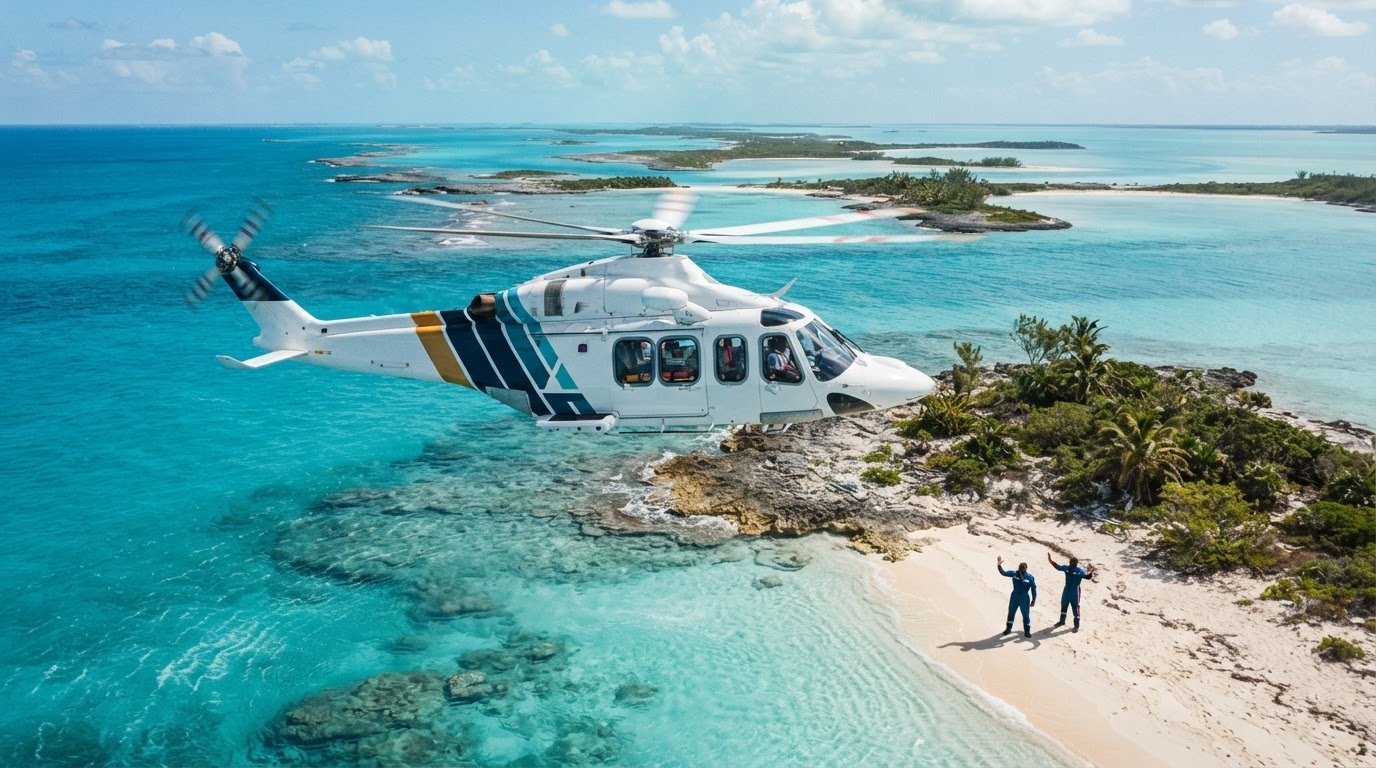
What if the key arrangements for a medical evacuation were made before an emergency begins? A Bahamas helicopter medevac membership gives eligible travelers advance access to Tropic Air Rescue’s concierge helicopter air-medical service. In the Bahamas, where some locations are difficult to reach by runway-dependent aircraft, planning ahead can help keep enrollment from becoming another task during a medical crisis.
Tropic Air Rescue’s helicopters can land at remote locations inaccessible to fixed-wing aircraft and carry life-support equipment. The service also coordinates with trauma centers. Flights are subject to operational limits, including aircraft availability, maintenance, regulations, patient condition and weather. FAA restrictions prohibit most Tropic Air Rescue aircraft from flying in inclement weather.
This article explains how short-term and annual memberships compare, when membership activates, and how direct health-insurer billing works. Membership is not an insurance policy, and members must maintain current medical insurance. Any costs not covered by insurance remain the member’s responsibility.
Key Takeaways
- A Bahamas helicopter medevac membership provides advance access to air-medical benefits, subject to membership terms and operational limits.
- Helicopters can land at some remote locations inaccessible to fixed-wing aircraft, but whether a flight can operate depends on the circumstances.
- Tropic Air Rescue bills health insurers directly for members. Members must maintain current medical insurance and are responsible for any uncovered costs.
- Compare short-term and annual membership options with the length of your stay and how often you expect to return.
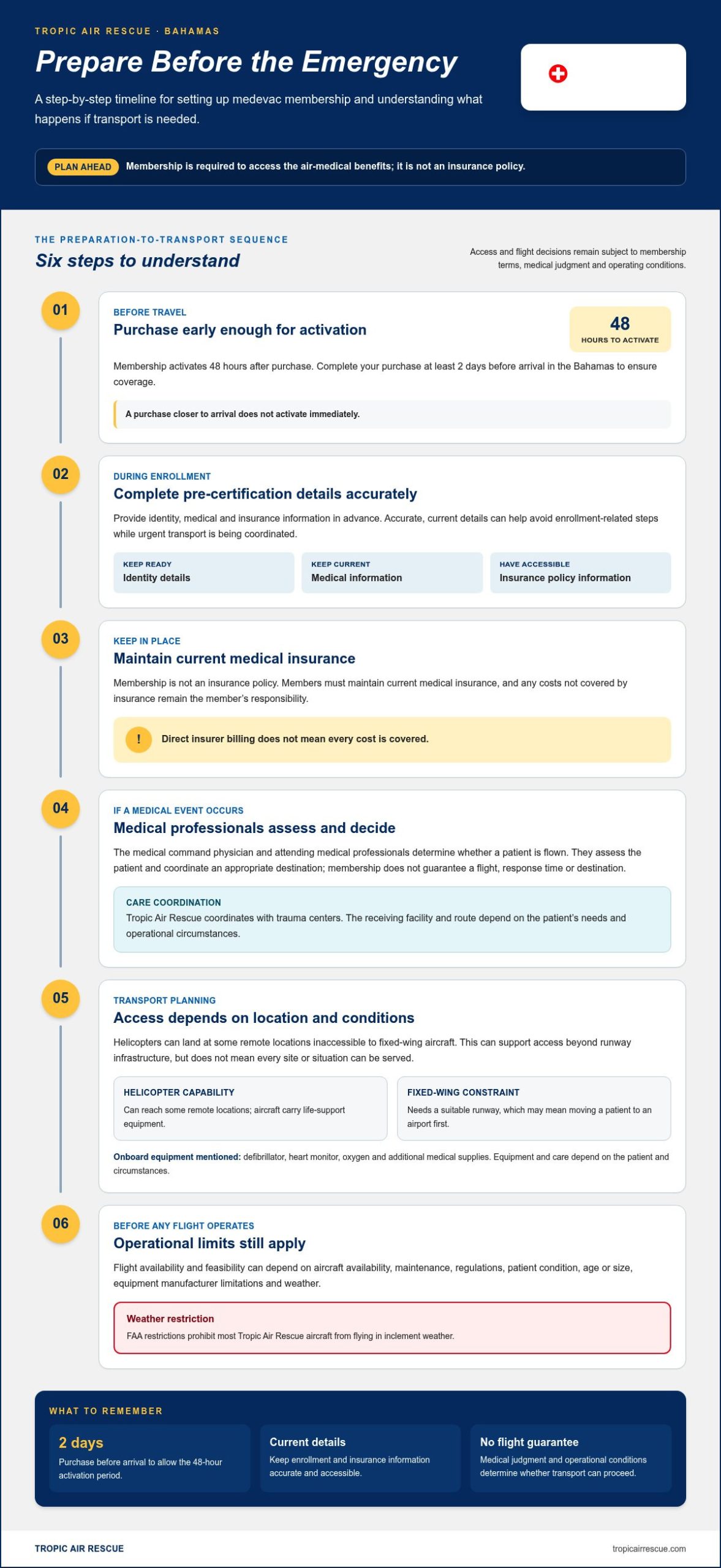
- Membership activates 48 hours after purchase. Complete your purchase at least 2 days before arrival in the Bahamas to ensure coverage.
Why Bahamas Helicopter Medevac Membership is a Tactical Necessity
In a serious medical emergency, care teams need to assess the patient, identify an appropriate destination and coordinate transport. A Bahamas helicopter medevac membership puts access to Tropic Air Rescue’s air-medical system in place ahead of time. Membership is required to access its benefits, so enrollment and activation are practical parts of travel preparation, not tasks to leave until an emergency.
Pre-certification collects identity and enrollment information in advance. Completing the application accurately and keeping your details current can help avoid enrollment-related steps when urgent transport is being coordinated.
This preparation does not replace medical assessment or guarantee that a flight will operate. The sole right to determine whether a patient is flown rests with Tropic Air Rescue’s medical command physician and attending medical professionals. Flights may also be limited by aircraft being used for another patient, equipment manufacturer limitations, government regulations, maintenance requirements, patient condition, age or size, and weather. FAA restrictions prohibit most Tropic Air Rescue aircraft from flying in inclement weather. This air ambulance services overview provides general background on the category.
The Concept of Pre-Certification
Enrollment is the time to provide accurate identity, medical and insurance information. Keep those details current and accessible. Tropic Air Rescue bills health insurers directly for members’ medical flights. Having your policy information ready can support billing coordination if a flight is needed, while membership establishes access to the service’s air-medical system.
Timing matters. Membership activates 48 hours after purchase. Complete the purchase at least 2 days before arrival in the Bahamas to ensure coverage. A membership purchased closer to arrival will not activate immediately.
Operational Readiness in the Bahamas
Ready. Agile. Direct. Helicopters can land at remote locations inaccessible to fixed-wing aircraft, and Tropic Air Rescue’s fleet carries life-support equipment. This capability can support access where a runway-dependent aircraft cannot land, but it does not mean every location or situation can be served.
When a patient needs transport, the medical command physician and attending medical professionals determine whether the patient is flown. The receiving hospital and route depend on the patient’s needs and operational circumstances. Membership does not guarantee a particular response time, destination or flight.
For travelers, the practical steps are straightforward: complete the purchase at least 2 days before arrival, allow the 48-hour activation period, provide accurate enrollment information and maintain current medical insurance. These steps prepare the membership side of the process before a medical event occurs.
The Helicopter Advantage: Precise Access to Remote Locations
Distance is only part of an evacuation challenge. A patient may be far from an airport, and reaching a runway can add a ground-transport step before a flight begins. Tropic Air Rescue’s helicopters can land at remote locations inaccessible to fixed-wing aircraft, supporting transport planning from locations beyond runway infrastructure.
“Direct” describes an approach that coordinates transport from the pickup location toward appropriate hospital care. It is not a promise that every site can be used or that every flight follows the same route. Landing conditions, patient needs and operational limits shape the plan. A Bahamas helicopter medevac membership provides access to the service’s benefits; the helicopter’s ability to reach remote locations is central to its approach.
Fixed-Wing vs. Helicopter Medevac
Runway access can be a constraint during an island emergency. A fixed-wing aircraft needs a suitable runway, which may mean moving a patient from a remote location to an airport first. A helicopter can land at some locations beyond runway infrastructure, potentially reducing the number of transfer steps. The practical difference is access, not a guarantee that a helicopter can land at any chosen site. Explore the advantages of helicopter medevac in the Bahamas for more context on how aircraft access shapes emergency transport.
Vessels add another consideration. A helicopter may support access near remote boating locations, but a yacht deck is not automatically a safe landing area. Conditions at the scene and aircraft limitations affect the transport plan. The advantage is flexible access planning, not a guarantee of landing on any boat.
Hospital-Grade Care at High Altitudes
Access matters only if medical support continues in transit. Tropic Air Rescue helicopters carry life-support equipment, including a defibrillator, heart monitor, onboard oxygen and additional medical supplies. The equipment and care needed depend on the patient and circumstances.
Tropic Air Rescue coordinates with trauma centers to connect a remote pickup with care suited to the patient’s needs. The receiving facility and route are part of medical and operational coordination, not a fixed itinerary. For travelers planning ahead, reviewing Tropic Air Rescue membership options explains how membership provides access to this helicopter air-medical service.
Financial Security: The No Out-of-Pocket Guarantee
A medical evacuation can bring financial uncertainty at the same time a family is managing an emergency. For members, Tropic Air Rescue bills health insurers directly for medical flights. This arrangement eliminates out-of-pocket flight expenses at the time of flight, but it does not mean every policy covers every expense. Members must maintain current medical insurance, and any costs not covered by insurance are the member’s responsibility.
Direct billing changes the payment process: rather than paying the flight cost first and then submitting a claim, the member’s insurer is billed directly. Members must remit payments received from insurers or third parties up to the amount charged. Those payments are not considered out-of-pocket expenses for the member. Review your policy so you understand its coverage and any costs for which you may be responsible.
Direct Insurance Coordination
Before travel, gather your insurer’s name, policy details and current contact information, and provide accurate information during enrollment. Tropic Air Rescue bills health insurers directly for members’ medical flights. Keep your policy information accessible in case it is needed for coordination.
Health insurance policies differ, and a policy issued outside the United States may not cover every flight or expense. Do not assume that travel coverage automatically pays for a helicopter medical flight. Membership is not an insurance policy, does not provide secondary insurance coverage and does not supplement existing insurance. Members are responsible for maintaining current medical insurance throughout the membership period, and any uncovered costs are their responsibility.
Direct billing means the insurer is billed rather than requiring the member to pay the flight cost upfront. It does not remove responsibility for uncovered expenses or guarantee that every flight will be covered by a member’s policy.
Protecting Your Assets from Medical Flight Costs
Air-medical transport is a specialized service. Instead of assuming that a later reimbursement claim will cover a flight, understand the membership billing arrangement before travel: Tropic Air Rescue bills health insurers directly, and members are responsible for costs their insurance does not cover.
Travel insurance policies can have conditions, exclusions or limits that affect evacuation benefits. Read your policy terms and do not assume that general travel coverage automatically pays for a helicopter medical flight. Membership provides access to the air-medical system and direct insurer billing. It does not replace valid health insurance or make an uncovered flight eligible for payment.
Tropic Air Rescue offers short-term and annual memberships. Compare the term with your planned stay and return trips, then complete the purchase at least 2 days before arrival to ensure coverage. Memberships are non-refundable and non-transferable, so consider the term carefully before purchasing.
Choosing the Right Membership: Short-Term vs. Annual Plans
The right membership term depends on how long you plan to stay in the Bahamas and how often you return. Compare your travel dates with the short-term and annual options, then purchase early enough for activation before arrival. Membership is required to access the air-medical system’s benefits.
Short-Term Coverage for Travelers
Short-term membership is an option for visitors planning a defined stay. Match the membership period to your travel window, and do not assume coverage begins on arrival. Membership activates 48 hours after purchase, so complete the purchase at least 2 days before arrival to ensure coverage. The short-term medevac coverage guide can help frame that planning decision.
If you make multiple trips, compare the length of each stay with the annual membership option. A short-term membership can align with a defined visit, while an annual membership may suit a longer or recurring travel pattern. In either case, purchase early enough to account for the activation period.
Annual Membership for Residents and Expats
Residents, expats and frequent visitors may consider annual membership for a longer membership period. Compare it with your travel pattern and the dates you expect to be in the Bahamas. Review the annual air rescue membership information as you weigh an annual term against a short-term option.
Consider how often you travel and the length of your planned stays. Tropic Air Rescue also provides inter-hospital transfer services and organ transport, including transportation for people awaiting organ donations. These are services offered by the company, but do not assume they are automatically included in a membership benefit.
Membership for Organizations
Memberships are limited to natural persons. Organizations cannot enroll in the membership program, and applicants must certify that they are not Medicaid beneficiaries. If you are considering membership for yourself, compare your expected time in the Bahamas with the short-term and annual options.
For a practical comparison, list your expected time in the Bahamas and how often you return. Then choose the individual membership term that fits. Explore Tropic Air Rescue membership options and purchase early, allowing for the 48-hour activation period.
Joining Tropic Air Rescue: The Path to Elite Protection
Preparation is most effective before departure, not during a medical crisis. Joining Tropic Air Rescue involves choosing a membership period, completing the purchase and allowing time for activation. Membership is required to access the service’s benefits, so enrollment is an important step to take before your stay in the Bahamas.
Membership activates 48 hours after purchase. Complete the purchase at least 2 days before arrival in the Bahamas to ensure coverage. Memberships are non-refundable and non-transferable. Membership supports preparation, but does not guarantee a particular response time or outcome. Flights may be unavailable because of aircraft use, equipment manufacturer limitations, government regulations, maintenance, patient condition, age or size, or weather. FAA restrictions prohibit most Tropic Air Rescue aircraft from flying in inclement weather.
The Enrollment Checklist
Use this sequence to prepare for enrollment. Complete the application accurately, and remember that purchase and activation are separate steps.
- Select a membership duration. Compare the short-term and annual options with your planned time in the Bahamas and how often you expect to return.
- Complete the application. Provide the requested details accurately, including insurance information. Applicants must certify that they are not Medicaid beneficiaries.
- Allow time for activation. Membership activates 48 hours after purchase. Complete the purchase at least 2 days before arrival to ensure coverage, then keep your membership and insurance information accessible.
This checklist makes enrollment a practical travel-preparation task. Add it to your pre-departure planning alongside travel documents and insurance details. If you are already in the Bahamas, a new purchase still takes 48 hours to activate.
Beyond Emergency: Inter-Hospital and Organ Transport
Air-medical support can involve more than an emergency pickup from a remote location. Tropic Air Rescue provides inter-hospital transfer services, coordinating transport between medical facilities when a patient needs to move from one facility to another. Clinical circumstances guide each transfer, and service arrangements depend on the applicable terms.
Tropic Air Rescue also provides organ transport and transportation for people awaiting organ donations. This is distinct from evacuating a patient and involves its own transport coordination. For an overview of the coordination involved in moving a patient between facilities, the inter-hospital transfer guide offers relevant context.
For individuals planning a stay in the Bahamas, the next step is to choose a membership term and complete the purchase early. A Bahamas helicopter medevac membership is a preparation decision: submit your application, purchase at least 2 days before arrival, allow 48 hours for activation and keep essential information accessible. Readiness starts well before a call for help is needed.
Make Preparedness Part of Your Travel Plan
Plan who needs individual membership, choose a term that fits your stay and complete the purchase before departure. Membership activates 48 hours after purchase, so purchase at least 2 days before arrival in the Bahamas to ensure coverage. Memberships are non-refundable and non-transferable.
A Bahamas helicopter medevac membership connects advance preparation with Tropic Air Rescue’s concierge helicopter air-medical service. The helicopters can land at remote locations inaccessible to fixed-wing aircraft and carry life-support equipment. Tropic Air Rescue bills health insurers directly, but members must maintain current medical insurance and are responsible for uncovered costs. Flight availability is subject to operational limitations, including FAA restrictions on most aircraft flying in inclement weather.
Take the next step while planning, not under pressure. Review the membership options, prepare your enrollment details and allow time for activation before travel. Secure Your Bahamas Medevac Membership Today and make enrollment part of your travel preparation.
Frequently Asked Questions
Is membership required to receive Tropic Air Rescue services?
Yes. Membership is required to access the benefits of Tropic Air Rescue’s concierge helicopter air-medical service. A non-member may request service, but Tropic Air Rescue may accept or refuse the request and may impose an emergency membership fee that is non-revokable once services are rendered. For planned travel, purchase in advance: membership activates 48 hours after purchase, and the purchase must be completed at least 2 days before arrival in the Bahamas to ensure coverage.
How does direct insurance billing work for helicopter medevac?
Tropic Air Rescue bills a member’s health insurer directly for medical flights. Members must maintain current medical insurance throughout the membership period and provide accurate policy information. Insurance plans differ, and members are responsible for costs not covered by their insurance. Membership is not an insurance policy and does not provide secondary insurance coverage.
What is the difference between helicopter and fixed-wing medical flights?
Helicopters can land at some remote locations without a runway, while fixed-wing aircraft require suitable runway access. In an island emergency, that difference may affect whether a patient needs ground transport to an airport before an airplane journey can begin. Helicopter access can support a more direct pickup, but landing options depend on conditions at the scene. Tropic Air Rescue’s air-medical service is helicopter-based.
Can Tropic Air Rescue land at remote resorts or private yachts?
Tropic Air Rescue helicopters can land at remote locations inaccessible to fixed-wing aircraft, but that does not mean every resort area or yacht deck is a safe landing location. Site conditions, aircraft limitations, maintenance, regulations, weather and patient circumstances can affect whether a flight can operate. The sole right to determine whether a patient is flown rests with Tropic Air Rescue’s medical command physician and attending medical professionals.
What medical equipment is available on the helicopters?
The helicopters carry life-support equipment, including a defibrillator, heart monitor, onboard oxygen and additional medical supplies. The aircraft also have GPS, a 4-axis autopilot, an electronic flight instrument system, a flight management computer and a 5-million-candle-power searchlight. A pilot-critical-care-paramedic crew supports patient transport. Equipment does not remove operational limits, including FAA restrictions on most Tropic Air Rescue aircraft flying in inclement weather.
Does membership cover transport to Florida trauma centers?
Tropic Air Rescue coordinates with trauma centers, and the receiving hospital heliport is selected by its medical director in coordination with attending medical professionals. Membership provides access to the air-medical system, but it does not guarantee a particular destination or that a flight will operate in every circumstance. Aircraft use, maintenance, weather, regulations, equipment limitations and patient condition can affect transport decisions.
Are there different membership plans for tourists and residents?
Tropic Air Rescue offers short-term and annual memberships, allowing travelers to compare their expected time in the Bahamas with the available terms. A visitor planning a defined trip may consider a short-term option; a resident or frequent visitor may consider an annual term. Membership is limited to natural persons, and applicants must certify that they are not Medicaid beneficiaries. Purchase at least 2 days before arrival to ensure coverage.
What happens if my insurance does not cover the full cost of the flight?
You are responsible for expenses your health insurance does not cover. Membership is not an insurance policy, does not supplement existing insurance and does not make Tropic Air Rescue responsible for an insurer’s shortfall. Maintain current medical insurance during your membership and understand its terms before travel. Direct billing supports payment coordination, but it does not guarantee that every flight or expense will be covered.