


The fastest way to get someone from the Bahamas to a US hospital isn’t always to arrange a flight first. If a person is seriously ill or injured, seek immediate local emergency care and clinical assessment. The medical team’s decisions, the patient’s location, aircraft access, and a receiving hospital’s readiness all shape the safest transfer plan. Knowing how to get from Bahamas to a US hospital fast starts with the right first call, not guesswork.
It’s understandable to wonder whether to contact emergency services, a hospital, or an air medical provider. Each has a different role, and early coordination can help avoid unnecessary delays without compromising care. A helicopter may suit some locations and medical needs, but no aircraft or destination is right for every situation.
This guide explains what to do first, how clinical assessment and coordination with a US hospital affect timing, and what information to prepare for the care and transport teams. It also explains how membership can fit into preparedness, including why to review eligibility, exclusions, activation terms, and insurer-billing language before an emergency. Membership isn’t a substitute for emergency services or a medical decision.
Key Takeaways
- To understand how to get from Bahamas to a US hospital fast, focus on early clinical decisions, suitable aircraft access, and coordinated handoffs, not flight speed alone.
- Care needs and receiving-facility coordination shape the transport plan and destination.
- Compare helicopter and fixed-wing access, transfer stages, distance, and clinical suitability for the specific situation.
- Use a practical checklist to share essential medical and location details, but don’t let optional paperwork delay urgent care.
- Membership may support emergency preparedness. Review eligibility and activation terms before travel.
How to get from Bahamas to a US hospital fast: first steps
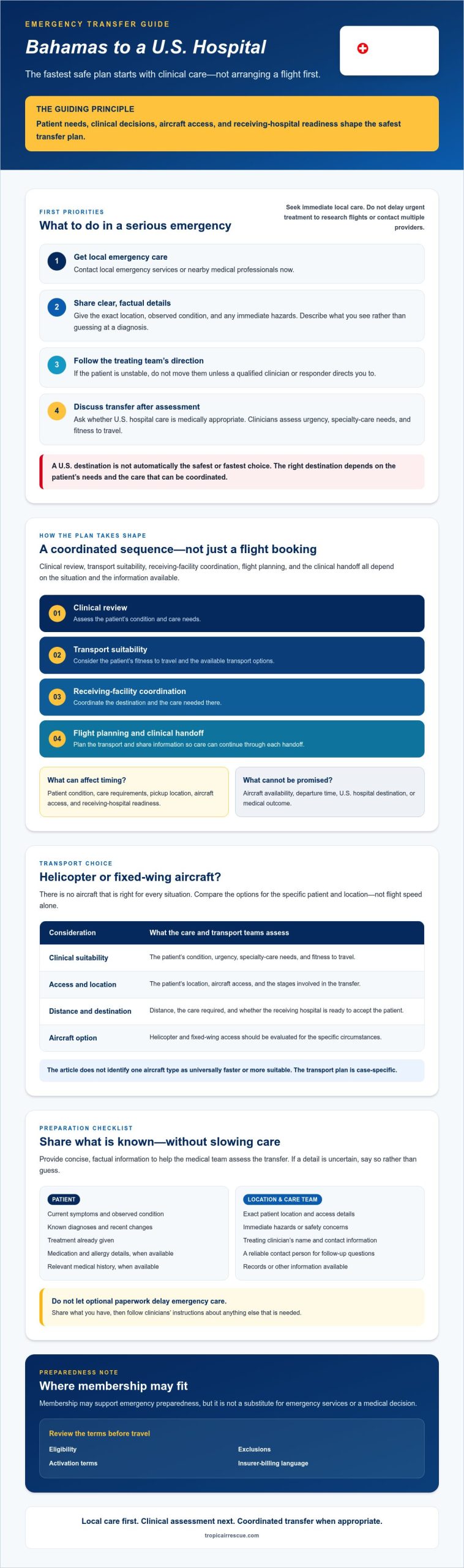
If someone is facing an active medical emergency, contact local emergency services or nearby medical professionals now. Don’t delay urgent care to research flights, contact multiple providers, or try to determine the diagnosis yourself. Air medical transport is considered after clinicians assess the patient and the situation.
There’s no guaranteed aircraft availability, departure time, US hospital destination, or medical outcome. The safest sequence is to seek immediate care, share accurate information, follow the treating team’s instructions, and then discuss whether and how a transfer should be coordinated. That’s the practical starting point for understanding how to get from Bahamas to a US hospital fast.
What should you do during a serious medical emergency?
Give responders the patient’s exact location, current condition, and any immediate hazards, such as an unsafe building or difficulty reaching the patient. Describe what you’ve observed instead of guessing at a diagnosis. If the patient is unstable, don’t move them unless a qualified clinician or responder directs you to. Moving them can create additional risk and complicate assessment or treatment.
Once the patient is receiving care, ask the treating team what level of care is needed and whether transfer to a US hospital is medically appropriate. Follow their instructions while they evaluate options. Aeromedical evacuation is a medically supported form of patient transport, not simply a flight arranged independently. Read this overview of aeromedical evacuation.
When does transfer to a US hospital enter the plan?
A transfer discussion follows clinical assessment. The treating clinician considers the patient’s urgency, the specialty care required, and whether the patient is fit to travel. These decisions help determine the appropriate transport arrangements and destination. A US hospital isn’t automatically the safest or fastest choice. The right destination depends on the patient’s needs and the care that can be coordinated.
Keep the handoff focused on clinical details. Tell the treating team what the patient’s condition was, what has changed, and which records or other information are available. Don’t promise a receiving hospital or departure time before the medical and transport teams have assessed the case and coordinated next steps.
- Seek care: Contact local responders or nearby medical professionals.
- Share facts: Provide the location, observed condition, and safety risks.
- Follow direction: Let clinicians guide care and any movement.
- Discuss transfer: Ask whether US care is appropriate after assessment.
For more on how urgent trauma cases may be evaluated for transport, read the 2026 trauma air transport guide. Immediate local care remains the priority. Transfer planning should support clinical decisions, not delay them.
How Bahamas to US air medical transfers are assessed and coordinated
A Bahamas to US medical transfer involves a sequence of decisions, not just a flight booking. The process generally moves from clinical review to transport-suitability assessment, receiving-facility coordination, flight planning, and a clinical handoff. Each step depends on the patient’s condition, the care required, the pickup location, and available transport options.
Medical transfer coordination brings together clinical decisions, aviation planning, and receiving-hospital readiness so the patient’s care can continue through each handoff. Clear, timely communication helps everyone work from the same information. Missing or outdated details can prompt follow-up questions, so share what’s known and identify anything that still needs confirmation.
What information helps the medical team assess a transfer?
Provide concise, factual details: current symptoms, known diagnoses, recent changes, and treatment already given. When available, gather medication and allergy details, relevant medical history, and the treating clinician’s name and contact information. Confirm the patient’s precise location and provide a reliable contact person who can answer follow-up questions.
Don’t delay emergency care to collect records or complete paperwork. Share what you have, then follow clinicians’ instructions about any additional information. If a detail is uncertain, say so rather than guessing.
How are the receiving hospital and handoff coordinated?
The patient’s clinical needs guide the choice of facility. Clinicians assess the level and type of care required, then coordinate with the receiving facility and transport medical personnel. The treating team can communicate the patient’s condition and care to date. The transport team can relay updates during the transfer, and the receiving team can prepare for the clinical handoff. The appropriate facility may not be the closest one or the one a family initially requests.
Flight planning takes place alongside those medical decisions, not instead of them. Aviation considerations are part of the operational picture. The Federal Aviation Administration provides guidance on FAA standards for helicopter air ambulances. Transport suitability and arrangements must be assessed for each case.
- Clinical review: Confirm the patient’s current status and care needs.
- Transport assessment: Determine whether transfer is suitable and what support is required.
- Facility coordination: Match the destination to the required care and receiving-facility arrangements.
- Handoff: Pass relevant clinical information to the receiving team.
For more on communication between facilities, read this inter-hospital transfer coordination guide. These linked decisions explain how to get from Bahamas to a US hospital fast without treating speed as a substitute for clinical suitability.
Helicopter or fixed-wing aircraft: which can get a patient there faster?
The fastest aircraft in the air isn’t automatically the fastest or safest way to reach appropriate care. Total transfer time includes reaching the aircraft, loading and stabilizing the patient, the flight, and the onward handoff. In the Bahamas, access at the pickup point can be decisive. A fixed-wing aircraft generally needs a suitable runway, while a helicopter may reach some remote locations that fixed-wing aircraft cannot. Neither option suits every patient or location.
Use this comparison as a starting point, not a dispatch decision. The treating clinicians and transport team must assess the individual case.
| Factor | Helicopter | Fixed-wing aircraft |
|---|---|---|
| Access | May reach some remote locations without a runway, if a suitable landing area and operating conditions are confirmed. | Requires access to an appropriate runway, with ground transport potentially needed at either end. |
| Distance | Can suit routes where direct access helps connect the pickup point with the next care or transfer stage. | May be considered for longer-distance air travel, subject to the aircraft, route, and logistics. |
| Transfer stages | May reduce ground-transfer barriers at pickup, but doesn’t eliminate coordination, landing, or onward-transfer needs. | May involve ground transport to and from airports, in addition to flight planning and clinical handoffs. |
| Clinical suitability | Depends on the patient’s condition, medical support needs, and operational assessment. | Also depends on the patient’s condition, required care, and the aircraft and route available. |
When can helicopter access matter in the Bahamas?
If the patient is somewhere that is difficult to reach by road or lacks convenient runway access, a helicopter may help with the first ground-transfer stage. Tropic Air Rescue’s helicopter fleet can access some remote locations that fixed-wing aircraft cannot. That doesn’t guarantee a shorter total transfer. The landing location, weather, patient’s condition, destination, and operating factors all need case-specific assessment.
Relevant professionals must confirm whether a location is suitable for landing. Don’t assume an aircraft can land at a particular property, vessel, or other location.
When might fixed-wing transport be considered?
Fixed-wing transport may be considered when distance, runway access, and the overall transfer plan make it appropriate. The aircraft may cover the air segment efficiently, but ground legs and handoffs still count. The decision should reflect the patient’s needs and the full route, not aircraft speed alone. Tropic Air Rescue’s described service is helicopter-based, not fixed-wing transport.
For a fuller discussion of the factors involved, read this helicopter-versus-fixed-wing comparison. The practical answer to how to get from Bahamas to a US hospital fast is the aircraft and route that clinicians and transport coordinators determine are suitable for the patient.
Prepare for a Bahamas to US hospital transfer without slowing care
Good preparation helps clinicians and coordinators assess options with fewer information gaps. It shouldn’t interrupt treatment. Keep essential details easy to access, share what you know, and follow the treating team’s instructions. If care is urgent, don’t pause to find documents, confirm insurance, or check membership status before seeking medical help.
Clear patient, location, and clinical details help teams assess transfer options. If possible, assign one companion to communicate updates and record instructions. A single point of contact can reduce the risk of conflicting messages while care and transfer decisions are being coordinated.
What should a companion have ready?
Start with the information clinicians need to identify the patient and understand the situation. Provide confirmed details and flag anything you’re unsure about.
- Gather now, if readily available: The patient’s full name and identifying details, exact current location, a reliable callback number, current symptoms and recent changes, known diagnoses, treatment already provided, medication and allergy details, and relevant medical notes.
- Choose one contact: Give the treating team and coordinators one reliable person to reach. Keep your phone accessible and write down instructions, names, and updates.
- Do later if needed: Look up insurer contact details, policy information, membership records, and additional paperwork only when doing so won’t delay urgent care or conflict with clinical instructions.
If a record isn’t available, say so. A clear verbal update is more useful than delaying care to find a document or guessing at missing information.
What should you check about membership and insurance?
Tropic Air Rescue benefits require membership. If membership may apply, confirm the patient’s current status and review eligibility, exclusions, and activation terms directly with the company. Do this without delaying emergency assessment or treatment.
Tropic Air Rescue bills members’ health insurers directly and accepts insurance payouts as full payment for members. Membership terms apply, so don’t assume every policy, patient, or situation is eligible. Check the current insurer-billing language and what the terms require. For planning context, see the short-term medevac coverage guide.
Knowing how to get from Bahamas to a US hospital fast also means knowing what to prepare before travel. Review Tropic Air Rescue’s membership information and terms in advance, then keep the relevant details accessible. Preparation supports coordination. It never replaces clinical assessment or urgent local care.
How Tropic Air Rescue fits into Bahamas to US emergency transport
Once local clinicians have assessed the patient and transfer is being considered, Tropic Air Rescue is a membership-based helicopter air-medical transport option in the Bahamas. The service provides emergency and inter-hospital transfers, uses life-support equipment, and coordinates with US hospitals. The appropriate receiving facility depends on the patient’s needs.
This is one part of the wider decision pathway, not a substitute for emergency response or clinical direction. The safest answer to how to get from Bahamas to a US hospital fast depends on the patient’s condition, transport suitability, access at the origin, and coordination with the receiving facility. Don’t assume a specific aircraft, departure time, destination, or outcome in advance.
What does the membership-based service provide?
Tropic Air Rescue offers short-term and annual memberships. Membership is required to receive the company’s benefits, so travelers should check current eligibility, exclusions, activation requirements, and the precise scope of service before relying on membership in an emergency. Don’t assume enrollment alone confirms eligibility for every patient or situation.
The company bills members’ health insurers directly and accepts insurance payouts as full payment for members. Confirm the current insurer-billing language and applicable membership terms directly with Tropic Air Rescue. Check how those terms apply to your circumstances.
How can travelers prepare before an emergency?
Review the membership details before travel, and keep enrollment information accessible to the traveler and a trusted companion. Make sure they know where to find relevant contact information and can accurately communicate the patient’s location and current condition if transfer coordination is needed. This preparation can support communication, but it doesn’t replace medical assessment.
If an emergency occurs, contact local emergency services or nearby medical professionals and follow their instructions. Don’t delay urgent care to search for membership documents or contact an air medical provider first. Discuss transfer options with the treating clinicians and have the situation assessed for the patient’s circumstances.
For a non-urgent review before travel, review Tropic Air Rescue membership options and confirm current terms directly with the company. Preparedness starts before an emergency. During one, follow local clinicians and responders.
Prepare before the next decision matters
The clearest path from the Bahamas to US hospital care starts with immediate local medical help. Clinicians assess whether transfer is appropriate, which transport fits the patient and location, and which receiving facility can provide the required care. Aircraft speed alone doesn’t determine the fastest safe transfer.
Keep essential patient and location details accessible, and follow the treating team’s instructions. For travelers planning ahead, Tropic Air Rescue provides helicopter air-medical transport with life-support equipment and coordination with US trauma centers. Membership is required to receive benefits. Options are tailored to the anticipated length of stay in the Bahamas, and travelers should confirm current eligibility, exclusions, and terms before travel.
If you’re preparing for a trip, review Tropic Air Rescue membership options and check the details in advance. In an active emergency, contact local responders or medical professionals first. Knowing how to get from Bahamas to a US hospital fast means being prepared while keeping urgent care and clinical judgment at the centre of every decision.
Frequently Asked Questions
What should I do first if someone needs emergency care in the Bahamas?
Contact local emergency services or nearby medical professionals immediately. Give them the patient’s location, observed condition, and any immediate safety risks. Follow qualified clinicians’ instructions, and don’t move an unstable patient unless they direct you to. Don’t delay urgent care to research flights or gather paperwork. Once the patient has been assessed, ask the treating team whether transfer is appropriate and what information will help coordinate next steps.
Can a helicopter take a patient directly from the Bahamas to a US hospital?
A helicopter transfer may be an option, but a direct flight to a particular US hospital can’t be assumed. The patient’s condition, pickup access, destination suitability, weather, operational factors, and coordination with the receiving facility all affect the plan. A transfer may also involve other transport stages or handoffs. Clinicians and transport coordinators assess the safest suitable arrangement for the individual case.
How fast can someone be flown from the Bahamas to a US hospital?
There’s no dependable time that applies to every transfer. Timing depends on clinical assessment, transport suitability, aircraft and location access, flight planning, conditions, and coordination with a receiving hospital. The flight itself is only one part of the process. If you’re asking how to get from Bahamas to a US hospital fast, seek local medical care first and share accurate patient and location details with the care team.
Is a helicopter always faster than a fixed-wing medical flight?
No. A helicopter may access some locations without convenient runway access, while fixed-wing transport may suit a route where runway and distance logistics fit. Ground transfers, loading, clinical support needs, and handoffs affect total time for either option. The fastest aircraft on paper may not be the safest or most suitable choice. The treating and transport teams must assess the patient, origin, destination, weather, and operational factors.
Can a patient be transferred to a US hospital without a doctor’s assessment?
A medical transfer should follow clinical assessment. The treating clinician evaluates the patient’s condition, urgency, required care, and fitness for transport. A US hospital isn’t automatically the safest or fastest destination. The appropriate facility depends on the patient’s needs and coordination with the receiving team. In an active emergency, contact local responders or medical professionals first. Don’t delay care while trying to arrange an international transfer independently.
Does Tropic Air Rescue membership cover an emergency flight to the United States?
Tropic Air Rescue provides helicopter air-medical transport and coordinates care with US hospitals. Membership is required to receive benefits. Whether a specific emergency transfer is eligible depends on current membership terms and assessment of the case. Before travel, confirm eligibility, exclusions, activation requirements, and the scope of US hospital coordination directly with the company. Membership is a preparedness option, not a substitute for emergency care or clinical assessment.
Will I have to pay out of pocket for a Tropic Air Rescue transfer?
Tropic Air Rescue bills members’ health insurers directly and accepts insurance payouts as full payment for members. Membership is required for benefits, and the applicable membership terms determine eligibility. Before relying on membership, confirm current eligibility, exclusions, activation terms, and insurer-billing language directly with Tropic Air Rescue. Ask the company about how the terms apply to your circumstances.