

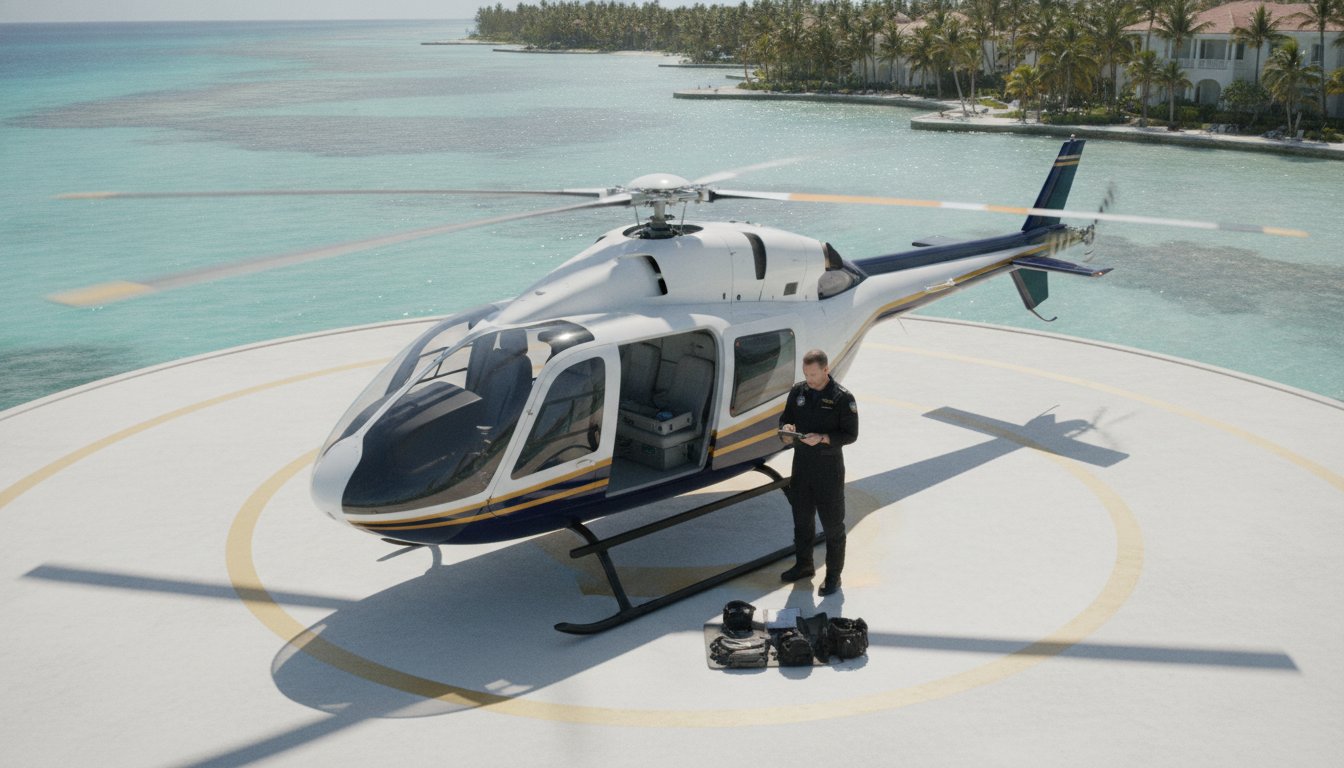
Over 90% of the islands and cays in the Bahamian archipelago lack a functional, paved runway. For a luxury property, this is more than a logistical hurdle; it is a direct threat to guest safety and operational continuity. When a medical crisis occurs, the traditional reliance on fixed-wing aircraft often results in dangerous multi-stage transfers or the dreaded reimbursement trap. You have likely seen the fallout when guests are forced to provide $50,000 credit authorizations upfront before a rescue flight even departs. It is a high-stakes scenario that risks your resort’s reputation and its duty of care obligations.
You recognize that a premium guest experience shouldn’t end when an emergency begins. This guide explores how to implement a robust resort medical evacuation plan Bahamas that protects your guests and your brand. We’ll detail the transition to direct-from-property helicopter transfers and the specialized B2B membership models that eliminate out-of-pocket costs at the point of service. You will discover a framework that ensures your elite standards remain intact, even during the most critical moments. We’ll cover everything from logistical precision to the financial benefits of pre-approved evacuation protocols.
Key Takeaways
- Establish a pre-approved resort medical evacuation plan Bahamas to transition from reactive crisis management to a proactive, concierge-level emergency protocol.
- Solve the archipelago’s logistical limitations by utilizing rotorcraft capable of landing directly on resort grounds, bypassing the critical lack of paved runways.
- Protect guests from the “reimbursement trap” through membership models that facilitate direct billing to insurance, removing the burden of massive upfront payments.
- Align your hospitality brand with modern Duty of Care standards to mitigate catastrophic legal risks and preserve your reputation during high-stakes medical incidents.
- Implement a turnkey B2B solution that secures your resort’s operational continuity through a seamless, two-step integration of elite aeromedical services.
Defining a Strategic Resort Medical Evacuation Plan in the Bahamas
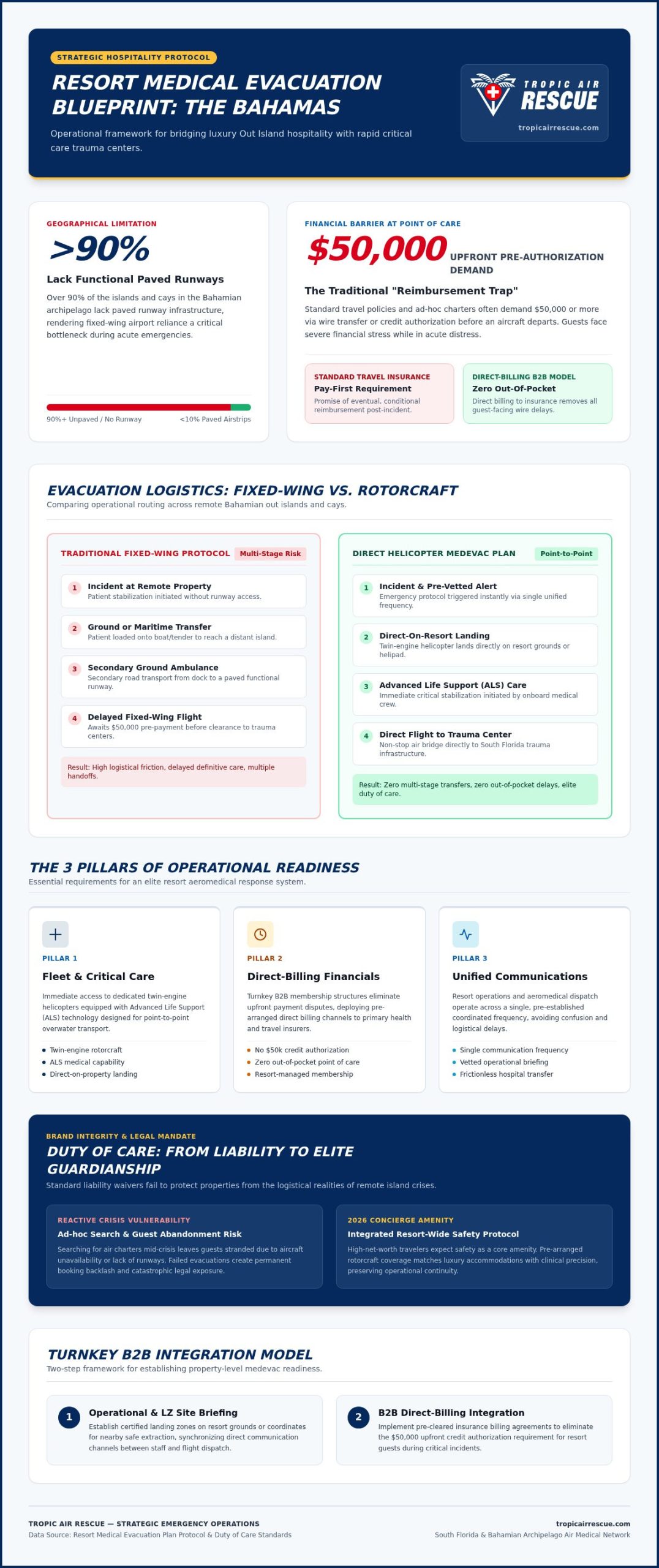
A strategic resort medical evacuation plan Bahamas functions as the critical bridge between a remote island property and a South Florida trauma center. It’s not merely a document stored in a manager’s desk; it’s a live, pre-arranged logistical and financial protocol designed to activate the moment a guest requires critical care. In the complex landscape of the Bahamian archipelago, where over 90% of the islands lack functional runways, a reactive approach is a liability. A strategic plan ensures that the resort isn’t searching for solutions during a crisis but is instead executing a vetted operational briefing.
The distinction between having insurance and having a standby aircraft is absolute. Travel insurance is a promise of eventual reimbursement. An integrated medevac plan is a guarantee of immediate arrival. Adhering to international medical evacuation protocols requires more than just a list of phone numbers. It demands a dedicated rotorcraft fleet capable of point-to-point transport. While fixed-wing aircraft are tethered to distant airstrips, a helicopter based on a proactive plan lands directly on resort grounds, effectively bypassing the geographical barriers that define the “reimbursement trap.”
The Components of a Robust Evacuation Protocol
Operational excellence depends on three pillars. First, readiness requires immediate access to twin-engine helicopters equipped with Advanced Life Support (ALS) technology. Second, financial coverage must include direct-billing mechanisms. This removes the “pay-first” requirement where guests are often asked for $50,000 or more via wire transfer before a flight launches. Third, communication chains must be pre-established. Resort staff and flight crews should operate on a single, coordinated frequency to ensure that patient stabilization and transport occur without friction.
Why 2026 Requires an Integrated Approach
Guest expectations have evolved. In 2026, premium travelers view “concierge-level” safety as a non-negotiable amenity rather than a luxury add-on. The shift from individual travel insurance to resort-managed safety memberships reflects this demand for seamless protection. A resort medical evacuation plan Bahamas is an essential operational asset that transforms a property’s emergency response from a logistical gamble into a predictable, elite service. By bundling these services into B2B membership plans, resorts provide a zero out-of-pocket guarantee that preserves both the guest’s health and the property’s reputation.
Duty of Care: Protecting Guests and Reputation in the Archipelago
Duty of care is a legal obligation, but in the luxury sector, it is a brand promise. Hospitality leaders must understand that a standard liability waiver does not account for the logistical isolation of the Out Islands. When a guest experiences a critical cardiac event or trauma, your property is the first responder. A single delay or a failed evacuation attempt can define your resort’s reputation for decades. Implementing a proactive resort medical evacuation plan Bahamas moves your operation from reactive risk to a position of elite guardianship.
Reputation Management in the Age of Instant Feedback
High-net-worth travelers prioritize safety as a primary amenity. They expect a seamless transition from the serenity of a private cay to professional medical intervention. In an era of viral social proof, an emergency handled with precision becomes a testament to your resort’s excellence. Conversely, a guest stranded due to aircraft unavailability or runway issues creates a permanent stain on your booking rates. Utilizing a concierge air medical service ensures that your safety protocols match the premium quality of your guest suites. It transforms a potential crisis into a demonstration of operational mastery.
Operational Liability and the Cost of Inaction
The most significant threat to guest satisfaction during a crisis is the “reimbursement trap.” Standard insurance often requires guests to pay tens of thousands of dollars upfront via wire transfer before a flight launches. This financial friction occurs at the worst possible moment. According to the U.S. Embassy in The Bahamas medical guidance, many facilities and independent transport providers require guaranteed payment before service. By integrating B2B membership plans, resorts eliminate this friction. These plans allow for direct billing to health insurers, ensuring that the evacuation begins immediately without a financial standoff. This standardized response reduces the burden on your management team and provides a zero out-of-pocket experience for the guest. It is the definitive way to protect both your patrons and your professional standing.
Logistical Readiness: Why Helicopters Define Effective Resort Evacuation
Geographic isolation is the primary enemy of an effective resort medical evacuation plan Bahamas. While many operators assume that standard emergency medical evacuation insurance covers all contingencies, these policies often ignore the physical reality of the archipelago. Fixed-wing aircraft require specific runway lengths, certified lighting, and ground support. In the Bahamas, only 61 islands possess functional runways, leaving over 90% of the territory inaccessible to traditional air ambulances. This creates a “double transfer” crisis where a critical patient must endure hazardous boat or ground transport before even reaching an aircraft. For a resort manager, this delay is an unacceptable risk to guest safety.
Helicopter vs. Fixed-Wing for Remote Island Access
The advantages of helicopter medevac in the Bahamas center on point-to-point efficiency. A twin-engine helicopter eliminates the need for secondary transfers by landing directly on resort grounds, beach helipads, or even open clearings. This capability protects the “Golden Hour” in trauma situations by removing the logistical friction of island geography. Every minute spent on a boat or in a ground ambulance is a minute lost to potential recovery. For remote properties, rotorcraft are not merely an alternative; they are the only viable solution for immediate, high-stakes extraction from the property to a definitive care facility.
Clinical Excellence in the Air
Clinical excellence in the air is the second half of the logistical equation. True readiness extends beyond the flight deck. Modern medevac helicopters operate as mobile intensive care units for remote islands, featuring advanced life-support (ALS) systems including cardiac monitors, ventilators, and 4-axis autopilot for flight stability. These aircraft are staffed by specialized flight nurses and paramedics trained specifically for the high-stakes environment of international air medical transport. This level of intervention begins the moment the aircraft touches down at your resort. It ensures the guest receives hospital-grade care at 5,000 feet while transiting directly to a South Florida trauma center helipad. This seamless transition from resort lawn to hospital rooftop is the ultimate luxury in a medical crisis, providing the professional composure guests expect from an elite hospitality brand.
Membership Models vs. Traditional Insurance: Closing the Operational Gap
Standard travel insurance often fails during the most critical hour of a medical emergency. These policies typically operate on a reimbursement basis, requiring guests to navigate complex claims and verification processes while facing life-threatening conditions. For a resort operator, this creates a significant operational bottleneck. A robust resort medical evacuation plan Bahamas bypasses these hurdles by prioritizing immediate activation over administrative verification. It ensures that the focus remains on patient stabilization rather than financial negotiation.
The “reimbursement trap” is a primary source of guest dissatisfaction and reputational risk. Independent air medical providers frequently demand guaranteed payment via credit authorization or wire transfer before an aircraft departs. When guests are forced to provide $25,000 to $60,000 upfront during a crisis, the luxury experience vanishes instantly. Membership models replace this financial friction with a pre-cleared response protocol. This eliminates the need for emergency wire transfers and allows the medical team to launch without delay.
Direct Billing: The Gold Standard for Premium Hospitality
Elite medevac services coordinate with international health insurers in real-time to facilitate direct billing. This mechanism ensures that the guest never receives a bill at the point of service. Telling a distressed family that their evacuation is already covered provides immense psychological relief and reinforces your property’s commitment to guest welfare. This concierge approach is a core feature of an annual air rescue membership, positioning the resort as a proactive guardian rather than a passive bystander.
Scalability for Resorts and Large Groups
B2B membership plans offer the flexibility needed to protect entire guest populations or specific high-value groups. Resorts can tailor coverage based on stay duration, annual occupancy metrics, or specific villa leases. Integrating these plans into booking packages or loyalty tiers automates the safety process and creates a seamless guest experience. It reduces administrative overhead for resort staff and ensures every guest is protected under a unified, audited protocol. To secure your property’s operational continuity, consider implementing B2B membership plans as a turnkey safety solution.
Implementing a Turnkey Medevac Solution for Your Hospitality Brand
Transitioning from a reactive emergency posture to a proactive safety framework requires a methodical approach. A robust resort medical evacuation plan Bahamas begins with a critical audit of your current logistical vulnerabilities. Many operators discover that their existing emergency plan relies on local clinics that lack surgical suites or fixed-wing providers that cannot land on-site. Addressing these gaps is the first step toward securing your property’s reputation and ensuring guest safety.
Implementation follows a structured four-step process:
- Audit Logistical Gaps: Identify the distance to the nearest paved runway and the capabilities of local medical facilities. If the transfer requires a boat or ground ambulance, your plan has a critical time-delay vulnerability.
- Establish Rotorcraft Partnerships: Secure a partnership with a helicopter-based air medical service. This ensures point-to-point transport capability directly from your resort grounds to a trauma center helipad.
- Integrate Membership Coverage: Embed medevac protection into guest registration or premium stay packages. This B2B approach automates guest enrollment and provides the zero out-of-pocket guarantee that high-net-worth travelers expect.
- Train Staff on Activation: Conduct operational briefings for security and medical teams. Every staff member must know the specific triggers for launching a rescue and the 24/7 coordination procedures required for a swift response.
Coordinating with International Trauma Centers
The transition from a resort setting to a clinical environment must be seamless. Effective plans include pre-established protocols for an inter-hospital transfer when a patient requires specialized intervention in South Florida. This involves real-time communication between the resort medical team, the flight crew, and the receiving trauma center. By managing the logistics of customs clearance and hospital admission before the aircraft lands, you ensure that the patient moves directly from the helipad to the ICU without administrative delays.
Next Steps for Resort Operations Managers
Operational readiness is a promise of arrival. When vetting an air rescue partner, prioritize providers with a dedicated fleet of twin-engine helicopters and a proven track record in the Bahamian archipelago. Verify that they maintain a 24/7 activation hotline that connects directly to flight dispatchers and medical directors. This direct line of communication is the backbone of your resort’s emergency action plan. It transforms your safety protocol from a theoretical document into a live, elite operational asset. To secure your property’s future, partner with Tropic Air Rescue for your resort medical evacuation plan today.
Securing Your Resort’s Future Through Operational Excellence
A robust resort medical evacuation plan Bahamas is no longer a luxury; it’s a critical operational asset. You’ve seen how geographic isolation and the lack of runway infrastructure demand a specialized approach to guest safety. By transitioning to a helicopter-based protocol, you eliminate the delays of multi-stage transfers. This ensures hospital-grade care begins at the resort lawn. This proactive strategy fulfills your duty of care while protecting your property’s premium reputation from the financial friction of the reimbursement trap.
Operational readiness means being always ready with an elite helicopter fleet capable of remote landings and advanced life-support (ALS) medical equipment. When you eliminate out-of-pocket costs through direct billing to health insurers, you provide the seamless concierge experience your guests expect. Meticulous preparation today prevents reputational damage tomorrow. It’s the definitive standard for 2026 hospitality leaders who value precision and guest security above all else.
Secure your resort with a concierge medevac membership today and provide your guests with the ultimate safety assurance. Your commitment to excellence is best reflected in the vigilance you provide when it matters most.
Frequently Asked Questions
What is a resort medical evacuation plan and why is it necessary in the Bahamas?
A resort medical evacuation plan Bahamas is a pre-arranged logistical and financial protocol designed to transport guests from a property to a trauma center during a crisis. It is necessary because over 90% of the archipelago lacks functional runways. Without a plan, resorts face logistical delays and massive liability. A proactive framework ensures immediate access to specialized aircraft, protecting both the guest’s health and the resort’s premium brand reputation.
How do helicopter medevac services differ from standard air ambulances?
Helicopter services provide point-to-point transport, whereas standard fixed-wing air ambulances require paved runways and ground ambulance transfers. In the Bahamas, fixed-wing aircraft often land miles away from the actual emergency site. This necessitates hazardous boat or ground transfers. Helicopters eliminate these secondary legs by landing directly at the resort. This reduces transit time significantly and maintains a continuous chain of professional medical care from the property to the hospital.
Does standard travel insurance cover the full cost of a helicopter evacuation?
Standard travel insurance often contains restrictive clauses that limit coverage to the nearest adequate facility, which might not meet a guest’s expectations. These policies frequently exclude private helicopter transport or cap benefits far below the actual cost of international medevac. Additionally, most insurers operate on a reimbursement basis. This means guests must pay tens of thousands of dollars upfront. A dedicated membership model closes these gaps by guaranteeing coverage and direct billing.
What is the ‘reimbursement trap’ in medical aviation?
The reimbursement trap refers to the industry-standard practice where medical transport providers demand full payment via wire transfer or credit authorization before launching an aircraft. Guests are often forced to provide between $25,000 and $60,000 at the moment of crisis. While travel insurance might eventually pay them back, the immediate financial friction causes immense stress. Membership-based plans eliminate this by billing health insurers directly, ensuring zero out-of-pocket costs at the point of service.
Can medevac helicopters land directly at a resort without a runway?
Yes, twin-engine medevac helicopters are designed for remote, runway-free landings. They can utilize resort lawns, beach helipads, or designated clearings to reach patients directly. This capability is vital in the Bahamas, where only 61 islands have paved airstrips. By landing on-site, the flight crew bypasses the need for local ground transport. This allows for a seamless transition from the resort setting to a stabilized, airborne intensive care environment.
How does direct billing to health insurance work for resort guests?
Direct billing works through a pre-established membership agreement between the resort, the guest, and the air medical provider. When an evacuation is triggered, the provider coordinates directly with the guest’s primary health insurance carrier to secure payment. Members are not required to pay upfront or handle claims paperwork during the emergency. The provider accepts the insurance payout as full payment. This process ensures the resort maintains its concierge-level service standards during high-stakes medical events.
What level of medical care is provided on a Tropic Air Rescue flight?
Every flight provides Advanced Life Support (ALS) care comparable to a mobile intensive care unit. The aircraft are equipped with hospital-grade technology, including cardiac monitors, ventilators, and specialized medication kits. Clinical teams consist of flight nurses and paramedics trained for critical care during international transport. This high level of en route care ensures that stabilization begins the moment the patient is loaded, maintaining professional composure throughout the transit to a Florida trauma center.
How long does it take to activate a resort medical evacuation plan?
Activation occurs immediately through a 24/7 dedicated hotline. Once resort security or medical staff trigger the request, flight dispatchers and clinical teams begin the launch sequence. Because the membership and logistical protocols are pre-approved, there is no delay for financial verification or aircraft sourcing. This streamlined process focuses entirely on the Golden Hour of trauma care. It ensures the quickest possible response time from the initial call to the aircraft landing on resort grounds.