

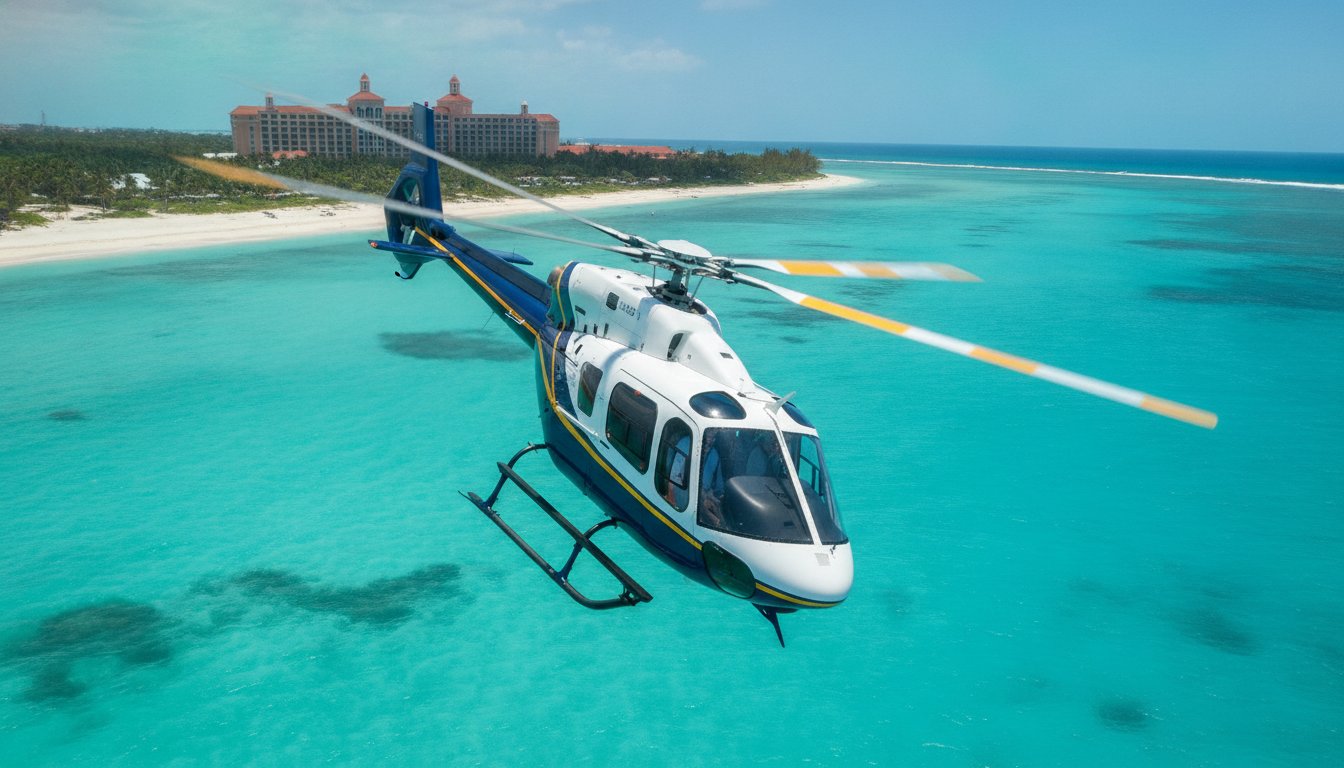
Standard travel insurance is designed to protect your wallet, but it isn’t equipped to save your life during a remote medical crisis. You’ve planned the perfect getaway, but the reality of island geography means the nearest advanced trauma center is often hundreds of miles across open water. You likely already know that a medical emergency in a remote location can lead to astronomical costs and dangerous delays. This guide provides a definitive 2026 checklist to secure comprehensive air ambulance coverage for Bahamas vacation plans, ensuring you bridge the gap between basic insurance and elite helicopter evacuation.
We will break down the critical logistical differences between fixed-wing and helicopter transport, explain how to eliminate out-of-pocket expenses through specialized membership, and outline the exact steps to access US-level care from any island location. You’ll gain a clear, professional strategy to handle the unexpected with total composure and logistical precision. This is about moving beyond hope and into a state of absolute readiness for your next island excursion. By the end of this briefing, you’ll have a professional medical emergency plan that functions as a logistical lifeline.
Key Takeaways
- Identify the critical logistical gaps in standard travel insurance that can compromise your air ambulance coverage for Bahamas vacation emergencies.
- Evaluate the necessity of helicopter transport for rapid medical extraction from remote islands where fixed-wing aircraft cannot land.
- Understand how a membership-based model utilizes direct billing to health insurers to eliminate the burden of massive out-of-pocket costs.
- Utilize the 2026 checklist to verify your current medical limits and secure specialized short-term medevac protection.
- Establish a professional concierge emergency plan that links any island location directly to elite US-level trauma care.
Why Your Bahamas Vacation Medical Emergency Plan Needs Specialized Coverage
The Bahamas is a paradise defined by its scattered geography, featuring hundreds of islands separated by vast stretches of open water. While this isolation is ideal for a getaway, it poses a severe logistical risk during a medical crisis. Most local facilities are equipped for routine care, but critical trauma requires immediate transfer to advanced centers. You need a plan that accounts for the fact that “adequate” doesn’t mean “ideal.” Standard medical evacuation often only guarantees transport to the nearest airport or a local clinic that meets a bare minimum standard. This creates a dangerous gap between a remote emergency and the specialized air medical services required for survival. Securing robust air ambulance coverage for Bahamas vacation travel means planning for a 2026 logistical landscape where speed and direct access to Florida trauma centers are the only acceptable metrics.
Limitations of Standard Travel Medical Insurance
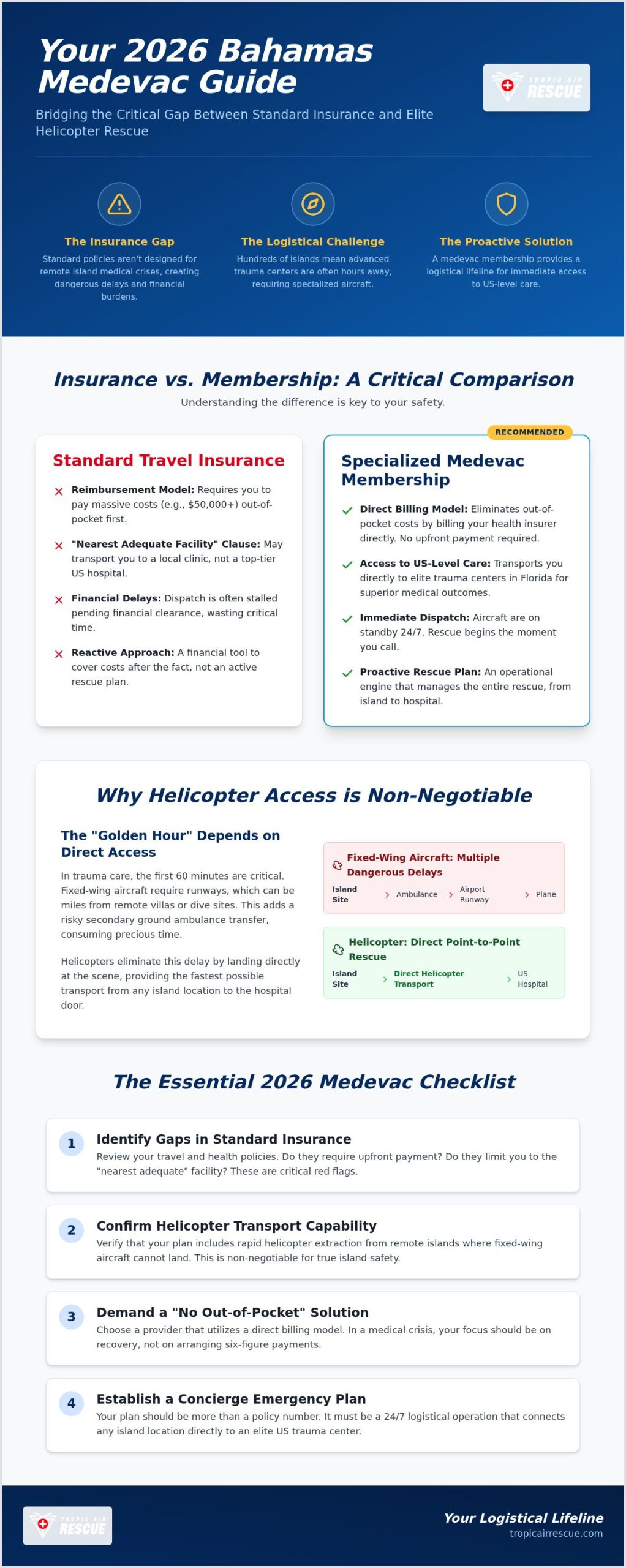
Many travelers rely on standard travel insurance, unaware of the financial and logistical friction built into the fine print. Most policies operate on a reimbursement model. This means you might be expected to pay $50,000 or more out-of-pocket before an aircraft is even dispatched. Even if the policy eventually covers the cost, the “Nearest Adequate Facility” clause allows the insurer to move you to a local hospital rather than a high-level trauma center in the United States. Credit card travel insurance is similarly restrictive. It often lacks the specialized coordination and dedicated assets needed for complex island medevac, leaving you stranded in a system that prioritizes cost-saving over clinical outcomes.
The Concierge Approach to Emergency Response
A concierge approach replaces passive insurance with an active rescue protocol. In 2026, professional medical aviation isn’t just about the flight. It’s about specialized island avionics and 24/7 readiness. Helicopters provide the versatility to land in remote areas where fixed-wing planes cannot operate. This eliminates the need for a secondary ground ambulance transfer to a distant runway, saving critical minutes during the “golden hour” of trauma care. Transitioning to a membership model ensures that your air ambulance coverage for Bahamas vacation needs is proactive. It positions you as a priority rather than just another claimant. The focus remains on immediate logistical execution and seamless access to US-level trauma care from any island location.
Medical Evacuation Insurance vs. Specialized Medevac Memberships
Understanding the distinction between a standard insurance policy and a specialized membership is vital for securing proper air ambulance coverage for Bahamas vacation travel. Standard insurance is a financial tool designed to mitigate risk through reimbursement. In contrast, a medevac membership is an operational engine that manages the rescue itself. While insurance might eventually cover the bill, a membership ensures the aircraft is dispatched without delay. The most prepared travelers adopt a gold standard approach by layering a membership on top of their primary health or travel policy. This dual-layer protection follows CDC recommendations on medical evacuation insurance while adding a layer of elite, concierge logistical support.
The Direct Billing Model Explained
The primary friction point in a medical crisis is the financial clearance required before transport. Most insurance companies require patients to pay upfront and file for reimbursement later. A membership model eliminates this hurdle through direct billing. By coordinating directly with your primary health insurer, the membership organization handles the complex financial logistics behind the scenes. This protocol removes the burden of direct patient invoicing during a high-stakes emergency. Tropic Air Rescue acts as the professional intermediary, ensuring that the focus remains on clinical care and rapid transport rather than credit card limits or wire transfers.
Response Speed and Aircraft Versatility
Geography dictates the effectiveness of a rescue. Fixed-wing aircraft are limited by the need for long, paved runways, which are often miles away from remote vacation rentals or dive sites. This logistical gap requires a secondary ground ambulance transfer, adding dangerous delays to the evacuation process. Helicopters provide the definitive solution for island-to-hospital transfers because they can land directly at or near the patient’s location. These aircraft are equipped with advanced life-support technology, essentially bringing ICU-level care to the patient. This versatility is essential for time-sensitive trauma where every minute influences the outcome. Before you finalize your itinerary, consider if short term medevac coverage is the missing piece in your safety protocol.
A specialized membership provides air ambulance coverage for Bahamas vacation scenarios that standard policies simply cannot match. It transitions the patient from a passive claimant to a priority mission. By controlling the assets and the medical team, the membership organization maintains a state of 24/7 readiness. This proactive stance ensures that when a crisis occurs, the response is immediate, professional, and fully funded. It is the difference between waiting for an insurance adjuster and launching a dedicated rescue mission.
Navigating Island Logistics: Why Helicopter Access is Non-Negotiable
The geography of the Bahamas creates a logistical “last mile” problem that standard insurance often ignores. While a fixed-wing plane might be waiting at a major airport in one of the primary island hubs, getting to that runway from a remote island can take hours. In a trauma situation, those hours are the difference between recovery and permanent injury. This is why dedicated air ambulance coverage for Bahamas vacation travel is incomplete without helicopter versatility. Traditional ambulances on smaller islands often face difficult road conditions or limited equipment, making the journey to an airstrip a significant medical risk in itself. You need a solution that eliminates the middleman and the wait time.
The Advantage of Helicopter Medevac
Helicopters offer a level of speed and geographical precision that fixed-wing aircraft cannot match across the entire archipelago, especially in its more remote areas. They eliminate the need for a secondary ground ambulance transfer, which is often the most dangerous and time-consuming part of an evacuation. Modern rescue helicopters utilize advanced avionics and high-performance engines to land in unimproved locations, including private beaches, yacht decks, or small clearings near vacation villas. trauma air transport Bahamas requires this point-to-point capability to ensure the patient reaches a surgical suite within the critical “golden hour.” This eliminates the friction of moving a patient between multiple vehicles and medical teams during a crisis.
Inter-Hospital Transfer Protocols
Emergency response often involves moving a stabilized patient from a small island clinic to a higher-acuity facility in Florida. These inter-hospital transfer services require meticulous coordination with international authorities and medical directors. A professional rescue team manages the complex logistics of clearing customs and immigration mid-flight, ensuring the aircraft isn’t held up by administrative red tape. Throughout this process, the medical team maintains a continuous chain of advanced life support. The aircraft functions as a flying intensive care unit, equipped with specialized monitors, ventilators, and medications to manage critical conditions during the transit across the Gulf Stream. This ensures that the patient’s condition is managed by experts from the moment of pickup until they are safely admitted to a US trauma center.
Coordination with Florida trauma centers is the final link in this logistical chain. By maintaining established protocols with these facilities, the rescue team ensures a seamless handoff upon arrival. This level of meticulous preparation is what defines a professional medevac membership. It transforms a chaotic emergency into a disciplined, high-speed operation where every variable is accounted for before the rotors even start turning. You gain the peace of mind that comes from knowing the most difficult part of the journey, the crossing to advanced care, is handled by specialists who do it every day.
The Essential 2026 Bahamas Medevac Checklist for Travelers
Preparation defines the outcome of any remote medical crisis. A comprehensive protocol for air ambulance coverage for Bahamas vacation travel isn’t a luxury; it is a logistical necessity. This 2026 checklist ensures your response is immediate, professional, and fully coordinated before you even depart for the islands. You don’t want to be deciphering insurance fine print while standing on a remote dock. You need a blueprint that handles the “last mile” from your location to a US trauma center with total precision.
Pre-Departure Logistical Steps
Operational readiness begins at home. You must audit your current medical flight insurance to identify restrictive “airport-to-airport” clauses that leave you stranded far from a runway. Many standard policies ignore the difficulty of getting a patient from a beach or vessel to a fixed-wing aircraft. Securing short term medevac coverage provides the specialized helicopter assets required to bridge this gap. Follow these three steps before take-off:
- Step 1: Confirm bed-to-bed coverage to ensure the medical team handles the entire transfer from your exact location to the receiving hospital.
- Step 2: Register your specific travel dates and island coordinates with your rescue provider to expedite dispatch.
- Step 3: Distribute digital membership credentials to every traveler in your party for offline access in areas with limited connectivity.
On-Island Readiness
Survival in the Out Islands depends on your ability to initiate a response with technical accuracy. You need a pre-established protocol for communicating with the flight coordination center. Program the emergency dispatch number into all satellite and mobile devices before you arrive. When a crisis occurs, be prepared to provide exact GPS coordinates rather than general island names. This allows the flight crew to calculate fuel and arrival times with surgical precision. Designate a specific member of your party to serve as the ground liaison to clear the landing zone and maintain communication with the incoming aircraft.
Confirming helicopter landing capabilities at your resort or vessel is another critical step. Many elite properties have designated zones, but verifying this in advance prevents delays during an extraction. Simultaneously, maintain a centralized digital medical dossier for everyone in your group. This file should contain blood types, known allergies, and current prescriptions. This data is vital for the flight medical team to maintain a continuous chain of care during the transit across the Gulf Stream. Access elite protection by choosing a Short-term Membership today to ensure your air ambulance coverage for Bahamas vacation scenarios is ironclad.
Securing Your Stay: How Tropic Air Rescue Eliminates Out-of-Pocket Costs
The financial burden of a medical emergency can be as debilitating as the physical injury. Most travelers assume their primary policy handles the logistics, only to find they must pay tens of thousands of dollars upfront before an aircraft is even dispatched. Tropic Air Rescue eliminates this friction through a dedicated direct billing model. By coordinating with your primary health insurance provider, we remove the need for direct patient invoicing for our members. This ensures that your air ambulance coverage for Bahamas vacation plans remains a logistical asset rather than a financial liability. Our fleet consists of helicopters equipped as flying intensive care units, featuring advanced life-support technology and specialized avionics to handle complex trauma missions and provide air transport within the Bahamas with surgical precision.
Choosing a professional rescue partner transforms your travel profile from vulnerable to protected. It’s about more than just a flight; it’s about the elite coordination required to bridge the gap between a remote island and a US trauma center. This proactive approach provides the peace of mind that comes with a concierge air medical service. When every second influences the clinical outcome, you don’t want to be negotiating with insurance adjusters. You want a team that is already moving.
Membership Tiers for Every Traveler
Our membership structure is designed to accommodate various travel profiles with clinical efficiency. Short-term Membership plans are tailored specifically for the duration of a single trip, providing a cost-effective solution for vacationers. For those who visit the islands frequently, our Annual Membership offers year-round protection and priority dispatch status. We also provide specialized B2B Membership Plans and group options. These are ideal for yacht crews, corporate retreats, and resort staff who require a standardized emergency protocol across their entire organization. Each tier maintains the same high standard of care and the zero out-of-pocket promise.
Taking the Next Step for Your 2026 Vacation
Activating your protection is a straightforward logistical step that should be completed before you depart. The process involves integrating your existing health insurance details with our membership database to facilitate immediate direct billing. This preparation ensures that if a crisis occurs, the financial clearance is already established. You can focus entirely on the safety of your party while our flight coordination center handles the international transfer logistics. Don’t leave your safety to chance or restrictive reimbursement policies. Secure your annual air rescue membership today to ensure your air ambulance coverage for Bahamas vacation travel is managed by the region’s leading medical aviation experts.
Secure Your Logistical Lifeline for 2026
Relying on standard travel insurance leaves a dangerous gap between a remote island emergency and a US trauma center. This briefing has established that successful medical evacuation in the Bahamas requires the versatility of helicopter transport to bypass the delays of ground ambulance transfers and fixed-wing runway requirements. By securing specialized air ambulance coverage for Bahamas vacation travel through a membership model, you replace financial uncertainty with a disciplined, high-speed rescue protocol. You move beyond the hope of a quick response and into a state of total operational readiness.
Tropic Air Rescue provides the elite infrastructure necessary for these high-stakes missions. Our Advanced Life Support helicopters bring ICU-level care directly to your location, while our concierge medical coordination handles the complex logistics of international transfers. Most importantly, our direct billing to your insurance provider eliminates the burden of out-of-pocket costs during a crisis. Don’t leave your safety to chance. Secure your Bahamas Vacation Medical Emergency Plan with a Tropic Air Rescue Membership and enjoy your island getaway with absolute confidence in your preparedness.
Frequently Asked Questions
Does standard travel insurance cover helicopter medical evacuation in the Bahamas?
Standard travel insurance typically covers transport to the nearest adequate facility, which may not be a US trauma center. These policies often operate on a reimbursement basis, requiring you to pay upfront. They rarely guarantee helicopter assets, often defaulting to slower ground or fixed-wing options. Specialized air ambulance coverage for Bahamas vacation travel ensures you bypass these limitations by providing direct access to dedicated medical aviation assets without the friction of insurance fine print.
What is the difference between a medevac membership and medical flight insurance?
A medevac membership is an active rescue service, while medical flight insurance is a passive financial policy. Memberships like those from Tropic Air Rescue provide immediate operational response and direct billing to your health insurer. Insurance often requires you to manage the logistics and pay thousands out-of-pocket before seeking reimbursement. Having a membership ensures that the aircraft is dispatched based on medical necessity rather than financial clearance.
How much does a medical evacuation from the Bahamas to Florida cost without a membership?
Without a membership, the cost of medical evacuation from the Bahamas to the United States is often astronomical. Patients are frequently required to provide proof of funds or pay tens of thousands of dollars before an aircraft is even commissioned. These expenses cover specialized medical crews, aviation fuel, and international landing fees. A membership eliminates this financial risk by utilizing a direct billing model that coordinates with your primary health insurance provider.
Can a medevac helicopter land directly at my remote resort or on my yacht?
Yes, helicopters provide the unique versatility required to land at remote resorts, private villas, or properly equipped yachts. Unlike fixed-wing aircraft that require long, paved runways, a medevac helicopter can perform point-to-point extractions. This capability is critical in the Bahamas, where many vacation spots are miles away from the nearest airport. It eliminates the need for a secondary, time-consuming ground ambulance transfer during a life-threatening trauma event.
Will I have to pay upfront for an air ambulance if I am a Tropic Air Rescue member?
No, members do not have to pay upfront for emergency transport. Tropic Air Rescue operates on a “Zero Out-of-Pocket” promise for its members. We coordinate directly with your primary health insurance provider to handle the billing logistics. This model removes the burden of direct patient invoicing during a medical crisis. It allows you to focus on clinical recovery while our team manages the complex financial and international coordination behind the scenes.
What medical equipment is available on a Tropic Air Rescue helicopter?
Every helicopter in the fleet functions as a flying intensive care unit. The aircraft are equipped with advanced life-support technology, including cardiac monitors, ventilators, and infusion pumps. Specialized medical kits allow the flight crew to manage critical trauma and cardiac events during transit. These advanced avionics and medical systems ensure that the patient receives a continuous chain of US-level care from the moment of pickup until hospital admission.
Is medical evacuation insurance necessary for a short Bahamas vacation?
Yes, securing air ambulance coverage for Bahamas vacation stays is essential regardless of the trip length. Medical emergencies are unpredictable and can occur within hours of arrival. Short-term memberships are specifically designed for travelers who need elite protection for a week or two. This ensures you have a professional logistical plan in place without the commitment of an annual fee. It is a small investment to prevent a massive logistical and financial crisis.
How does Tropic Air Rescue coordinate with US trauma centers?
Coordination involves established medical protocols and direct communication with Florida trauma centers. Our flight coordination center manages the entire process, including clearing customs and immigration mid-flight. We provide a seamless clinical handoff by sharing real-time patient data with the receiving medical team. This ensures that a specialized surgical or trauma team is ready for the patient the moment the helicopter lands at the hospital helipad in the United States.