

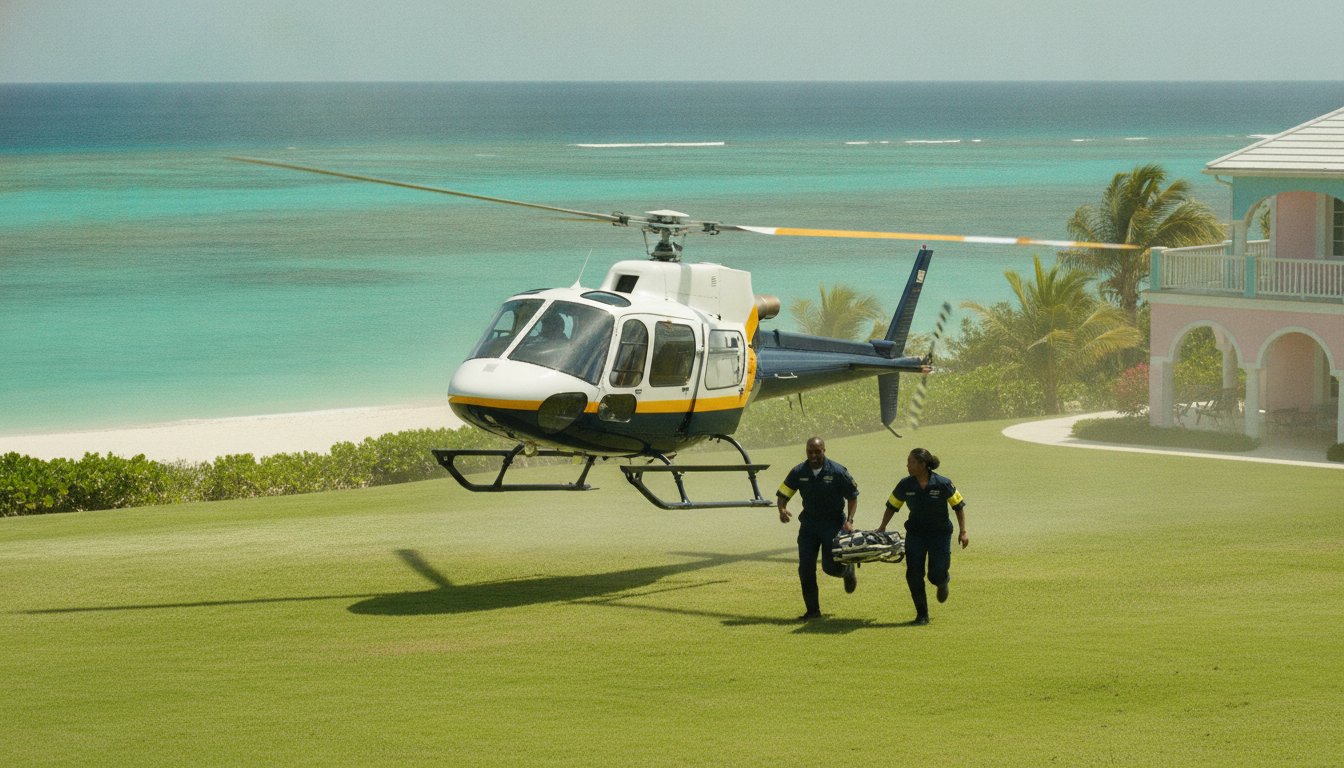
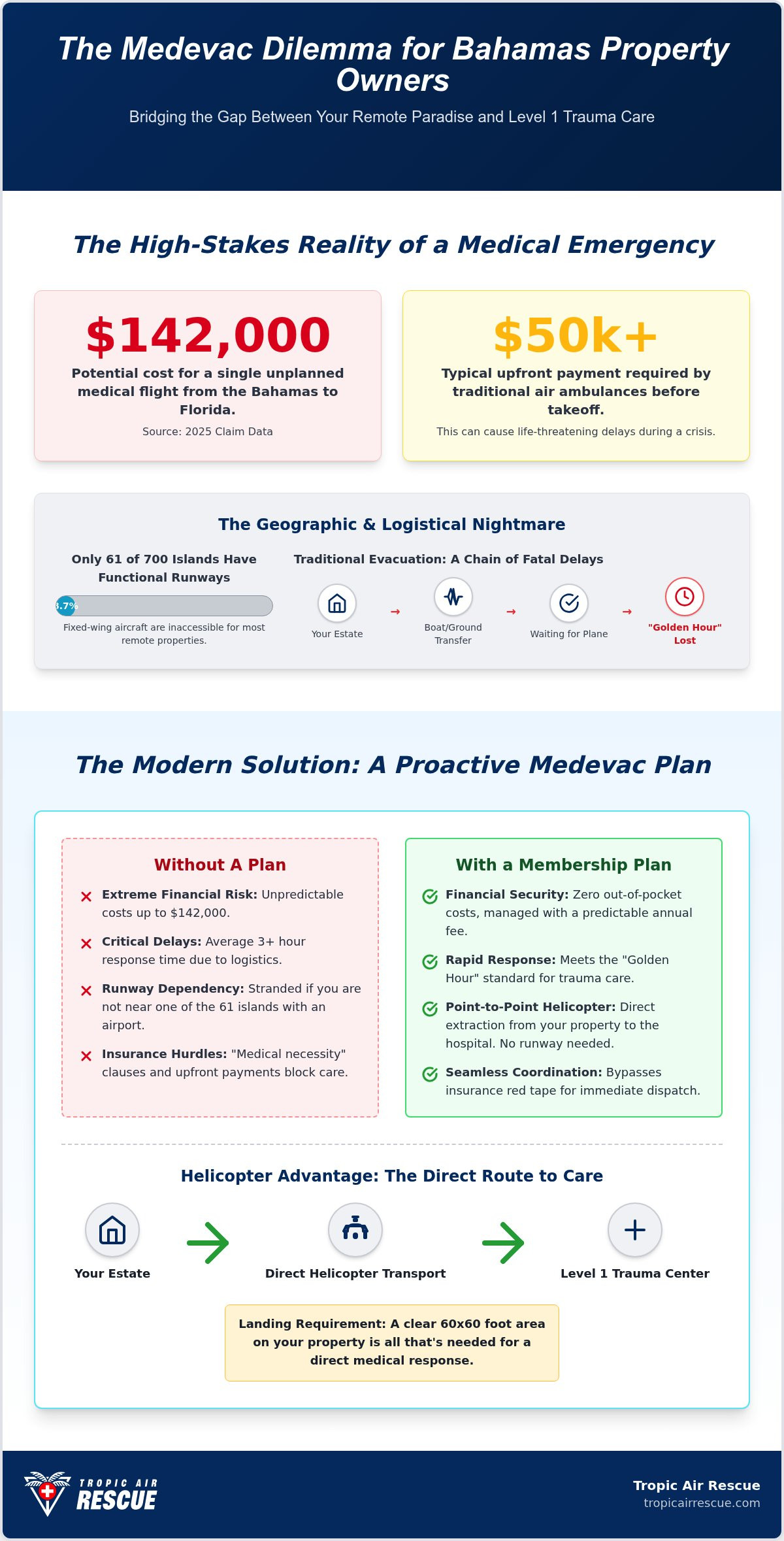
A single medical evacuation claim from the Bahamas to Florida reached $142,000 in 2025. Only 61 of the 700 islands in the archipelago have functional runways. For those in more secluded locations, the distance to high-acuity care is measured in critical minutes and extreme financial risk. Establishing a professional medevac plan for remote island homeowners Bahamas is now essential estate infrastructure. It’s the only reliable method to bypass the logistical delays and high costs of traditional air ambulance services.
You’ve built a life in the Bahamas for its peace, but you shouldn’t have to worry about being stranded during a cardiac or trauma event. Many owners feel a justified distrust of local infrastructure for complex emergencies. This guide shows you how to secure a ‘set and forget’ medical security plan that guarantees access to Florida Level 1 trauma centers. You’ll learn about 2026 insurance reimbursement trends, the benefits of annual memberships, and how to eliminate the $50,000 upfront fees that often delay life-saving transport.
Key Takeaways
- Identify why point-to-point helicopter extraction is the only viable method to meet the “Golden Hour” for trauma care on islands lacking functional runways.
- Implement a comprehensive medevac plan for remote island homeowners Bahamas to eliminate the $142,000 financial risk associated with traditional emergency flights.
- Discover how membership models bypass the fatal delays of “medical necessity” clauses found in standard international health insurance policies.
- Learn the technical requirements for establishing a private landing zone on your estate to ensure immediate medical response from specialized flight crews.
- Establish a protocol that guarantees seamless coordination with Florida Level 1 trauma centers for high-acuity medical events and complex trauma.
Why Bahamas Property Owners Need a 2026 Medevac Plan
A medevac plan is a pre-arranged medical extraction protocol. It’s a critical component of estate infrastructure for those living beyond the reach of municipal services. For property owners, this isn’t just about health; it’s about securing a significant investment and the lives within it. In 2026, the complexity of international logistics and the increasing scarcity of rapid-response resources make a formal medevac plan for remote island homeowners Bahamas a non-negotiable asset.
The “Golden Hour” remains the standard for emergency medicine. This is the sixty-minute window following a traumatic injury or cardiac event where specialized care is most effective. In the Bahamian archipelago, geography is your primary adversary. With hundreds of islands scattered across thousands of square miles, the time required to coordinate a random air ambulance can easily exceed three hours. A pre-established plan cuts through this logistical friction by providing immediate, elite coordination.
The Gap Between Local Care and Level 1 Trauma Centers
Local clinics provide essential primary care but lack the stabilization technology for high-acuity events. Complex neurological or cardiac crises require the intervention of a Level 1 trauma center, typically located in Florida. Many remote estates are situated in “medical deserts” where the nearest runway might be an hour away by boat. Accessing sophisticated air medical services through a membership ensures that the aircraft comes to you, rather than you struggling to reach the aircraft. This point-to-point capability is the difference between specialized intervention and catastrophic outcomes.
Financial Risks of Unplanned Air Medical Evacuation
The financial exposure of an unplanned extraction is significant. In 2025, a single medical evacuation claim from the Bahamas to Florida reached $142,000. Traditional air ambulance providers often require an upfront payment of $50,000 to $100,000 before they’ll even clear a flight path. Most US domestic health plans and Medicare aren’t accepted by these international providers, leaving families to liquidate assets in the middle of a crisis.
A proactive medevac plan for remote island homeowners Bahamas eliminates this predatory billing cycle. By utilizing a membership model like an Annual Membership, homeowners secure a “no out-of-pocket” guarantee. This shifts the burden from your personal accounts to a managed system of direct insurance billing. It’s a disciplined approach to risk management that ensures your focus remains on recovery, not the logistics of a six-figure wire transfer. It positions medical safety as a predictable annual utility rather than a volatile emergency expense.
Helicopter Logistics: Why Fixed-Wing Transport Often Fails Remote Estates
Traditional air medical transport relies heavily on fixed-wing aircraft. While these planes are fast in the air, they are tethered to the ground by a critical limitation: runway dependency. In an archipelago where only 61 of the 700 islands possess functional runways, relying on a plane creates a logistical bottleneck. A medevac plan for remote island homeowners Bahamas must account for the reality that most private estates are miles from the nearest international airport. Point-to-point transport is the elimination of secondary ground ambulance transfers, providing a direct link between a patient’s doorstep and a trauma center.
Fixed-wing missions are multi-stage relays. They require a boat or ground ambulance to move the patient from their property to a runway, followed by a transfer into the aircraft, and eventually another ground transfer in Florida. Every transition increases the risk of clinical instability. Helicopters bypass this “runway dependency trap” by landing directly on private property, beaches, or nearby clearings. This streamlined approach saves hours, not just minutes, during the “Golden Hour” of emergency care.
Bypassing the Need for Local Runways
Modern medical helicopters require a clear landing area of only 60×60 feet. This allows flight crews to land on private lawns or adjacent docks, effectively bringing the emergency room to the patient. Without this capability, homeowners on remote cays face dangerous “secondary transport” delays. Waiting for a boat to reach a distant island with a runway can be fatal during a cardiac event. When reviewing CDC guidance on medevac insurance, it’s clear that logistical speed is as vital as the insurance coverage itself. Helicopters provide the tactical advantage necessary to navigate the Bahamian “medical desert” without compromise.
Hospital-Grade Care in the Air
Helicopters are not just transport vehicles; they are mobile intensive care units. Advanced Life Support (ALS) capabilities are standard in a professional medevac plan for remote island homeowners Bahamas. These aircraft are equipped with sophisticated medical technology, including:
- Ventilators and cardiac monitors for continuous stabilization.
- Emergency medications and IV pumps for high-acuity care.
- Advanced avionics for precise navigation in remote maritime environments.
Flight nurses and paramedics are trained specifically for high-altitude medicine and the unique challenges of inter-island extraction. This level of expertise ensures that treatment begins the moment the crew touches down on your property. You can explore further details on the advantages of helicopter medevac in the Bahamas to understand why fixed-wing alternatives often fall short for private residents. Securing an Annual Membership ensures these specialized assets are dispatched the moment they are needed.
Evaluating Your Medevac Options: Membership vs. Traditional Insurance
Standard health and travel insurance policies often provide a false sense of security for Bahamian residents. While these plans may list “medical evacuation” as a benefit, the operational reality for homeowners on private islands is significantly more complex. A professional medevac plan for remote island homeowners Bahamas differs from standard travel insurance in one primary way: speed of dispatch. Standard policies are almost always governed by a “Medical Necessity” clause. This requires a remote insurance adjuster to verify that the patient’s condition is life-threatening and that local care is inadequate before they authorize a flight. In a cardiac or trauma event, this administrative delay can be fatal.
The concierge membership model ignores these bureaucratic hurdles. It treats the emergency as a clinical priority rather than a financial transaction. Instead of waiting for an adjuster’s approval, the aircraft is dispatched based on the immediate assessment of flight medics. This ensures that the “Golden Hour” isn’t wasted on phone calls and policy verifications.
The Adjuster Barrier in Traditional Travel Insurance
Traditional travel insurance relies on a reimbursement or pre-authorization model. This creates an “adjuster barrier” where an individual in a call center thousands of miles away can veto a life-saving mission. Many policies also contain “reasonable and customary” fee caps that fall far short of the actual costs of inter-island helicopter extraction. As noted in the U.S. Embassy guidance on medical evacuation, costs for these services often exceed $50,000, and local helicopter transport is generally unavailable. Property owners need a protocol that prioritizes clinical urgency over financial vetting to ensure they aren’t left stranded during a crisis.
The Concierge Advantage of Annual Membership
A membership-based approach removes the financial friction from the emergency response. It provides priority dispatch and 24/7 coordination with Florida trauma centers. This is a core benefit of an annual air rescue membership. The service functions as a dedicated medical utility for your estate, ensuring specialized assets are always ready for deployment.
The financial mechanics are equally streamlined. Instead of a “reimbursement” model, which requires you to pay upfront and fight for a refund later, members benefit from a “no out-of-pocket” guarantee. The provider coordinates directly with your health insurer to handle the billing. You don’t have to produce a $100,000 wire transfer while a family member is in critical condition. It’s a disciplined approach to risk management that ensures a medevac plan for remote island homeowners Bahamas functions as a seamless, high-end guardian for your family and guests.
Integrating Medevac into Your Property Management Strategy
Estate management in the Bahamas involves more than landscaping and security. It requires a proactive medical defense. A medevac plan for remote island homeowners Bahamas should be treated as a standard operating procedure for every member of the household staff. This protocol ensures that when a crisis occurs, the response is automatic rather than reactive. Coordinating with local island clinics serves as a vital first-response liaison, but the property itself must be ready for a high-performance extraction at a moment’s notice.
Preparing the Property for Emergency Access
Technical readiness is the foundation of a successful rescue. A helicopter landing zone (LZ) requires a minimum 60×60 foot clear area. This space must be level, free of loose debris that could be sucked into rotors, and clear of vertical obstacles like power lines or tall palms. For 24/7 readiness, night-landing considerations are paramount. You don’t need a permanent helipad, but you must have a method to mark the LZ with portable lighting or vehicle high-beams during an after-hours emergency.
Precision is mandatory for flight crews navigating to remote cays. Maintain current GPS coordinates and high-resolution site photos on file with your concierge provider. These assets allow pilots to visualize the approach before they even leave the hangar. Sharing property access details, such as gate codes or dock locations, with the dispatch center eliminates the friction that often delays traditional emergency services. You can register your property today to ensure your estate is fully integrated into a professional rescue network.
Staff and Guest Communication Protocols
A plan is only as effective as the people executing it. Training caretakers and estate managers on how to initiate a medevac call via the dedicated concierge line is essential. They should be familiar with the medevac plan for remote island homeowners Bahamas and its specific Annual Membership benefits to avoid hesitation during the dispatch process. Staff must understand that the “No Out-of-Pocket” guarantee means they can call for help without worrying about immediate financial authorization.
For those who host long-term guests or renters, including medevac plan details in the “House Book” provides immediate peace of mind. This document should clearly outline the steps for contacting rescue services and the location of the designated landing zone. It ensures everyone on the property knows that elite medical support is a phone call away, creating a secure environment for residents and visitors alike.
Securing Your Bahamas Medevac Plan with Tropic Air Rescue
Tropic Air Rescue serves as the vigilant guardian for the Bahamian archipelago. For those who have invested in the islands, a medevac plan for remote island homeowners Bahamas is the final layer of property security. It ensures that the isolation of a private estate doesn’t become a liability during a medical crisis. The service provides a seamless bridge from a remote landing zone to the highest tier of American clinical excellence. This isn’t a generic utility; it’s an elite, specialized partnership designed for high-stakes environments.
The Path to Florida Trauma Centers
Speed is only half the equation. The other half is logistical precision. Tropic Air Rescue manages the complexities of international customs and medical repatriation logistics. This coordination is vital for patients requiring urgent cardiac, stroke, or trauma interventions. By maintaining direct relationships with Florida’s premier facilities, the flight crew ensures a bed-to-bed transition. Treating an emergency as a mission rather than a flight allows for a focus on clinical outcomes. This level of oversight is detailed further in our guide to coordinating inter-hospital medical transfers. Every second saved in customs or hospital intake is a second gained in the recovery process.
Enrollment for Property Owners and Expats
Readiness begins with a simple selection. For year-round residents and frequent visitors, the Annual Membership is the standard for continuous protection. It positions medical extraction as a fixed utility of the estate, much like power or water. For seasonal visitors or short-term guests, the Short-term Membership provides the same elite level of care for a defined duration. This flexibility ensures that your family and guests are protected regardless of the length of their stay.
The onboarding process is methodical and efficient. It involves a basic medical profile for all household members and a property site assessment to verify landing zone coordinates. This proactive step ensures that when a call is placed, the pilot already has a visualized flight path and a confirmed landing point. It eliminates the fatal “where are you” questions that plague traditional emergency responses. You don’t have to worry about the financial shock of six-figure bills. The membership handles the burden through direct insurance billing. Secure your 2026 Bahamas Medevac Plan today to ensure your island investment includes the ultimate safety net.
Elite Readiness for Bahamian Estates
Living in the archipelago requires a disciplined approach to safety. Traditional air ambulances often fail to reach remote properties during the critical “Golden Hour” due to runway dependency. A professional medevac plan for remote island homeowners Bahamas replaces logistical uncertainty with a specialized helicopter fleet capable of direct estate access. You’ve learned that standard insurance adjusters can be a barrier to care; our membership model bypasses these delays to prioritize your health.
Preparation is the ultimate form of property management. By establishing a landing zone and securing a concierge medical partner, you protect both your family and your investment. Tropic Air Rescue provides 24/7 concierge medical dispatch and coordinates directly with Florida trauma centers. Our members benefit from direct billing to health insurers, ensuring no out-of-pocket costs during a crisis. It’s time to transition from reactive anxiety to proactive security. Protect your residence with a 2026 Medevac Membership and enjoy the peace of mind that comes with elite preparedness. Your island sanctuary deserves nothing less.
Frequently Asked Questions
Is medevac insurance for Bahamas homeowners different from standard travel insurance?
Yes, it’s a dedicated operational protocol rather than just a financial policy. Travel insurance often requires medical necessity vetting by adjusters before authorizing transport. A medevac plan for remote island homeowners Bahamas through Tropic Air Rescue ensures immediate dispatch without bureaucratic delays. It focuses on point-to-point helicopter extraction rather than the multi-stage logistics of standard travel plans. Membership provides a concierge level of readiness that standard travel insurance simply can’t match in remote maritime environments.
Can a medical helicopter land directly on my private property in the Bahamas?
Yes, our specialized helicopter fleet is designed to land directly on private estates, lawns, or beaches. This eliminates the need for ground ambulance transfers to distant runways. A clear area of approximately 60×60 feet is required for safe operations. By landing on-site, we bypass the runway dependency that often delays fixed-wing aircraft. This capability is essential for homeowners living on islands without international airport infrastructure or functional runways.
What happens if my health insurance doesn’t cover the full cost of the flight?
Membership eliminates the risk of unpaid balances. Tropic Air Rescue utilizes a direct billing model where we coordinate with your health insurer. We accept the insurance payout as payment in full for our members. This ensures you face zero out-of-pocket expenses for emergency transport. You don’t have to worry about “reasonable and customary” fee caps or hidden deductibles that often leave non-members with six-figure medical bills after an evacuation.
How fast is the response time for a medevac flight from the Out Islands?
Response times are minimized through pre-established flight protocols and concierge dispatch. Because helicopters provide point-to-point transport, we eliminate the hours usually lost coordinating ground ambulances and boat transfers. Our team maintains 24/7 readiness to ensure we reach remote locations within the “Golden Hour.” Having your property’s GPS coordinates and site photos on file allows our pilots to launch immediately without the delays associated with traditional emergency service navigation.
Does the membership cover my guests and household staff?
Coverage depends on the specific plan you select for your estate. We offer Annual Membership plans for permanent residents and B2B Membership Plans that can be tailored to include household staff. For visitors, a Short-term Membership is available to ensure everyone on your property is protected. Integrating these plans into your property management strategy ensures that guests and employees have the same no out-of-pocket guarantees as the property owner.
Are the helicopters equipped for critical care and life support?
Every aircraft in the fleet functions as a mobile intensive care unit. Our helicopters are equipped with advanced life-support (ALS) technology, including ventilators, cardiac monitors, and emergency medications. The flight crews consist of specialized flight nurses and paramedics trained for high-acuity trauma and cardiac events. This ensures that hospital-grade care begins the moment we touch down on your property, maintaining clinical stability throughout the flight to a Florida trauma center.
How do you coordinate transfers to US hospitals in Florida?
We manage the entire transfer process, including international customs and medical repatriation logistics. Our dispatch center maintains constant communication with Florida Level 1 trauma centers to ensure a bed is ready upon arrival. We handle the medical repatriation paperwork and coordinate with specialized teams for cardiac or neurological care. This seamless transition from a remote Bahamian estate to a US facility is a core component of a professional medevac plan for remote island homeowners Bahamas.
Is there a limit to the number of flights covered under an annual membership?
An Annual Membership provides comprehensive protection for emergency medical evacuations as defined in the membership agreement. There isn’t a pre-set numerical limit on life-saving emergency flights for members. The focus remains on providing immediate, high-acuity transport whenever a medical crisis occurs on your property. This “set and forget” security ensures that your access to elite medical aviation remains constant throughout the year without the fear of exhausting your benefits.