

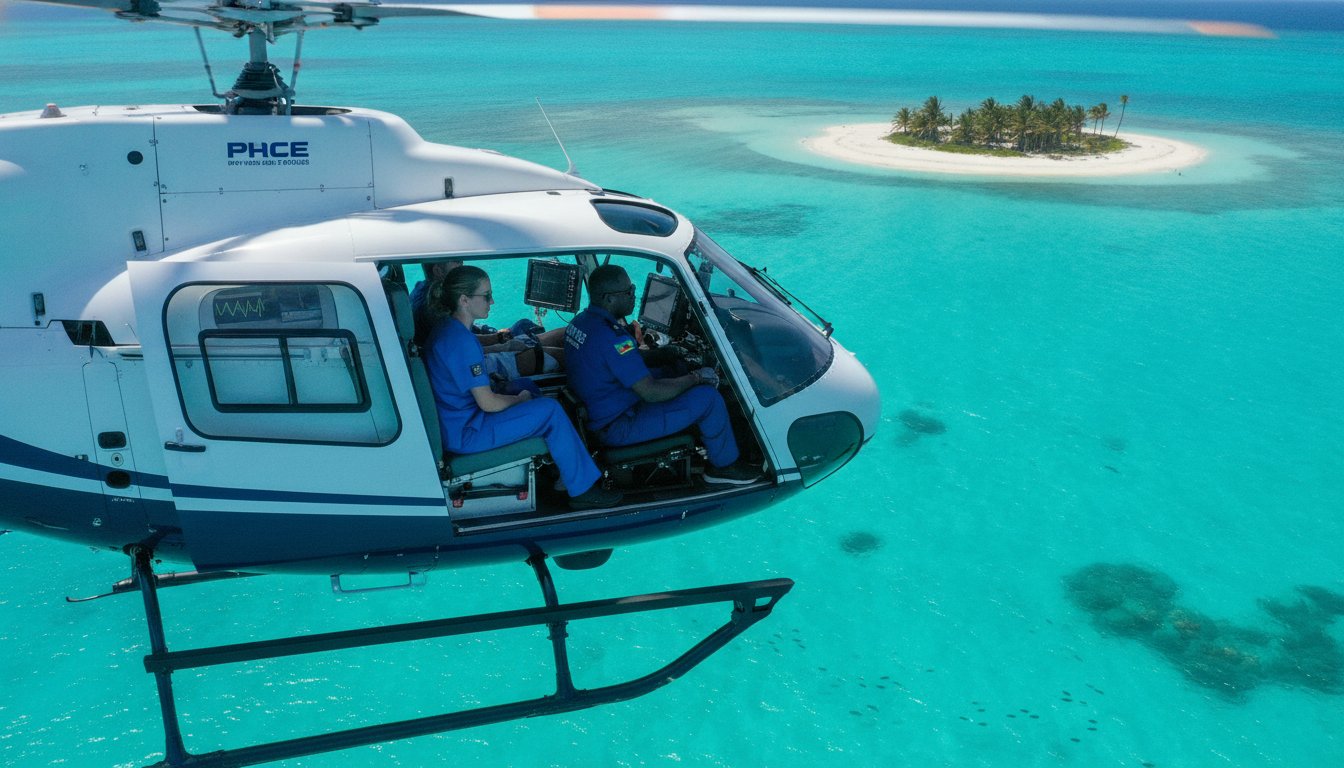
A medical flight is not a transport vehicle; it is a high-velocity extension of the intensive care unit. In the Bahamas, where geography often separates patients from life-saving interventions, a high acuity medical flight serves as the critical link between remote stabilization and definitive care. You understand that in a crisis, every second without specialist equipment is a second lost. We agree that the standard of care should not drop just because a patient is in transit between islands. The fear of inadequate care or logistical delays in remote areas is a heavy burden for any family to carry.
This article provides a clear understanding of the specialized equipment and rigorous protocols that transform a helicopter into a mobile ICU. You will gain confidence in the medical capabilities available and see exactly how we bridge the gap to Florida trauma centers. We preview the advanced life-support technology, the elite staffing requirements, and the streamlined coordination process that ensures a seamless transition. By the end of this guide, you’ll know why hospital-grade care is a constant, not a variable, during a high-stakes medical transfer.
Key Takeaways
- Differentiate between basic transport and high-acuity care, focusing on the continuous monitoring and intensive life support requirements of critical patients.
- Explore the technical specifications of the mobile ICU environment, including redundant oxygen systems and hospital-grade equipment adapted for the aviation environment.
- Understand the elite staffing standards required for a high acuity medical flight, including specialized CCRN and CFRN certifications for flight crews.
- Learn how bed-to-bed logistics ensure a seamless transition from local Bahamas facilities to specialized trauma centers in Florida.
- Discover how membership models eliminate financial barriers by facilitating direct insurance billing for emergency inter-hospital transfers.
Defining High Acuity Medical Flight Services
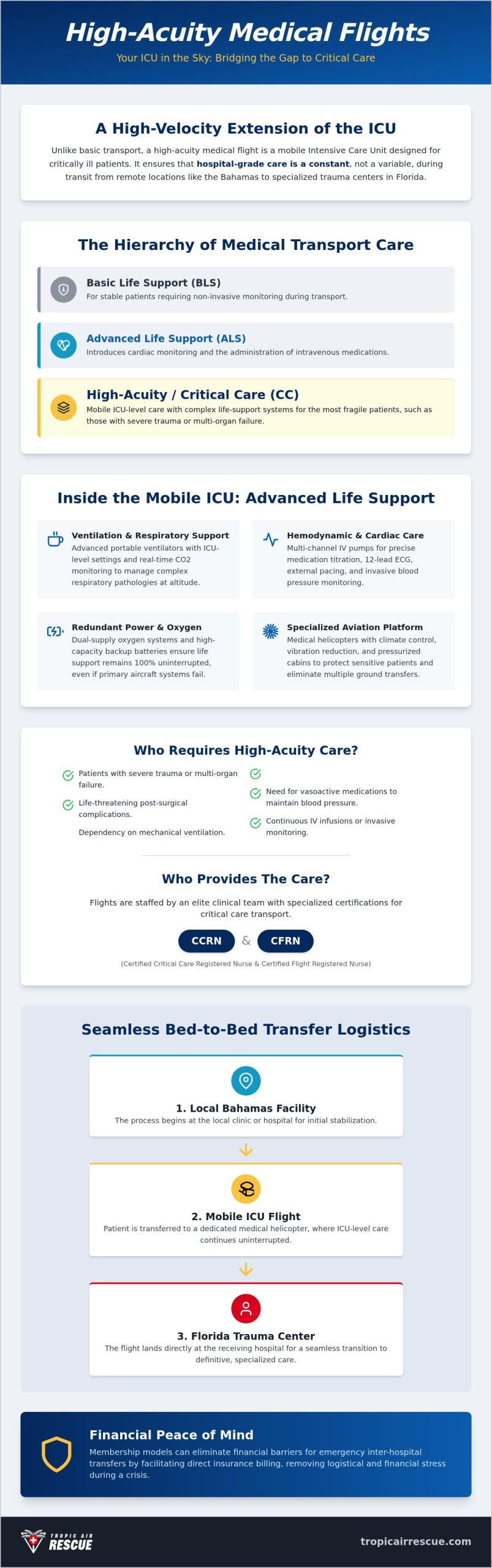
A high acuity medical flight represents the highest tier of Air medical services. It is reserved for patients whose physiological status is fragile and requires constant, high-level intervention. Unlike standard transport, these flights function as a mobile intensive care unit. This level of care is mandatory for patients experiencing multi-organ failure, severe trauma, or life-threatening post-surgical complications. The objective is to maintain hospital-grade stability throughout the transition from the Bahamas to specialized centers.
Understanding the hierarchy of care is vital for patient safety. Basic Life Support (BLS) provides non-invasive monitoring for stable patients. Advanced Life Support (ALS) introduces cardiac monitoring and intravenous medications. High acuity care, or Critical Care (CC), goes further. It involves complex life-support systems usually found only in a stationary ICU. In the Bahamas, where the first 60 minutes, known as the Golden Hour, dictates survival, deploying a high acuity medical flight is often the only way to reach a Florida trauma center in time.
Criteria for High Acuity Patient Classification
Patients are classified as high acuity based on specific clinical dependencies. If a patient requires hemodynamic monitoring due to instability or is dependent on vasoactive medications to maintain blood pressure, they meet this threshold. Mechanical ventilation and advanced airway management also necessitate high-acuity protocols. Additionally, any patient requiring continuous IV infusions or invasive monitoring equipment must be transported under this specialized framework to ensure zero interruption in care.
The Role of Specialized Aviation in Critical Care
The platform matters as much as the personnel. Helicopters provide a distinct point-to-point advantage over fixed-wing aircraft. They can land directly at remote island clinics or on hospital pads, eliminating the need for multiple ground ambulance transfers. This speed of mobilization is critical for time-sensitive high-acuity transfers. Modern medical helicopters also feature climate control and vibration reduction to protect sensitive patients. Pressurized environments are maintained to prevent physiological stress during altitude changes, ensuring the patient’s condition remains stable from takeoff to landing.
Advanced Life Support: The Mobile ICU Environment
The cabin of a high acuity medical flight is a masterpiece of medical engineering. It is a miniaturized, flight-certified ICU designed to maintain life in the most volatile conditions. Organizations like the Association of Air Medical Services (AAMS) define the rigorous standards for these high-stakes environments. Every piece of equipment must be ruggedized for aviation while remaining precise enough for critical care. We utilize compact, multi-function monitoring systems that provide a 360-degree view of the patient’s status without overcrowding the limited workspace.
Redundancy is the cornerstone of operational safety. We don’t rely on a single source of power or oxygen. Dual-supply oxygen systems and high-capacity backup battery arrays ensure that life-support remains uninterrupted. Even if the aircraft’s primary electrical system encounters an issue, the medical suite continues to function at full capacity. This level of meticulous preparedness is a hallmark of our inter-hospital transfer services. Our aircraft also carry a comprehensive pharmacological suite, including a full pharmacy of Advanced Cardiovascular Life Support (ACLS) medications for immediate intervention.
Ventilation and Respiratory Support
Managing a patient’s breathing at three thousand feet requires more than basic oxygen. Our aircraft are equipped with advanced portable ventilators capable of ICU-level settings. These systems handle complex respiratory pathologies with high precision. We monitor end-tidal CO2 and arterial blood gases in real-time to ensure the patient’s blood chemistry remains balanced. This is vital at altitude. Changes in barometric pressure can affect gas exchange significantly. Our teams are trained to adjust ventilator settings instantly to maintain optimal oxygenation throughout the flight.
Hemodynamic Monitoring and Cardiac Care
Precision dosing can be the difference between stability and crisis. We use multi-channel IV pumps for the precise titration of critical medications, such as vasopressors or sedatives. The medical suite includes 12-lead ECG monitoring and external pacing capabilities for cardiac emergencies. We employ both non-invasive and invasive blood pressure monitoring protocols. This allows the flight team to observe every heartbeat and every pressure shift with surgical accuracy. This level of data density is a standard requirement for any high acuity medical flight, ensuring the patient’s cardiovascular system is managed with the same rigor found in a top-tier Florida trauma center.
Advanced technology is only as effective as the clinicians operating it. A high acuity medical flight requires a specialized medical team capable of functioning at the highest level of clinical intensity. This team typically consists of a Flight Nurse and a Flight Paramedic. These aren’t standard healthcare providers. They hold elite certifications such as CCRN (Critical Care Registered Nurse) and CFRN (Certified Flight Registered Nurse). These credentials verify their ability to manage complex cases in an austere aviation environment where every second counts.
Flying changes the physiological landscape. Crew members must proactively manage stressors like hypoxia, G-forces, and noise interference, which can mask critical patient changes. We utilize a concierge approach to medical oversight. This ensures the team provides personalized, high-stakes care from the initial island departure through to the final hospital admission in Florida. There is no lapse in monitoring; the care is continuous and disciplined. It’s a seamless bridge between facilities that prioritizes patient safety above all else.
The Flight Nurse and Paramedic Dynamic
Managing an unstable patient in a confined helicopter cabin requires a unique collaborative dynamic. The nurse and paramedic work under strict medical direction but maintain the autonomous decision-making skills necessary for immediate mid-flight interventions. Experience is the primary filter for our staffing. Every clinician must have years of extensive background in ICU or ER settings before they are cleared for flight duty. They’ve mastered the ability to perform complex tasks in tight spaces, ensuring the patient’s stability never wavers during the transition.
Continuous Professional Education in Aero-Medicine
Proficiency in aero-medicine requires constant refinement. Our teams undergo rigorous simulation training to prepare for rare but high-stakes medical scenarios. They maintain proficiency in advanced life-saving procedures, including intubation and chest tube insertion, under the constraints of flight. By adhering to international safety and medical standards, we ensure that every high acuity medical flight is managed by a team that is always ready. This methodical approach to training provides the quiet confidence required to handle the most challenging transfers safely and efficiently.
Navigating Complex Inter-Hospital Transfer Logistics
A high acuity medical flight is a multi-layered logistical operation that begins long before the rotors turn. We operate on a “Bed-to-Bed” promise. This means our responsibility extends beyond the aircraft cabin. We manage the entire transition from the sending facility in the Bahamas to the receiving ICU in Florida. It is a concierge-level service designed to eliminate the anxiety of logistical delays. Our team handles every detail, ensuring the patient never leaves the care of a critical care professional.
The flight coordinator acts as the mission’s central nervous system. They manage the variables that the medical team cannot. This includes monitoring fast-changing weather patterns, calculating fuel stops, and securing medical clearance for international transit. They also handle the complexities of customs and immigration. For a critical patient, a ten-minute delay at a border is ten minutes too long. We ensure all paperwork is filed and cleared before the aircraft touches down. Effective medical evacuation coordination is what transforms a high-risk transfer into a seamless, controlled operation. This level of meticulous planning is what defines our inter-hospital transfer services.
Inter-Hospital Coordination Protocols
The “handshake” between facilities is the most vulnerable point in a transfer. We don’t just fly; we coordinate. Our team secures a receiving physician and confirms the availability of a specialized ICU bed before departure. Detailed clinical handovers are conducted to ensure continuity of care. Every medication, vital sign trend, and intervention is documented and communicated. For a deeper look at this process, see our Guide to Coordinating Inter-Hospital Medical Transfers.
International Flight Logistics for Critical Patients
Transporting a patient from a remote island to a regional trauma hub requires precise geographical knowledge. Our high acuity medical flight teams specialize in navigating remote locations that are often inaccessible to fixed-wing aircraft. This capability saves hours of ground transport time. We also ensure that all medical documentation meets strict international transit requirements, preventing administrative bottlenecks. You can find specific route details in our Bahamas to Florida Medical Helicopter Transfer Guide.
Securing High Acuity Care via Membership Models
The financial reality of critical care transport is a significant consideration for anyone in the Bahamas. A single high acuity medical flight involves massive operational overhead, including specialized aviation fuel, hospital-grade equipment maintenance, and the salaries of elite CCRN-certified staff. Without a pre-secured plan, these flights can cost tens of thousands of dollars out-of-pocket. For many, this creates a high-stakes barrier to care during a life-threatening crisis. Membership-based models are designed to remove this financial friction entirely. We position these services as an essential safeguard for both residents and long-term travelers. It ensures that the highest level of medical intervention is always a phone call away, regardless of immediate financial liquidity.
The Membership Advantage for Critical Care
Membership provides a decisive operational advantage during the Golden Hour. It allows for the immediate activation of high-acuity assets without the typical delays associated with payment clearance or wire transfers. In a medical emergency, every minute spent on financial logistics is a minute lost for the patient’s recovery. We offer tailored plans that cater to the unique needs of annual residents and short-term visitors alike. This provides the peace of mind that comes from knowing patient transfer to Florida trauma centers is a guaranteed resource. It’s a disciplined, proactive approach to safety that prioritizes rapid mobilization above all else.
Direct Insurance Billing and Concierge Support
Our concierge support extends far beyond the flight cabin to handle the administrative weight of the transfer. High-acuity care is clinically complex, and the insurance billing that follows can be equally daunting for a family in distress. We eliminate this stress through our direct billing protocols. For members, this translates to a “No Out-of-Pocket” benefit where we interface directly with health insurance providers. Our specialized team manages the entire claims process, from verifying benefits to submitting final documentation. This ensures that a high acuity medical flight remains an accessible option during a crisis. Don’t leave your medical security to chance. Secure your safety and ensure your family has access to the most advanced care available with a Tropic Air Rescue Membership.
Ensuring Seamless Critical Care Transitions
A high acuity medical flight is a specialized clinical intervention rather than a simple transport. You now understand how hospital-grade equipment, elite medical staffing, and rigorous inter-hospital protocols merge to protect patients during their most vulnerable moments. The transition from a remote island facility to a specialized Florida trauma center requires disciplined coordination and uncompromising medical standards. By removing the logistical and financial friction of emergency transfers, you ensure that high-stakes care is always accessible. Professional preparation is the ultimate guardian when every second counts.
Take a proactive step for your family’s safety and financial stability today. Secure Your High Acuity Coverage with Tropic Air Rescue. Our membership model provides direct billing to health insurance and immediate access to Advanced Life Support (ALS) helicopters. We maintain expert coordination with US trauma centers to provide a seamless, concierge-level bridge to definitive care. You deserve the confidence that comes with meticulous preparedness and elite medical oversight. Stay protected with a partner who is always ready to respond.
Frequently Asked Questions
What qualifies a patient for a high acuity medical flight?
Patients requiring continuous monitoring and life-sustaining interventions qualify for this level of service. This includes individuals with multi-organ failure, severe trauma, or those dependent on mechanical ventilation and vasoactive medications. Medical necessity is determined by the referring physician’s clinical assessment of the patient’s stability. A high acuity medical flight ensures there is no interruption in ICU-level care during the transition between medical facilities.
Can a medical helicopter carry the same equipment as an ICU?
Yes, our helicopters are configured as mobile intensive care units with specialized, flight-certified technology. This includes advanced portable ventilators, multi-channel infusion pumps, and comprehensive hemodynamic monitoring systems. Every piece of equipment is ruggedized for the aviation environment while maintaining the precision required for critical care. We also maintain redundant oxygen and power systems to ensure life-support remains operational throughout the entire duration of the flight.
How many medical professionals are on a high acuity flight?
A standard high-acuity team consists of two elite medical professionals, typically a Flight Nurse and a Flight Paramedic. These clinicians hold advanced certifications like CCRN and CFRN, which require extensive experience in emergency and intensive care settings. This dual-clinician model ensures that complex procedures can be performed safely in a confined space. Their collaborative dynamic allows for autonomous decision-making and immediate intervention during high-stakes medical transfers.
Does insurance typically cover high acuity medical transfers?
Coverage for a high acuity medical flight varies by provider and is generally based on documented medical necessity. For members, we eliminate financial uncertainty by facilitating direct billing to health insurance providers. This “No Out-of-Pocket” benefit means our concierge team manages the complex administrative claims process on your behalf. It’s essential to verify your specific policy details or secure a membership to ensure these costs are covered during a crisis.
What is the difference between a standard medevac and high acuity care?
The primary difference lies in the level of clinical intervention and monitoring provided during transit. Standard medevac often refers to Basic Life Support for stable patients. High acuity care involves a mobile ICU environment capable of managing unstable patients who require invasive monitoring or continuous life support. While standard transport focuses on movement, a high acuity medical flight focuses on the active stabilization and management of life-threatening conditions.
How long does it take to mobilize a high acuity medical flight?
Mobilization times depend on current aircraft availability, weather conditions, and the completion of medical clearance protocols. Members receive priority activation, which streamlines the medical evacuation coordination needed to launch a mission. Our flight coordinators work rapidly to manage fuel, flight plans, and customs requirements for international transfers. You should contact our operations center directly to check the current readiness status and estimated launch times for your specific location.
Can high-acuity flights operate from remote island locations?
Helicopters are uniquely suited for remote island operations because they don’t require traditional runways. We can land directly at clinics or designated landing zones that are inaccessible to fixed-wing aircraft. This point-to-point capability significantly reduces the total transfer time by eliminating multiple ground ambulance transitions. It’s the most efficient way to move a critical patient from a remote Bahamas location to a specialized regional trauma center.
Are family members allowed to accompany patients on high acuity flights?
Weight and space constraints in a high-acuity helicopter environment often limit our ability to carry passengers. The primary focus is always the patient’s safety and the medical team’s ability to perform life-saving interventions. While we understand the desire to stay together, the clinical needs of the patient take precedence. You should discuss specific passenger availability with the flight coordinator during the initial mission planning phase to understand the current aircraft’s capacity.