

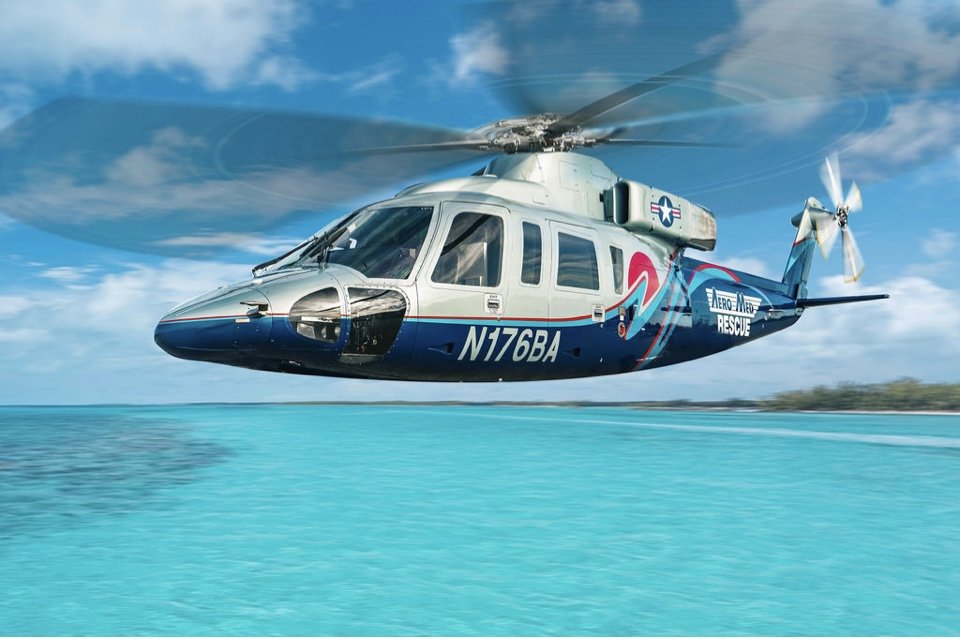
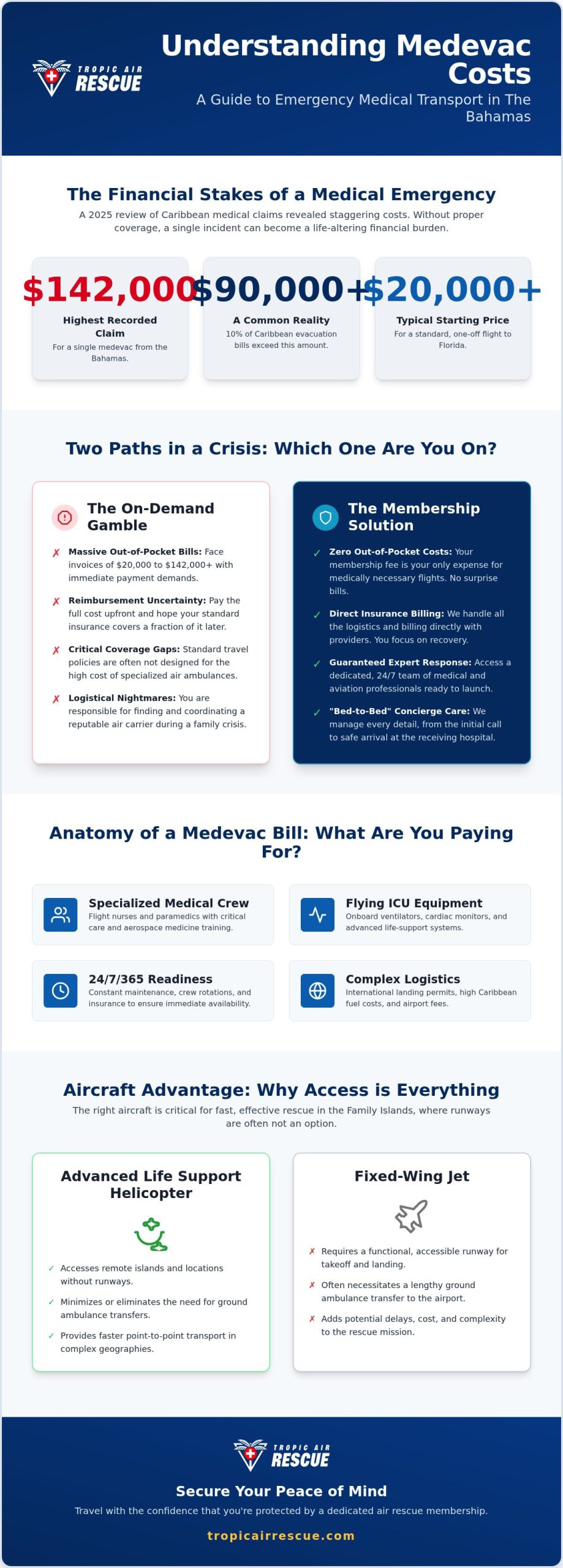
A 2025 review of Caribbean medical claims found that 10% of evacuation bills exceeded $90,000, with the highest recorded Bahamian claim reaching $142,000. For travelers exploring the Family Islands, these figures represent a severe financial risk that standard travel insurance often fails to mitigate. You shouldn’t have to choose between your life savings and life-saving care while navigating the remote beauty of the Exumas or Abaco. This 2026 guide breaks down the true price of emergency transport and explains exactly how to avoid medevac costs in Bahamas by utilizing a specialized membership model instead of relying on unpredictable reimbursement schemes.
Discover the critical factors that drive air medical pricing, including specialized crew requirements and the logistical complexity of island-to-hospital transit. We will examine why Advanced Life Support helicopters offer a decisive advantage over fixed-wing jets when accessing remote locations that lack functional runways. You’ll gain a clear understanding of how elite membership services provide a concierge-level response while guaranteeing zero out-of-pocket expenses. This is the essential framework for securing professional medical protection without the threat of a five-figure bill.
Key Takeaways
- Identify the specific logistical overheads and medical equipment requirements that drive standard Caribbean air ambulance costs toward $20,000 or more.
- Learn how to avoid medevac costs in Bahamas by utilizing a specialized membership model that prioritizes direct insurance billing over out-of-pocket payments.
- Evaluate the speed and accessibility of Advanced Life Support helicopters compared to fixed-wing aircraft, which often require additional ground ambulance transfers.
- Recognize the critical coverage gaps in standard travel insurance policies and why a dedicated rescue membership is the essential preparation for remote island travel.
- Determine the optimal protection strategy for your trip, ranging from short-term vacation coverage to long-term annual membership plans.
Understanding the Cost of Medevac from Bahamas
Medical evacuation, or medevac, represents the rapid transport of critically ill or injured patients via specialized aircraft. These aren’t standard planes; they function as mobile intensive care units equipped with advanced life-support systems. When an emergency occurs in the Bahamas, industry averages for a one-off medical flight to Florida often start at $20,000. For complex cases or remote island extractions, these retail prices can easily double or triple. Understanding these logistical variables is the primary way to learn how to avoid medevac costs in Bahamas through strategic preparation rather than reactive spending.
Final invoices are influenced by several high-stakes factors. The type of aircraft utilized, the specific critical care staff required, and the cost of international landing permits all play a role. These retail medevac prices reflect the immense overhead of 24/7 operational readiness. Maintaining specialized avionics and keeping elite medical personnel on standby requires significant capital. When you pay for a retail flight, you aren’t just paying for fuel; you’re paying for the immediate availability of a life-saving asset.
The Logistics of an Air Ambulance Flight
Effective Air medical services require a seamless “bed-to-bed” protocol. This means the medical team manages the patient from the initial hospital bed in the Bahamas to the receiving trauma center in the United States. This continuity of care is vital for patient stability. It requires a highly trained team, typically consisting of flight nurses and paramedics who specialize in aerospace medicine. The operational cost of maintaining a medical helicopter in a state of 24/7 flight-readiness involves constant maintenance, crew rotations, and specialized insurance. These teams must be ready to launch within minutes of a call, regardless of the hour.
Retail vs. Membership Pricing Models
Relying on “on-demand” chartering during a medical crisis is a significant financial gamble. Without a prior arrangement, families are forced to navigate complex aviation logistics while facing massive, unexpected bills. A membership model replaces this volatility with a predictable, fixed-cost alternative. Members benefit from a system designed to eliminate the friction of emergency transport. By securing short term medevac coverage, travelers and residents can ensure that the focus remains on medical outcomes rather than financial logistics. Transitioning from a retail mindset to a membership-based approach is the most effective strategy for those seeking how to avoid medevac costs in Bahamas.
Hidden Factors That Drive Up Medevac Expenses
Beyond the aircraft itself, the financial weight of a rescue is often hidden in the fine print of aviation logistics. Fuel prices in the Caribbean are notoriously high and subject to sudden fluctuations. International flights between the Bahamas and South Florida require strict adherence to regulatory protocols and landing permits. These administrative hurdles require 24/7 coordination teams to manage. Without a membership, these costs are passed directly to the patient as retail line items. Learning how to avoid medevac costs in Bahamas starts with recognizing that you aren’t just paying for a flight; you’re paying for a complex international medical operation that must meet stringent CDC recommendations on medical evacuation insurance and safety standards.
Medical Acuity and Staffing Requirements
A patient’s clinical status dictates the entire operational footprint of the mission. ICU-level patients require a different tier of intervention than those who are medically stable. This status determines the medical crew composition, often requiring multiple flight nurses and paramedics trained in critical care. The presence of onboard ventilators, heart monitors, and advanced oxygen systems turns the aircraft into a flying intensive care unit. For remote island rescues, specialized avionics and high-precision GPS are non-negotiable. These tools ensure the crew can locate and land safely in areas where traditional navigation aids are absent. This level of technical sophistication is a key reason why retail bills can exceed $90,000 for a single event.
Landing Fees and Airport Logistics
Airport logistics in the Bahamas are far from uniform. International hubs like Nassau or Freeport charge significantly different landing and handling fees compared to private island strips or remote Family Island airfields. A major hidden expense often ignored by standard providers is the ground transport fee. If a fixed-wing aircraft is used, the patient must be moved via ground ambulance from the clinic to the airport, and then from the U.S. airport to the final hospital. These “middle-mile” transfers add thousands to the total bill and create dangerous delays. Utilizing aircraft that do not require traditional runways provides a strategic advantage. It eliminates the need for multiple transfers and reduces the total time in transit. To ensure these logistical hurdles don’t become your financial burden, consider a comprehensive rescue membership before your next trip. This proactive step is the most reliable way to ensure that the focus remains on recovery rather than managing five-figure invoices.
Helicopter vs. Fixed-Wing: Efficiency and Value
The operational reality of air rescue in the Bahamas is defined by geography. While fixed-wing medical jets are often marketed as the fastest option, their speed is frequently negated by their dependency on the ground. These aircraft require paved, maintained runways that meet international safety standards. In a fragmented archipelago, this means a patient must often endure a jarring ground ambulance ride from a local clinic to an international airport. Helicopters eliminate this “middle-mile” entirely by providing true point-to-point transport. By landing directly at the source of the emergency, they remove the logistical friction that inflates retail bills. Choosing an aircraft that bypasses these secondary transfers is exactly how to avoid medevac costs in Bahamas that stem from multiple vehicle logistics.
Efficiency also translates to clinical outcomes. Helicopters are the gold standard for trauma and time-critical interhospital transfers because they bypass airport congestion and ground traffic delays. In a medical crisis, the time spent taxiing on a runway or waiting for a ground ambulance at a busy Florida airport is time lost. A specialized medical helicopter operates with a focus on speed and medical acuity, ensuring the patient remains stable in a controlled, high-tech environment from takeoff to landing.
Direct Trauma Center Coordination
Landing on a hospital helipad in South Florida is a decisive advantage. This capability bypasses the secondary ground ambulance transfer typically required when a fixed-wing jet lands at a municipal airport. It saves critical minutes. It also saves money. A Medical Director oversees this entire coordination, selecting the specific facility best equipped for the patient’s condition. This ensures the patient goes directly to specialized care without unnecessary detours. Direct access reduces patient risk and eliminates the extra $2,000 to $5,000 often charged for ground transfers within the United States. This streamlined approach ensures that every dollar spent is focused on medical intervention rather than redundant transportation.
Accessing Remote Island Locations
Many locations in the Bahamas are entirely inaccessible to fixed-wing medical jets. For travelers on a yacht in the Exumas or a remote resort in the Abacos, a runway might be miles away. The “cost of delay” in these scenarios is measured in patient outcomes. Advanced Life Support helicopters can land on beaches, at resorts, or even directly on private vessels. They reach the patient exactly where they are. This capability is essential for emergencies where every minute affects the prognosis. Choosing a helicopter-based rescue service is the only way to ensure your coverage is truly comprehensive across the entire Bahamian landscape, regardless of how remote your destination might be.
Eliminating Out-of-Pocket Costs via Membership
The core challenge of a medical emergency in the Bahamas isn’t just the medical crisis; it’s the immediate financial demand. Most air ambulance providers operate as a utility, requiring a significant cash deposit or full payment before the aircraft even leaves the tarmac. This can leave families scrambling to liquidate $20,000 or more in a matter of minutes. A specialized membership model fundamentally changes this dynamic. By shifting from a reactive charter to a proactive subscription, you replace high-stakes financial risk with a predictable, elite service. This is exactly how to avoid medevac costs in Bahamas when time is of the essence and liquidity is a secondary concern.
Membership offers a concierge approach to emergency logistics. It involves pre-certification, where your medical and insurance data are collected during enrollment. This ensures that when a call for rescue comes in, the dispatch team doesn’t waste time on administrative verification. The flight is authorized immediately. This transition from a generic utility to a high-end medical partner provides a level of security that standard travel insurance simply cannot match. It’s the difference between being a customer and being a member with a dedicated guardian.
How Direct Insurance Billing Works
Traditional travel insurance typically follows a reimbursement model. You pay the provider upfront, keep every receipt, and file a claim weeks later. This model fails during a $20,000+ medevac event because it assumes you have the cash ready. Direct insurance billing is a superior alternative. Under this model, the medevac provider coordinates directly with your health insurer to settle the costs of the flight. For members, this results in $0 out-of-pocket expenses for the transport itself. By having your membership and insurance data on file before an emergency strikes, you eliminate the financial friction that often delays life-saving care.
Peace of Mind for Travelers and Expats
Security should be tailored to your lifestyle. Whether you are a yacht owner cruising the Exumas or a second-home owner in Nassau, your rescue plan must be agile. Membership plans are designed to fit your specific duration of stay, ranging from short-term vacation coverage to permanent annual protection for residents. This “Ready, Agile, Direct” approach ensures that you have access to Advanced Life Support helicopters regardless of your location. To secure your financial and medical safety before your next trip, you can apply for a membership plan today. This proactive step is the definitive answer for anyone wondering how to avoid medevac costs in Bahamas while maintaining access to elite, point-to-point medical transport.
Securing Your Bahamas Air Rescue Coverage
The financial volatility of Caribbean medical emergencies is a manageable risk. While a single flight can result in a $20,000 to $100,000 retail bill, membership provides a structural shield against these costs. Membership is the only mechanism that grants full access to concierge logistics and direct insurance billing. Without this prior arrangement, patients are treated as “private pay” clients, which often requires immediate wire transfers before a mission can launch. Understanding how to avoid medevac costs in Bahamas requires moving beyond the hope that standard travel insurance is enough; it demands a dedicated rescue partner with specialized assets stationed in the region.
Coverage plans should be selected based on your specific operational needs. For vacationers, a Short-term Membership provides elite protection for the exact duration of a trip. Residents, second-home owners—including those maintaining properties in the Tampa Bay area with the help of Sun Air Services—and frequent yacht travelers benefit from an Annual Membership, which ensures 24/7 readiness throughout the year. These plans cover more than just primary rescue. They include Interhospital Transfer Services for patients who need to move from a local clinic to a more advanced trauma center. They also support critical logistics like Organ Transport, utilizing the same Advanced Life Support (ALS) helicopters to maintain the highest standards of medical precision.
Enrolling in a Concierge Plan
Onboarding is a streamlined administrative protocol designed for speed. You provide your identity and health insurance information upfront, allowing the dispatch team to build a comprehensive profile before a crisis occurs. This pre-certification is the key to achieving rapid response times. It removes the need for financial vetting during the “golden hour” of medical intervention. Joining is a simple process completed through a secure digital portal, ensuring your data is protected and immediately accessible to flight coordinators. Once enrolled, you’re no longer a stranger navigating a complex system; you’re a member with a guaranteed response plan.
Conclusion: Membership as the Standard
The high cost of medical evacuation in the Bahamas is a solved problem for those who prioritize preparation. By choosing a membership model, you replace the threat of a six-figure bill with the quiet confidence of elite protection. This specialized air medevac experience is essential for navigating the unique geographical challenges of the islands. Don’t leave your financial security to chance or rely on the limited caps of standard travel policies. Secure your peace of mind and ensure you have a direct line to life-saving care. Enroll in a membership plan today to guarantee that your next trip to the Bahamas is protected by the most capable rescue assets in the region.
Prioritize Your Medical and Financial Security
Effective emergency preparation in the Bahamas requires a transition from standard travel insurance to specialized air rescue. You now understand that point-to-point helicopter transport is the most efficient way to bypass the logistical friction and secondary ground ambulance fees inherent in fixed-wing transfers. By securing a dedicated membership, you replace the threat of high-stakes financial loss with the certainty of a professional, concierge medical response. This proactive strategy is the definitive answer for anyone seeking how to avoid medevac costs in Bahamas while maintaining access to elite critical care. Readiness is paramount.
Your safety shouldn’t depend on the availability of a runway or the depth of your immediate liquidity. Our specialized helicopter fleet provides direct access to remote island locations and private vessels, ensuring you reach expert care without delay. Every mission includes direct coordination with Florida trauma centers to streamline your recovery. Secure your Bahamas medevac coverage with a Tropic Air Rescue membership today to guarantee zero out-of-pocket costs for emergency transport. Maintain your peace of mind and focus on the beauty of the islands, knowing your elite protection is always ready.
Frequently Asked Questions
How much does an air ambulance from the Bahamas to Florida typically cost?
A medical evacuation flight from the Bahamas to Florida typically costs between $15,000 and $30,000. These figures can escalate beyond $100,000 depending on the patient’s medical acuity and the specific specialized equipment required. In extreme cases without insurance or membership, a medical jet transport from Nassau to Miami can cost upwards of $500,000.
Does my regular health insurance cover the cost of a medevac flight?
Regular health insurance rarely covers international medical flights in full. Most U.S. health plans, including Medicare, are not accepted by Bahamian medical providers or private air ambulance companies. Patients without a specialized rescue plan are typically required to pay the full retail cost of the flight upfront before the aircraft is dispatched.
What is the difference between medevac insurance and a medevac membership?
The primary difference lies in the payment model and logistical support. Standard insurance operates on a reimbursement basis, meaning you must pay tens of thousands of dollars upfront and file a claim later. A membership model acts as a concierge service that handles all billing and logistics directly, which is the most reliable strategy for how to avoid medevac costs in Bahamas.
Can a helicopter land at my remote villa or on a yacht?
Yes, Advanced Life Support helicopters are designed for point-to-point transport from remote locations. They can land at private villas, resorts, and on yachts with sufficient deck space or nearby clearings. This capability is a decisive advantage over fixed-wing aircraft, which require a functional runway and a secondary ground ambulance transfer.
Will I have to pay anything out-of-pocket if I am a member?
Members typically pay zero out-of-pocket costs for the evacuation flight itself. The provider handles the financial complexity by billing your primary health insurance directly. For those looking to optimize their underlying health coverage, Reef Retire provides specialized guidance on supplemental plans that ensure you are fully protected both at home and abroad. This model eliminates the need for immediate cash outlays or wire transfers during a medical emergency, ensuring that financial barriers don’t delay life-saving care.
How quickly can an emergency medical flight be dispatched from the Bahamas?
Emergency flights are dispatched immediately upon medical authorization. For members, the pre-certification process ensures that identity and insurance data are already on file. This proactive preparation allows the flight crew to launch within minutes of a call, providing the fastest possible transit to a Florida trauma center.
What medical equipment is available on a medevac helicopter?
Medevac helicopters function as mobile intensive care units equipped with Advanced Life Support (ALS) technology. Standard onboard equipment includes ventilators, multi-parameter heart monitors, and advanced oxygen systems. Each flight is staffed by an elite team of critical care flight nurses and paramedics trained for high-stakes medical intervention.
Can a family member fly with the patient during a medical evacuation?
One family member can usually accompany the patient if the aircraft’s weight and balance limits allow. The final decision is made by the flight crew and Medical Director based on the patient’s condition and the space required for medical intervention. Prioritizing the patient’s stability and the crew’s ability to operate equipment is the primary safety standard.