

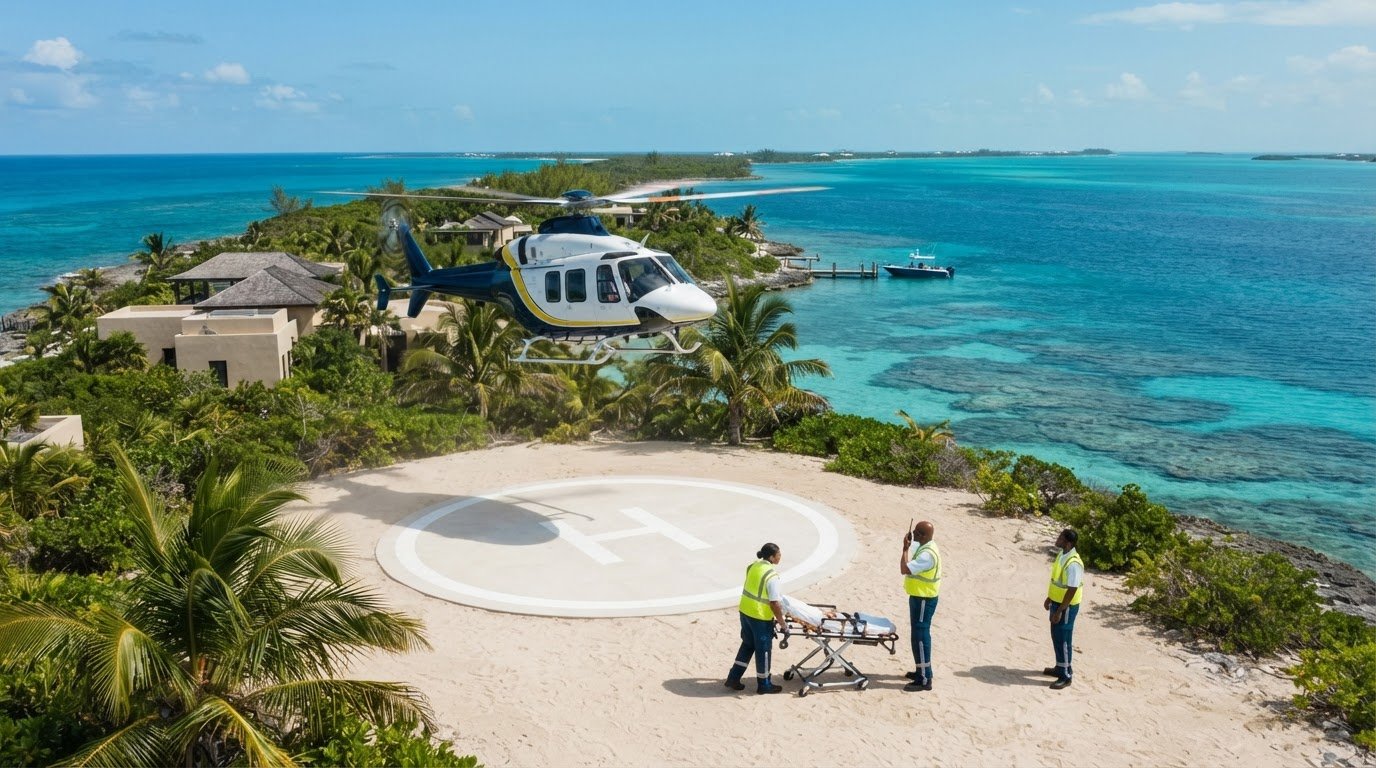
What if the helicopter is only one part of a successful island evacuation? In the Bahamas, a helicopter ambulance for private islands can connect a remote location with emergency transport and onward hospital care. Reaching the island is only the start: accurate patient information, coordination with a receiving care facility, and a clear transfer plan all help shape the response.
It’s understandable to wonder how help can reach an island without a runway, what happens after pickup, and how coverage works. Helicopters can land at remote locations inaccessible to fixed-wing aircraft, while coordinated medical transport connects the pickup with the next stage of care.
This 2026 readiness guide explains the role and limits of helicopter medical evacuation, the location and site information that support coordination, and how to prepare before a stay. Tropic Air Rescue provides emergency and interhospital transport throughout the Bahamas. Membership is required to access service benefits, with short-term and annual options for different lengths of stay. Membership is not insurance. For members, health insurers are billed directly, and insurer payments are accepted as full payment.
Key Takeaways
- Effective island evacuation planning links the pickup location with transport coordination and receiving care, not just aircraft access.
- Learn how a helicopter ambulance for private islands can support access where fixed-wing aircraft cannot land, and why site details matter.
- Prepare a concise response reference with precise location information, access instructions, and emergency contacts ready to retrieve.
- Understand how patient information and mission circumstances guide coordination and the handoff to a receiving care facility.
- Compare short-term and annual membership options when planning coverage around the length of a Bahamas stay.
Why a Helicopter Ambulance Matters on a Private Island
A helicopter ambulance is an air-medical transport service that coordinates a patient’s transfer with the receiving care facility. Unlike ordinary passenger transport, it is organized around a medical need, the patient’s location and condition, and the next stage of care. This general overview of air ambulance services explains how helicopters and fixed-wing aircraft serve different transport roles.
For a helicopter ambulance for private islands, the aircraft is only one part of the response. The pickup location must be reachable, a suitable landing area must be identified, and onward care must be coordinated. In the Bahamas, Tropic Air Rescue provides helicopter air-medical transport for emergency and interhospital transfers, coordinating with receiving care facilities.
What makes private-island medical access different?
Water separates an island property from care elsewhere. Limited ground access can make the journey from the patient to a departure point, and from arrival to a care facility, a central part of the plan. A helicopter can reach remote locations inaccessible to fixed-wing aircraft, but a property address alone does not establish that a safe, usable landing location is available.
For example, a residence may have open water nearby but obstacles or uneven ground around the buildings. The nearest clear area might be outside the property, or another transfer might be needed after landing. These details shape how access and onward transport are coordinated. Owners and property managers can help by keeping precise location information and clear directions ready to share.
What a helicopter ambulance can, and cannot, promise
Helicopter access can reduce reliance on a runway when reaching some remote locations. It does not mean every island property is accessible by air or that a helicopter can land at every proposed site. The landing location and operational conditions matter. Whether transport can proceed, and how it is coordinated, depends on the mission circumstances and the patient’s needs.
Medical evacuation is also different from booking a routine passenger flight. The response is coordinated around a patient and a transfer to care, not simply a destination. Missions can involve different locations, patient needs, and receiving-care arrangements. Transport capability does not guarantee a particular clinical outcome or arrival time.
That distinction matters when setting expectations. A helicopter may provide access where fixed-wing aircraft cannot land, yet the full transfer still depends on the location, conditions, and coordination required. Prepare by keeping site access instructions, location details, and emergency contacts easy to retrieve. Membership is required to access Tropic Air Rescue service benefits, so arrange coverage before a stay rather than treating it as a substitute for an evacuation plan.
How Helicopter Medical Evacuation Connects an Island Patient to Care
A helicopter evacuation is a coordinated sequence, not simply a flight from an island to a hospital. For a helicopter ambulance for private islands, the response connects the people reporting the emergency, the patient’s location and needs, the aircraft, and the receiving care facility. Each mission is shaped by its circumstances, so the following steps are a framework, not a promise that every transfer will follow the same sequence.
- Share the emergency information. Give the response team the patient’s precise location, a callback number, a concise account of what has happened, and instructions for reaching the property or potential landing area. Identify one contact person who can relay updates and answer follow-up questions.
- Coordinate the response. The information provided helps the team consider the patient’s situation, location, and mission circumstances. Coordination includes the receiving care facility, so the destination and onward arrangements are part of the plan, not an afterthought.
- Transport the patient. If the mission proceeds, the helicopter provides air-medical transport. Tropic Air Rescue aircraft are equipped with avionics and life-support equipment. The specific response depends on the circumstances and the patient’s needs.
- Hand off to receiving care. The transfer continues beyond the landing. Coordination with the receiving facility supports the transition from air transport to the next stage of care. Depending on the situation, additional onward arrangements may be part of the journey.
What information supports an organized response?
Keep key details together and easy to retrieve: the patient’s location, a reliable callback number, a concise description of the immediate situation, and access or potential landing-area instructions. Share accurate updates as circumstances change. A designated contact can keep communication clear, particularly when several people are at the property. These details support coordination; they are not a substitute for clinical assessment or treatment.
How does the patient reach the next point of care?
The flight is one link in a broader medical journey. The receiving facility and the patient’s needs inform how the transfer is coordinated, including the handoff after arrival. For a closer look at facility-to-facility coordination, see this guide to coordinating inter-hospital medical transfers.
Preparation matters before an emergency. Keep the property’s location details, access instructions, and the designated contact’s number in a shared, accessible place. In a high-pressure situation, a concise and consistent account can help the response team coordinate next steps without relying on scattered messages or uncertain directions.
Air-medical operations also sit within aviation and medical transport frameworks. The EMS.gov fact sheet on air ambulance regulation provides regulatory context. For a planned stay in the Bahamas, review Tropic Air Rescue membership options ahead of time, since membership is required to access service benefits.
Helicopter Access, Fixed-Wing Limits, and Island-Site Realities
On a private island, aircraft access depends on more than distance. The type of aircraft, the available landing location, operational conditions, patient needs, and route to receiving care all shape the transfer plan. Helicopters can land at remote locations inaccessible to fixed-wing aircraft, but that capability does not mean every property is a usable pickup point.
| Consideration | Helicopter | Fixed-wing aircraft |
|---|---|---|
| Access | Can reach some remote locations that fixed-wing aircraft cannot. | Typically needs runway access, which may require another transfer from an island property. |
| Landing location | Requires a suitable landing area and operational conditions that support the mission. | Requires an appropriate runway at the departure or arrival point. |
| Role in transfer | May connect a remote pickup location with the next point of care. | May form part of a transfer where suitable runway access is available. |
This is a practical distinction, not a universal ranking. Neither aircraft type is automatically right for every patient or route. The helicopter versus fixed-wing medevac guide explores how aircraft choice relates to emergency transport in the Bahamas.
What determines whether a helicopter can reach a private island?
Reachability depends on the actual pickup location, whether a suitable landing area is accessible, and whether operational conditions support the mission. A map pin identifies where the patient is, but it does not establish that a helicopter can land there. A nearby open area may be relevant, yet its suitability still needs to be considered as part of the response. Remote landing capability is not a guarantee of access to every island or property.
For owners and property managers, useful preparation starts with accurate location details and clear directions to potential access areas. Share known obstacles or access limitations when describing the site. Do not assume a lawn, beach, or open patch is suitable simply because it looks unobstructed from the ground. The operational assessment and circumstances of the mission remain decisive.
When does the wider transfer plan matter most?
The pickup is only one segment of a medical evacuation. The patient’s destination and receiving-care arrangements shape how the journey is coordinated. Reaching an island is not the same as completing a transfer to appropriate care; the plan must account for what happens after the aircraft departs and when the patient reaches the next facility.
Aircraft access also does not determine clinical suitability or guarantee an outcome or arrival time. Those are separate considerations, shaped by patient needs and mission-specific operational decisions. Treat the helicopter as one component in a coordinated medical transfer, with the pickup point, destination, and onward handoff considered together.

Prepare a Private Island for a Medical Evacuation
Readiness is built before anyone needs help. For owners, property managers, and travel organizers in the Bahamas, a simple, current response file makes essential location and contact details easier to share under pressure. It supports professional coordination, but it does not determine whether a particular site is suitable for landing or replace decisions made for a specific mission.
What should a property readiness file contain?
Keep the file accessible to the people responsible for the property and update it when details change. Include:
- Property location: Record precise location details that can be communicated clearly, along with the property name or other identifying information used by staff.
- Access instructions: Note how responders can reach the property and where a potential pickup area is located. Describe relevant obstacles or access limitations without presenting a location as an approved landing site.
- Contact details: List a reachable on-site contact and a backup contact, with reliable callback information.
- Guest or patient information: Keep relevant details organized through appropriate, privacy-conscious processes. Share information with responsible people when needed for coordination.
- Response roles: Identify who can provide directions, who can communicate updates, and who can help responders locate the patient.
Store the information somewhere responsible staff or travel companions can retrieve it, including if the primary contact is unavailable. Review it before each new stay or staffing change. A consistent file location and clear naming system can prevent confusion from outdated messages or last-minute searching.
How can hosts prepare guests and staff?
During orientation, explain how to raise an emergency, which contact should coordinate communications, and where to find location and access details. Choose one person to provide consistent updates when possible. This reduces the risk of conflicting directions while allowing others to focus on their assigned responsibilities.
Keep instructions practical. A staff member should be able to describe the property location and access route without relying on local shorthand a responder may not recognize. Make sure guests know whom to alert, but do not expect them to assess whether an air-medical mission is appropriate or to direct clinical care.
A checklist is a preparation tool, not an emergency response service. In an incident, follow professional instructions and provide concise, accurate updates. A helicopter ambulance for private islands depends on coordinated information and mission-specific decisions; a prepared property file helps communicate the setting but cannot guarantee aircraft access.
Include coverage planning in the same advance-preparation routine. Tropic Air Rescue membership is required to access service benefits, so arrange it before the stay rather than during an emergency. Short-term and annual membership options can suit different anticipated lengths of stay. Membership is not insurance. Arrange membership before your Bahamas stay and keep the relevant details with the readiness file.
Arrange Helicopter Ambulance Readiness Through Membership
For a private-island stay in the Bahamas, readiness includes arranging access before an emergency. Tropic Air Rescue membership is required to access service benefits. Choosing an option in advance gives travelers and hosts time to organize the practical details alongside the property’s emergency contacts and response information.
Membership is not insurance, and it does not guarantee a particular mission, eligibility decision, or claim outcome. It is part of the service access model. Understand that distinction before travel, and keep membership details available to the person responsible for coordinating communications if an emergency occurs.
How do short-term and annual membership fit different stays?
Short-term membership is an option for a defined visit, while annual membership may suit a longer-term presence or repeated stays. The appropriate option depends on the anticipated length of time in the Bahamas. Include the decision in travel planning rather than waiting until arrival, then make sure the traveler or property contact who may need the information can find it. This short-term medevac guide for island travelers offers additional context for planning a visit.
What should private-island planners understand about billing?
For members, health insurers are billed directly, and insurer payments are accepted as full payment. This is the billing arrangement for members; it does not mean membership is an insurance policy. Keep relevant insurer information accessible so it can be provided as part of coordination when needed. Membership does not guarantee an insurer’s decision or a particular claim outcome.
For a host organizing a stay, make membership planning part of the same preparation routine as emergency contacts and property access notes. Travelers can ensure the person coordinating a response knows where membership and insurer details are stored. A concise, shared record can reduce confusion when attention is focused on the patient.
- Match the option to the stay: Consider short-term membership for a defined visit or annual membership for a longer presence.
- Keep details accessible: Store membership and insurer information with emergency contacts where the designated coordinator can retrieve it.
- Understand the distinction: Membership is required to access service benefits, but it is not insurance.
Planning ahead makes the service and billing model clearer before travel. If helicopter ambulance for private islands is part of your Bahamas readiness plan, arrange your Tropic Air Rescue membership before your stay.
Make Your Bahamas Stay Emergency-Ready
Before your next stay, turn your evacuation plan into a practical routine. Decide who will hold the property details, who can communicate with responders, and where membership and insurer information will be stored. Keep responsibilities clear when guests, staff, or travel plans change.
Tropic Air Rescue provides helicopter air-medical service throughout the Bahamas, with remote-location landing capability subject to operational conditions. Membership is required to access service benefits. Organizing these details before travel can support informed preparation without assuming membership is insurance or that access to a particular site is guaranteed.
Take the next step while there’s time to plan. Explore Tropic Air Rescue membership and medical transport and prepare your arrangements in advance. A clear plan is a practical way to support a safer, more informed stay.
Frequently Asked Questions
Can a helicopter ambulance land on any private island?
No. Helicopters can reach remote locations inaccessible to fixed-wing aircraft, but that does not mean every island or property has a suitable landing location. Access depends on the actual site and operational conditions for the mission. For example, a property’s coordinates may be clear while its available open area has obstacles or limited access. Share accurate location and site information so the response can be coordinated around the real setting.
Is a helicopter ambulance always faster than other medical transport?
No. A helicopter is not automatically the fastest option for every patient or route. The overall journey includes more than time in the air: reaching the pickup area, coordinating the destination, and arranging onward movement after landing can all matter. Operational conditions and patient needs also shape the plan. Compare the complete route from the patient’s location to the next point of care, not aircraft speed alone.
What information should I give during a medical emergency on a private island?
Give the response team the patient’s precise location, a reliable callback number, a concise description of the immediate situation, and clear instructions for reaching the property. If available, share GPS coordinates alongside a recognizable property name or landmark. Identify one person who can stay reachable and provide updates. Keep information accurate and focused; do not delay sharing essential location details while trying to assemble a complete history.
Does a helicopter ambulance provide medical care during transport?
Air-medical transport is different from an ordinary passenger flight. Tropic Air Rescue aircraft are equipped with life-support equipment, but that equipment alone does not specify what care will be provided on a particular mission. The patient’s needs and mission circumstances inform coordination. Share relevant information with the response team, and follow professional instructions rather than assuming a specific onboard treatment, clinical team, or outcome.
Does medevac membership replace health insurance?
No. Membership is not health insurance. For Tropic Air Rescue members, health insurers are billed directly, and insurer payments are accepted as full payment. That billing arrangement does not make membership an insurance policy or guarantee a particular insurer decision. Keep your health-insurance details accessible and understand that membership and insurance play distinct roles in planning for medical transport in the Bahamas.
Can a helicopter ambulance transfer a patient between hospitals?
Yes. Tropic Air Rescue provides interhospital transport, which can connect a patient at one care facility with another as part of a coordinated transfer. The receiving facility and the patient’s needs inform the arrangements. Clear communication about the current location, intended destination, and relevant patient information helps coordinate the medical journey. Each mission is shaped by its circumstances.
When should private-island visitors arrange medevac membership?
Arrange membership before your Bahamas stay, not during an emergency. Membership is required to access Tropic Air Rescue service benefits, and short-term and annual options can be considered based on your anticipated length of stay. Add membership details to your travel records and make sure a responsible companion or property contact knows where to find them. Advance preparation leaves more room to understand the arrangements calmly.