

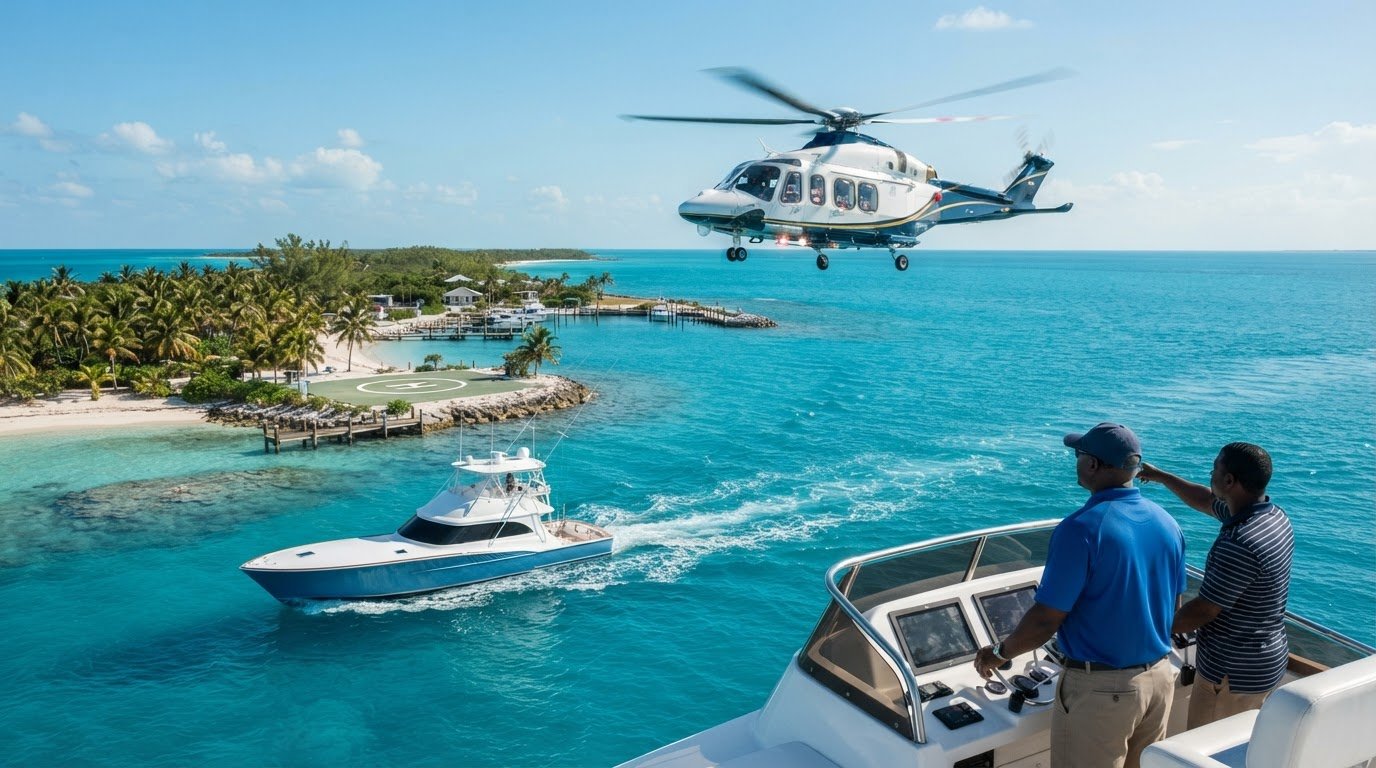
What if the hardest part of a medical emergency at sea isn’t the flight, but coordinating care from your vessel to an accessible landing location? For boat owners, medical flight coverage for boat owners in Bahamas is best understood as a pre-arranged medical transport benefit, not a substitute for boat or health insurance.
It’s reasonable to wonder who coordinates transport, what insurance will cover, and how help can reach you across a wide island nation. Tropic Air Rescue membership is required to access its benefits. For active members, the company bills health insurers directly and does not seek payment beyond the insurance reimbursement. Membership and insurance have distinct roles, so understand both before departure.
This article explains how membership and insurance billing work, what information to have ready for emergency coordination, and how to choose a short-term or annual membership based on your stay in The Bahamas. It also explains why a response from a vessel involves coordinating a transfer to an accessible landing location, rather than assuming a helicopter can extract someone directly from the boat.
Key Takeaways
- Medical flight coverage for boat owners in Bahamas is a pre-arranged transport benefit, not insurance for your vessel.
- In an emergency, clear details about your position, the patient’s condition, and a reliable callback method support coordination.
- Compare membership, health insurance, and boat insurance by their separate roles before you depart.
- Prepare an onboard emergency sheet with crew and guest details, vessel location information, and membership records.
- Estimate your time in The Bahamas, then choose a short-term or annual membership period that fits your stay.
What medical flight coverage means for boat owners in the Bahamas
For boat owners, medical flight coverage is a pre-arranged way to access eligible air-medical transport benefits through a membership. It is not a boat policy, a general rescue service, or a guarantee that a helicopter will come directly to a vessel. Membership provides access to a specialized medical transport service for emergency or interhospital transfers, subject to the applicable membership terms.
This distinction matters in the Bahamas, where a vessel may be far from routine medical facilities. A serious injury or illness can require more than transport to shore. It may also call for medical coordination and onward air transport. A helicopter can land in remote locations inaccessible to fixed-wing aircraft, but that does not mean a patient is extracted directly from a boat. The transfer from vessel to an accessible landing location must be coordinated for the circumstances.
For background on the broader term and the different situations it can cover, see What is medical evacuation? For boaters, the practical question is how a membership-based service fits into an emergency plan before leaving familiar medical access behind.
What does medical-flight membership provide?
Tropic Air Rescue provides helicopter air-medical transport throughout the Bahamas, including emergency transport and interhospital transfers. The company coordinates with trauma centers when appropriate. This is medical transport, not a private charter, general boat assistance, or a substitute for arranging the vessel-to-landing-location transfer. Membership is required to receive Tropic Air Rescue benefits.
Think of membership as pre-arranged access to the service, rather than a promise about a particular aircraft, timing, or medical outcome. Pre-certification allows identity and enrollment information to be collected before an emergency, so those details are available during coordination.
How membership differs from health and boat insurance
Membership and insurance serve different purposes. Membership provides access to eligible medical-flight services. Health insurance relates to medical expenses under a policy’s terms, while boat insurance protects the vessel and may cover other specified marine risks. Medical-flight membership does not insure the boat or replace health insurance.
For active members, Tropic Air Rescue bills health insurers directly and does not seek payment beyond the insurance reimbursement. This billing arrangement does not make membership an insurance policy or mean every policy and medical circumstance is treated identically. Keep your health-insurance details and membership information accessible, and remember that active membership is required for benefits.
For boat owners, the value is in arranging transport access before it’s needed. If a crew member becomes seriously ill while the vessel is away from routine medical facilities, membership is the pre-arranged access point. The health-insurance policy remains separate, and the vessel’s insurance continues to serve its own purpose. Keeping those roles clear helps the crew know what information to provide and what the membership is designed to address.
How a medical-flight response can be coordinated from a boat
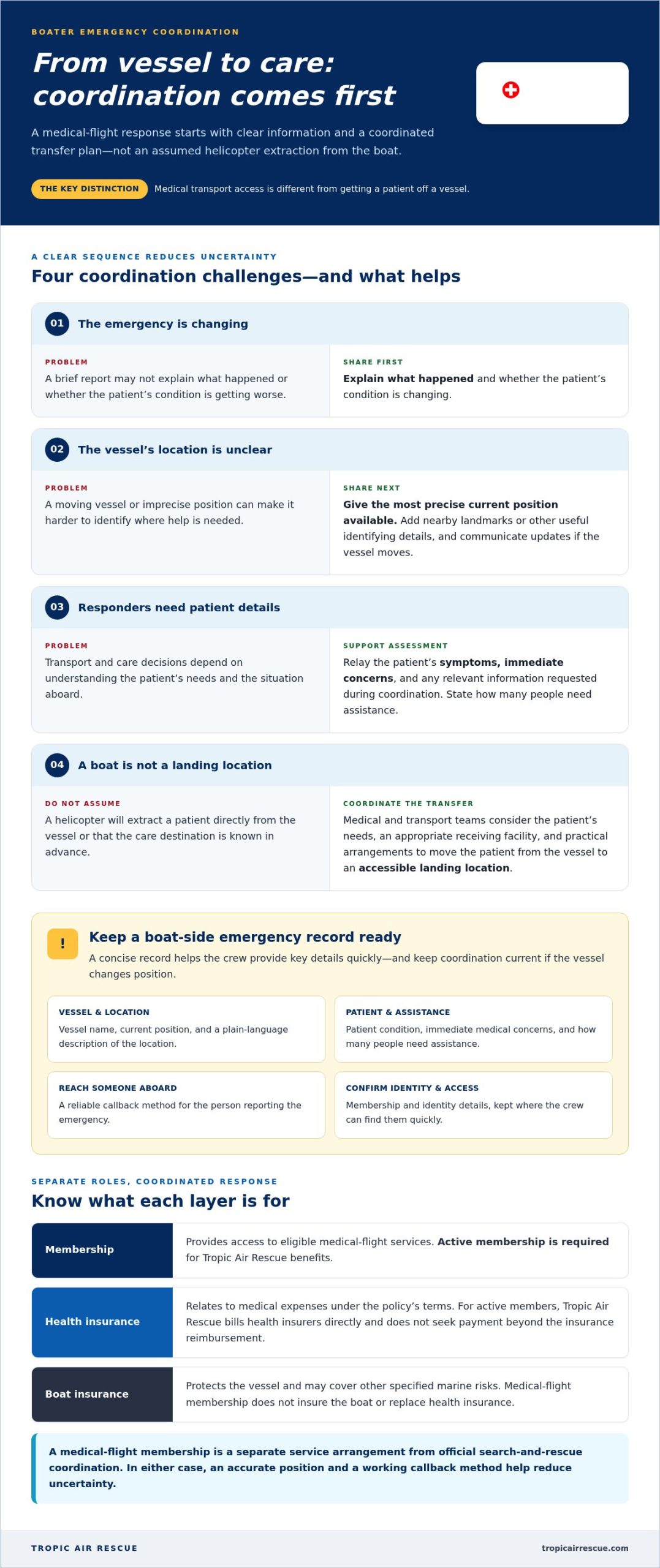
A medical response from a vessel depends on clear information and coordinated decisions. The initial report should explain what happened, where the boat is now, and how responders can reach someone aboard. Medical assessment helps guide the next steps. A helicopter landing location and the patient’s transfer from the vessel must be coordinated for the situation, so don’t assume a helicopter will extract someone directly from the boat.
The U.S. and Bahamas Search and Rescue Agreement provides context for official search-and-rescue coordination. A medical-flight membership is a separate service arrangement. In either case, an accurate position and working callback method help reduce uncertainty about the vessel’s location and how to reach the person reporting the emergency.
- Report the emergency. Explain what happened and whether the patient’s condition is changing.
- Share the vessel’s position. Give the most precise current location available, then describe nearby landmarks or other useful identifying details.
- Support medical assessment. Relay the patient’s symptoms, immediate concerns, and relevant information requested during coordination.
- Coordinate the transfer. Medical and transport teams can consider the patient’s needs, an appropriate receiving facility, and practical arrangements for moving the patient from the vessel to an accessible landing location.
What information should boat owners prepare?
Keep a concise emergency record where the crew can find it quickly. Include the vessel’s name and current position, a plain-language description of its location, and a reliable callback method. Record the patient’s condition, immediate medical concerns, and how many people need assistance. Keep membership and identity details accessible as well. If the vessel moves, communicate the updated position clearly so coordination uses current information.
Why pre-certification and medical coordination matter
Pre-certification means enrollment information is collected before an emergency, making identity and membership details available during coordination. Medical assessment informs the care plan. Tropic Air Rescue’s medical director determines an appropriate care destination based on the circumstances, so don’t assume the destination in advance. Coordination with trauma centers may be appropriate, while the specific receiving facility depends on the case.
Helicopters can land at remote locations inaccessible to fixed-wing aircraft. That capability can support access in remote areas, but it is not the same as helicopter-to-vessel extraction. The transfer method and accessible landing location depend on the situation and must be coordinated rather than presumed.
For boat owners, medical flight coverage for boat owners in Bahamas is most useful as part of a practical response plan: prepare the vessel details, keep enrollment information available, and communicate position changes. Review Tropic Air Rescue membership information as you prepare your onboard emergency records.
Compare membership, insurance, and other emergency plans
Medical flight coverage for boat owners in Bahamas is one part of an emergency plan, not a substitute for every other form of protection. Compare the arrangements by purpose: membership provides access to eligible air-medical transport benefits, health insurance addresses medical expenses under its policy terms, and boat insurance protects the vessel and specified marine risks. Don’t assume one replaces or duplicates another.
| Arrangement | Primary purpose | How to think about it |
|---|---|---|
| Medical-flight membership | Access to eligible air-medical transport benefits | Membership is required to receive Tropic Air Rescue benefits. |
| Health insurance | Medical expenses covered under the policy’s terms | Keep policy details available; coverage depends on the applicable plan and circumstances. |
| Boat insurance | Protection for the vessel and specified marine risks | It is not medical-flight membership and does not insure access to air-medical transport. |
This comparison is about purpose, not a judgment about what any particular health or boat policy includes. Review each arrangement for its distinct role and keep the relevant documents accessible. A boat policy may be essential for vessel-related risks, but it isn’t a substitute for the membership required for Tropic Air Rescue benefits.
Short-term or annual membership: which fits your stay?
Membership options are tailored to your anticipated time in The Bahamas. A defined visit may align with a short-term membership, while recurring or extended time in the country may make an annual membership more suitable. Consider your planned stay and how often you expect to return, then compare the options. The short-term medevac coverage guide can help you think through trip length.
What direct insurance billing means for members
For active members, Tropic Air Rescue bills health insurers directly and does not seek payment beyond the insurance reimbursement. This describes the company’s billing approach for active members; it is not a promise that an insurer will reimburse a particular amount or handle every case the same way. Keep membership and health-insurance information available so those details can support coordination if needed.
Before departure, map your arrangements by role: membership for access to eligible medical-flight benefits, health insurance for medical expenses under its terms, and boat insurance for vessel-related protection. Then consider whether a short-term or annual membership better matches your anticipated stay. The aim is not to choose one in place of the others, but to understand what each is for and have the right information ready.
Prepare your boat and crew before an emergency
A concise onboard plan can make communication more orderly when someone needs urgent medical attention. In the Bahamas, a vessel’s position may change while coordination is underway. The crew should know how to report its current location, reach the person coordinating the response, and share relevant patient information. Preparation won’t determine the response or outcome, but it can help the crew provide clear, useful details.
Create an onboard medical-response brief
Keep a short, accessible information sheet for crew and guests. Update it when the people aboard or the vessel’s circumstances change. Include:
- Vessel details: name and other identifying information, plus the current position and a plain-language description of the location.
- Communications: the equipment available to reach assistance and a reliable callback method. Make sure crew know where the equipment is kept.
- People aboard: passenger names, relevant medical information, emergency contacts, and the number of people needing assistance.
- Membership information: the member’s identifying and enrollment details, stored where the crew can retrieve them quickly.
Keep the information easy to find, rather than buried in a folder or known only to the captain. If the vessel moves, designate someone to communicate the update so the response team has current details.
Brief the crew without creating false certainty
Assign clear roles before departure. One person can communicate the emergency and relay updates, another can assist the patient and gather requested information, and a third can help maintain a clear line of communication. On a smaller crew, one person may need to cover more than one role. The goal is to avoid confusion about who is responsible for each task.
Review how to describe the patient’s condition plainly, including what changed and when. Keep membership details and the emergency sheet accessible to the people assigned to communicate. Medical flight coverage for boat owners in Bahamas works best as a prepared part of a wider onboard plan, not as a prediction of exactly how a response will unfold.
Explain the limits of the plan, too. Medical assessment and operational coordination guide the response and transfer arrangements. A helicopter’s ability to land in remote locations does not mean it can extract a patient directly from a vessel. The transfer to an accessible landing location and the appropriate arrangements depend on the circumstances. For general aircraft context, see this helicopter versus fixed-wing medevac comparison.
Before your next trip, review membership options and prepare your crew to keep enrollment information ready. A brief crew review can help everyone understand their role and the details they may need to communicate.
Choose Bahamas medical-flight coverage and prepare to act
Make the decision before the vessel departs. Start with your expected time in The Bahamas, choose the membership period that fits your stay, and complete enrollment so your information is available ahead of an emergency. Membership is required for Tropic Air Rescue benefits and must be active to receive them. It is a proactive transport arrangement, not a guarantee of a particular response, arrival time, or medical outcome.
Match membership to your time in the Bahamas
For a defined visit, consider whether a short-term membership aligns with your planned stay. If you expect recurring or extended time in the country, compare that pattern with the annual membership option. Use your actual boating plans, including the length of the visit and whether you expect to return, to guide your choice. The short-term medevac coverage guide offers further context for considering trip length.
After selecting a period, complete enrollment before setting out and keep the relevant membership details accessible to the crew. Pre-certification allows identity and enrollment information to be collected in advance, rather than leaving those details to be assembled during a stressful situation. Pair that preparation with an onboard brief, a clear crew communication plan, and current vessel-location information.
Take the next step with Tropic Air Rescue
Tropic Air Rescue provides helicopter air-medical transport throughout the Bahamas. The service supports emergency and interhospital transport, with medical coordination guiding the response. For boat owners, the process may involve coordinating a patient’s transfer from the vessel to an accessible landing location. A helicopter’s ability to land in remote locations does not mean it will extract a patient directly from a boat; arrangements depend on the medical and operational circumstances.
For active members, Tropic Air Rescue bills health insurers directly and does not seek payment beyond the insurance reimbursement. This describes the company’s billing approach, not a guarantee of insurer reimbursement in every circumstance. Keep your membership and health-insurance information available so the relevant details can be shared during coordination.
Medical flight coverage for boat owners in Bahamas is best prepared as a sequence: estimate your stay, choose the membership period that matches it, enroll, then brief the crew on where to find the information and how to communicate. To review the service and membership details, explore Tropic Air Rescue membership options and the concierge air-medical service guide.
Make readiness part of every departure
A sound plan is one the crew can use under pressure. Before the next passage, set aside time to review the emergency brief, confirm who will communicate, and make sure everyone knows where membership details are kept. Revisit the plan when guests or crew change, or when your time in The Bahamas shifts from a defined visit to a longer stay.
That preparation gives medical flight coverage for boat owners in Bahamas a practical place in your broader onboard safety plan. It doesn’t remove uncertainty from an emergency, but it helps you make decisions in advance and communicate more clearly when circumstances become urgent.
Tropic Air Rescue offers short-term and annual membership options, tailored to your anticipated time in the Bahamas. For active members, the company bills health insurers directly and doesn’t seek payment beyond the insurance reimbursement. Explore the membership details and choose the option that fits your plans: Explore Tropic Air Rescue membership options.
Prepare before departure, brief your crew, and set out with a clearer plan.
Frequently Asked Questions
Does medical-flight membership replace boat or health insurance?
No. Membership provides access to Tropic Air Rescue benefits, while boat insurance and health insurance serve separate purposes. Keep the policies that address your vessel and medical expenses; membership doesn’t replace either one. For active members, Tropic Air Rescue bills health insurers directly and doesn’t seek payment beyond the insurance reimbursement. That billing approach isn’t a guarantee that every insurer will reimburse every service or circumstance.
Can a helicopter land directly on my boat in the Bahamas?
Don’t assume a helicopter can land on or extract a patient directly from your vessel. Helicopters can land at remote locations, but the patient’s transfer from boat to an accessible landing location depends on medical and operational coordination. During an emergency, provide the vessel’s precise current position and a reliable way to call you back. Those details support coordination without establishing a particular pickup method or landing point.
Does Tropic Air Rescue provide medical-flight coverage throughout the Bahamas?
Yes. Tropic Air Rescue provides helicopter air-medical service throughout the Bahamas. Membership is required to receive benefits, so boat owners should have active membership before relying on them. National service scope doesn’t guarantee a particular response time, aircraft dispatch, landing arrangement, or medical outcome. Include membership details in your onboard emergency information so the crew can provide them during coordination.
How does direct insurance billing work for active members?
For services provided to active members, Tropic Air Rescue bills the member’s health insurer directly. The company doesn’t seek payment beyond the insurance reimbursement. This is the stated billing approach for active members, not a guarantee of how much an insurer will reimburse in a specific case. Keep your health-insurance information available alongside membership details, and don’t assume the arrangement applies to non-members or unrelated expenses.
Should I choose short-term or annual membership as a boat owner?
Choose based on how long you anticipate being in The Bahamas. A defined boating visit may suit a short-term membership, while recurring or extended stays may point toward an annual option. Consider your expected departure and return plans, then select the period that aligns with them. Both options are designed around anticipated length of stay; membership benefits require completed enrollment and active membership.
What information should I share during a medical emergency aboard a boat?
Share the vessel’s current position, a dependable callback method, the patient’s condition, and how many people need assistance. If the boat has moved since the initial report, communicate its updated position promptly. Clear, current details help medical and operational teams coordinate assessment and transfer arrangements, including consideration of an appropriate receiving facility. Information supports coordination, but it doesn’t guarantee a specific aircraft, landing point, or arrival time.
Does medical-flight membership guarantee a helicopter response?
No. Membership shouldn’t be understood as a guaranteed dispatch, arrival time, or medical outcome. It is required to receive Tropic Air Rescue benefits, and emergency transport involves medical and operational coordination. Before travel, complete enrollment so your information is prepared in advance. Pair that step with a crew briefing and accessible vessel details, giving your crew a clear plan for communicating if an emergency occurs.