

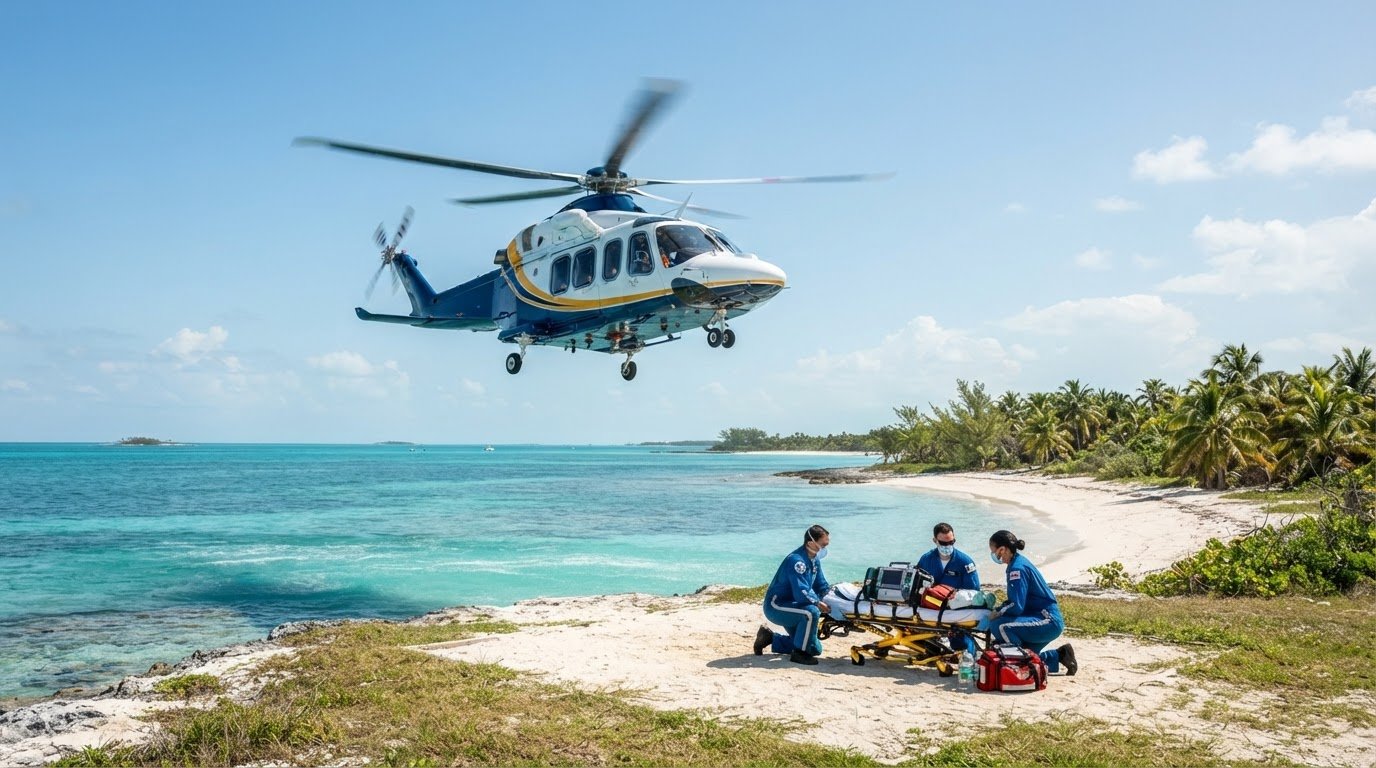
What happens when a medical emergency strikes somewhere a road or fixed-wing aircraft can’t reach? In the Bahamas, distance and access can complicate evacuation when time matters. Helicopter rescue services can bridge that gap, bringing advanced life-support equipment to remote locations and transporting patients toward appropriate hospital care.
It’s reasonable to worry about being stranded, the care available during transit, and who will pay for an air medical flight. A specialized helicopter response can connect the pickup location with ongoing medical care, with life-support equipment on board. At Tropic Air Rescue, membership is required to receive service benefits. Members’ health insurers are billed directly, and Tropic Air Rescue accepts insurance reimbursement as full payment, so members have no out-of-pocket costs.
This article explains how helicopter rescue supports point-to-point medical transport, reaches locations fixed-wing aircraft can’t access, and coordinates a journey from evacuation to hospital care. You’ll also learn how the membership model handles billing and what to consider when preparing for an emergency.
Key Takeaways
- Learn how helicopter rescue services bring advanced life-support equipment to emergencies in locations that can be difficult to reach by road or other aircraft.
- Understand why helicopter versus fixed-wing medevac is an important decision for point-to-point island transport.
- See how membership provides access to emergency transport, with direct insurance billing and no out-of-pocket costs for members.
- Explore how short-term and annual air rescue memberships can help you prepare for unexpected medical evacuation needs.
- Discover how Tropic Air Rescue’s concierge approach coordinates transport from remote locations toward hospital care.
Defining Helicopter Rescue Services in Modern Emergency Medicine
In an emergency, the fastest route to care may not be a road. Helicopter rescue services provide point-to-point medical evacuation, connecting a patient at the scene or in a remote location with the next stage of care. By flying over water and rugged terrain, a helicopter can help close the distance when ground or sea transport would take too long.
Helicopter medevac is a specialized air medical service that supports patient monitoring and life-support care during transport. The broader field of Air medical services includes different aircraft and transport models. A helicopter’s ability to land near an incident can be especially useful when access is limited.
That capability can matter during the “Golden Hour,” a term commonly used for the early period after serious trauma when timely assessment and treatment can be critical. It isn’t a guaranteed outcome or a fixed deadline. The practical priority is to reduce delays to appropriate care, particularly when a patient may need urgent specialist or surgical intervention.
The Concept of the Airborne ICU
A helicopter’s medical cabin is configured to support patient care in transit. Depending on the aircraft and mission, medical equipment may include cardiac monitoring, oxygen, and life-support systems. The medical team monitors the patient, provides stabilization within its capabilities, and shares relevant information with the receiving care team. Tropic Air Rescue equips all flights with advanced life-support equipment.
When to Utilize Helicopter Rescue
Air evacuation may be considered when a time-sensitive injury or illness occurs somewhere ground or sea transport cannot reach quickly. It can also serve remote locations without a paved runway, because a helicopter can access suitable landing areas that fixed-wing aircraft cannot. Another use is an interhospital transfer when a patient needs continued medical care during the journey. The right transport plan depends on the patient’s needs, access, and destination. Tropic Air Rescue provides helicopter rescue benefits to members.
The value is not flight alone. It is the coordinated movement of a patient from a difficult-to-reach location toward appropriate medical care, with support maintained during the journey.
Advanced Capabilities: Medical Technology and Aviation Excellence
In air medical transport, clinical equipment and flight capability work together. The aircraft must support the care plan during transit, while navigation and communications systems help the flight proceed safely and keep the receiving care team informed. The value is not technology for its own sake. It is the ability to support care and coordination between pickup and handoff.
Medical configurations vary by aircraft and mission. Tropic Air Rescue equips all flights with advanced life-support equipment. Equipment and clinical decisions are matched to the patient’s needs, while flight planning takes account of the destination, route, weather, and available landing options. Night or poor-weather operations depend on conditions and operational limits; no aircraft capability removes the need for those assessments.
Onboard Life-Support Systems
During transport, the medical team monitors the patient and supports stability until care can continue at the receiving facility. Depending on the aircraft’s medical configuration and the patient’s condition, air medical equipment can support monitoring, oxygen delivery, and other life-support needs. These tools help the team assess changes in the patient’s condition and respond within the scope of care available onboard.
Aviation Precision in Remote Areas
Helicopters can take off and land vertically, removing the need for a runway and making them useful for reaching suitable landing sites beyond conventional airport access. That can matter when a patient is at a remote shore or on a vessel. Navigation technology supports route planning, while the aviation crew assesses whether a landing area and conditions are suitable for the mission.
Communications are another critical link. Sharing patient and transport information with the receiving care team supports a coordinated handoff and helps prepare for the next stage of treatment. Tropic Air Rescue coordinates transport with trauma centers, connecting flight logistics with the care provided during the journey.
For patients and families, these capabilities matter when they support continuity: medical support in transit, access to locations that are difficult to reach, and organized coordination toward hospital care. Membership is required to receive Tropic Air Rescue benefits, and members have no out-of-pocket costs. To understand how membership fits into the service, review Tropic Air Rescue membership information.
Helicopter vs. Fixed-Wing: Strategic Advantages in the Bahamas
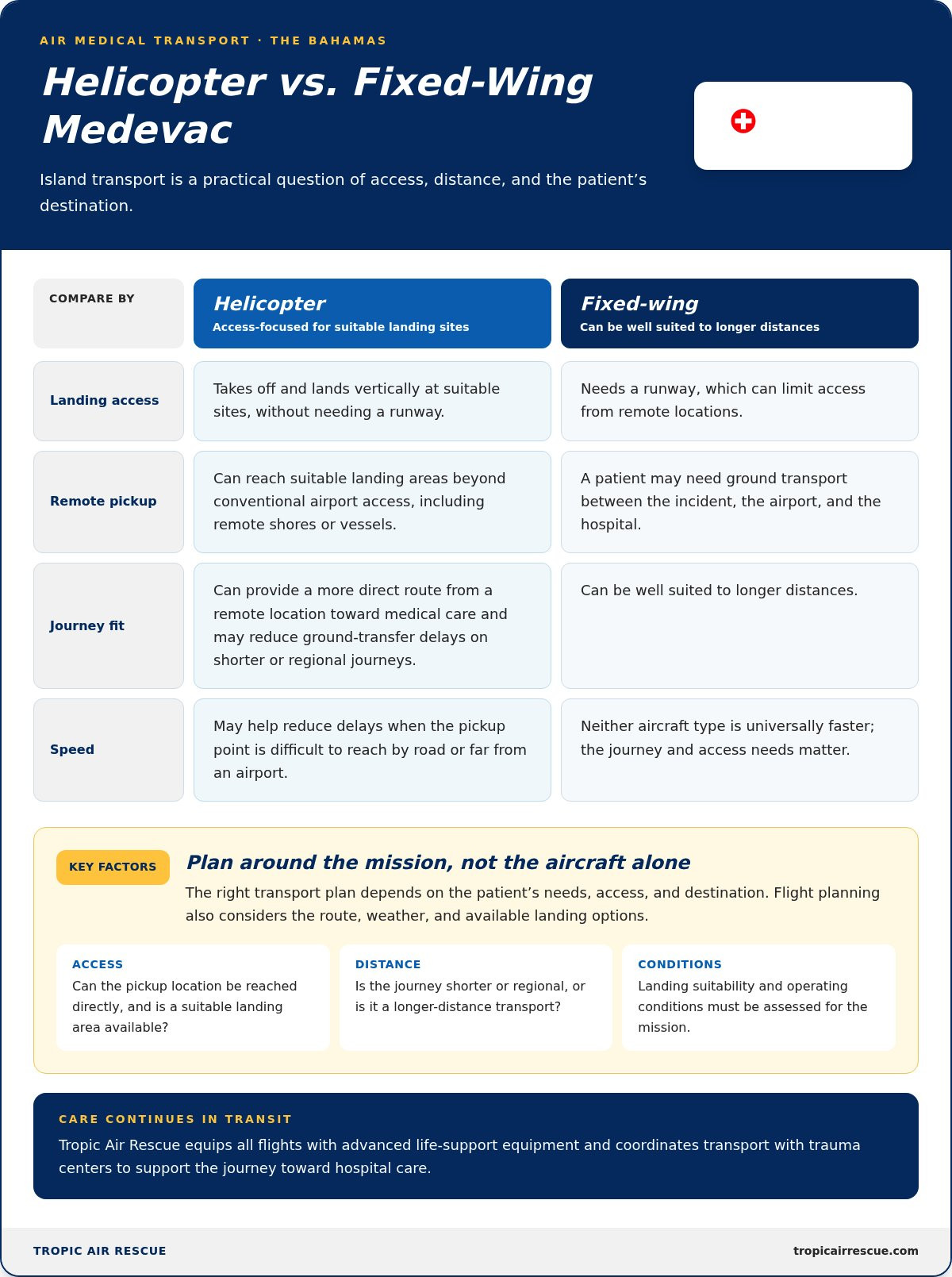
Island geography changes the transport equation. A fixed-wing aircraft needs a runway, and the patient may still need ground transport between the incident, airport, and hospital. A helicopter can take off and land vertically at suitable sites, allowing a more direct route from a remote location toward medical care. For island transport, helicopter vs fixed wing medevac is a practical question of access, distance, and the patient’s destination.
Neither aircraft type is universally faster. Fixed-wing aircraft can be well suited to longer distances, while helicopter rescue services can reduce ground-transfer delays on shorter or regional journeys when the pickup point is far from an airport. Total travel time depends on the route, weather, landing access, and care requirements. In a remote setting, the key advantage may not be cruising speed, but whether the aircraft can reach the patient directly.
Landing Versatility and Access
A helicopter does not require a conventional runway, which can make it possible to reach suitable landing areas near a remote property or vessel. The crew must assess the site and operating conditions before landing. Fixed-wing transport, by contrast, depends on airport access, followed by ground travel to and from the airport. Where water separates locations, removing a transfer leg can simplify the evacuation plan and support a more continuous journey toward care.
Operational Speed and Efficiency
When a patient is far from an airport, each handoff can add coordination and travel time. Point-to-point helicopter transport can bypass some ground movement, although no single time saving applies to every mission. Dispatch, aircraft preparation, weather, clinical needs, and the receiving destination all affect timing. Planning also accounts for where the patient can be safely picked up and where appropriate care is available.
For a patient who needs care beyond what is available nearby, the destination matters as much as the aircraft. Tropic Air Rescue coordinates medical transport with trauma centers, organizing the logistics around the patient’s transfer rather than an airport connection alone. Membership is required to receive service benefits, and members have no out-of-pocket costs.
The choice comes down to the route’s real constraints: runway access, distance to the patient, the need for ground transfers, and the destination’s ability to continue treatment. In remote island settings, a helicopter’s landing flexibility can make a direct medical evacuation possible where airport-based transport would require additional steps.
Securing Coverage: The Air Medical Membership Model
In a medical emergency, arranging transport is only part of the challenge. Understanding the financial process matters too. Membership is required to receive Tropic Air Rescue’s helicopter rescue services and associated benefits. The model makes access and billing more straightforward: Tropic Air Rescue bills a member’s health insurer and accepts the insurance reimbursement as full payment, so members have no out-of-pocket costs.
An annual air rescue membership can help people who spend extended time in the Bahamas prepare in advance. Membership establishes access to the service and explains how billing works before an emergency. Members aren’t directly invoiced for transport under this membership model.
How Direct Billing Works
After an eligible member receives transport, Tropic Air Rescue bills the member’s health insurer. The company accepts the insurance reimbursement as full payment, leaving the member with no out-of-pocket costs. Direct billing can ease the administrative burden during an already difficult situation. It also differs from a model where the patient receives a bill directly for the flight.
Membership Options
Membership types suit different timeframes and organizations. Short-term membership can serve travelers with a defined stay, while annual membership can suit people who spend more time in the Bahamas. B2B membership plans give businesses an option for arranging membership for groups. Consider who needs coverage and for how long, then select the membership timeframe that fits. Membership must be in place to receive benefits.
Membership is a preparation decision, not something to leave until an emergency. Review the annual membership details to understand how the plan works, then explore Tropic Air Rescue membership and choose the option that fits your time in the Bahamas.
Tropic Air Rescue: Your National Concierge Medevac Partner
In a complex medical evacuation, the flight is only one part of the response. Tropic Air Rescue provides helicopter medevac services across the Bahamas, coordinating transport and patient care as part of an organized process. Its aircraft can reach remote locations that fixed-wing aircraft cannot, helping connect patients with medical facilities when geography complicates the journey.
Across the Bahamas, water and limited access can make a conventional transfer difficult. Tropic Air Rescue coordinates with trauma centers and provides interhospital transfers, helping align transport with the patient’s next stage of care. The focus is to move the patient from the point of need toward appropriate treatment while maintaining communication and clinical support along the way.
The Concierge Experience
A coordinated transfer involves more than arranging an aircraft. It can require communication between local medical staff, transport teams, and the receiving facility, with attention to the patient’s condition and destination. Tropic Air Rescue’s concierge model brings these logistics together during a high-stakes situation. Its services also include organ transport and interhospital transfers for patients who need continued medical care between facilities.
For families, a clear coordination process can reduce uncertainty about what happens next. The team manages transport logistics and supports a connected handoff, while clinicians at either end of the journey direct the patient’s care.
Prepared Through Membership
Preparation begins before an emergency. Membership is required to receive Tropic Air Rescue benefits, and members have no out-of-pocket costs. Health insurers are billed directly, with insurance reimbursement accepted as full payment. Short-term and annual memberships serve different travel patterns, while B2B membership plans provide an option for organizations. This structure helps members understand access and billing before an urgent medical need.
Helicopter rescue services depend on coordination among aviation, medical, and receiving-care teams. Tropic Air Rescue brings those elements together, with access to remote locations and coordination with trauma centers. Each mission is shaped by the patient’s needs, location, destination, and operating conditions.
To prepare for medical transport in the Bahamas, explore Tropic Air Rescue membership. Membership provides access to the service, with direct insurance billing and no out-of-pocket costs for members.
Be Prepared for the Journey to Care
In a remote medical emergency, access matters. Helicopter rescue services can connect patients at hard-to-reach locations with medical care, while onboard life-support equipment supports care during transit. The right aircraft can also reduce transfer steps between a remote pickup point and the next stage of treatment.
Preparation includes understanding membership before an emergency. Membership is required for Tropic Air Rescue benefits. Members’ health insurers are billed directly, and insurance reimbursement is accepted as full payment, so members have no out-of-pocket costs. With advanced life-support equipment on every flight and coordination with trauma centers, the service brings medical support and transfer logistics together.
Take the next step before you need urgent transport. Explore Tropic Air Rescue membership and review the options for your time in the Bahamas.
Frequently Asked Questions
How do helicopter rescue services differ from standard air ambulances?
Helicopter rescue services use a rotary-wing aircraft to transport patients directly from suitable landing sites, including remote locations that may be inaccessible to fixed-wing aircraft. “Air ambulance” is a broader term that can include different aircraft and transport arrangements. The practical distinction is access: helicopters can take off and land vertically, while fixed-wing aircraft require runways and may involve additional ground transfers to reach the patient or hospital.
Can a medical helicopter land at my private residence or a remote resort?
A medical helicopter may be able to land at a suitable site near a residence or remote resort, but the location must be assessed for safe operations. Landing space, nearby obstacles, weather, and other conditions can affect the decision. Tropic Air Rescue can reach remote locations that fixed-wing aircraft cannot, but not every property or resort is suitable as a landing site.
What level of medical staff is on board a Tropic Air Rescue flight?
Tropic Air Rescue equips all flights with advanced life-support equipment and provides medical transport. The medical support during a flight is guided by the mission and the patient’s needs. The team supports the patient during transport and coordinates the journey toward the receiving facility, helping maintain continuity between pickup and hospital care.
Is helicopter medevac covered by my standard health insurance?
Insurance arrangements depend on your plan and the circumstances of the transport, so don’t assume a standard policy covers every flight. Tropic Air Rescue uses a membership model: membership is required to receive benefits, and the company bills members’ health insurers directly. It accepts the insurance reimbursement as full payment, meaning members have no out-of-pocket costs under this model.
What is the “Golden Hour” and why is it critical for helicopter rescue?
The “Golden Hour” is a commonly used term for the early period after a serious injury, when prompt assessment and treatment can be especially important. It isn’t a guaranteed deadline or a promise of survival. Helicopter transport may help reduce delays when distance, water, or terrain makes other transport difficult, supporting a faster connection to appropriate care when time-sensitive treatment is needed.
How do I activate helicopter rescue services in an emergency?
If an emergency occurs, seek immediate local medical assistance and communicate the patient’s location and condition to the responding medical team. If the patient is a Tropic Air Rescue member, make the membership known as part of the coordination. Membership is required for service benefits. The transport plan depends on the patient’s needs, location, and operating conditions; don’t delay urgent local care while arranging transport.
Are there out-of-pocket costs for Tropic Air Rescue members?
No. Tropic Air Rescue bills members’ health insurers directly and accepts the insurance reimbursement as full payment, so members have no out-of-pocket costs. Membership is required to receive these benefits. This model is designed to make the financial process more straightforward during medical transport and does not involve direct patient invoicing.
Can helicopters transport patients directly to trauma centers?
Tropic Air Rescue coordinates medical transport with trauma centers, supporting transfers when that destination is appropriate for the patient’s care. The destination and transport plan depend on clinical needs and operating considerations. The service coordinates the journey rather than treating a particular hospital destination as automatic, helping connect the patient’s current care team with the receiving facility.