

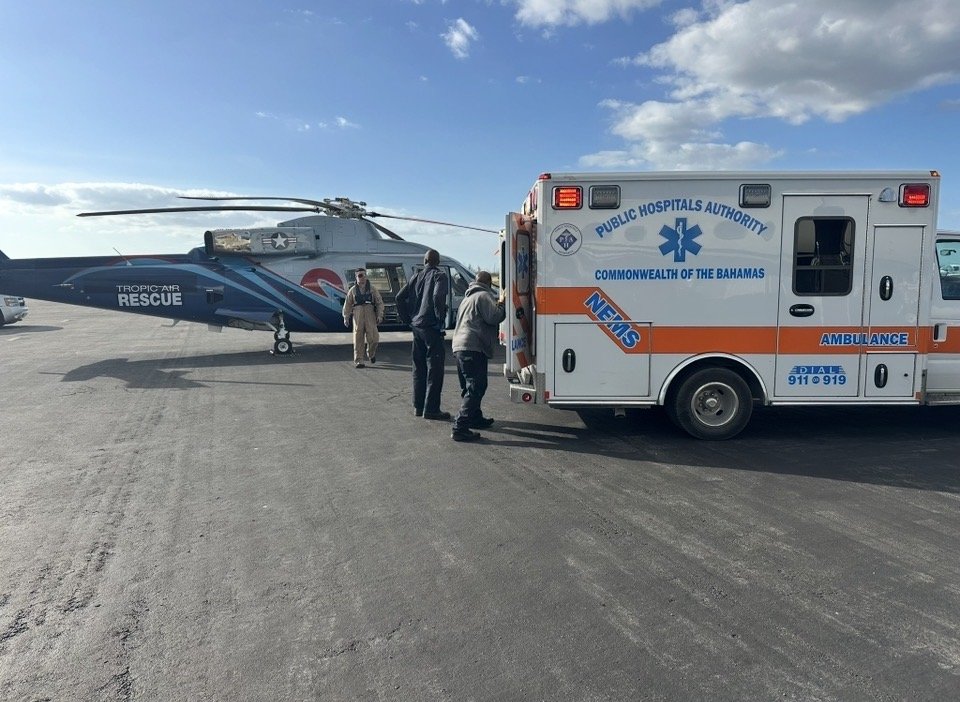
Did you know that a medical evacuation from the Bahamas can cost as much as $142,000, yet only 61 of the country’s 700 islands have a runway? If you’re exploring remote cays, the fear of being stranded during a medical crisis is a heavy burden to carry. This complete guide to Tropic Air Rescue explains how to replace that anxiety with the certainty of an elite medical logistics network. You’ll learn how to master the logistics of the Bahamas’ premier concierge helicopter service to ensure a rapid, professional response when every second counts.
We understand that the complexity of international insurance and the threat of massive air ambulance bills can be overwhelming. This article provides a clear roadmap for securing guaranteed transport directly to Florida trauma centers with zero out-of-pocket response costs. We’ll examine the specialized Sikorsky S-76B fleet, the 48-hour membership activation window, and the direct billing protocols that protect your health and your assets. From remote island landing capabilities to expert paramedic coordination, here’s everything you need to know about the region’s most disciplined rescue operation.
Key Takeaways
- Master the logistics of point-to-point helicopter transport to bypass the limitations of remote island geography and traditional runways.
- Use this complete guide to Tropic Air Rescue to select the membership tier that aligns with your residency status and ensures immediate response readiness.
- Secure your financial stability by leveraging a direct insurance billing model designed to eliminate high out-of-pocket costs for emergency evacuations.
- Learn the onboarding protocols required to pre-certify your medical data for a faster, more coordinated transition to elite Florida trauma centers.
- Understand the critical role of interhospital transfer services in moving patients from local clinics to specialized facilities with surgical precision.
The Concierge Standard: Defining Tropic Air Rescue’s Mission
Tropic Air Rescue isn’t a utility; it’s a private, elite medical logistics network. It serves as the vital bridge between the remote cays of the Bahamas and the advanced trauma centers of South Florida. This complete guide to Tropic Air Rescue details how the service operates on a philosophy of being Ready, Agile, and Direct. Preparation is constant. Response is immediate. There are no middlemen to delay critical care. Membership is the definitive prerequisite for accessing this specialized concierge response. This complete guide to Tropic Air Rescue is designed to help you understand how this premium service functions as your primary defense against medical uncertainty.
The mission focuses on three operational pillars:
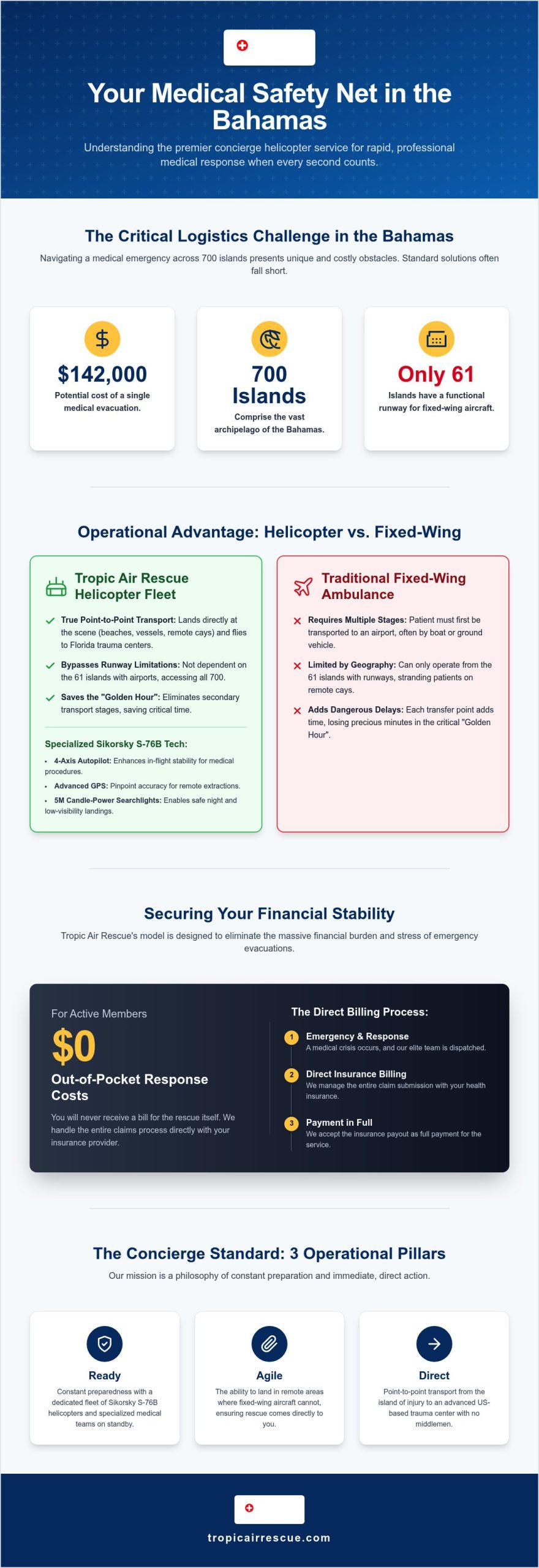
- Ready: Constant preparedness with a fleet of Sikorsky S-76B helicopters and specialized medical teams.
- Agile: The ability to land in remote areas where fixed-wing aircraft cannot reach.
- Direct: Point-to-point transport from the island of injury to a US-based trauma center.
The Logistical Safety Net Concept
Most travelers assume their standard health insurance provides total coverage abroad. In the Bahamas, that assumption is dangerous. Traditional policies often limit transport to the “nearest adequate facility,” which might be a local clinic lacking specialized surgical teams or equipment. Tropic Air Rescue provides a dedicated response layer that bypasses these logistical gaps. While generic air ambulance services focus on simple transport, this concierge network prioritizes medical outcome by coordinating directly with Florida trauma centers. It’s a proactive safety net designed for those who value exclusivity and meticulous preparation.
Direct Billing and Zero Out-of-Pocket Costs
The primary barrier to medical evacuation is often financial. A single flight can exceed $142,000 in the Bahamas, and many providers require payment upfront before the rotors even turn. Tropic Air Rescue eliminates this crisis-point stress through a sophisticated direct billing mechanism. For active members, the service handles the entire claims process with health insurance providers. They accept the insurance payout as payment in full, ensuring there are no hidden fees or surprise invoices. This model removes the massive financial barrier that often delays emergency response. It’s a disciplined approach to medical logistics that prioritizes the patient over the paperwork, ensuring that members never receive a bill for the rescue itself.
Operational Advantage: Why Helicopter Transport is Critical
In an archipelago of 700 islands, the distance between a medical crisis and specialized care is measured in minutes, not miles. While traditional air ambulances often rely on fixed-wing aircraft, these units are tethered to the 61 islands equipped with functional runways. If an emergency occurs on a remote cay or a private vessel, a fixed-wing response requires a secondary ground transport stage. This adds dangerous delays to an already high-stakes situation. This complete guide to Tropic Air Rescue highlights the operational necessity of a helicopter-based fleet. By utilizing the Sikorsky S-76B, the service provides true point-to-point extraction that fixed-wing planes simply cannot match.
Precision is non-negotiable. The fleet utilizes specialized aviation technology to manage the complex geography of the Bahamas. Key technical features include:
- 4-Axis Autopilot: Enhances flight stability, allowing the medical team to perform procedures with minimal aircraft movement.
- Advanced GPS: Ensures pinpoint accuracy for extractions from remote island coordinates.
- 5M Candle-Power Searchlights: Enables safe, high-visibility landings in unlit, remote environments or during night operations.
These tools allow pilots to land on beaches, private clearings, or even the decks of large vessels. It is a level of agility that ensures the rescue comes to the patient, rather than the patient struggling to reach the rescue. This complete guide to Tropic Air Rescue details how these technical advantages translate into saved lives during the most critical moments.
Helicopter vs. Fixed-Wing: The Bahamas Context
The “Golden Hour” is the critical window following a trauma or cardiac event where medical intervention is most effective. Fixed-wing aircraft lose valuable time during the “last mile” logistics. A patient must be stabilized, moved to a ground ambulance, and driven to an airport. In contrast, a helicopter lands directly at the site of injury. Official guidance on medical assistance in The Bahamas often notes the limited resources available outside major hubs. Helicopters bridge this gap by providing an immediate, high-speed corridor to Florida trauma centers without the need for an intermediate airport transfer. This directness is the primary advantage for those staying in the Out Islands.
Advanced Life Support (ALS) Onboard
Speed is only half the equation; the quality of care during transit is equally vital. Each aircraft functions as a flying intensive care unit. The cabin is outfitted with hospital-grade equipment, including advanced defibrillators, multi-lead heart monitors, and dedicated oxygen systems. A team of two pilots and two critical care paramedics or nurses staffs every flight. They maintain Advanced Life Support (ALS) standards throughout the journey, providing specialized stabilization while crossing the Gulf Stream. This ensures that the transition from a remote beach to a world-class trauma center is seamless and medically sound. If you are planning a trip to the Out Islands, you can review membership options to secure this level of airborne care before you depart.
Navigating Membership: Coverage for Every Length of Stay
Membership is the definitive trigger for the entire Tropic Air Rescue operation. It is not merely a subscription; it is a pre-authorized activation protocol that removes the administrative friction typically found in international medical crises. Without an active membership, the complex chain of logistics, from helicopter dispatch to Florida trauma center coordination, cannot move with the necessary speed. This complete guide to Tropic Air Rescue emphasizes that pre-certification is the most critical step for any traveler or resident. By providing identity, medical history, and insurance data during enrollment, you authorize the team to act immediately when an emergency call is triggered.
The membership model serves as a specialized insurance layer. It ensures that the logistical and financial barriers of a $142,000 evacuation are cleared before an incident occurs. This proactive approach is what separates a concierge rescue service from a standard utility. Whether you are a weekend visitor or a permanent resident, having an active membership profile means the rescue team is already prepared for your specific needs. This complete guide to Tropic Air Rescue outlines how these tiers are structured to provide maximum flexibility and security.
Short-term Membership for Visitors
Short-term plans are engineered for tourists, yacht passengers, and seasonal travelers who require high-level protection for a specific window of time. These memberships allow you to match your coverage dates exactly to your arrival and departure from the Bahamas. It is a strategic choice for those exploring the Out Islands where local medical infrastructure is limited. For those visiting for a specific duration, securing short term medevac coverage ensures that elite airborne care is active the moment you land. Remember that memberships become active 48 hours after purchase, so early enrollment is essential for full protection during your stay.
Annual Membership for Residents and Expats
For long-term residents, second-home owners, and frequent Out Island visitors, the annual membership offers the highest level of preparedness. This tier provides year-round security and maintains your pre-certification data in a permanent “ready” state. It eliminates the need for repeated enrollments and ensures that your family or staff are covered at all times. B2B membership plans are also available for remote island resorts and corporate groups. these plans provide a comprehensive safety solution for organizations operating in high-risk, remote environments. An annual commitment signals a disciplined approach to safety, ensuring that the “Ready. Agile. Direct.” philosophy is always working in your favor.
Beyond Emergencies: Interhospital Transfers and Specialized Logistics
The utility of an elite medical network extends beyond the initial point of injury. While the rapid extraction from a remote beach is a primary focus, the organization’s Interhospital Transfer Services provide a critical secondary layer of care. This complete guide to Tropic Air Rescue explains how patients are moved from local clinics to specialized Florida facilities with surgical precision. When a patient requires a higher level of acuity than a local facility can provide, the logistics team initiates a high-stakes clinical handoff. This process ensures that the transition between medical environments is seamless and medically sound.
The Medical Director plays a pivotal role in these operations. They evaluate the patient’s current condition and determine the most appropriate destination hospital, whether it’s a Level 1 trauma center or a specialized cardiac unit in South Florida. Once the destination is confirmed, the helicopter flies directly to the hospital’s rooftop heliport. This direct access is a significant advantage over fixed-wing services, which require a secondary ground ambulance transfer from a regional airport. By landing directly at the receiving facility, the team eliminates unnecessary movement and reduces the total transit time for the patient.
Specialized Organ Transport Services
Time is the definitive enemy in transplant logistics. Tropic Air Rescue provides specialized Organ Transport Services that operate with the same disciplined urgency as their medical evacuations. This involves coordinating international flight paths and ensuring the extreme logistical precision required for organ viability. The specialized fleet and 4-axis autopilot systems provide the stability necessary for transporting both organs and patients awaiting urgent donations. It’s why regional health networks and surgical teams trust this network as their primary partner for time-sensitive medical logistics across the Gulf Stream.
International Coordination Protocols
Crossing international borders with a critically ill patient involves immense administrative complexity. The concierge model handles these international coordination protocols entirely, managing everything from medical repatriation paperwork to liaising with US Customs and Border Protection. The team communicates directly with Florida hospitals to ensure immediate admission upon arrival, bypassing the standard delays of the emergency room. This complete guide to Tropic Air Rescue highlights how this “concierge” touch allows family members to focus on recovery while the logistics experts manage the bureaucracy of international medical flight. If your medical needs require a coordinated transfer between facilities, you can view our interhospital transfer protocols to learn more about our specialized logistics.
Securing Your Coverage: The Onboarding and Response Protocol
Onboarding is the first phase of professional preparedness. It begins with a comprehensive enrollment process where you provide medical history and insurance details. This complete guide to Tropic Air Rescue emphasizes that this step isn’t just administrative. It’s the technical foundation for the “Direct” response model. By gathering this data upfront, the logistics team eliminates the need for intake interviews during a life-threatening trauma event. You’re not just buying a membership; you’re pre-authorizing a specialized medical strike team to act on your behalf.
The activation sequence is a disciplined, multi-stage protocol. When a member triggers an emergency call, the coordination center immediately verifies the landing zone coordinates and the member’s pre-certified medical profile. While the flight crew prepares the Sikorsky S-76B for launch, dispatchers initiate contact with South Florida trauma centers. This real-time coordination ensures that every link in the chain of survival is ready before the aircraft even crosses the Gulf Stream. It’s a synchronized effort that prioritizes clinical outcomes over paperwork.
Deployment is rapid and methodical. The helicopter launch protocols prioritize speed without sacrificing safety. Once the patient is onboard, the focus shifts to maintaining clinical stability at altitude. Post-transport, the concierge service extends to the financial side of the operation. The team manages the direct billing process with your insurance carrier. This removes the patient’s financial burden and ensures that the “no out-of-pocket” promise is fulfilled through professional claims management. This complete guide to Tropic Air Rescue highlights that your only job during a crisis is to trigger the call; the network handles the rest.
The Pre-Certification Advantage
Minutes matter in trauma care. Having your medical data on file allows paramedics to prepare specific interventions while in transit. This is the primary difference between a pre-certified member and a non-member in a crisis. For a non-member, the response is often delayed by identity verification and payment authorization. For a member, the intake process was completed during onboarding, allowing the team to focus entirely on the clinical mission. It’s the most important step in any island safety plan. It transforms a chaotic emergency into a controlled, professional evolution.
Final Checklist for Bahamas Travelers
Preparation is the mark of a disciplined traveler. Use this checklist before departing for the Out Islands to ensure your safety net is fully operational:
- Confirm your membership status is active. Remember that new memberships require 48 hours for activation, so don’t wait until the day of travel to enroll.
- Ensure every family member, guest, or crew member is covered under your specific plan.
- Keep the emergency contact information clearly displayed on your private vessel or in your island residence.
- Verify that your insurance details on file are current and accurate to facilitate seamless direct billing.
Mastering Your Bahamas Safety Strategy
Navigating the 700 islands of the Bahamas requires more than a standard travel policy; it demands a disciplined medical logistics plan. This complete guide to Tropic Air Rescue has detailed how point-to-point helicopter transport and elite coordination with Florida trauma centers eliminate the logistical delays inherent in fixed-wing evacuations. By maintaining an advanced fleet and a high-stakes clinical staff, the service ensures that remote geography is no longer a barrier to world-class care.
Financial security is just as critical as clinical speed. The membership model replaces the threat of massive out-of-pocket bills with a professional direct billing system that handles insurance carriers on your behalf. You can travel with confidence knowing that your pre-certified data is ready for immediate activation. Secure your Bahamas medical safety net with a Tropic Air Rescue membership today. Proactive preparation is the definitive key to a safe and secure island experience.
Frequently Asked Questions
Do I need a membership for Tropic Air Rescue to respond?
Membership is mandatory for a guaranteed response. This status ensures your medical data is pre-certified and your insurance is authorized for direct billing before a crisis occurs. Without it, the complex logistics required for international medevac cannot be activated with the necessary speed. It’s the definitive safety layer for anyone spending time in the Bahamas, providing the authorization required for immediate helicopter dispatch.
How does direct insurance billing work for air medical services?
The direct billing protocol removes the financial burden from the patient during a crisis. Tropic Air Rescue coordinates directly with your health insurance provider to secure payment for the flight. For active members, the organization accepts the insurance payout as payment in full. This eliminates the risk of receiving a surprise invoice for tens of thousands of dollars after a life-saving mission is completed.
Can Tropic Air Rescue land at my remote island house or yacht?
Yes, the specialized helicopter fleet is designed for point-to-point extraction. Pilots utilize 4-axis autopilot and high-intensity searchlights to land in remote island clearings, on beaches, or on the decks of private vessels. This complete guide to Tropic Air Rescue emphasizes that this agility is critical because the vast majority of the archipelago lacks functional runways for fixed-wing aircraft.
What is the difference between a helicopter and a fixed-wing air ambulance?
The primary difference is the “last mile” of transport. Fixed-wing aircraft are restricted to airports, requiring a secondary ground ambulance to move the patient from the site of injury to the plane. Helicopters land directly at the patient’s location. This directness saves vital minutes during the “Golden Hour” when medical intervention is most effective for trauma or cardiac events.
Is Tropic Air Rescue coverage available for short-term tourists?
Short-term memberships are specifically engineered for visitors and yacht passengers. These plans allow you to secure coverage that matches your travel dates exactly. It’s a strategic choice for tourists who want the security of an elite medical network without a long-term commitment. Ensure you enroll at least 48 hours before your arrival to satisfy the mandatory activation window.
How does the coordination with Florida trauma centers benefit patients?
Coordination ensures seamless transitions to Level 1 trauma centers or cardiac units in South Florida. The medical team bypasses local clinics that may lack specialized surgeons or equipment. By communicating with receiving hospitals in real-time, the service ensures immediate admission upon arrival. This complete guide to Tropic Air Rescue notes that the concierge team also manages all international repatriation paperwork.
Are there any out-of-pocket costs for members during an emergency?
Active members face zero out-of-pocket costs for the emergency response itself. The organization bills the member’s health insurance directly and doesn’t seek additional payments beyond what the insurance provider covers. This model removes the massive financial barrier that often delays emergency care in the Caribbean. It provides total financial peace of mind during high-stakes medical situations.
What medical equipment is available on the helicopters?
Each helicopter functions as a mobile intensive care unit. The aircraft are outfitted with Advanced Life Support (ALS) equipment, including multi-lead heart monitors, defibrillators, and advanced oxygen systems. A team of two pilots and two critical care paramedics or nurses staffs every flight. They maintain hospital-grade care while crossing the Gulf Stream, ensuring the patient remains stable until they reach a Florida trauma center.