

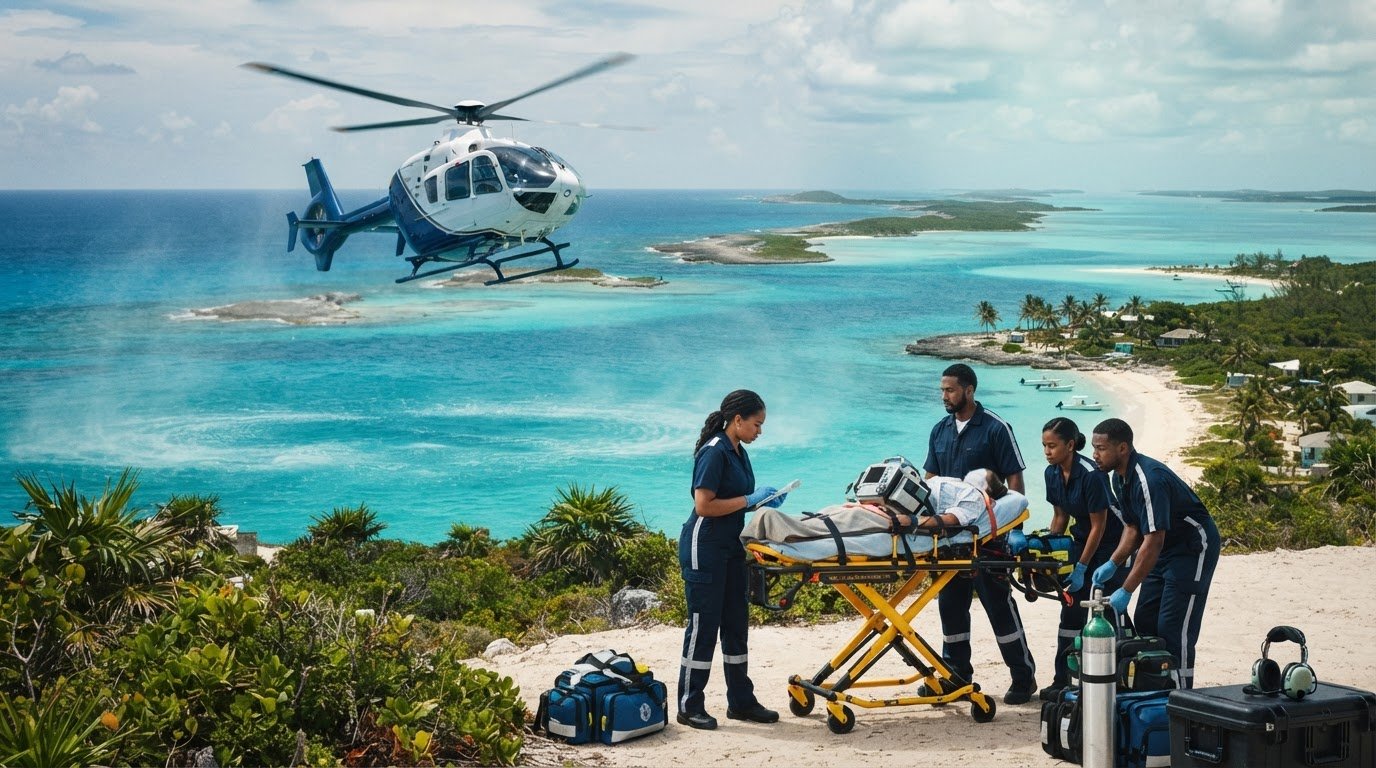
In a cardiac emergency in the Bahamas, getting an aircraft moving is only one part of reaching appropriate care. The cardiac emergency air transport Bahamas pathway starts with contacting local emergency services and following professional instructions. Medical teams assess the patient and coordinate next steps, including whether an inter-island transfer is appropriate. Helicopter medical transport can help reach remote locations and support a coordinated transfer.
It’s understandable to be unsure what to do first, where care will take place, or how transport and billing work. This guide explains the emergency response pathway, the role helicopter air medical transport can play, and how the receiving care team fits into transfer planning.
Preparation matters before an emergency. Membership is required for Tropic Air Rescue transport benefits, so enrolling in advance allows identity and membership information to be collected ahead of time. Tropic Air Rescue bills health insurers directly for member services and accepts insurer payments as full payment. Here’s what membership prepares, how it relates to insurance, and why emergency decisions must remain guided by local emergency services and medical professionals.
Key Takeaways
- For a suspected cardiac emergency, contact local emergency services immediately and follow professional instructions. This article provides information, not a diagnosis or substitute for emergency care.
- Cardiac emergency air transport Bahamas planning can include helicopter access as part of a coordinated care pathway. The patient’s needs and circumstances guide transport decisions.
- Transport from an emergency scene and an interhospital transfer are different processes. The treating team guides decisions about transfer.
- Keep key medical details, emergency contacts, and membership records accessible so they can be shared when needed.
- Choose a membership option that reflects your anticipated stay. Advance enrollment does not replace contacting emergency services during an emergency.
Cardiac emergency in the Bahamas: what to do first
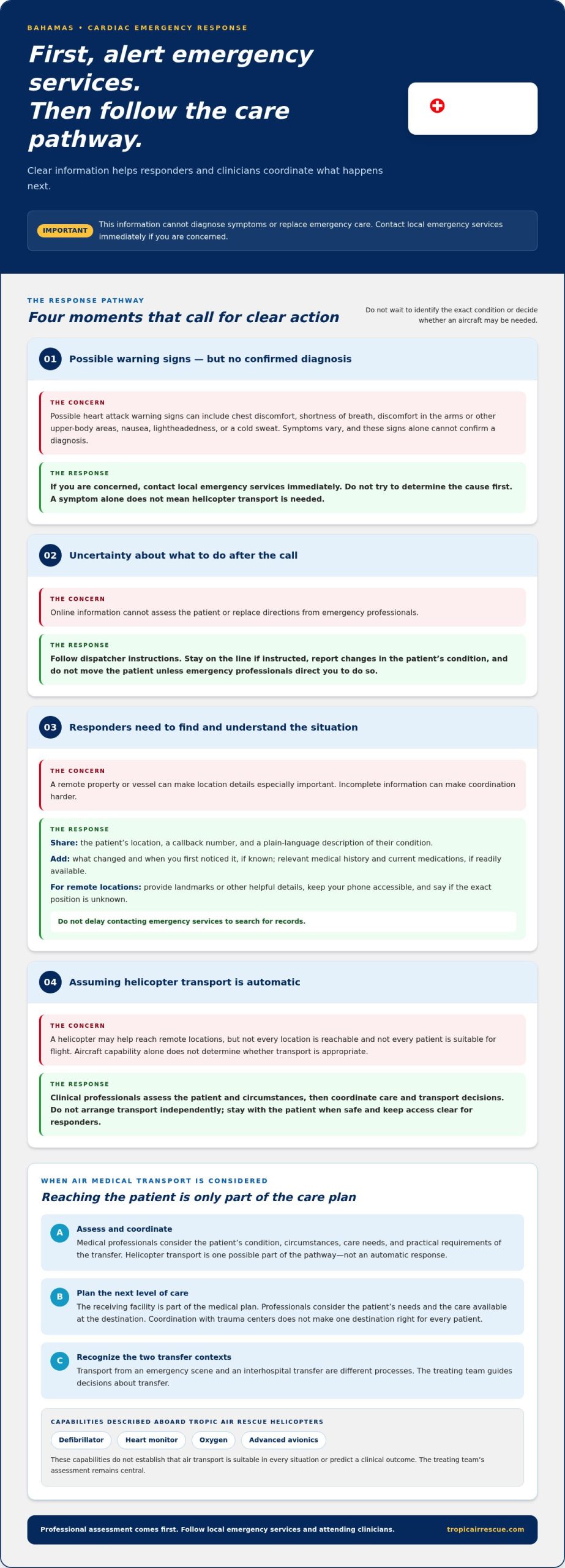
For a suspected cardiac emergency, contact local emergency services immediately. Don’t wait to identify the exact condition or decide whether an aircraft may be needed. This article is informational; it can’t diagnose symptoms or replace guidance from emergency professionals. Get local help involved and give responders clear information so they can direct the next steps.
- Alert emergency services. Explain that you’re concerned about a possible cardiac emergency.
- Follow dispatcher instructions. Stay on the line if instructed, and don’t substitute online guidance for directions from emergency professionals.
- Share the location and condition. Give the clearest location details available and describe what you observe.
Recognize concern without attempting a diagnosis
Possible heart attack warning signs can include chest discomfort, shortness of breath, discomfort in the arms or other upper-body areas, nausea, lightheadedness, or a cold sweat. Symptoms vary, and these signs alone can’t confirm a diagnosis. If you’re concerned, make the emergency call instead of trying to determine the cause first. A symptom does not, by itself, mean helicopter transport is needed.
Share clear information with emergency responders
Give the dispatcher the patient’s location, a callback number, and a plain-language account of the person’s condition. Describe what has changed and when you first noticed it, if known. Share relevant medical history and current medications if they’re readily available, but don’t delay contacting emergency services to search for records. Follow the dispatcher and attending clinicians, not online advice.
Be precise about location, especially if the patient is at a remote property or aboard a vessel. Share landmarks or other details that could help responders find the patient. If you don’t know the exact position, say so and provide the best information available. Keep your phone accessible in case responders need clarification.
Clinical professionals determine whether air medical transport is appropriate. They assess the patient’s condition and circumstances, then coordinate care and transport decisions. Helicopter transport is one possible part of the pathway, not an automatic response to every symptom. Air medical services can involve clinical staff, specialised equipment, and coordination with ground-based care.
In the cardiac emergency air transport Bahamas pathway, professional assessment comes first. Don’t arrange transport independently or move the patient unless emergency professionals direct you to do so. Stay with the patient when it is safe, keep access clear for responders, and promptly report any changes in the person’s condition. Clear communication supports coordinated decisions without delaying emergency care.
How helicopter cardiac emergency transport works across the Bahamas
Air medical transport is a clinician-coordinated transfer by aircraft when the patient’s condition and circumstances make it an appropriate part of care. For a cardiac emergency, this is more than sending an aircraft to a location. Medical professionals assess the patient, consider the care required, and coordinate transport as part of a broader pathway to an appropriate receiving facility. Tropic Air Rescue provides helicopter air medical transport for emergency and interhospital transfers throughout the Bahamas.
Why helicopter access can matter for island transport
The Bahamas includes remote locations that a helicopter may be able to reach even when fixed-wing aircraft cannot access the site directly. This can matter for a patient on an island or at another remote location, but it doesn’t mean every location is reachable or every patient is suitable for flight. Clinical needs and operational assessment guide the decision.
When transport is considered, coordination connects the patient’s location with the next stage of care. Responders and clinicians assess the circumstances, including the patient’s condition and the practical requirements of the transfer. Aircraft capability alone doesn’t determine whether a flight is appropriate, and it can’t guarantee arrival time, suitability, or a clinical outcome.
Clinical coordination and destination planning
The receiving facility is part of the medical plan. Professionals consider the patient’s needs and the care available at the destination when deciding where a transfer should go. Tropic Air Rescue coordinates with trauma centers, but that doesn’t make any one destination appropriate for every patient. Destination planning depends on the individual case and clinical assessment.
Equipment described aboard Tropic Air Rescue helicopters includes a defibrillator, heart monitor, and oxygen, supported by advanced avionics. These capabilities are relevant to a medically coordinated transfer, but they don’t establish that air transport is suitable in every situation or predict a clinical outcome. The treating team’s assessment remains central.
For someone following the cardiac emergency air transport Bahamas pathway, the key distinction is between reaching a patient and arranging the next appropriate level of care. A helicopter may provide access to a remote location; medical coordination connects that access to assessment, transport decisions, and destination planning. Each step depends on the patient’s circumstances, not aircraft capability alone.
Families can get a clearer picture of how location, clinical decisions, and transfer coordination fit together by reviewing this Bahamas trauma air transport guide. To learn more about the helicopter medical transport service and its role in the Bahamas pathway, explore Tropic Air Rescue’s helicopter transport information.
When cardiac patients may need an interhospital air transfer
An interhospital transfer differs from transport from an emergency scene. It begins after a patient is already receiving care at a healthcare facility. If the treating team determines that another facility is more appropriate for the patient’s needs, clinicians assess whether air medical transport is suitable and coordinate the next steps.
In the cardiac emergency air transport Bahamas pathway, an aircraft is one part of a clinical decision, not a substitute for one. A family member can ask questions and share useful information, but the treating clinician determines whether a transfer is medically needed. The decision depends on the patient’s condition, the care required, and the clinical resources available.
What can lead clinicians to consider a transfer?
Clinicians weigh the patient’s care requirements against what can be provided at the current facility and what a receiving facility can offer. They also consider the patient’s stability and whether movement is appropriate. These factors are specific to each case, so an online article can’t determine whether a particular patient should be transferred or flown.
For families, a practical next step is to ask the treating team to explain its recommendation, the purpose of the transfer, and what information is needed to coordinate it. If the team recommends transfer, follow its assessment. Don’t select a destination or arrange movement independently of the clinicians managing the patient’s care.
How a coordinated transfer supports continuity
A transfer requires a handoff between the referring and receiving care teams. Coordination helps align the patient’s information, the receiving facility, and transport arrangements before movement. The treating team can share the patient’s needs and relevant records so receiving clinicians have context for the next stage of care.
Tropic Air Rescue provides interhospital transfer services as part of a broader care pathway. The transfer plan is shaped by the clinical teams’ assessment and arrangements with the receiving facility. Coordination helps organise the transition between care settings, but it is not a promise of a particular outcome.
Families can help by keeping communication clear and directing questions to the clinicians overseeing the patient. Useful details may include:
- The name and contact details of the referring care team.
- The receiving facility identified by the clinical team.
- Relevant patient information the care team requests for the handoff.
- A family contact who can receive updates and help coordinate practical details.
These details support communication, but the clinical teams remain responsible for assessing medical needs and deciding whether a transfer is appropriate. For a closer look at the coordination involved, the inter-hospital medical transfer guide explains how transfers can be organised between healthcare facilities.
Prepare for cardiac air transport before an emergency
Preparation can reduce the scramble for basic information if a cardiac emergency occurs during a stay in the Bahamas. Keep essential details easy to access, and make sure a trusted travel companion or family member knows where to find them. This supports communication with responders and clinicians. It never replaces contacting local emergency services when urgent help is needed.
Information worth keeping accessible
Maintain a concise, current record that can be shared with clinicians if requested. A phone note or printed page may help if someone can locate it quickly. Include useful essentials, but don’t delay an emergency call or care to collect paperwork.
- Medical details: Known diagnoses, allergies, and current medications.
- Emergency contacts: Names and reachable callback details for people who should be informed.
- Membership records: Enrollment information and the identity details provided during registration.
Make the information accessible to the person travelling with you, not only on a device or in an account that may be difficult to access. If the patient is receiving care, share relevant details with clinicians when asked. Responders and treating professionals will guide which information is useful and what happens next.
Understand membership before travel
Tropic Air Rescue membership is required to receive service benefits. Short-term and annual membership options let travelers and residents choose according to their anticipated length of stay in the Bahamas. Advance enrollment collects identity and membership information before an emergency, helping prepare those details for a potential service request.
Enrollment is preparation, not an emergency response. If someone develops concerning symptoms, contact local emergency services immediately and follow professional instructions. Don’t spend time searching for membership records before making that call. Membership information can be shared during coordination when appropriate, while clinical professionals determine the patient’s needs and whether air medical transport is suitable.
Before travelling, make a brief readiness check:
- Confirm that medical details and emergency contacts are current and accessible.
- Tell a companion where to find the information and membership records.
- Choose a membership option based on the expected duration of the Bahamas stay.
- Keep enrollment details accessible, but don’t treat them as a substitute for emergency services.
Travelers considering short-term coverage can use this short-term medevac coverage guide to understand how advance planning fits into an island stay. For preparation before travel, review membership options and enroll in advance. Organising key details can make them easier to share, while decisions about urgent care remain with emergency responders and clinicians.
Tropic Air Rescue membership and cardiac air transport next steps
Keep the response pathway clear: for an active suspected emergency, contact local emergency services and follow their instructions. Emergency professionals assess the patient first. If clinicians determine that air medical transfer is appropriate, transport can then be coordinated as part of the patient’s care. Membership supports access to service benefits, but it doesn’t replace emergency care or determine whether a particular flight is clinically suitable.
For residents and visitors planning for cardiac emergency air transport Bahamas, it helps to understand these roles before a crisis. Emergency response, clinical decisions, transport coordination, and membership are connected, but they are not interchangeable. Treating professionals guide care decisions. Membership allows members to provide enrollment and identity information in advance.
What membership and insurance billing mean
Tropic Air Rescue membership is required to receive service benefits. Short-term and annual options can be selected according to the anticipated length of a stay in the Bahamas. Enrolling before travel allows identity and membership information to be collected in advance, rather than making enrollment part of an urgent response.
Membership and clinical eligibility answer different questions. Membership relates to access to service benefits; it doesn’t mean that a specific transfer will be arranged. Clinicians assess the patient’s needs and circumstances, and transport is coordinated when appropriate. A family member can share membership information with responders or the care team when relevant, while leaving medical decisions to professionals.
For member services, Tropic Air Rescue bills health insurers directly and accepts the insurer’s payment as full payment. This describes the service’s billing approach; it doesn’t change the membership requirement or determine the clinical decision to transport. Keep membership details accessible so they can be shared during coordination if needed. Don’t delay calling emergency services to locate enrollment records.
A clear next step for residents and visitors
If an emergency is happening now, stop planning and contact local emergency services immediately. Follow the dispatcher’s instructions and the attending clinicians’ guidance. Membership information can support coordination, but it is not a substitute for activating emergency care. Membership status also cannot establish in advance that air transport is suitable for a particular patient.
For advance preparation, consider the expected length of your stay and review the relevant membership and enrollment information before travel. That gives you time to understand the role of membership and have identity details ready. Keep the information easy to access, but make contacting emergency services your first action if urgent symptoms arise.
For a practical next step before travel, explore Tropic Air Rescue membership and review the enrollment information. Preparation can organise key details in advance; emergency services and clinicians remain the first point of action and decision-making during a cardiac event.
Turn preparation into a shared plan
Make readiness something your travel companions understand, not a detail only one person can access. Before a trip, agree who will take the lead if someone becomes unwell, who can communicate key information, and where essential records can be found. A clear plan can reduce uncertainty and help people focus on the decisions that matter in the moment.
The cardiac emergency air transport Bahamas pathway depends on coordinated decisions. Keep your role practical: act promptly, share accurate information, and follow emergency and clinical professionals’ directions. Planning can’t predict what care will be needed, but it can help you approach an unexpected situation with greater clarity.
Before your next trip, review membership options and enrollment information. Review Tropic Air Rescue membership options and include preparation in your travel planning. A thoughtful plan can help you travel with more confidence and respond with purpose.
Frequently Asked Questions
What should I do first during a suspected cardiac emergency in the Bahamas?
Contact local emergency services immediately and follow the dispatcher’s instructions. Describe what you observe and provide the patient’s location and a callback number. If you’re with the patient, keep your phone available and share changes in their condition as directed. Don’t wait to identify the precise cause or search for transport options before calling. Emergency professionals will advise on immediate next steps and whether further assessment or transfer is needed.
Can a helicopter transport a cardiac patient from a remote location in the Bahamas?
A helicopter may be able to reach some remote locations that fixed-wing aircraft can’t access directly, but access isn’t universal. Whether a flight is appropriate depends on the patient’s clinical condition and an operational assessment. A remote location alone doesn’t mean a patient should fly. In the cardiac emergency air transport Bahamas pathway, clinicians guide care decisions and transport coordination; don’t assume a particular arrival time or availability.
When might a cardiac patient need an interhospital air transfer?
An interhospital transfer may be considered when the treating team determines that the patient’s needs call for care at another facility. Clinicians assess the patient’s condition, the care required, and the clinical resources available before recommending movement. A family member can ask the care team to explain the reason for its recommendation and what information is needed for the handoff. Treating clinicians, not an online article, determine medical need.
Does Tropic Air Rescue provide fixed-wing air ambulance transport?
No. Tropic Air Rescue provides helicopter air medical transport, not fixed-wing air ambulance transport. Its helicopter service can access remote locations that may be inaccessible to fixed-wing aircraft, although this doesn’t mean every location or patient is suitable for helicopter transport. The care team’s clinical assessment and operational considerations guide whether a helicopter transfer is appropriate for a particular situation.
Is membership required for Tropic Air Rescue benefits?
Yes. Membership is required to receive Tropic Air Rescue service benefits. Short-term and annual membership options reflect the anticipated length of a stay in the Bahamas. Enrollment collects identity and membership information in advance, helping prepare those details before an emergency. Membership doesn’t replace contacting local emergency services, and it doesn’t determine whether clinicians consider a specific transfer medically appropriate.
How does insurance billing work for Tropic Air Rescue members?
Tropic Air Rescue bills health insurers directly for member services and accepts the insurer’s payment as full payment for members. The company does not invoice patients directly for transport. Membership is required for benefits. Keep membership and insurance details accessible so they can be shared during coordination, but don’t delay contacting emergency services to locate documents.
What medical equipment is described aboard Tropic Air Rescue helicopters?
Equipment described aboard Tropic Air Rescue helicopters includes a defibrillator, a heart monitor, and oxygen, along with advanced avionics. These are equipment capabilities, not a promise of a particular clinical outcome or proof that helicopter transport is suitable in every case. Treating professionals assess the patient’s needs and circumstances, then guide decisions about care and any transfer.