


Your travel insurance policy is not a rescue plan; it’s a reimbursement contract. If you’re seriously injured in a remote location, you don’t need a claims adjuster. You need a flight crew. Understanding the reality of medevac membership vs travel insurance is the difference between being trapped in a sub-par local clinic and being flown directly to a specialist you trust.
It’s reasonable to assume that medical evacuation coverage means you’re coming home. However, the fine print often limits you to the nearest adequate facility. This leaves you stranded in a hospital that meets a basic standard but lacks the advanced care you require. This article explains why travel insurance alone is a financial safety net that often fails during a logistical crisis. You’ll discover how a dedicated medevac membership provides an elite, concierge response that handles the high cost of private medical flights with zero out-of-pocket expenses. We’ll break down the operational differences, the hospital-of-choice benefit, and how to ensure a helicopter actually shows up when every second counts.
Key Takeaways
- Identify the critical distinction between medevac membership vs travel insurance, moving beyond simple financial reimbursement to secure a guaranteed operational response.
- Recognize the “nearest acceptable facility” clause in standard policies and how it can leave you stranded in a medical facility that doesn’t meet your personal standards.
- Learn why specialized helicopter transport is superior for reaching remote areas that are inaccessible to the fixed-wing aircraft typically used by insurance providers.
- Understand the concierge benefit of direct billing, which removes the financial friction of paying for emergency flights upfront while waiting for reimbursement.
- Determine why a dedicated membership is the only way to ensure hospital-of-choice transport rather than accepting the logistics dictated by a claims adjuster.
Understanding the Core Difference: Financial Safety vs. Operational Response
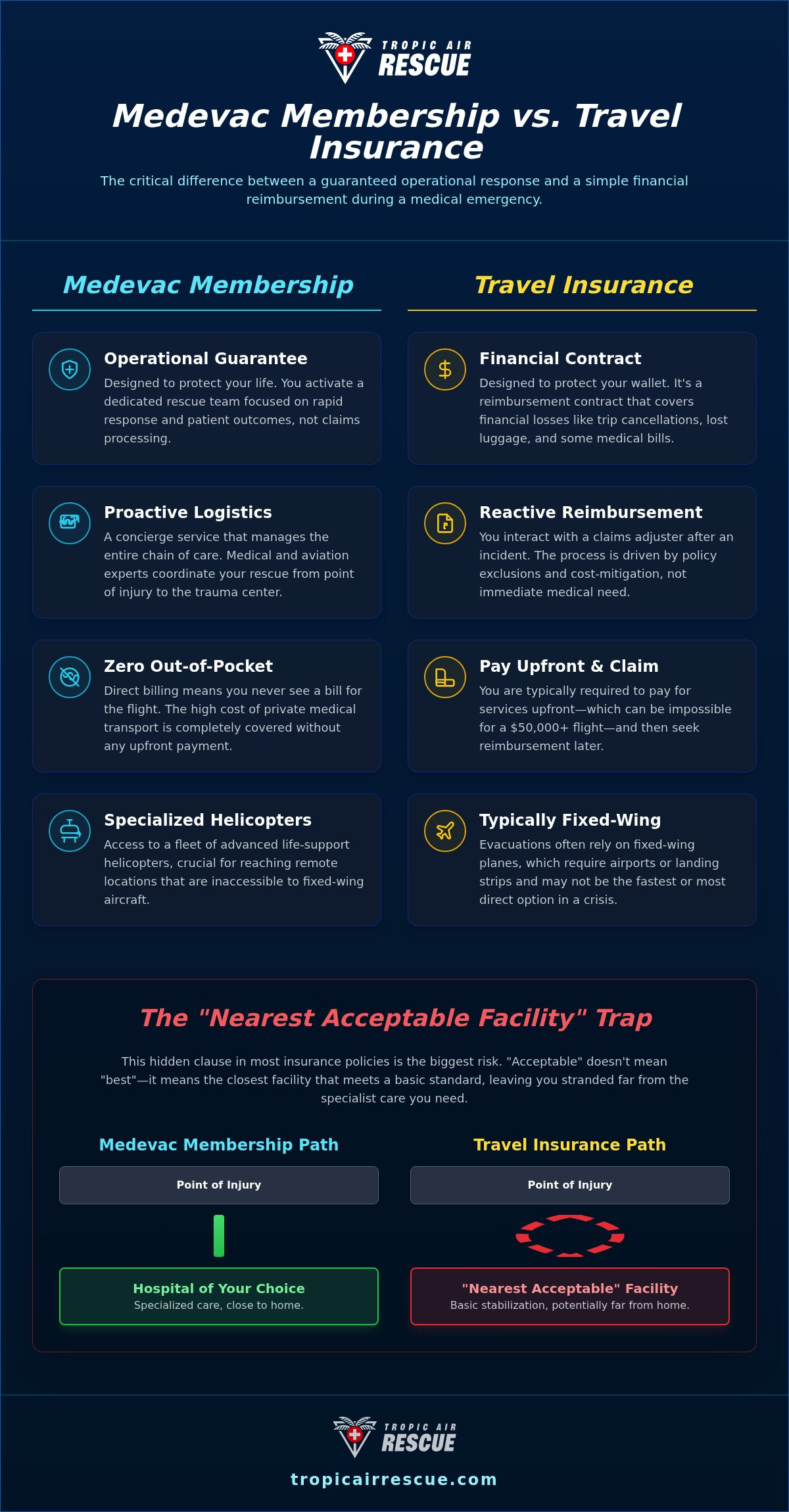
Travel insurance is a financial contract. Medevac membership is an operational guarantee. While they often appear in the same search results, the fundamental distinction between medevac membership vs travel insurance determines whether you receive a check in the mail or a rescue team at your location. One is designed to protect your wallet; the other is designed to protect your life.
Insurance companies are risk managers. Their primary motivation is cost mitigation. When you file a claim, you’re interacting with a financial institution that evaluates your case against a set of policy exclusions. In contrast, a medevac membership is a service-focused logistical solution. It’s a direct link to an elite rescue organization that prioritizes rapid response and patient outcomes over claims processing.
Travel Insurance: The Financial Safety Net
A standard travel insurance policy acts as a broad safety net for your trip. It’s built to reimburse you for financial losses related to trip cancellations, lost luggage, or general hospital bills. However, it’s rarely a proactive rescue tool. Consider these limitations:
- Reimbursement Model: Most policies require you to pay upfront for medical services and seek reimbursement later, which is impossible for a $50,000 helicopter flight.
- Financial Caps: Evacuation coverage often has restrictive ceilings that don’t cover the full cost of private, specialized transport.
- Cost-First Logic: The insurer decides if an evacuation is “medically necessary” based on the cheapest available option, not the best medical outcome.
Medevac Membership: The Logistics Coordinator
Membership turns the traditional model on its head. Instead of filing a claim after the fact, you activate a rescue team the moment a crisis occurs. This concierge approach ensures that the entire chain of care, from the point of injury to the trauma center, is managed by medical and aviation experts. For a technical perspective on these operations, an Air Medical Services Overview provides insight into how these specialized units function as mobile intensive care units.
A membership provides immediate access to a fleet of advanced life-support helicopters. These aircraft are not subject to the same infrastructure requirements as the fixed-wing planes typically used by insurance companies. Because a membership organization controls the logistics, they eliminate the middleman. There are no insurance adjusters to argue with while you’re in a critical state. The response is immediate, professional, and focused entirely on getting you to the right hospital.
Choosing between these two options isn’t about choosing one or the other. It’s about recognizing that travel insurance covers your baggage and your bills, while a medevac membership covers your extraction and your survival. One handles the paperwork; the other handles the rescue.
The ‘Nearest Acceptable Facility’ Trap: Why Standard Insurance Falls Short
The “nearest acceptable facility” clause is the most dangerous hidden detail in standard travel policies. When comparing medevac membership vs travel insurance, this single phrase dictates your entire recovery trajectory. To an insurance provider, “acceptable” means the closest facility capable of stabilizing your condition. It doesn’t mean the best facility for your specific injury or the one closest to your home. While an insurance adjuster defines medical necessity as the bare minimum required to prevent immediate fatality, a medical pilot defines it as the logistical path to the highest standard of specialized care.
The CDC on Medical Evacuation Insurance notes that many policies only cover transport to the nearest location where adequate care is available. This definition is highly subjective and often favors the insurer’s bottom line. If a local clinic can provide basic stabilization, your insurance company has technically fulfilled its duty. They are under no obligation to fly you to a specialist or a hospital in your home country.
The Reality of Local Medical Facilities
Local clinics in remote or international destinations often lack the sophisticated equipment required for neurological or cardiac emergencies. They may be able to stabilize a patient, but they cannot provide the intensive, specialized intervention needed for a full recovery. Once a patient is deemed stable by a local physician, a standard insurance provider often refuses further transport. This leaves the patient trapped in a basic facility, far from their support system, simply because the insurer has met its contractual obligation. The danger of being stuck in an under-equipped hospital is a reality for those relying solely on trip-based coverage.
Gaining Control Over Your Destination
A dedicated membership removes the insurer’s cost-saving logic from the equation. It prioritizes the medical outcome and patient preference. Instead of being relegated to the nearest clinic, members gain access to advanced trauma centers in the United States. This level of care is essential for complex trauma cases that require immediate surgical intervention. Elite providers offer interhospital transfer services that ensure critical care continuity. This concierge model ensures you are moved to a hospital of your choice, where your own doctors and family are located. It transforms a forced medical stay into a managed recovery path, prioritizing excellence over the cheapest available flight.
Helicopter vs. Fixed-Wing: The Critical Access Gap
Access isn’t just about the ability to fly; it’s about the ability to land. In the logistical comparison of medevac membership vs travel insurance, the type of aircraft deployed is a life-altering variable. Most travel insurance providers prioritize cost mitigation by contracting fixed-wing air ambulances. While these planes are efficient for long-distance transport between major cities, they’re tethered to infrastructure. A fixed-wing aircraft requires a paved runway, airport fuel services, and cleared flight paths. If your emergency occurs in a location without a major airport, insurance-based transport creates a dangerous delay.
A dedicated medevac membership utilizes specialized helicopters that bridge this “last mile” gap. Helicopters provide true bed-to-bed service, landing directly at remote resorts, private yachts, or even roadsides near the point of injury. This eliminates the need for multiple transfers between vehicles. While insurance adjusters focus on the cheapest flight, a membership focuses on the most direct route to a trauma center. The ability to bypass airport logistics isn’t a luxury; it’s a critical operational necessity during the golden hour of medical response.
Reaching the Unreachable Locations
For those exploring remote national island chains, a helicopter is often the only viable extraction method. Many of these locations lack the 3,000-foot runways required for medical jets. We utilize advanced avionics to navigate difficult terrain and execute precision landings in areas that are completely inaccessible to fixed-wing aircraft. This specialized capability is a core pillar of our service. Travelers planning trips to secluded areas should consult our Short-Term Medevac Guide for Island Travelers 2026 to understand the specific logistical requirements of remote rescue.
Speed and Continuity of Care
The most significant advantage of helicopter transport is the elimination of the ground ambulance leg. In a standard insurance-led evacuation, a patient must be moved by ground ambulance from the clinic to an airport, loaded onto a plane, and then moved by another ground ambulance at the destination. Each transfer increases risk and wastes critical time. Specialized helicopters function as mobile intensive care units, equipped with advanced life support technology. By staying under the care of the same flight medical team during the entire transfer, patients benefit from uninterrupted clinical monitoring. This continuity of care ensures that the high-level intervention started at the scene remains constant until the patient is delivered directly to the receiving trauma center.
Eliminating the Out-of-Pocket Burden: Direct Billing vs. Reimbursement
Financial friction defines the standard insurance experience. When analyzing medevac membership vs travel insurance, the most immediate impact is felt at the point of service. Travel insurance operates almost exclusively on a reimbursement model. This requires the patient or their family to secure funding for a specialized flight before the aircraft ever leaves the hangar. In a high-stakes medical crisis, this financial hurdle creates a dangerous delay. It forces families to negotiate with claims adjusters while a loved one requires urgent care.
A concierge membership eliminates this friction entirely. The provider acts as the primary coordinator, issuing an immediate guarantee of payment to the flight operator. This ensures that the rescue team is activated based on medical necessity rather than the verification of a credit card limit. For the member, this results in a $0 out-of-pocket experience. It transforms a logistical nightmare into a managed professional operation, providing total peace of mind during a life-threatening event.
The Hidden Costs of Air Ambulance Services
The cost of air medical transport is substantial. International medical evacuations can exceed $250,000 in severe cases, depending on the distance and the required level of clinical support. Many travelers mistakenly rely on credit card “emergency coverage” to handle these expenses. However, these benefits often have low caps, frequently around $10,000, which are exhausted within the first hour of flight operations. The complexity of international medical billing, including customs fees and specialized clinical staffing, often leads to unexpected invoices that standard policies fail to cover. Without a membership, the patient remains the primary party responsible for these massive costs.
How Direct Insurance Coordination Works
A premium membership organization removes the administrative burden from the patient’s family. Instead of requiring the member to pay first and argue with an adjuster later, the provider coordinates directly with your existing health insurance. The membership benefit ensures the company accepts insurance reimbursement as full payment for the transport. This direct billing process is the hallmark of an elite concierge service. It allows the family to focus on recovery while the logistics team manages the financial coordination. To secure this level of protection, you can view our membership plans and eliminate the risk of unexpected medical debt.
Securing National Coverage: Why Specialized Membership Is Essential
Standard insurance is built for the casual traveler. It’s not an adequate safety plan for individuals with complex logistical needs, such as yacht owners, second-home residents, or those frequently visiting remote island chains. When you evaluate medevac membership vs travel insurance for national coverage, the limitations of trip-based policies become clear. Insurers often rely on third-party providers who may not be in the immediate vicinity. This creates a gap in response time that can be catastrophic. A dedicated national fleet remains in a state of constant readiness, positioned to respond to the specific geographic challenges of your location. With travel insurance premiums rising by an average of 18-35% in 2026, the financial and operational argument for a stable membership becomes even more compelling.
Concierge Air Medical Standards
Operating at an elite level requires more than just aircraft. It requires a commitment to professional medical aviation standards that prioritize patient safety and technological precision. Our operations include seamless coordination with Florida trauma centers, ensuring that members are transported to world-class facilities equipped for complex interventions. Local expertise is a decisive factor in rescue speed, much like how Florida residents trust Ray Brown Air and Heat to handle specialized needs like optimizing home cooling. A provider with a permanent national presence understands the specific landing zones, weather patterns, and hospital capabilities of the region. This specialized knowledge allows for a faster, more coordinated response than a generic crew contracted by an insurance company.
Immediate Readiness and Activation
The hallmark of a premium service is a simplified activation process. In a crisis, you don’t have time to navigate a phone tree or wait for an insurance adjuster’s approval. Members benefit from a “one call” activation system that puts a rescue team in motion immediately. This proactive approach provides immense peace of mind for family members. They know a dedicated team is on standby, ready to manage every detail of the extraction and transfer. Don’t leave your safety to the chance of a reimbursement policy. Ensure you have a guaranteed logistical partner by securing a Tropic Air Rescue Membership today.
Secure Your Operational Safety Net
The distinction between medevac membership vs travel insurance is the difference between receiving a reimbursement check and activating a professional rescue crew. While travel insurance manages your trip’s financial risk, it lacks the specialized equipment and authority to bypass the “nearest acceptable facility” trap. True peace of mind requires a partner that controls the entire chain of care, from remote extraction to hospital-of-choice delivery.
Our concierge model prioritizes immediate readiness through an advanced helicopter life support fleet. Members benefit from direct billing to health insurance, ensuring no out-of-pocket costs during a life-threatening crisis. This operational approach removes the administrative burden from your family, allowing them to focus entirely on your recovery. Don’t leave your survival to the fine print of a standard policy. Take control of your medical security and ensure that when you need help, an elite team is already on standby.
Secure Your National Medevac Membership Today
Frequently Asked Questions
Does my standard travel insurance cover medical evacuation?
Most standard travel insurance policies include a provision for medical evacuation, but the coverage is often restrictive. It typically only mandates transport to the “nearest adequate facility” as determined by the insurer’s cost-mitigation team. This is a critical point of failure in the medevac membership vs travel insurance comparison. While insurance covers the bill for a basic clinic, a membership ensures you are moved to a specialized trauma center of your choice.
What is the difference between repatriation and medical evacuation?
Medical evacuation is the urgent transport of a patient from the site of injury or a local clinic to a high-level hospital for immediate treatment. Repatriation is the logistical process of returning a patient to their home country once they are clinically stable. While insurance often focuses on repatriation via commercial flights, a membership prioritizes the high-stakes evacuation phase using specialized aircraft and intensive care crews.
Is medevac membership worth it if I already have health insurance?
Yes, because most health insurance plans provide little to no coverage for the logistical costs of a private air ambulance. A membership acts as a concierge service that manages the entire rescue operation and bills your health insurer directly. This eliminates the out-of-pocket burden and ensures you receive professional Interhospital Transfer Services without waiting for a claims adjuster to approve the specialized flight expenses.
Will a medevac membership transport me back to my home country?
A primary benefit of a dedicated membership is the hospital-of-choice guarantee. Unlike standard travel insurance, which often leaves you at the nearest stabilized facility, a membership facilitates transport back to a specialized hospital in your home country. This allows you to recover under the care of your own physicians and remain close to your family support system, which is essential for long-term clinical outcomes.
How do I activate my medevac membership in an emergency?
Activation is a streamlined “one call” process designed for high-stakes situations. Members contact the emergency dispatch center directly via a dedicated line found on their membership card. This triggers an immediate operational briefing and the deployment of a rescue team. There’s no need to seek prior approval from a travel insurance provider; the focus remains entirely on rapid clinical intervention and the logistics of your extraction.
What happens if the nearest hospital is not capable of treating my condition?
If the local facility lacks the necessary specialized equipment for your condition, a membership facilitates an immediate transfer to a higher-level trauma center. Standard insurance often considers a patient “stable” once they reach any basic clinic, regardless of that facility’s long-term care capabilities. Membership providers prioritize medical excellence, ensuring you are moved to a facility that meets elite clinical standards for your specific injury.
Are there any exclusions I should know about in medevac memberships?
Exclusions typically include active war zones, injuries sustained during illegal acts, or self-inflicted harm. Some plans may have age limits for new applicants, though many memberships cover pre-existing conditions that standard travel insurance policies frequently exclude. It’s vital to review your service agreement to understand the geographical boundaries and the specific clinical criteria required to trigger an emergency flight activation.
Can I get a short-term medevac membership for a single trip?
Yes, a Short-term Membership is an ideal solution for individual voyages or seasonal travel. These plans provide the same elite helicopter rescue and direct-billing benefits as annual memberships but are tailored to your specific travel dates. This is a common choice for yacht owners and island travelers who require premium protection during a high-risk excursion without the need for a year-long commitment.