


What if the symptoms disappear before you’ve decided what to do? If you’re asking what to do if you have a stroke in the Bahamas, don’t wait to see whether sudden face drooping, arm weakness, speech difficulty, vision changes, confusion, or severe dizziness will pass. Call 919 for emergency medical help. Time matters, and symptoms that resolve still need urgent assessment.
It’s understandable to worry about reaching appropriate care across an island setting. Start by activating local emergency services, noting when symptoms began or when the person was last well, and following responders’ instructions. Don’t give food, drink, or medication while waiting unless a medical professional directs you to.
This guide explains how to recognize possible stroke symptoms, what to tell responders, and what may happen after hospital assessment. It also describes how helicopter air-medical transport may fit into a coordinated interhospital transfer when clinically appropriate. Transport is not the first response to suspected stroke, and membership-based preparation does not replace emergency services or hospital treatment.
Key Takeaways
- Learn what to do if you have a stroke in the Bahamas: activate emergency services immediately rather than waiting to see if symptoms improve.
- Understand why stroke symptoms need urgent assessment, even though the cause cannot be determined at home.
- See how clinicians assess the patient, guide care, and decide whether a transfer may be appropriate.
- Prepare useful information for responders, including when symptoms began or when the person was last known to be well.
- Understand how membership-based air-medical transport may fit into advance planning. Membership is required for Tropic Air Rescue service benefits.
Stroke in the Bahamas: Recognize Signs and Act
If you suspect a stroke, call local emergency services immediately on 919. In the Bahamas, 919 is the emergency number for ambulance, fire, and police. Don’t wait for symptoms to worsen or disappear, and don’t arrange air transport before emergency services have been activated and the person has received medical assessment.
How to recognize possible stroke symptoms
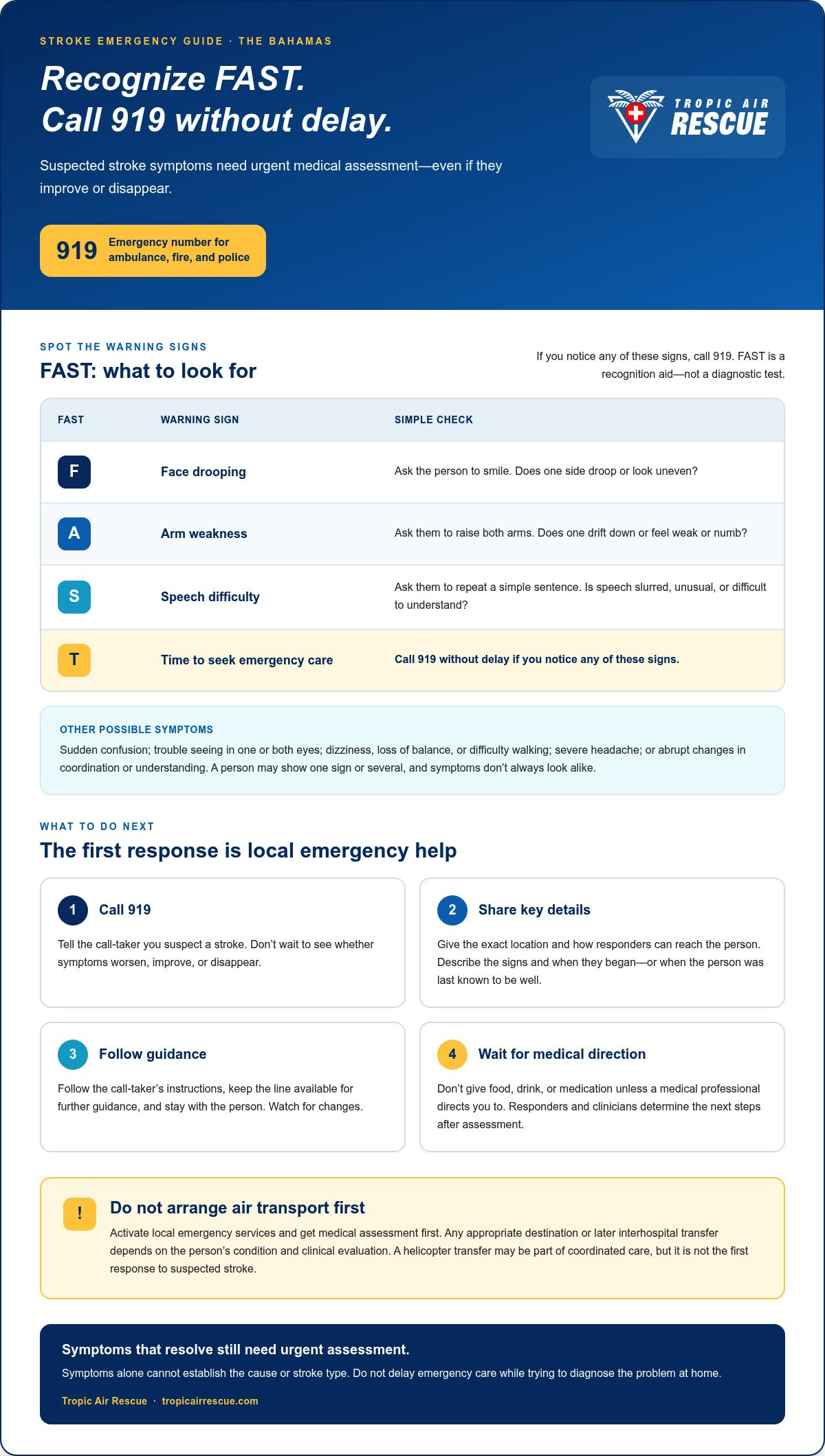
Use FAST to spot common warning signs:
- Face drooping: Ask the person to smile. Does one side of the face droop or look uneven?
- Arm weakness: Ask them to raise both arms. Does one arm drift down or feel weak or numb?
- Speech difficulty: Ask them to repeat a simple sentence. Is their speech slurred, unusual, or difficult to understand?
- Time to seek emergency care: If you notice any of these signs, call 919 without delay.
Other possible symptoms include sudden confusion, trouble seeing in one or both eyes, dizziness, loss of balance, difficulty walking, or a severe headache. Notice abrupt changes in coordination or the ability to understand and respond. A person may show one sign or several; symptoms don’t always look alike.
FAST is a recognition aid, not a diagnostic test. A person’s age, medical history, or apparently mild symptoms cannot safely rule out stroke. For a general overview of stroke types, causes, symptoms, and treatment, see the Wikipedia article on Stroke, but don’t use online information to delay emergency care.
Suspected stroke symptoms require urgent emergency assessment, even when you’re uncertain.
Why the first call should be to local emergency services
Calling 919 starts the local emergency response and lets responders guide the next steps. Getting an assessment underway is essential. The appropriate destination and any later transfer depend on the person’s condition and clinical evaluation. A helicopter air-medical transfer may be part of coordinated care, but it isn’t the first response to suspected stroke.
Tropic Air Rescue provides membership-based helicopter air-medical transport throughout the Bahamas, but emergency services must be activated first. When speaking with the emergency call-taker, share the essentials:
- Say that you suspect a stroke.
- Give the exact location and explain how responders can reach the person.
- Describe the signs you’ve observed and when they started, or when the person was last known to be well.
- Follow the call-taker’s instructions and keep the line available for further guidance.
Stay with the person and watch for changes while help is being arranged. Don’t postpone the call to search online, contact a transport service, or wait for someone else to decide. The immediate priority is emergency activation and assessment. Responders and clinicians can determine the next steps after evaluating the situation.
What Happens During a Stroke, and Why Emergency Assessment Cannot Wait
A stroke occurs when blood flow to part of the brain is interrupted or when a blood vessel bleeds within the brain. Brain tissue depends on a steady supply of oxygen and nutrients. When that supply is disrupted, effects can begin suddenly and may affect movement, speech, vision, balance, or thinking. Symptoms alone cannot establish the cause or impact.
Ischemic and hemorrhagic stroke: two different emergencies
An ischemic stroke happens when a blockage interrupts blood flow to part of the brain. A hemorrhagic stroke happens when a blood vessel leaks or ruptures, causing bleeding. Both are serious emergencies, but they involve different mechanisms and may need different care. Symptoms can overlap, so their appearance cannot reliably identify the type or determine suitable treatment.
Treatment decisions depend on clinical assessment. Clinicians may evaluate symptoms and medical history and use brain imaging to identify what is happening. The goal is to establish the cause and guide care, rather than guess based on how the person looks or feels. The CDC information on stroke symptoms also explains why sudden warning signs need prompt attention.
Only clinical assessment can determine the stroke type and suitable care. Don’t try to distinguish a blockage from bleeding at home. A previous stroke diagnosis doesn’t establish what is causing new symptoms; a new episode needs fresh medical evaluation.
Why symptoms that improve still need urgent attention
Symptoms that ease or disappear don’t prove the danger has passed. A transient ischemic attack, or TIA, is a temporary interruption of blood flow to the brain that can cause stroke-like symptoms. It is a warning event that needs prompt medical assessment, not a reason to wait at home. Clinicians must evaluate what happened and determine the next steps.
Improvement can be misleading. Someone may regain clearer speech or steadier movement and still need urgent assessment to understand the cause and address the risk. Note when symptoms began, or when the person was last known to be well, and share that information with responders and clinicians. Don’t cancel emergency help or delay evaluation because symptoms have resolved.
If you’re considering what to do if you have a stroke in the Bahamas, prioritize emergency assessment rather than trying to identify the stroke type yourself. After evaluation, clinicians determine the appropriate facility and care. If you’re planning ahead for eligible medical transport, explore Tropic Air Rescue membership. Membership is required for its service benefits and doesn’t replace local emergency services or hospital treatment.
Stroke Care and Medical Transport in the Bahamas: How Decisions Are Made
After emergency services are activated, responders assess the person and clinicians evaluate the suspected stroke. The patient receives appropriate initial care, and a transfer may be considered if further services are needed. Each stage informs the next. Across an island setting, transport is part of the clinical plan, not a substitute for assessment.
Assessment first, then a transfer decision
At the hospital, clinicians assess the patient’s symptoms and condition, determine which tests are needed, and decide on care. They consider the person’s needs, the services required, and practical arrangements for reaching an appropriate facility. A suspected stroke does not automatically mean a particular destination or helicopter transfer is necessary.
If a transfer is recommended, the referring and receiving care teams coordinate the handoff and transport plan. This aligns the patient’s clinical needs with the receiving facility and the practical requirements of the journey. Families can share relevant information with the care team, but qualified clinicians decide on the appropriate facility, treatment, and mode of transport. The trauma air transport guide for the Bahamas provides more context on how transport can fit into emergency care.
Ground and helicopter transport have different roles
Ground transport may be appropriate for reaching nearby emergency care or moving a patient when road access and clinical circumstances support it. Helicopter air-medical transport may be considered when the care team determines a coordinated transfer is suitable. These are not competing treatment options. The patient’s condition, destination, access, and logistics guide the decision.
The option that looks fastest isn’t automatically the right one. A clinician must assess the patient and coordinate with the receiving facility. The patient or family shouldn’t choose based on symptoms alone, and a helicopter should never delay the initial call for local emergency help.
How helicopter air-medical transport may fit
Tropic Air Rescue provides membership-based helicopter air-medical transport throughout the Bahamas, including emergency and interhospital transfers. Membership is required for service benefits. When clinicians determine a transfer is appropriate, transport coordination can form part of the wider care plan. The service does not replace local emergency response, hospital assessment, or treatment, and not every suspected stroke requires or qualifies for air transport.
Interhospital transfer coordination brings the sending and receiving teams together with the transport arrangements. For a closer look at this process, see the guide to coordinating inter-hospital medical transfers.
For anyone researching what to do if you have a stroke in the Bahamas, keep the order clear: activate local emergency services, allow clinicians to assess and stabilize the patient, then follow their direction on whether a transfer is appropriate. Medical judgment leads; transport coordination follows.
What to Do While Waiting for Help After a Stroke
After calling 919, stay with the person and follow the emergency call-taker’s instructions. Speak calmly and keep directions simple. You don’t need to diagnose the cause or manage the emergency yourself. Focus on observing, sharing clear information, and avoiding anything that could delay professional assessment.
Prepare information for responders
One especially useful detail is when symptoms began, or when the person was last known to be well. If you didn’t see the onset, say so rather than guessing. Record when symptoms began and share that time with responders. Write it down if you can do so without leaving the person unattended or interrupting the emergency call.
Note what you’ve observed and whether anything changes. Be ready to share known medical conditions and medications if the information is readily available. Don’t delay the response to search for paperwork or collect belongings. Keep the call active and don’t hang up unless instructed.
- Describe the symptoms and when they started or were last absent.
- Tell the dispatcher if the person’s condition changes, such as becoming less responsive.
- Share known conditions and medication information if it’s immediately accessible.
- Follow the call-taker’s instructions and relay new information to responders when they arrive.
What not to do before professional assessment
Don’t wait to see whether symptoms resolve. A change in appearance or temporary improvement doesn’t establish that the danger has passed. Don’t give the person food, drink, or medication unless qualified emergency professionals instruct you to. Swallowing may be affected, and treatment decisions belong to clinicians assessing the patient.
If emergency services are available, don’t attempt to drive the person yourself. Responders can assess the situation and guide the next steps. A family member’s vehicle may not suit the person’s needs, and choosing a destination or arranging other transport shouldn’t delay emergency assessment. Avoid moving the person unnecessarily. Tell the dispatcher about any immediate safety concern and follow their direction.
Keep the area accessible for responders. If you’re in a building, arrange for someone else to guide them to the person if possible without leaving the patient alone. Stay close, watch for changes, and communicate them promptly. If you’re alone, prioritize the emergency call and the dispatcher’s instructions over gathering information or belongings.
Knowing what to do if you have a stroke in the Bahamas also means being prepared for care after the first emergency response. Once immediate help is underway, review Tropic Air Rescue membership options as advance preparation for eligible air-medical transport. Membership is required for service benefits and does not replace local emergency services or hospital treatment.
Plan Ahead for Stroke Emergencies in the Bahamas
Preparation is easier before a health emergency. Organizing a few details in advance can help you communicate clearly, whether you’re a resident moving between islands or a visitor in the Bahamas. Keep emergency contact information and medical details accessible, and make sure someone travelling with you knows where to find them.
Prepare essential medical and travel information
Save the Bahamas emergency number, 919, in your phone and keep it written somewhere accessible. Before travel, review current local emergency instructions so you know how to request help. Be ready to describe your exact location, including the name of your accommodation or vessel and useful directions or landmarks. Clear location details help responders understand where assistance is needed.
Keep a concise record of relevant medical information, including:
- Emergency contacts and their relationship to you.
- Current medications and known medical conditions.
- Allergies or other details that may matter to clinicians.
- Accommodation details and the best way to reach you.
Store this information where a companion can find it if you’re unable to communicate. For island travel, make sure the people with you know your location and can share it with emergency responders. These steps support communication; they don’t replace calling for local emergency help if a stroke is suspected.
Understand membership-based air-medical support
Emergency planning can also include understanding how air-medical transport may fit into care. Tropic Air Rescue provides membership-based helicopter transport throughout the Bahamas, including emergency and interhospital transfers. A transfer is coordinated as part of care when appropriate; it isn’t automatic, and membership doesn’t guarantee transport, treatment, or an outcome. Qualified clinicians assess the patient and determine whether a transfer is suitable.
Short-term and annual membership options are tailored to the anticipated length of a stay in the Bahamas. Membership is required for service benefits. Tropic Air Rescue bills health insurers directly for members, and accepted insurance payouts are treated as full payment, so members incur no out-of-pocket costs. Keep relevant policy information accessible with your medical details.
Travelers considering a shorter visit can use the short-term medevac guide for island travelers to understand how advance planning may fit an island stay. Membership is preparation for eligible emergency transport, not a substitute for local emergency services or hospital assessment.
Knowing what to do if you have a stroke in the Bahamas starts with immediate emergency action, but preparation can make the next steps easier to coordinate. Review Tropic Air Rescue membership options as part of your travel or household emergency planning.
Make Your Emergency Plan Before You Need It
A clear plan turns uncertainty into a next step. Decide who in your household or travel group will call for help, who will share the person’s location, and where essential medical information can be found. Keep responsibilities simple enough to follow under pressure.
If you’re considering what to do if you have a stroke in the Bahamas, preparation can also include understanding how coordinated air-medical transport may fit after emergency assessment. Tropic Air Rescue provides helicopter transport throughout the Bahamas, with advanced avionics and life-support equipment aboard its fleet. Tropic Air Rescue bills health insurers directly for members, and accepted insurance payouts are treated as full payment, so members incur no out-of-pocket costs.
Reviewing membership in advance can help you understand this option as part of a broader travel or household plan. It doesn’t replace local emergency services or clinical decisions, and it doesn’t guarantee transport or an outcome. Keep your immediate response plan clear and separate.
Review Tropic Air Rescue membership options as part of your emergency plan. A thoughtful plan can help you act with greater clarity when it matters.
Frequently Asked Questions
What are the first signs of a stroke?
Common warning signs include sudden facial asymmetry, weakness or numbness in an arm, and difficulty speaking or understanding speech. Other possible signs are sudden vision changes, confusion, dizziness, or trouble with balance and coordination. Symptoms may appear in different combinations, and a person may not show every familiar sign. If a change comes on suddenly, treat it as urgent and call 919 for emergency help in the Bahamas.
Should I call emergency services if stroke symptoms go away?
Yes. Call 919 even if symptoms have eased or disappeared. A temporary episode can be a transient ischemic attack, which needs prompt medical assessment and may warn of a more serious event. Note when symptoms began and when they improved, then share that timeline with responders. Don’t assume the person is safe because they can speak or move normally again, and don’t delay care to monitor them.
Can someone having a stroke travel to hospital by private car?
If emergency services are available, call them rather than driving the person yourself. Responders can assess the situation and advise on the next step. A private car may be unsuitable if the person’s condition changes during the journey or they need assistance en route. Don’t choose a hospital or arrange other transport based only on symptoms. Follow the emergency call-taker’s instructions and explain any access or location challenges.
What information should I give emergency responders during a suspected stroke?
Tell responders the person’s exact location, what changes you noticed, and when they began. If you didn’t witness the onset, provide the last time the person was known to be well rather than estimating. Mention any changes since symptoms began, along with known medical conditions, medications, or allergies if you know them. For example, say that speech became unclear after lunch rather than simply reporting that the person seems unwell.
Can a helicopter transfer someone having a stroke in the Bahamas?
A helicopter transfer may be considered after clinical assessment, but it isn’t automatic for every suspected stroke. Qualified professionals determine whether a transfer is appropriate based on the patient’s condition, care needs, receiving facility, and logistics. Tropic Air Rescue provides membership-based helicopter air-medical transport, including emergency and interhospital transfers. Activate local emergency services first. A transport decision belongs within the coordinated care plan, not with a family member assessing symptoms alone.
Does Tropic Air Rescue membership cover emergency medical transport?
Membership is required for Tropic Air Rescue service benefits and access to its membership-based transport service. It supports eligible emergency and interhospital helicopter transfers, but it doesn’t guarantee that a particular patient will be transported or determine clinical eligibility. Tropic Air Rescue bills health insurers directly for members, and accepted insurance payouts are treated as full payment, so members incur no out-of-pocket costs. Membership is advance preparation, not a replacement for local emergency response, hospital assessment, or treatment.
What is the difference between an ischemic stroke and a hemorrhagic stroke?
An ischemic stroke occurs when a blockage interrupts blood flow to part of the brain. A hemorrhagic stroke occurs when a blood vessel leaks or ruptures and causes bleeding in the brain. The symptoms can overlap, so a bystander can’t reliably tell which type is occurring by observation. Clinicians use assessment and appropriate tests to identify the cause and guide care. Don’t try to determine the type before seeking emergency help.