

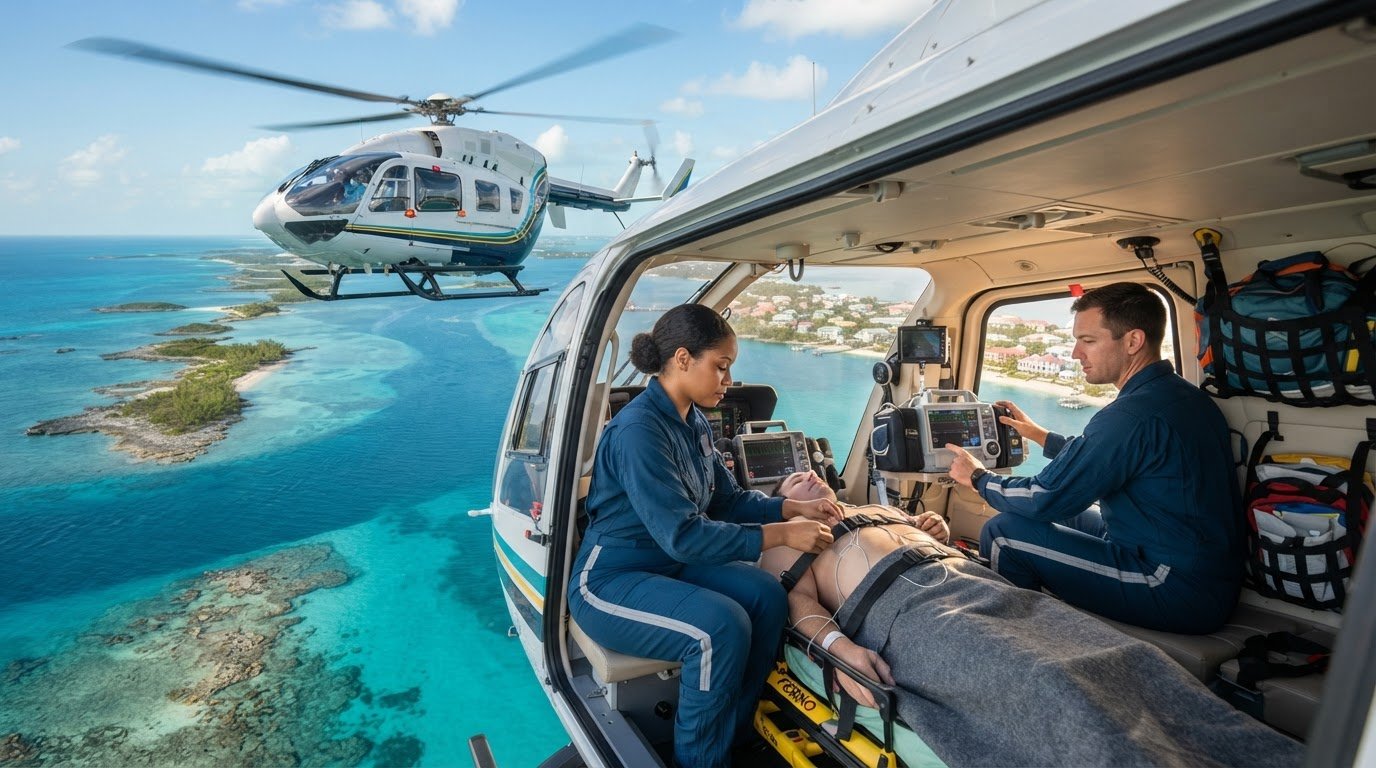
The fastest route isn’t automatically the right neurological transfer. A neurological emergency medical flight is a coordinated care decision, guided by the patient’s condition and the receiving hospital’s ability to provide appropriate care. Sudden weakness, facial drooping, difficulty speaking, a seizure, or abrupt loss of coordination calls for immediate professional assessment. Don’t wait to decide whether air transport is needed. Contact emergency services so qualified professionals can assess the situation.
It’s understandable to wonder whether ground or air transport is safer, how a patient will be supported in transit, and how the receiving facility fits into the plan. This guide explains factors that inform transport decisions and what coordinated neurological transfers can involve in the Bahamas. You’ll learn how helicopter transport fits into the options, how clinical coordination supports a transfer, and how Tropic Air Rescue’s membership model relates to insurer billing for members. The aircraft matters, but so do medical assessment, transfer planning, and continuity of care.
Key Takeaways
- Suspected stroke, a seizure emergency, or serious head injury needs immediate professional assessment, not self-diagnosis.
- A neurological emergency medical flight is considered in context: patient needs, distance, access, and destination care all inform the transport decision.
- Expect a coordinated process from emergency assessment and destination planning through transfer and clinical handoff.
- Family members can support the handoff by following emergency professionals’ instructions and sharing relevant records when requested.
- In the Bahamas, Tropic Air Rescue provides membership-based helicopter air-medical transport, with short-term and annual membership options tailored to anticipated stay length.
Neurological Emergency Medical Flight: Recognizing Urgency Without Self-Diagnosing
A neurological emergency can be frightening, but deciding whether someone needs an aircraft is not a family member’s responsibility. A neurological emergency medical flight is clinician-coordinated air transport for urgent medical needs. It is one part of a broader response that can include assessment, destination planning, and communication between care teams. A medical flight supports an emergency-care and transfer plan, but it does not replace assessment.
If you suspect a medical emergency in the Bahamas, contact local emergency services first and follow their instructions. This article is for general information, not an emergency response service. Don’t delay professional help while trying to identify a diagnosis or compare transport options.
Which neurological emergencies may prompt urgent assessment?
Examples include suspected stroke, prolonged or repeated seizures, and serious traumatic brain injury. Sudden changes in speech, movement, or awareness, as well as a severe headache, can also warrant urgent assessment. These examples aren’t a diagnostic checklist: symptoms can have different causes, and their meaning depends on professional evaluation. Don’t use someone’s ability to speak, move, or respond as a reason to rule out an emergency.
Tell emergency responders what you observed, including when the change began if you know. Their assessment, not a symptom match made at home, guides the next steps.
Why the first decision is medical assessment, not aircraft selection
Qualified responders assess the patient and determine what care and transfer arrangements are appropriate. A flight may be considered, but it isn’t automatically the right choice for every neurological emergency. The decision depends on the patient’s clinical needs, the destination and care available there, access to the patient, and operational conditions.
Ground and air transport each have a role. Helicopter access can be relevant when geography or transfer needs make aircraft access important, but aircraft selection is only one part of the plan. The purpose of air medical services is to transport patients as part of care. That general overview describes aeromedical transport and aircraft types, not an individual patient’s suitability to fly.
Act first. Contact emergency services and follow professional guidance. Don’t postpone care to research aircraft, estimate travel time, or decide for yourself that air transport is necessary. Responders’ assessment sets the transfer process in motion, followed by destination coordination and clinical handoff as part of the wider plan.
How Neurological Emergency Flights Are Assessed and Coordinated
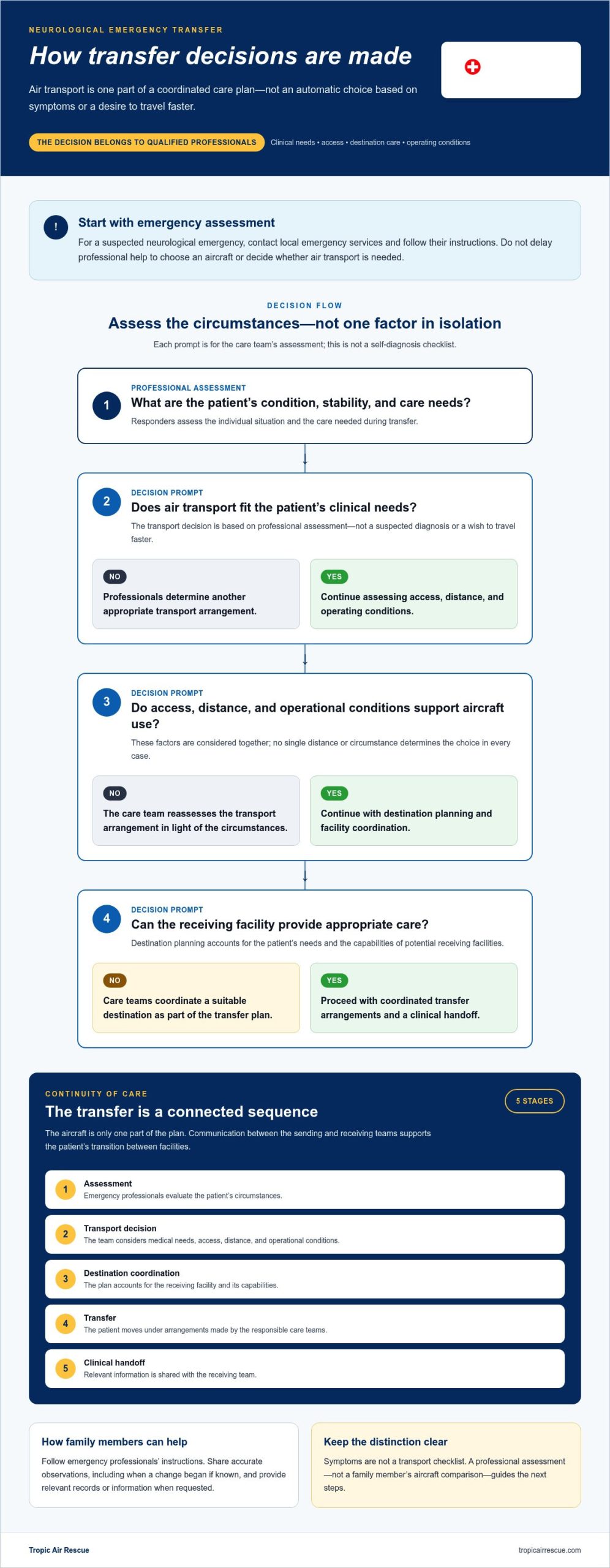
A neurological emergency medical flight involves more than arranging an aircraft. The transfer is a connected sequence: emergency assessment, a transport decision, destination coordination, transfer, and clinical handoff. Each stage helps align the patient’s needs with the care available at the receiving facility.
Think coordinated assessment, transport, and handoff, not flight alone. Air transport may be considered when medical professionals judge it appropriate for the patient and circumstances. A suspected diagnosis or desire to travel faster does not automatically make it the right choice.
What information supports a medical transport decision?
Medical professionals consider the patient’s condition and stability, the care required during transfer, distance, access to the patient, and the capabilities of potential receiving facilities. They use the individual circumstances and current protocols to assess whether air transport is suitable. No single factor, symptom, or distance determines the choice in every case.
Families can share accurate information when requested and follow emergency responders’ directions. Transport suitability is a clinical and operational decision, not something to determine by comparing aircraft independently.
How an interhospital handoff fits into the transfer
When a patient is moving between hospitals, the sending and receiving facilities coordinate relevant patient information and transfer arrangements. This communication helps the receiving team understand the reason for transfer and prepare for the patient’s arrival. The handoff is a vital part of continuity between facilities, not a separate detail to address after the flight.
Tropic Air Rescue provides interhospital transfer services and coordinates with trauma centers. For a closer look at the facility-to-facility process, read this guide to inter-hospital transfer coordination.
The sequence at a glance:
- Assessment: Emergency professionals evaluate the patient’s circumstances.
- Transport decision: They consider medical needs, access, distance, and operational conditions.
- Destination coordination: The transfer plan accounts for the receiving facility and its capabilities.
- Transfer: The patient moves under arrangements made by the responsible care teams.
- Clinical handoff: Relevant information is shared with the receiving team.
Clear coordination links these steps. Follow the instructions of the professionals managing the emergency and provide requested records or information. The care teams determine the appropriate plan and manage the transfer details.
Ground, Helicopter, or Fixed-Wing Transport: What Shapes the Choice?
The right transport mode depends on more than distance or the assumption that flying is faster. Medical professionals consider the patient’s needs, where care is available, access to the patient, and the arrangements required to reach the receiving facility. The appropriate transport mode depends on clinical and operational circumstances.
Ground transport may be appropriate when it can meet the patient’s needs and connect effectively with the destination. Air transport may be considered when geography, access, or transfer requirements make an aircraft relevant. A neurological emergency medical flight is not automatically preferable. The decision belongs to the professionals assessing the patient and coordinating the transfer.
When can helicopter medical transport be considered?
A helicopter may be considered when access and transfer requirements make it relevant to the plan. Tropic Air Rescue provides helicopter air-medical transport throughout the Bahamas, including transfers where reaching a remote location is a consideration. Access is not automatic: the specific location and operational conditions matter. Medical assessment and coordination guide whether helicopter transport is appropriate for the patient.
How does fixed-wing transport differ from helicopter transfer?
Fixed-wing aircraft are airplanes. Helicopters can provide a different kind of access, including to locations where landing-area considerations differ. Each mode has distinct operational requirements, and the practical choice depends on the patient, origin, destination, and transfer arrangements. Neither mode is inherently safer, faster, or better for every neurological emergency. Tropic Air Rescue provides helicopter air-medical transport, not fixed-wing transport.
For more detail on how these aircraft options compare in the Bahamas, see the helicopter and fixed-wing medevac comparison.
How the transport choice fits the whole transfer
The aircraft is only one part of a coordinated plan. Responders and care teams also consider how the patient will reach the aircraft, which destination can provide the required care, and how the handoff will be managed. Weather and other operational conditions can affect what is feasible. These factors are assessed together, not as a simple contest between road and air.
For readers considering advance preparation, Tropic Air Rescue’s helicopter air-medical transport in the Bahamas is offered through membership. The transport decision in an emergency remains based on the patient’s circumstances and professional assessment.
What Patients and Families Can Expect During a Neurological Transfer
A neurological transfer involves coordinated information sharing as well as patient transport. Depending on the circumstances, care teams may communicate about the patient’s condition, plan the transfer, and pass relevant information to the receiving facility. Details vary according to the patient, medical direction, destination, and operational conditions. A neurological emergency medical flight is one possible part of the process, not a fixed sequence that is identical for every patient.
For family members, the priority is to follow emergency professionals’ instructions. Share information or records when requested, but don’t delay urgent care to search for paperwork or gather belongings. If the patient is moving between facilities, the care teams coordinate the clinical handoff. Family communication follows patient-care and operational needs.
What information may help the care team coordinate?
Useful context can include the patient’s medications, known allergies, relevant medical conditions, and available records. If you know when a change began or have information about recent care, share it when asked. Keep details factual and concise. Clinicians will assess the patient and determine what information is relevant to the transfer.
Preparation checklist, only if it doesn’t delay care:
- Be ready to share medication and allergy information.
- Note known medical conditions and relevant recent care.
- Gather available records only when responders or the care team request them.
- Follow instructions about where to go, what to bring, and how to stay in contact.
Missing records shouldn’t stop you from seeking emergency help. Responders can begin assessment based on the situation and available information.
How are the receiving facility and family kept aligned?
For an interhospital transfer, the sending and receiving facilities coordinate relevant patient information and transfer arrangements. That facility-to-facility communication supports a clear clinical handoff. Tropic Air Rescue provides interhospital transfer services and coordinates with receiving facilities, including trauma centers.
Family updates depend on the patient’s care needs and operational circumstances. Don’t assume a particular update schedule or that you’ll be able to accompany or speak with the patient during flight. Follow instructions from the teams coordinating care, and keep your contact details available if they need to reach you.
If you’re planning ahead for a stay in the Bahamas, explore Tropic Air Rescue membership options for helicopter air-medical support. In an active emergency, contact local emergency services and follow their direction first.
Tropic Air Rescue: Membership-Based Neurological Medical Flight Support
In the Bahamas, Tropic Air Rescue provides concierge helicopter air-medical transport for emergency and interhospital transfers. A neurological emergency medical flight is guided by professional assessment and transfer coordination: the patient’s needs, destination, and operational circumstances inform the plan. The helicopter is one element of that pathway, supported by onboard advanced avionics and life-support equipment.
Coordination extends beyond the aircraft. Tropic Air Rescue works with receiving facilities, including trauma centers, to support interhospital transfer arrangements. These capabilities are part of a coordinated service model, not a guarantee of a particular response time or clinical outcome.
How membership and insurance billing fit together
Membership is required to access Tropic Air Rescue’s air-medical transport service. Short-term and annual membership options are available and tailored to anticipated length of stay. This gives residents and visitors a way to plan for potential transport needs before an emergency occurs.
For members, Tropic Air Rescue bills health insurers directly and accepts insurer payouts as full payment, so members incur no out-of-pocket costs. Membership and insurance arrangements work together to provide access to the service without direct patient invoicing.
What makes a coordinated helicopter service relevant
Air-medical transport involves more than flight logistics. The receiving facility and transfer teams must be part of the plan, while onboard medical equipment supports care during transport. In the Bahamas, helicopter access can be relevant to interhospital transfers and locations where aircraft access matters. The specific transport decision remains dependent on clinical assessment and operational conditions.
For a broader overview of the service model, review the concierge air medical service guide. To learn how membership is structured for anticipated stays, explore Tropic Air Rescue membership. Membership planning is intended for preparation. In an active emergency, contact local emergency services and follow their instructions.
Prepare for a Coordinated Transfer Plan
A neurological emergency medical flight is one possible part of a broader care plan. Suspected neurological emergencies need immediate professional assessment, and the appropriate transport mode depends on the patient’s needs, access, destination, and operational circumstances. The aircraft is only one part of the transfer; coordination with the receiving facility and a clear clinical handoff matter too.
For residents and visitors in the Bahamas, Tropic Air Rescue provides helicopter air-medical transport throughout the country, with coordination that includes trauma centers. Membership is required, with short-term and annual options tailored to anticipated stay length. For members, Tropic Air Rescue bills health insurers directly and accepts insurer payouts as full payment, so members incur no out-of-pocket costs.
Preparation can bring clarity before an emergency. Explore Tropic Air Rescue membership to understand the membership options and service model. If an emergency occurs, contact local emergency services first and follow professional instructions. A calm, coordinated plan can help families know what to expect and who is guiding each step.
Frequently Asked Questions
What is a neurological emergency medical flight?
A neurological emergency medical flight is clinician-coordinated air transport for urgent medical needs related to a suspected or known neurological emergency. It’s one part of a wider care and transfer plan, which can include patient assessment, destination coordination, and a clinical handoff. The aircraft type and transport decision depend on medical and operational circumstances. In the Bahamas, Tropic Air Rescue provides helicopter air-medical transport for emergency and interhospital transfers.
When might a patient need air transport for a neurological emergency?
Air transport may be considered when medical professionals determine it suits the patient’s needs and transfer circumstances. Suspected stroke, prolonged or repeated seizures, or serious head injuries require immediate professional assessment, but no particular symptom automatically means an aircraft is needed. Responders consider the patient’s condition, care requirements, access, distance, destination, and operational conditions. Contact local emergency services first, and don’t delay care while comparing transport options.
Is a helicopter medical flight safer or faster than ground transport?
Neither helicopter nor ground transport is automatically safer or faster for every patient. The appropriate mode depends on clinical needs, access, distance, destination, and operational conditions. Ground transport may suit some transfers; helicopter access may be relevant when geography or transfer requirements make aircraft access important. Medical professionals assess the circumstances and coordinate the plan. A transport decision shouldn’t be based on speed assumptions alone.
What happens during an interhospital neurological transfer?
An interhospital transfer involves coordination between the sending and receiving facilities, transport planning, movement of the patient, and a clinical handoff. Relevant patient information and transfer arrangements are shared to support continuity of care. The process varies with the patient’s needs and the facilities involved. Tropic Air Rescue provides interhospital transfer services and coordinates with trauma centers. Families should follow care-team instructions and share requested records when available.
Can family members travel with a patient on a medical flight?
Whether a family member can travel with a patient depends on the transport’s medical and operational circumstances. Don’t assume a seat will be available or that accompanying the patient will be possible. The care and transport teams determine arrangements based on the patient’s needs and the flight plan. Follow their instructions, keep your phone available if appropriate, and ask the medical team how family communication will be handled.
How much does a neurological emergency medical flight cost?
Tropic Air Rescue requires membership, with short-term and annual options tailored to anticipated length of stay in the Bahamas. For members, the company bills health insurers directly and accepts insurer payouts as full payment, so members incur no out-of-pocket costs.
Does Tropic Air Rescue provide neurological emergency flights throughout the Bahamas?
Yes. Tropic Air Rescue provides concierge helicopter air-medical transport throughout the Bahamas, including emergency and interhospital transfers. Membership is required. Medical professionals assess whether air transport is appropriate for the patient, while the transfer plan accounts for destination coordination and operational circumstances. Tropic Air Rescue also coordinates with trauma centers. If an emergency is occurring now, contact local emergency services first and follow their instructions.