


When the nearest appropriate medical care is beyond the reach of a routine ground transfer, an emergency airlift may be considered. In the Bahamas, arranging one involves more than dispatching an aircraft: the patient’s needs, access to a safe landing area, weather, and coordination with a receiving medical facility all shape the plan. Knowing what information to share and who coordinates each step can make a difficult situation less uncertain.
It’s reasonable to have questions about how a patient gets from a remote location to appropriate care, what helicopter medical transport can provide, and how membership and insurance fit together. Tropic Air Rescue provides helicopter medical transport for emergency and interhospital transfers in the Bahamas. Membership is required, and the company bills health insurers directly for members with insurance, accepting insurer payouts as full payment under its membership model. Confirm the current membership terms and insurance arrangements with the provider.
This article explains the basic response sequence, when helicopters may be considered, and what to confirm about membership before travel. It also covers how the patient’s location, medical providers, transport service, and receiving facility contribute to an airlift plan.
Key Takeaways
- An emergency airlift involves more than aircraft dispatch. Medical need, access, weather, and coordination all inform the plan.
- When requesting help, share the patient’s condition, precise location, and any available medical information.
- Helicopters and fixed-wing aircraft have different access and landing requirements. The suitable option depends on the patient and operating conditions.
- Confirm current membership terms and insurer arrangements before travel so you understand how Tropic Air Rescue membership works.
- Short-term, annual, and B2B membership options serve different planning needs. Review the applicable terms in advance.
What Is an Emergency Airlift, and When Might It Be Needed?
An emergency airlift is urgent air medical transport arranged for a patient who may need care that isn’t available at their current location. It connects clinical assessment with aircraft access and a receiving facility. Whether to proceed depends on the patient’s condition, landing access, weather, and coordination among the people involved. Air transport may be considered when local care cannot meet the patient’s needs and a medical team assesses transfer as appropriate.
In the Bahamas, distance between islands and differences in available medical facilities can make transfer planning especially important. An air medical flight is not simply a faster way to travel. The plan must account for the patient’s needs and practical operating conditions. The general concept of Medical evacuation includes different transport methods, selected according to the circumstances.
How does emergency airlift differ from ordinary air travel?
Ordinary air travel moves passengers between destinations. Medical transport is organized around a patient’s condition, clinical requirements, and handover to appropriate care. Depending on the aircraft and service, medical equipment may include life-support systems. This capability doesn’t promise a particular treatment or outcome. Care depends on the patient and clinical team. Emergency airlift is also different from private charter or non-emergency travel, which isn’t arranged to meet an urgent medical transfer need.
Transport decisions involve more than choosing an aircraft. Medical professionals assess whether transfer is suitable, while operators consider access, weather, destination, and other operational factors. Conditions can change, so a request doesn’t guarantee that an airlift will proceed.
When might a helicopter airlift be considered?
A helicopter may be considered when a patient needs urgent transfer and a suitable landing location is available. Helicopters can reach some remote locations that fixed-wing aircraft cannot access directly, including places without a usable runway. The route and transfer plan depend on the patient’s needs and operational assessment. The treating or coordinating medical team determines whether helicopter transport is appropriate. It should not be assumed to be the right option in every emergency.
Tropic Air Rescue provides helicopter medical transport in the Bahamas, including emergency and interhospital transfers. Its helicopters have advanced avionics and life-support equipment, and can land at some remote locations inaccessible to fixed-wing aircraft. These capabilities don’t assure availability or a particular medical result. In an urgent situation, contact local emergency services first and follow the medical team’s direction.
How Emergency Airlift Is Coordinated From First Contact to Transfer
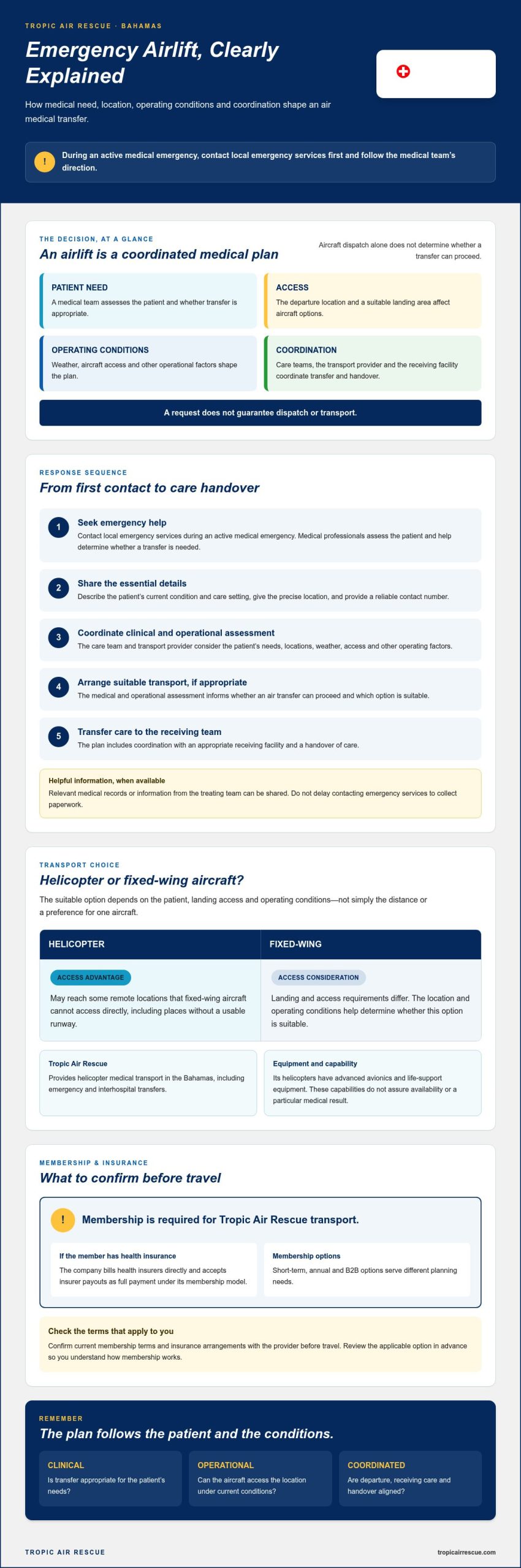
An emergency airlift is a coordinated medical and aviation operation, not simply a request for an aircraft. The basic sequence is to seek emergency help, share the patient’s condition and location, coordinate clinical and operational assessments, arrange suitable transport if appropriate, and hand over care to the receiving team. Each stage depends on the circumstances. A request alone doesn’t guarantee dispatch or transport.
Start with local emergency services during an active medical emergency. Medical professionals can assess the patient and help determine whether a transfer is needed. If air transport is being considered, the transport provider and care team coordinate details such as the patient’s condition, departure and receiving locations, and handover plan. Flight decisions and timing depend on clinical need, weather, aircraft access, and other operating factors.
What information helps the response team assess a request?
Clear, accurate details help the team understand the situation. Be ready to describe the patient’s current condition and care setting, provide the precise location, and share a reliable contact number. If available, have relevant medical records or information from the treating team ready to relay. Don’t delay contacting emergency services to collect paperwork. Sharing information supports assessment, but doesn’t guarantee that an air transfer will proceed.
How are receiving facilities and transfers coordinated?
The treating and coordinating teams consider the patient’s needs and an appropriate destination, then work through transfer and handover details with the receiving facility. Tropic Air Rescue coordinates with trauma centers, but that doesn’t guarantee acceptance by a particular facility. For more on the planning involved, see this inter-hospital medical transfer guide.
Operational assessment matters alongside medical planning. Weather, landing access, and aircraft suitability can affect whether and how a flight proceeds. The Federal Aviation Administration publishes guidelines for helicopter air ambulances, which cover aviation considerations for these operations. They should not be read as a statement of Bahamas-specific requirements.
Before travel, review Tropic Air Rescue membership information and confirm the current terms. Membership is required to access its air medical service. Preparation doesn’t replace contacting local emergency services when urgent help is needed.
Helicopter Emergency Airlift vs Other Transport: What Determines the Right Option?
No aircraft is the right choice in every emergency. A helicopter may be considered when direct access to a patient is important and a suitable landing area is available. Fixed-wing aircraft generally need an appropriate runway, while ground transport may suit situations where the route, patient’s condition, and care needs make it appropriate. These are general differences, not a dispatch decision. The right plan depends on clinical assessment and operational feasibility. Tropic Air Rescue provides helicopter medical transport, not fixed-wing air ambulance transport.
| Transport option | Access and landing | What shapes the decision |
|---|---|---|
| Helicopter | Can reach some remote locations inaccessible to fixed-wing aircraft, provided a suitable landing area is available. | Patient needs, landing access, weather, aircraft capability, and coordination with the receiving facility. Case-dependent. |
| Fixed-wing aircraft | Requires a suitable runway for aircraft access and landing. | Patient condition, destination, runway access, weather, aircraft capability, and transfer logistics. Case-dependent. |
| Ground transport | Uses accessible roads and requires a suitable route between care locations. | Patient needs, distance, road access, clinical assessment, and coordination. Case-dependent. |
When can helicopter access be an advantage?
A helicopter may provide access when a patient is in a remote location without a suitable runway nearby. That advantage depends on a safe, suitable landing area and conditions that permit the operation. A helicopter’s ability to reach certain locations doesn’t mean it can land anywhere or that transport will proceed. For a closer look at the trade-offs, read this helicopter versus fixed-wing medevac comparison.
Why is the aircraft not the only decision?
Aircraft selection is one part of a wider medical transfer plan. The team must consider the patient’s condition, the care required at the destination, and how the receiving facility and handover will be coordinated. Weather, landing access, and aircraft capability also matter. An emergency airlift isn’t automatically the preferred option just because an aircraft can reach the location. The treating or coordinating medical team assesses what is appropriate.
This comparison is general information, not individual medical or dispatch advice. In an active emergency, contact local emergency services and follow the direction of medical professionals. Tropic Air Rescue provides helicopter medical transport in the Bahamas. Transport decisions depend on clinical assessment and operating conditions.
What to Do Before and During an Emergency Airlift Request
If someone is experiencing a medical emergency, contact local emergency services first. Don’t delay urgent care while searching online, checking membership details, or trying to arrange aircraft independently. Medical professionals can assess the situation and advise on next steps, including whether an air transfer should be considered.
Preparation can help you communicate clearly under pressure. Keep essential information accessible, but don’t wait to assemble a complete file before asking for help.
What should travelers prepare in advance?
Before travelling in the Bahamas, make sure the relevant members of your party know where to find emergency contacts and membership details. Confirm current membership terms directly with the provider, including how membership activation and insurer arrangements work. Tropic Air Rescue membership is required to access its air medical service, so resolve questions before travel rather than during a crisis.
For short-term travel, review this short-term medevac coverage guide and verify current details with the provider.
What should you communicate during a request?
Give the responder or coordinating team concise, factual information. If you’re unsure about a detail, say so rather than guessing. Share:
- Patient condition: Describe what happened and the symptoms you can observe.
- Current care setting: Explain whether the patient is at a clinic, hospital, or another location, and identify any medical team already involved.
- Exact location: Provide clear location details and any access information that could help responders reach the patient.
- Reliable contacts: Give a number where you or the treating provider can be reached.
- Available records: Mention relevant medical information or records that can be shared without delaying care.
What should families expect during coordination?
The response team may need to speak with the patient’s care providers, review medical information, assess transport requirements, and coordinate with a potential receiving facility. Keep your phone available and relay updates promptly. A family contact can help gather records and communicate with relatives, while leaving clinical decisions to medical professionals.
Dispatch, routing, and destination depend on clinical assessment and operating conditions. Weather, aircraft access, and coordination with the receiving facility can all affect the plan. No checklist or membership arrangement guarantees that a flight will proceed. Review Tropic Air Rescue membership information before travelling, and confirm current terms and the insurer process directly with the provider.
How Tropic Air Rescue Membership Supports Emergency Airlift Readiness
Membership is required to access Tropic Air Rescue’s helicopter air medical service. Arranging membership before travel gives you time to understand the applicable terms and how insurance billing works, rather than trying to resolve those questions during an emergency. Membership supports preparation, but it doesn’t guarantee that a particular flight will be available or appropriate.
Tropic Air Rescue offers short-term and annual memberships, as well as B2B membership plans. The appropriate option depends on your travel plans or organization’s needs. Before selecting one, confirm who is covered, the membership duration, when it takes effect, and any terms that apply to your circumstances. Don’t assume that having health insurance alone provides access to the service.
How does membership relate to insurance billing?
For members with health insurance, Tropic Air Rescue bills the insurer directly and accepts the insurer’s payout as full payment under its stated model. Under this arrangement, members have no out-of-pocket costs for the flight itself. Confirm current membership terms, eligibility, and insurer billing details with Tropic Air Rescue before relying on them. Don’t assume other medical or travel expenses are included.
Direct insurer billing can clarify one part of the financial arrangement in advance. It doesn’t replace reviewing your policy or the provider’s current terms. Ask what information may be needed from you or your insurer, and keep relevant membership and insurance details accessible to your travel party.
What should you confirm before choosing coverage?
Review the details before departure, while there’s time to ask questions. Confirm:
- Whether short-term, annual, or B2B membership fits your travel or organizational needs.
- Who is included and which membership terms apply.
- When membership becomes active and whether any waiting period applies.
- How direct insurer billing works under the current arrangement.
- Where to find membership information and whom to contact if circumstances change.
Membership is a readiness measure, not a promise of dispatch, aircraft availability, a particular destination, or a medical outcome. Any transport decision remains subject to clinical assessment and operating conditions. Review the current membership options and terms directly with the provider before travel.
Contact Tropic Air Rescue about membership to confirm the details that apply to you.
Prepare Before the Need Arises
An emergency airlift depends on clinical assessment, aircraft access, weather, and coordination with the receiving facility. Knowing the basic response sequence can help you share useful information and focus on urgent care instead of trying to resolve every logistical question at once.
Tropic Air Rescue provides helicopter medical transport using aircraft equipped with advanced avionics and life-support equipment. The company coordinates with trauma centers. Membership is required, and its model includes direct health-insurer billing for members, with insurer payouts accepted as full payment. Confirm current membership and insurer terms in advance. Membership doesn’t guarantee a particular flight or outcome.
Preparation is practical: keep membership information and emergency contacts accessible, know whom to contact, and make sure your travel party knows where to find key details. Review the available membership categories and confirm which terms apply to your situation before travelling.
Review Tropic Air Rescue membership options and confirm the terms that apply before your trip.
Frequently Asked Questions
What is an emergency airlift?
An emergency airlift is urgent air medical transport arranged for a patient who may need care that isn’t available where they are. The treating or coordinating medical team assesses whether transfer is appropriate, while the transport provider considers aircraft access, weather, and other operating factors. The process involves coordinating the patient’s location and medical needs with a receiving facility. A request doesn’t guarantee that a flight will proceed.
When is a helicopter airlift used for a medical emergency?
A helicopter airlift may be considered when a patient needs medical transfer and helicopter access is suitable, including at some remote locations inaccessible to fixed-wing aircraft. The patient’s condition, destination, landing area, weather, and aircraft capability all inform the decision. Medical professionals and the coordinating team assess whether this option is appropriate. A helicopter isn’t automatically faster or preferable in every situation, and transport depends on clinical and operational assessment.
Can a helicopter land wherever an emergency airlift is needed?
No. A helicopter needs a suitable landing area, and the location must be accessible under the conditions at the time. Weather, site characteristics, and operational assessment can affect whether landing is possible. Helicopters can reach some remote locations inaccessible to fixed-wing aircraft, but that doesn’t mean they can land anywhere. The transport team assesses access and feasibility during planning. Don’t assume a flight can reach a specific site.
How is an emergency airlift arranged?
In an active medical emergency, contact local emergency services first. Medical professionals assess the patient and help determine whether transfer is needed. If air transport is considered, the coordinating team gathers details about the patient’s condition, current location, care setting, and destination, then assesses aircraft access and operating conditions. Share relevant available medical records and a reliable contact. The request, assessment, and coordination process doesn’t guarantee dispatch or a particular flight time.
Does emergency airlift membership cover the cost of transport?
For Tropic Air Rescue members with health insurance, the company bills the insurer directly and accepts the insurer’s payout as full payment for transport under its stated model. Members therefore have no out-of-pocket costs for the flight itself under that arrangement. Membership is required to access the service. Confirm current membership terms, eligibility, and insurer billing details with Tropic Air Rescue before travel, since arrangements may depend on applicable terms.
What happens if weather or medical needs prevent an airlift?
If clinical assessment or operating conditions mean an airlift can’t proceed, follow the treating medical team’s direction and continue care through appropriate local emergency or medical providers. Weather, aircraft access, and the patient’s condition can affect transport decisions. The coordinating team can assess the situation and discuss next steps, but available alternatives depend on the circumstances. Membership doesn’t guarantee that a flight will be dispatched or that a specific outcome will follow.
Can emergency airlift transfer a patient to a trauma center?
It may be possible when the patient’s clinical needs, transport conditions, and receiving facility arrangements support the transfer. Tropic Air Rescue coordinates with trauma centers, but coordination doesn’t guarantee that a particular facility will accept a patient. The medical team assesses the appropriate destination and works through transfer details with the receiving facility. Whether the transfer proceeds depends on clinical assessment and operational feasibility, including aircraft access and weather conditions.