

In a life-threatening medical emergency on a remote Bahamian island, a standard insurance policy is just a piece of paper; what you actually need is an immediate flight path. Many residents live with the underlying fear of being stranded during a crisis, worrying that the high cost of air ambulances or the limitations of fixed-wing aircraft will delay critical care. You understand that when every second counts, the distance between your home and a Florida trauma center can feel insurmountable. It’s a common anxiety for those who value the seclusion of the islands but recognize the logistical reality of local healthcare gaps.
This guide demonstrates how to build a robust medical evacuation plan for Bahamas expats that ensures rapid, concierge-level helicopter transport without the burden of out-of-pocket costs. You’ll discover how specialized rotor-wing aircraft provide point-to-point access where traditional planes cannot land. We will break down the essential differences between travel insurance and dedicated medevac memberships, providing a clear roadmap for 2026 to ensure your medical security is as elite as your lifestyle. We’ll preview the operational checklists and membership benefits that turn a potential tragedy into a managed, professional response.
Key Takeaways
- Distinguish between standard travel insurance and a dedicated logistical framework to ensure your emergency response is pre-arranged and immediate.
- Evaluate critical technical requirements for 2026, including Advanced Life Support equipment and advanced avionics necessary for precision landings in remote areas.
- Understand the operational advantages of point-to-point helicopter transport over fixed-wing aircraft, which often require time-consuming ground ambulance transfers.
- Learn how a robust medical evacuation plan for Bahamas expats integrates direct insurance billing to eliminate out-of-pocket expenses during a medical emergency.
- Explore tiered membership structures that offer concierge coordination for emergency rescues and specialized interhospital transfers.
Defining a Professional Medical Evacuation Plan for Bahamas Expats
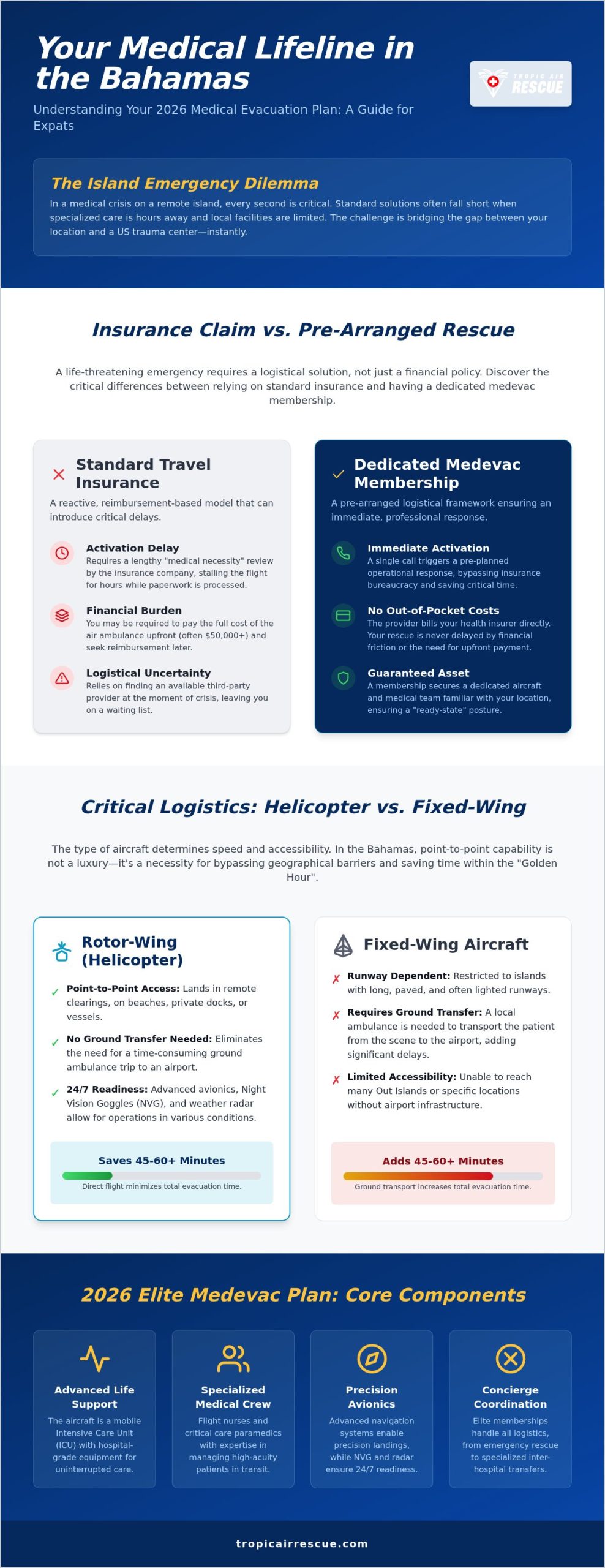
A professional medical evacuation plan for Bahamas expats is a pre-arranged logistical framework, not a reactive insurance claim. It functions as a comprehensive bridge between a remote island location and advanced tertiary care in Florida. For 2026, the industry standard demands a “ready-state” posture where aviation and medical teams maintain real-time synchronization. This infrastructure ensures that when a crisis occurs, the response is an operational execution rather than a frantic search for available resources. It’s the difference between having a guaranteed seat on a life-saving flight and being stuck on a waiting list while a dispatcher checks for availability.
The Logistical Reality of Island Living
The geography of the Bahamas creates significant hurdles for conventional air medical services. Many Out Islands lack the long, paved runways required for fixed-wing aircraft, especially during night operations or inclement weather. This creates a dangerous reliance on local clinics that may not have the capacity to manage complex trauma or cardiac events. Medical outcomes often depend on the “Golden Hour,” the sixty-minute window following an injury where specialized care is most effective. Professional medical aviation bridges this gap by utilizing rotor-wing assets that can land in clearings, on beaches, or at private docks. This point-to-point capability eliminates the need for a ground ambulance to transport a patient to an airport, a process that often adds 45 to 60 minutes to the total evacuation time.
Insurance vs. Membership: Understanding the Gap
Standard insurance policies frequently fail during high-stakes emergencies because they’re often based on reimbursement models. Under these terms, you may be required to pay the full cost of an air ambulance upfront before the insurance company audits the necessity of the flight. If you don’t have a membership, this financial friction can lead to catastrophic delays when immediate action is required. A dedicated medical evacuation plan for Bahamas expats operates differently by prioritizing the rescue over the paperwork. It ensures your security is financially viable and operationally sound through specific protocols:
- Direct Billing: The provider bills your health insurer directly, removing the need for you to liquidate assets or maximize credit cards during a crisis.
- Pre-Authorization: Memberships often bypass the lengthy insurance “medical necessity” review that can stall a flight for hours.
- Logistical Control: A membership secures a dedicated asset that is already familiar with your specific island location and medical history.
The ‘Membership Advantage’ provides total financial security by removing the burden of upfront payments and ensuring your rescue is triggered by a single call rather than an insurance approval process.
Technical Standards in Professional Medical Aviation
The efficacy of a medical evacuation plan for Bahamas expats is dictated by the technical specifications of the response platform. In 2026, Advanced Life Support (ALS) standards require more than just a fast flight; they demand a mobile intensive care unit. This includes specialized medical flight crews, typically comprised of a flight nurse and a critical care paramedic, who manage high-acuity patients during the transit to Florida. Unlike standard transport services, these teams utilize hospital-grade equipment designed for the unique stresses of flight, ensuring that care is never interrupted between the scene and the hospital bed.
Helicopter Avionics and Remote Access
Helicopter versatility is the cornerstone of remote rescue operations in the Bahamian archipelago. Precision landings on private vessels, beaches, or remote clearings require advanced avionics that go beyond standard GPS. Modern rotor-wing assets utilize night-vision goggles (NVG) and high-resolution weather radar to maintain 24/7 operational readiness. While fixed-wing aircraft are restricted to maintained runways, helicopters navigate directly to the patient’s coordinates. This capability is critical when a trauma victim is located on an island with no airport infrastructure, effectively removing the logistical bottleneck of ground transport. For those seeking comprehensive protection, an annual membership provides guaranteed access to this advanced technology.
Hospital-Grade Care at 5,000 Feet
Maintaining the chain of care requires an environment that mirrors a trauma center’s capabilities. Onboard critical care suites feature multi-parameter cardiac monitors, portable ventilators, and advanced trauma kits capable of managing complex neurological or cardiac emergencies. This technical density allows for continuous monitoring and intervention during the flight. Current CDC guidance on medical evacuation insurance emphasizes the importance of verifying these medical capabilities before a crisis occurs. High-acuity transport protocols also include real-time telemetry, which transmits vital signs directly to receiving Florida trauma centers. This proactive coordination ensures the surgical team is briefed and ready before the rotors even stop spinning. By securing a specialized medical evacuation plan for Bahamas expats, you ensure that the level of care provided in the air matches the excellence of the destination facility.
Critical Logistics: Helicopter vs. Fixed-Wing Transport
Many expats assume a jet is the fastest way home. This is a logistical fallacy in the archipelago. A fixed-wing aircraft is limited to “Airport-to-Airport” transport. It requires a ground ambulance to move the patient from their residence or a local clinic to the nearest runway. This adds multiple touchpoints where the patient must be moved, increasing risk and wasting critical minutes. A comprehensive medical evacuation plan for Bahamas expats prioritizes “Point-to-Point” logistics, where the aircraft comes to the patient, not the other way around. In a high-stakes emergency, the time spent waiting for a ground ambulance to navigate island roads can be the difference between recovery and permanent disability.
The Advantage of Point-to-Point Response
Helicopter transport provides a true concierge experience by offering “Bed-to-Bed” service. Rotor-wing aircraft can land directly at the scene of an accident, a private estate, or even a yacht at sea. This eliminates the hidden delays of ground transfers entirely. More importantly, it allows for direct delivery to a hospital’s rooftop helipad. By bypassing the traffic and logistical hurdles of airport-to-hospital ground transport in Florida, you save up to 90 minutes of total transit time. Understanding the advantages of helicopter medevac in the Bahamas is essential for anyone living on the Out Islands where runways are sparse, unpaved, or poorly lit at night.
Inter-Hospital Transfer Efficiency
When a patient is stabilized at a local island facility but requires specialized intervention, speed becomes the ultimate differentiator. Inter-hospital transfer services must be streamlined to maintain the “chain of care” without interruption. Helicopters excel here by landing directly at the clinic’s parking lot or designated clear zone. This efficiency is vital for international medical repatriation, where the goal is to move the patient to a higher level of care in the United States as quickly as possible. A professional medical evacuation plan for Bahamas expats ensures that these transfers are handled with surgical precision. Dispatchers coordinate with both the departing facility and the receiving trauma center to ensure a seamless handoff, ensuring the patient never waits on a tarmac or in a hallway.
Building Your 2026 Medevac Plan: Essential Criteria
Constructing a medical evacuation plan for Bahamas expats requires a rigorous vetting process that goes beyond comparing premiums. You’re building a logistical safety net that must function perfectly under extreme pressure. The first criterion is geographic reach. You must verify that your provider has the specific authorization and equipment to land at your exact island coordinates, whether that’s a private helipad, a clearing near your estate, or a remote beach. A plan that relies on you reaching a major airport is fundamentally flawed in a Bahamian context. You need a partner that brings the ICU to your doorstep.
Beyond physical access, evaluate the clinical and operational depth of the service. A professional plan must include inter-hospital transfer capabilities for specialized care. This ensures that if you’re stabilized at a local clinic but require a neurosurgeon in Florida, the transition is immediate and seamless. Verify that the fleet carries Advanced Life Support (ALS) equipment and that every flight is staffed by certified flight nurses and paramedics. These technical standards are the baseline for 2026 medical security.
Financial Security and Insurance Integration
The most common failure in emergency logistics is financial friction. Standard insurance often requires hours of “medical necessity” reviews before authorizing a flight. A robust medical evacuation plan for Bahamas expats eliminates this bottleneck through a membership model. These memberships are designed to accept insurance payouts as full payment, effectively removing the threat of a $50,000 out-of-pocket bill. By securing air ambulance membership benefits, you gain access to concierge billing teams who handle the administrative complexity. This allows you to focus on the patient while the provider manages the insurance claims in the background.
Coordination with International Trauma Centers
Speed is the only metric that matters during a cardiac or trauma event. Effective plans rely on pre-established protocols with leading US-based medical facilities, ensuring that a bed is waiting before the aircraft leaves the ground. These logistics are highly specialized, extending to time-critical missions like organ transport where every second dictates the viability of the procedure. Seamless international transfer logistics are the foundation of any high-stakes medical response plan. Your provider should act as an elite guardian, coordinating with Florida trauma centers to ensure your arrival is expected and your medical data is transmitted in real time. To protect your family with this level of precision, secure your 2026 membership today and finalize your emergency readiness.
The Tropic Air Rescue Membership: Elite Concierge Protection
The Tropic Air Rescue membership represents the most sophisticated medical evacuation plan for Bahamas expats available in 2026. It’s designed for those who refuse to compromise on safety. Our fleet maintains an “Always Ready” posture, meaning aircraft and crews are positioned for immediate deployment. We don’t wait for a crisis to begin our preparations. Every helicopter undergoes rigorous daily maintenance and is pre-staged with advanced life-support equipment. This proactive approach eliminates the delays common with charter services or generic insurance-led rescues. When you’re a member, you’re a priority on our flight manifest.
We provide tiered subscription plans to match your specific lifestyle. Residents and second-home owners can choose coverage that aligns with their time on the islands. Our B2B membership plans also offer tailored solutions for local businesses and yacht crews. This modular approach ensures that you only pay for the protection you need while maintaining access to our elite aviation assets. It’s a logistical investment that guarantees a professional response is only one call away, regardless of your island’s remote location.
Annual Membership for Long-Term Expats
For residents committed to the island lifestyle, our annual air rescue membership provides year-round security. It covers the entire household, including guests and family members visiting from abroad. This comprehensive protection removes the anxiety of island living, especially in remote areas where local clinics have limited capacity. You gain a dedicated partner who understands your specific medical history and geographic location. This familiarity speeds up response times and ensures the medical team arrives with the right protocols for your unique needs. It’s the missing link in a standard expat health insurance policy.
The Concierge Medical Service Difference
Elite expats choose professional medical aviation because they value personalized, high-end coordination. We bridge the gap between a Bahamian clinic and a US-based trauma center with surgical precision. Our concierge team manages every detail of the inter-hospital transfer. We communicate directly with Florida surgeons and specialists before you even leave the ground. This level of synchronization is why we’re the definitive choice for high-stakes medical logistics. You’re never just a patient number; you’re a member of an exclusive safety network. Take the final step in your 2026 planning by securing your membership and ensuring your family has a guaranteed flight path to the best care in the world.
Finalizing Your 2026 Emergency Infrastructure
Living in the Bahamas shouldn’t mean compromising on medical security. You’ve learned that a true medical evacuation plan for Bahamas expats is an operational infrastructure, not just a policy. It requires an elite helicopter fleet capable of point-to-point rescue and direct coordination with Florida trauma centers. By choosing a membership model over standard insurance, you eliminate the financial friction of upfront payments through direct insurance billing. This specialized approach ensures that care begins the moment the crew arrives at your location.
Readiness is the only defense against the unpredictable nature of island life. You can now distinguish between the limitations of fixed-wing aircraft and the precision of rotor-wing medical transport. This guide has provided the essential criteria for 2026 safety standards, moving you from anxiety to expert preparation. It’s time to finalize your logistical safety net and ensure your family remains protected. Secure Your 2026 Medevac Membership Today and enjoy the peace of mind that comes with professional guardianship. Your island lifestyle deserves a safety plan that is always ready.
Frequently Asked Questions
Is medical evacuation covered by my standard expat health insurance?
Standard expat health insurance often covers medical evacuation as a line item but rarely manages the actual logistics. These policies typically operate on a reimbursement basis or require lengthy pre-authorizations that can delay a flight by several hours. In a crisis, the immediate deployment of a medical evacuation plan for Bahamas expats is necessary because it bypasses the administrative friction and financial hurdles of traditional insurance claims, ensuring the rescue begins immediately.
What is the difference between a helicopter and a fixed-wing air ambulance?
Helicopters provide point-to-point transport while fixed-wing aircraft are limited to airport-to-airport operations. A helicopter can land directly at a remote scene, private estate, or hospital helipad, eliminating the need for ground ambulance transfers. This “Bed-to-Bed” service saves critical time during the “Golden Hour” of trauma care. Fixed-wing aircraft require a functional runway and additional ground logistics, which often adds significant delay in the Bahamian archipelago where infrastructure is sparse.
How much does a medical evacuation from the Bahamas typically cost without a plan?
Without a pre-arranged plan, a medical evacuation from the Bahamas can range from $50,000 to over $100,000 out-of-pocket. These costs vary based on the patient’s location, the type of aircraft required, and the level of medical care needed during transit. Without a membership that facilitates direct insurance billing, providers often require full payment via wire transfer or credit card before an aircraft is ever dispatched to the islands.
Can a medevac helicopter land at my private residence or yacht?
Yes, specialized medevac helicopters are designed to land at private residences, clearings, and vessels at sea provided there is sufficient clearance. This capability is a cornerstone of a robust medical evacuation plan for Bahamas expats, as it provides access to locations where no runways exist. Pilots utilize advanced avionics and night-vision technology to ensure precision landings in remote areas, ensuring that the rescue team reaches you exactly where the emergency occurs.
What happens if I need to be transferred to a trauma center in Florida?
If a transfer to Florida is required, the coordination team manages all logistics from the initial call to the hospital handoff. This includes securing a bed at a specialized trauma center and transmitting real-time telemetry data to the receiving surgical team. The goal is a seamless transition of care, ensuring that the hospital is fully briefed and prepared to receive the patient immediately upon landing on the rooftop helipad, bypassing traditional emergency room delays.
How do I activate my medical evacuation plan in an emergency?
Activation is triggered by a single call to the dedicated emergency dispatch center. Once the call is received, the flight coordinator verifies your coordinates and dispatches the nearest helicopter asset. Simultaneously, the medical team prepares the onboard life-support equipment while the administrative staff initiates the direct billing process with your insurer. This synchronized response ensures that the aircraft is airborne while the paperwork is managed efficiently in the background.
Does a medevac membership cover my guests or family members?
Membership coverage depends on the specific tier selected at enrollment. Annual memberships are typically structured to include the primary resident and their immediate household family members. Some plans also offer options to extend protection to guests or yacht crew members through B2B membership plans. It’s essential to verify your specific plan details to ensure all frequent visitors are included in the logistical framework before an emergency arises on your property.
What medical equipment is available on a professional medical aviation flight?
Professional medical aviation flights are equipped with Advanced Life Support (ALS) technology equivalent to a mobile intensive care unit. Onboard equipment includes portable ventilators, multi-parameter cardiac monitors, and advanced trauma kits. The aircraft also carries specialized medications and high-acuity supplies managed by a certified flight nurse and paramedic. This technical density ensures that the chain of care remains unbroken from the island scene to the Florida hospital bed.