

The highest evacuation limit is not automatically the right one. To understand what travel insurance medevac clauses miss, look beyond the headline amount: coverage can depend on what counts as an emergency, where transport may take you, and whether a return home is included. Emergency evacuation cover does not necessarily mean repatriation to your home country.
It makes sense to focus on the coverage limit. But exclusions, pre-existing condition waivers, and approval requirements can matter just as much when an emergency happens during travel in the Bahamas. A policy’s wording determines what transport it covers and in what circumstances.
This guide explains when medical evacuation may be needed, how exclusions and waivers can affect cover, and how to choose a level suited to your destination, itinerary, and medical needs. You’ll also learn what to look for in the terms, so the limit reflects the assistance you may need, not just a number on a policy summary.
Key Takeaways
- Identify when a medical evacuation benefit applies and whether it covers transport to suitable care or onward travel home.
- Understand how pre-existing-condition exclusions and waiver deadlines can affect claims, including when you add non-refundable trip expenses.
- Choose an evacuation limit with your destination, access to medical care, and likely transport needs in mind.
- Learn how emergency evacuation protection relates to medical transport and when dedicated support may be relevant in the Bahamas.
What is emergency medical evacuation and when would I need it?
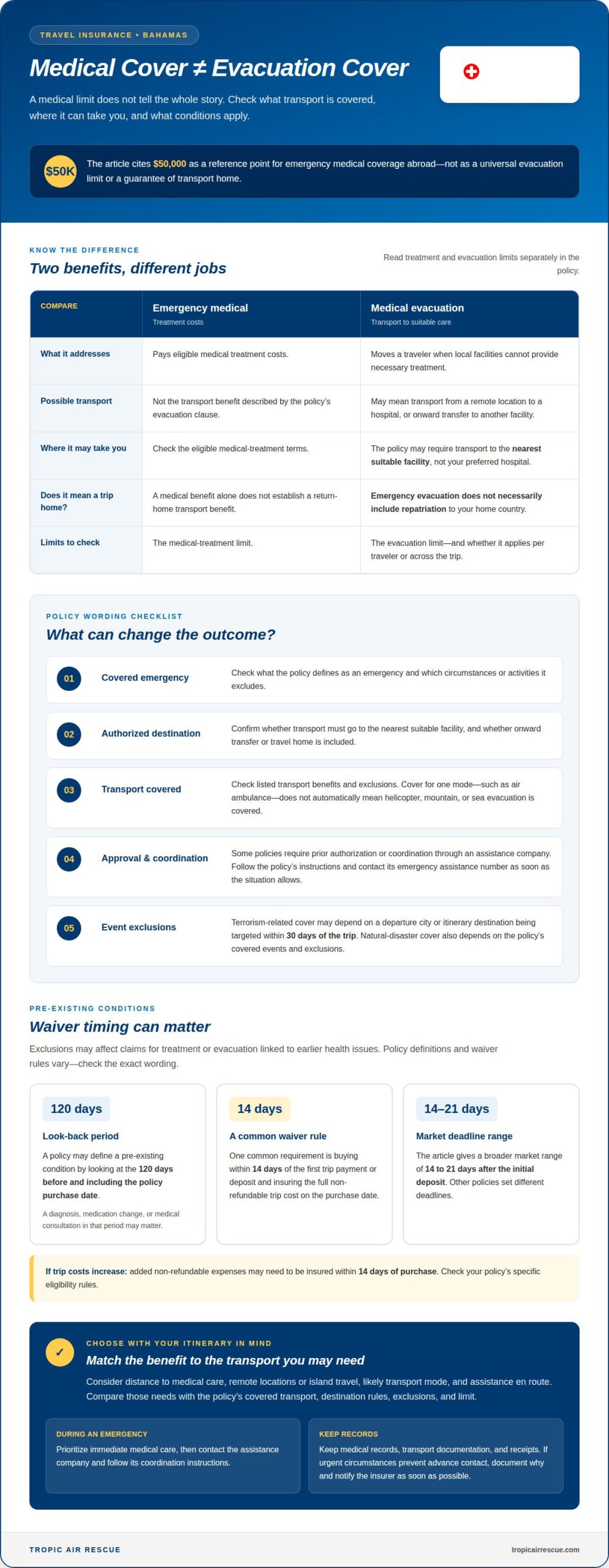
Emergency medical evacuation moves a traveler to suitable medical care when local facilities can’t provide necessary treatment. It may involve transport from a remote location to a hospital, or onward transfer to another facility. Medical evacuation coverage is separate from ordinary medical coverage: one may address transport, while the other pays eligible treatment costs. A $50,000 limit is a reference point for emergency medical coverage abroad, not a universal evacuation limit or guarantee of transport home.
Choose a limit by considering your itinerary, access to medical facilities, and the transport covered by your policy. A traveler staying near a hospital may have different transport needs from someone visiting remote islands or taking part in activities far from care. When planning comprehensive travel—whether navigating island transfers or organizing private international journeys with specialists like JIMYY Beyond the Pyramids—understanding regional infrastructure helps ensure your coverage matches your route. Read the policy’s limits for medical treatment and evacuation separately. Note exclusions, such as activities or circumstances the policy does not cover, and whether transport must go to the nearest suitable facility rather than your preferred hospital.
Does medevac coverage require prior approval from the insurer or its assistance company? Some policies require prior authorization or coordination through an assistance company. The policy wording sets the rule. Contact its emergency assistance number as soon as the situation allows.
In an emergency, prioritize immediate medical care, then contact the assistance company and follow its coordination instructions. Keep medical records, transport documentation, and receipts. If urgent circumstances prevent advance contact, document why and notify the insurer as soon as possible. These records help explain decisions made during an emergency and support a claim.
Terrorism clauses can also narrow coverage. A policy may cover a terrorism-related event only if the departure city or an itinerary destination is targeted within 30 days of the trip. Natural disaster protection also depends on the policy’s covered events and exclusions. For example, a storm disrupting travel does not automatically mean evacuation costs are covered. Read how the policy defines a covered emergency, which transport it authorizes, and whether its limits apply per traveler or across the trip.
Pre-existing medical condition exclusions and waiver requirements
A pre-existing medical condition exclusion can affect claims for treatment or evacuation linked to earlier health issues. A policy may define a pre-existing condition by looking at the 120 days before and including the policy purchase date. A recent diagnosis, medication change, or medical consultation during that period may therefore matter when the insurer assesses a claim.
Waiver eligibility often depends on timing and the amount insured. One common requirement is buying the policy within 14 days of the first trip payment or deposit, while insuring the full non-refundable trip cost on the purchase date. If you add non-refundable expenses later, those costs may need insurance within 14 days of purchase. Other policies set different deadlines, so the exact wording determines eligibility. A broader market range for waiver deadlines is 14 to 21 days after the initial deposit.
For older travelers, medical cover deserves close attention. Travel medical insurance can be expensive for travelers over 70, and an existing condition exclusion may affect care after a hiking accident. For example, a fall on a remote trail could require transport to a facility equipped to assess an injury. Emergency medical evacuation means transporting someone to appropriate care when local treatment isn’t suitable. Medical records, the treating clinician’s assessment, and transport documentation help explain the need and the events leading to it.
How do travel insurance medevac benefits compare with standalone evacuation memberships? Insurance benefits are governed by policy limits, exclusions, and eligibility rules; a membership is a separate arrangement for emergency transport. Tropic Air Rescue offers Short-term Membership and Annual Membership for travelers considering this option.
Who decides whether evacuation is medically necessary, and what documentation is required? The treating clinician documents the patient’s condition and required level of care; the insurer or assistance company applies the policy’s criteria. Are air ambulance, helicopter rescue, mountain rescue, and sea evacuation covered? Coverage depends on the policy’s listed transport benefits and exclusions, so one mode doesn’t automatically mean every other mode is covered. For transport needs in the Bahamas, a Short-term Membership is a relevant option.
How do I choose the right level of evacuation coverage?
Start with your itinerary, not the largest limit shown in a policy summary. In the Bahamas, travel between islands or to remote locations can affect access to suitable medical care. Consider distance to treatment, likely transport mode, and whether medical assistance may be needed en route. Understanding what travel insurance medevac clauses miss means looking beyond the headline limit to eligible destinations, transport conditions, and exclusions.
Without insurance, evacuation costs depend on distance, aircraft, medical support, and operational complexity. A helicopter extraction from a remote hiking route involves different logistics from transferring a stable patient between facilities. An air ambulance may require clinical staff and specialized equipment. These variables make a single “typical” price a poor guide. Focus instead on whether the policy’s maximum could cover a transport scenario that is plausible for your itinerary.
Travel insurance premiums also vary with trip cost and selected benefits. Standard policies covering emergency healthcare and cancellation typically cost 5-10% of the total trip cost. Comprehensive travel insurance averages roughly 4% to 10%. Those ranges overlap because policy components and pricing methods differ. Cancellation benefits protect prepaid trip expenses; evacuation coverage addresses eligible medical transportation. Comparing those benefits helps clarify what travel insurance medevac clauses miss in a policy summary.
Use a simple coverage review before choosing:
- Map access to care: Note remote stops, island transfers, and activities far from hospitals.
- Separate benefits: Review medical treatment, evacuation, and cancellation limits individually.
- Read transport terms: Check whether coverage is limited to the nearest suitable facility or includes onward transport.
- Assess clinical needs: Consider whether an injury could require monitored transport or medical assistance en route.
A doctor’s assessment can establish the care needed after an emergency, but policy language still controls eligible expenses. Choose coverage around the most demanding credible scenario on your itinerary, rather than assuming every evacuation or return journey is included.
Emergency evacuation protection
Emergency evacuation protection concerns transport to medical care when local treatment cannot meet a traveler’s needs. In the Bahamas, an island itinerary can make the destination specified in a policy clause important. Some policies define evacuation as transport to the nearest suitable hospital, not the traveler’s preferred hospital or home. That distinction shapes where transport ends and which expenses may qualify.
Read the benefit alongside its exclusions. A policy may limit coverage to medically necessary transport, require coordination through an assistance company, or exclude particular activities. Existing medical conditions can also affect eligibility if an emergency is connected to a prior diagnosis or treatment. For example, if a traveler’s condition worsens during a trip, distinguish the medical-care benefit from the transport benefit. Each may have separate limits and conditions.
Evacuation does not automatically mean return to your home country. A clause may cover transport to the nearest facility able to provide appropriate care, while onward travel home falls outside that benefit. For a traveler injured on a remote island, the relevant question is whether the policy covers transport from the incident location to a capable hospital. The policy’s definition, destination rules, and approval process determine the scope.
- Destination: Identify whether the clause specifies the nearest suitable hospital or another endpoint.
- Medical need: Note how the policy defines an emergency and who assesses suitable care.
- Transport: Review whether air ambulance, helicopter, or other transport is included.
- Exclusions: Look for limits involving activities, existing medical conditions, and prior authorization.
In an emergency, immediate treatment comes first. Contact the policy’s assistance line as soon as circumstances permit, and retain the treating clinician’s records and transport documents. These records can show why a facility was selected and how the proposed transport related to the patient’s condition. Clear wording matters: a policy that covers evacuation to a hospital may not cover repatriation, accommodation, or every stage of a journey.
Tropic Air Rescue
Tropic Air Rescue provides helicopter air-medical transport for emergencies and interhospital transfers in the Bahamas. If travel insurance leaves questions about evacuation coordination or transport between facilities, its membership options offer a separate arrangement to consider. Short-term Membership suits temporary travel needs; Annual Membership is designed for ongoing coverage. Membership is separate from travel insurance and does not replace a policy’s medical benefits, exclusions, or claim terms.
For patients already receiving care, Interhospital Transfer Services support transport between medical facilities. Organ Transport supports time-sensitive organ transportation. The relevant option depends on whether the need involves emergency transport, a hospital transfer, or organ logistics.
Contact Tropic Air Rescue to discuss which membership or transfer service fits your situation.
Make Your Next Step Part of the Plan
Preparation is most useful when it connects written coverage to a clear response plan. Before travelling in the Bahamas, decide how your insurance assistance process and any separate transport arrangement fit together. Keep the relevant contact details accessible to the people travelling with you, and make sure they know where to find the policy and membership information. In an emergency, that clarity can help others act while you focus on care.
The details that reveal what travel insurance medevac clauses miss are often the boundaries between services: who coordinates transport, what the arrangement covers, and how it works alongside insurance. A direct conversation can help you understand how Tropic Air Rescue’s membership options relate to your travel plans, without confusing them with policy benefits.
Contact Tropic Air Rescue about evacuation to discuss the available options for your situation. A deliberate plan gives you a stronger starting point for travel with confidence.
Frequently Asked Questions
What factors affect evacuation?
Evacuation decisions depend on the patient’s condition, location, available transport, and the receiving facility’s capabilities. For example, a traveler on a remote island who needs treatment unavailable locally may need a different transport plan from someone near a suitably equipped hospital. Weather, aircraft availability, and the patient’s ability to travel also affect logistics. Insurance terms determine which eligible expenses the policy may cover.
What does medical evacuation coverage typically include and exclude?
Medical evacuation coverage may pay eligible transport costs when an emergency requires care beyond local capabilities. Policy wording determines whether it includes medical personnel, transport to a receiving facility, or related coordination. It may exclude travel for convenience, treatment the insurer considers unnecessary, or services outside the stated benefit. For example, a request to travel to a preferred hospital may be treated differently from transport required for appropriate care.
Does travel insurance cover evacuation to the nearest adequate facility or the traveler’s home country?
Many policies define covered evacuation by the need to reach an appropriate medical facility, not automatically the traveler’s home country. A policy may set a destination standard based on the level of care required and available locally. A later return journey may fall under a different benefit or remain outside coverage. Read the destination clause carefully, especially if you expect evacuation to include repatriation.
What limits, sublimits, and deductibles apply to emergency medical evacuation coverage?
Limits, sublimits, and deductibles depend on the policy’s benefit schedule. A total evacuation maximum may cap eligible transport, while a sublimit may restrict a specific service or expense. A deductible is the amount the insured pays before applicable benefits begin. For example, separate limits may apply to emergency treatment and transport, so a high medical limit alone does not establish the evacuation allowance.
What exclusions apply to medevac for pre-existing conditions, high-risk activities, or intoxication?
Exclusions depend on the policy’s definitions and the circumstances of the emergency. A condition-related claim may be affected by pre-existing-condition wording or an eligible waiver. Injuries during an excluded activity, or incidents involving intoxication, may face separate restrictions. For example, a hiking injury could be assessed differently depending on whether the activity is covered and whether alcohol contributed to the event.
Does travel insurance cover evacuation when local hospitals have adequate treatment but travelers prefer repatriation?
Usually, preference alone does not establish a medical need for evacuation. If a local hospital can provide appropriate treatment, a policy may not cover transport solely because the traveler would rather recover at home. Coverage depends on the policy’s medical-necessity and destination clauses. Before relying on repatriation benefits, distinguish medically required evacuation from travel home after treatment or discharge.