

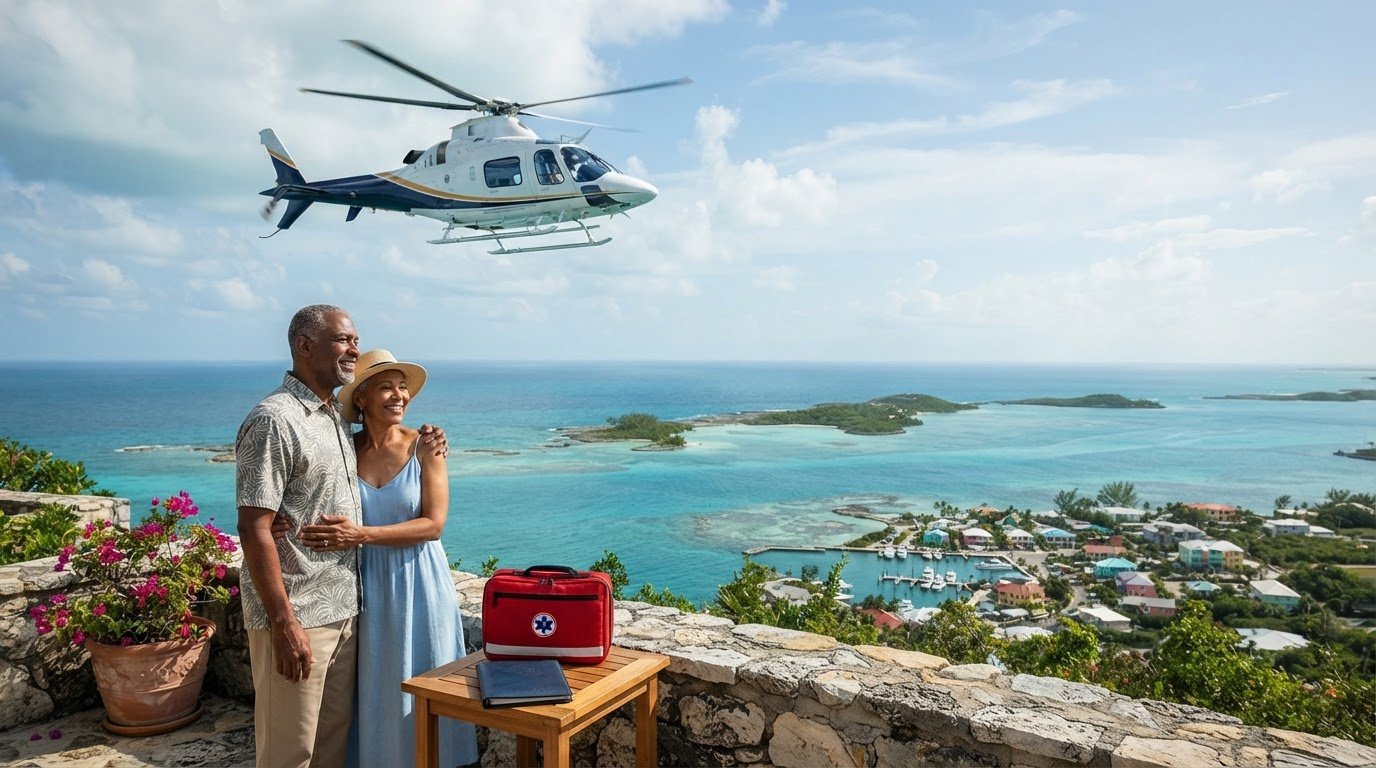
What if a serious medical emergency happens on an island with no direct route to the care you need? A retiree medical safety plan for Bahamas living must account for more than health insurance. It needs a clear way to coordinate transport to appropriate trauma care, including in Florida when necessary.
It’s reasonable to assume your U.S. insurance will cover an emergency abroad, but evacuation benefits and payment arrangements can be difficult to interpret. In the Bahamas, distance between islands can add another layer of uncertainty when time matters.
This guide explains how to build a practical medical safety plan for retirement, what to confirm with your insurer, and how a Bahamas-specific helicopter medevac membership can fit into your preparations. Tropic Air Rescue coordinates with Florida trauma centers and bills insurance companies directly for members; the flight itself has no out-of-pocket cost to members at the time of rescue. You’ll also learn why a membership is distinct from health insurance and what questions to ask before an emergency, so you can make informed decisions about access, coverage, and transfer coordination.
Key Takeaways
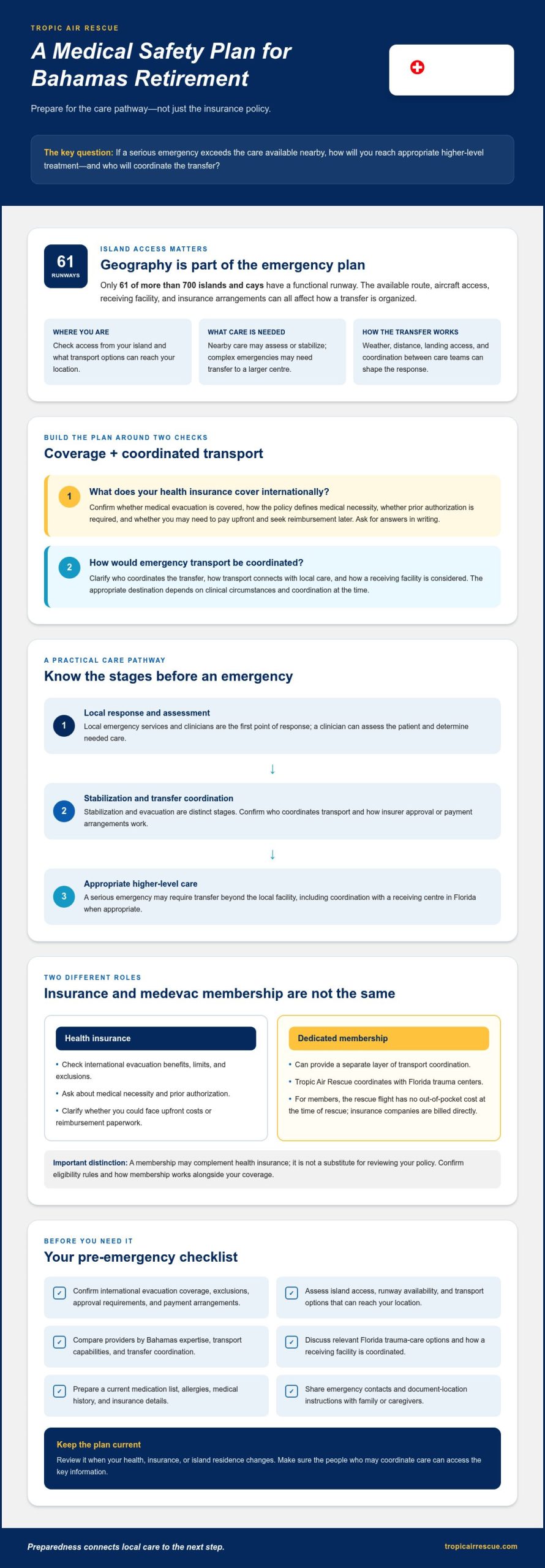
- Build a retiree medical safety plan for Bahamas living around two checks: what your health insurance covers internationally and how emergency transport would be coordinated.
- Assess access from your island, including whether a runway is available and what transport options can reach your location.
- Compare providers by their Bahamas expertise, transport capabilities, and approach to coordinating transfers to appropriate care.
- Learn how a dedicated membership may complement health insurance and reduce members’ out-of-pocket costs for the rescue flight.
- Use a practical checklist to clarify emergency procedures and prepare key medical and insurance information before you need it.
Assessing Healthcare Realities for Retirees in the Bahamas
Retirement in the Bahamas can mean living far from the hospital best equipped for a complex emergency. The country has public and private healthcare facilities, but the care available depends on where you live and what treatment you need. The overview of Healthcare in the Bahamas offers useful context on the system, including the National Health Insurance program. For retirees, the key question is more specific: how would you get from local care to advanced treatment if an emergency exceeds what’s available nearby?
Island geography makes that question operational, not theoretical. The research brief reports that only 61 of more than 700 islands and cays have a functional runway. A nearby clinic may be able to assess or stabilize a patient, while definitive treatment for a serious cardiac event, major injury, or other complex condition may require transfer to a larger centre. The route, aircraft access, receiving facility, and insurance arrangements all affect the plan.
The Critical Gap in Emergency Response
Local emergency services remain the first point of response, but reaching a patient and arranging onward transport can be more complicated on a remote island than in a city. Weather, distance, landing access, and coordination between care teams can shape the timeline. A pre-defined evacuation protocol helps residents and family members know whom to contact, what information to provide, and how transfer decisions will be coordinated.
In Bahamas medevac planning, the “Golden Hour” is the critical early period after a serious emergency when prompt access to assessment and appropriate higher-level care may influence treatment options.
Stabilization and evacuation are distinct stages. A local clinician can assess the patient and determine what care is needed; an international transfer may then involve coordinating transport and a receiving facility. Confirm in advance how your insurer handles medical evacuation, whether prior authorization is required, and who coordinates the transfer.
Why Retirees Need a Specialized Safety Plan
Age alone doesn’t determine emergency risk, but retirees may have existing health conditions or need specialist care that isn’t available on every island. A retiree medical safety plan for Bahamas residents should therefore cover both routine healthcare and the less frequent, higher-acuity scenario: a serious emergency requiring transfer beyond the local facility.
Basic travel insurance may not be designed for long-term residence, so review its limits and exclusions rather than assuming evacuation is included. Ask how it defines medical necessity, which providers it will coordinate with, and whether you could face upfront transport costs. A dedicated membership may provide a separate layer of transport coordination. Tropic Air Rescue offers Bahamas-focused helicopter medevac membership, with coordination to Florida trauma centers and direct billing to insurance companies for members. Learn more about trauma air transport in the Bahamas as you map out the steps between local stabilization and higher-level care.
Core Components of a 2026 Medical Safety Plan
A reliable plan connects coverage, transport coordination, receiving care, and the people who may need to act for you. Build it before an emergency, then review it when your health, insurance, or island residence changes. For a retiree medical safety plan for Bahamas residents, these four steps turn general preparation into a usable protocol.
- Audit your health insurance. Check whether your policy covers international medical evacuation, what conditions apply, whether the insurer must approve transport, and whether you must pay first and claim reimbursement later. For retirees navigating cross-border coverage, consulting insurance and retirement specialists like Safe Harbor Financial Resources can help clarify existing policies and safeguard long-term assets. Ask for answers in writing.
- Consider a dedicated rescue membership. Health insurance and transport coordination serve different purposes. A Bahamas-focused membership may help organize the medical transport response; confirm its eligibility rules and how it works alongside your coverage.
- Discuss a U.S. receiving-care pathway. Identify the Florida trauma-care options relevant to your needs, while understanding that the appropriate destination depends on clinical circumstances and coordination at the time.
- Prepare a “Go-Plan.” Give family or caregivers a current medication list, allergies, medical history, insurance details, emergency contacts, and instructions for locating important documents. Keep a copy accessible to the people who may coordinate care.
Insurance Policy vs. Medevac Membership
A reimbursement benefit can leave a family managing substantial paperwork and potentially arranging payment during a crisis. Review the precise claims process: does the insurer coordinate and pay providers, or could you be expected to pay and seek reimbursement? A membership is not a substitute for health insurance, and its terms matter. Ask about dispatch procedures, covered circumstances, and how the provider coordinates with your insurer. Tropic Air Rescue says it bills insurance companies directly for members, with no out-of-pocket cost to members for the flight at the time of rescue. For broader health preparation, check CDC health information for the Bahamas for current destination-specific guidance.
Establishing the Florida Connection
Discuss in advance how a transfer to a U.S. facility may be coordinated, what clinical information will travel with you, and who can communicate with family. A planned pathway is not a guaranteed destination; the treating team and transport coordination determine what is appropriate. Learn how inter-hospital transfer coordination works, and ask how medical records, medication details, and insurance information are handled across care teams.
Review your membership options and coordination details directly with Tropic Air Rescue, then store the resulting instructions with your Go-Plan.
The Logistical Advantage: Helicopter vs. Fixed-Wing
The aircraft’s access point can shape the entire transport chain. A fixed-wing aircraft needs a suitable runway, which may mean a patient first travels by ground ambulance from a home, clinic, or resort to an airport. A helicopter may be able to land closer to the patient when the location is suitable, reducing the number of transfer stages. Neither option is right for every case, so compare the complete route rather than flight time alone.
Consider each handoff: reaching the patient, boarding the aircraft, arriving at the receiving location, and transferring into hospital care. A helicopter can shorten some ground legs, but timing depends on location, clinical needs, weather, and operational conditions. Read more about the advantages of helicopter medevac in the Bahamas and ask providers how they evaluate the route for your situation.
Accessibility Across the Islands
For a resident whose property or local clinic is far from an airport, ground transport to a runway can add a separate leg before fixed-wing travel begins. Ask how a provider assesses possible landing sites, coordinates any ground ambulance transfers, and adapts the plan when a landing near the patient isn’t feasible. Helicopters can reach some suitable locations that fixed-wing aircraft cannot, subject to site safety and operational conditions.
Review the U.S. Embassy guidance on Bahamian medical care for broader context on local facilities, insurance, and medical evacuation. A retiree medical safety plan for Bahamas residents should account for the practical connection between where care begins and where it can continue.
Medical Support During Transit
Transport capability also depends on the medical equipment and care available onboard. Tropic Air Rescue states that its helicopters are equipped for Advanced Life Support (ALS). Ask any provider about its aircraft’s medical equipment, the clinical staff accompanying patients, and how care is coordinated during transit. Don’t assume every aircraft or crew offers the same capabilities.
For a transfer to Florida, clear communication between the treating team, transport provider, and receiving facility is essential. The patient’s clinical needs help determine the appropriate transport plan and destination. Confirm in advance how medical information will be shared and how the transfer process is coordinated.
Review Bahamas-focused membership and transport coordination details at Tropic Air Rescue’s membership information.
Evaluating Providers: A Retiree Buying Guide
A provider comparison should go beyond the policy summary. For a retiree medical safety plan for Bahamas residents, assess how the service operates, where it can respond, how billing works, and what its stated response process actually measures. Ask for clear answers in writing before choosing a membership.
- Fleet and operations: Does the provider operate its own aircraft, or arrange transport through third parties? Ask who makes dispatch decisions and how the aircraft’s location and availability affect response.
- Geographic focus: Does the provider specialize in the Bahamas and understand island access, or coordinate across a broader network? Confirm that your island and circumstances fit its stated scope.
- Billing: Will the provider bill your insurer directly, or might you need to pay first and submit a claim? Ask whether your specific U.S. health plan is accepted and what costs, if any, fall outside the transport benefit.
- Response measures: Ask what “response time” means. Is it measured from the call to dispatch, takeoff, or arrival at the patient’s location? Request any available performance information, but don’t treat an average as a guarantee for an individual emergency.
The “No Out-of-Pocket” Standard
Payment arrangements matter under pressure. A pay-and-claim policy may require the family to arrange funds and handle reimbursement paperwork while care is being coordinated. Ask how a membership works with your insurance, what the member is responsible for, and whether the provider bills your insurer directly. Tropic Air Rescue states that it bills insurance companies directly for members and that members have no out-of-pocket cost for the flight at the time of rescue. Confirm how those terms apply to your own coverage; don’t assume every insurer or related expense is included.
Concierge-Level Service Expectations
“Concierge” should describe specific coordination, not serve as a substitute for details. Ask who communicates with the treating facility, how updates reach your family, and what support is available after transfer. These arrangements can vary, so get the provider’s process rather than assuming it includes ongoing family coordination. Read more about the concierge air medical service model.
For permanent residents, an annual membership may offer a continuing layer of emergency transport preparation, while a short-term membership may suit a defined period. Compare eligibility, coverage terms, and renewal details with your long-term health insurance. Then review Tropic Air Rescue membership options to assess whether its Bahamas-focused membership fits your plan.
Securing Your Bahamas Retirement with Tropic Air Rescue
A strong retiree medical safety plan for Bahamas living needs a practical link between an emergency on the islands and appropriate higher-level care. Tropic Air Rescue offers Bahamas-focused helicopter medevac memberships, coordinates with Florida trauma centers, and bills insurance companies directly for members. The company states that members have no out-of-pocket cost for the flight itself at the time of rescue. That can remove the need to pay for the flight upfront, though it doesn’t replace health insurance or mean every related medical expense is covered.
Membership is one component of preparation, not a substitute for knowing what to do. Keep the membership details alongside your insurance information, medication list, medical history, and emergency contacts. Make sure a family member or caregiver knows where these records are and how to contact the relevant providers.
Membership Tailored to Your Lifestyle
Your time in the Bahamas can help guide which membership option to explore. A short-term membership may suit a second-home owner staying for a defined period; an annual membership may be worth considering for someone who lives in the country year-round. Retiree communities or organizations can ask about B2B membership plans. Before enrolling, confirm who is eligible, what circumstances are covered, and how membership coordinates with your existing health insurance.
The First Step Toward Preparedness
Before enrolling, review the current membership terms and ask what information is needed from international residents. Confirm the applicable coverage period, how to request assistance, how insurance billing is handled, and what information family members should have available. Don’t assume a specific dispatch timeframe or availability; ask the provider to explain its response process and any applicable conditions.
Once you have the details, add them to your written emergency plan and share that plan with the people who may need to act on your behalf. This preparation helps turn membership from a line in your records into a coordinated part of your retirement safety arrangements.
To review the available membership options and discuss how they may fit your Bahamas plans, explore a Tropic Air Rescue membership.
Put Your Medical Safety Plan in Place
A dependable retiree medical safety plan for Bahamas living pairs health insurance with a clear transport pathway and practical instructions for family or caregivers. Review your policy before an emergency, confirm how evacuation costs are handled, and keep essential medical information easy to access.
Tropic Air Rescue offers a Bahamas-focused helicopter medevac membership with Advanced Life Support (ALS) equipped helicopters, coordination with Florida trauma centers, and direct billing to insurance companies for members. The company states that members have no out-of-pocket cost for the flight itself at the time of rescue. Confirm how membership terms fit your insurer and personal circumstances, then add the relevant contact and response details to your emergency plan.
Preparation can’t remove every uncertainty, but it can make the next steps clearer for you and the people supporting you. Secure Your Professional Medical Aviation Coverage Today and take a confident step toward a more prepared retirement in the Bahamas.
Frequently Asked Questions
Does US Medicare cover medical evacuation from the Bahamas?
U.S. Medicare generally doesn’t cover medical care outside the United States, and retirees shouldn’t assume it will pay for evacuation from the Bahamas. Coverage can depend on your specific plan and circumstances. Check directly with Medicare or your plan administrator, and ask whether emergency transport, international care, and transfer to a U.S. facility are included. Get the terms in writing and consider how you would arrange transport if coverage is denied or limited.
What is the difference between travel insurance and a medevac membership?
Travel insurance is an insurance policy that may cover eligible medical costs or evacuation under its terms, often through a claims process. A medevac membership provides access to a transport service under membership conditions and may coordinate the response. They aren’t interchangeable: check whether your policy arranges transport or reimburses you afterward, and ask the membership provider about eligibility and coordination. A membership should complement, not replace, suitable health insurance.
Can a helicopter land at my private residence in the Bahamas?
Possibly, but a landing at a private residence can’t be assumed. It depends on whether the site is suitable and safe for the aircraft, along with operational conditions and any necessary permissions. Share your location details with the provider in advance and ask how landing access is assessed. If landing at the residence isn’t feasible, transport may require a nearby suitable landing area and ground ambulance coordination.
How much does a typical air ambulance from the Bahamas to Florida cost without membership?
There isn’t one dependable price for a non-member transport. The amount can depend on the patient’s condition, origin and destination, aircraft and medical requirements, and operational circumstances. Before an emergency, ask your health insurer whether evacuation is covered, whether it requires prior approval, and if you could need to pay upfront. Request details from any prospective provider about billing responsibilities and what is included in a transport arrangement.
Will Tropic Air Rescue bill my insurance company directly?
Yes. Tropic Air Rescue states that it bills health insurers directly for members, and that members have no out-of-pocket cost for the flight itself at the time of rescue. Membership is required to access these benefits. Before relying on this arrangement, confirm your membership eligibility and ask how your specific insurance policy applies. Direct billing for the flight doesn’t mean every medical expense or related service is covered.
What medical equipment is available on the helicopter during transport?
Tropic Air Rescue states that its helicopters have Advanced Life Support (ALS) capability and are equipped with life-support equipment and advanced avionics. The exact equipment and care available for a particular transport can depend on operational and clinical requirements. Ask the provider what equipment is carried, what medical crew accompanies patients, and how the team coordinates with the treating facility and receiving hospital for your circumstances.
How do I coordinate an inter-hospital transfer if I am already admitted to a local clinic?
Start by telling your treating clinician that a transfer may be needed; the medical team can assess your condition and discuss appropriate next steps. Contact your membership provider to understand its coordination process and inform your insurer if required. Be ready to share medical records, current medications, and insurance details. The treating team and transfer coordinator can work through the receiving facility and transport arrangements based on clinical needs.
Are there short-term memberships for retirees who only spend the winter in the Bahamas?
Yes. Tropic Air Rescue offers short-term memberships, as well as annual memberships. A short-term option may suit retirees who stay in the Bahamas for a defined part of the year, but confirm the coverage dates, eligibility requirements, and applicable terms before enrolling. Add the membership contact and instructions to your emergency plan, and make sure a family member or caregiver knows where to find that information.