

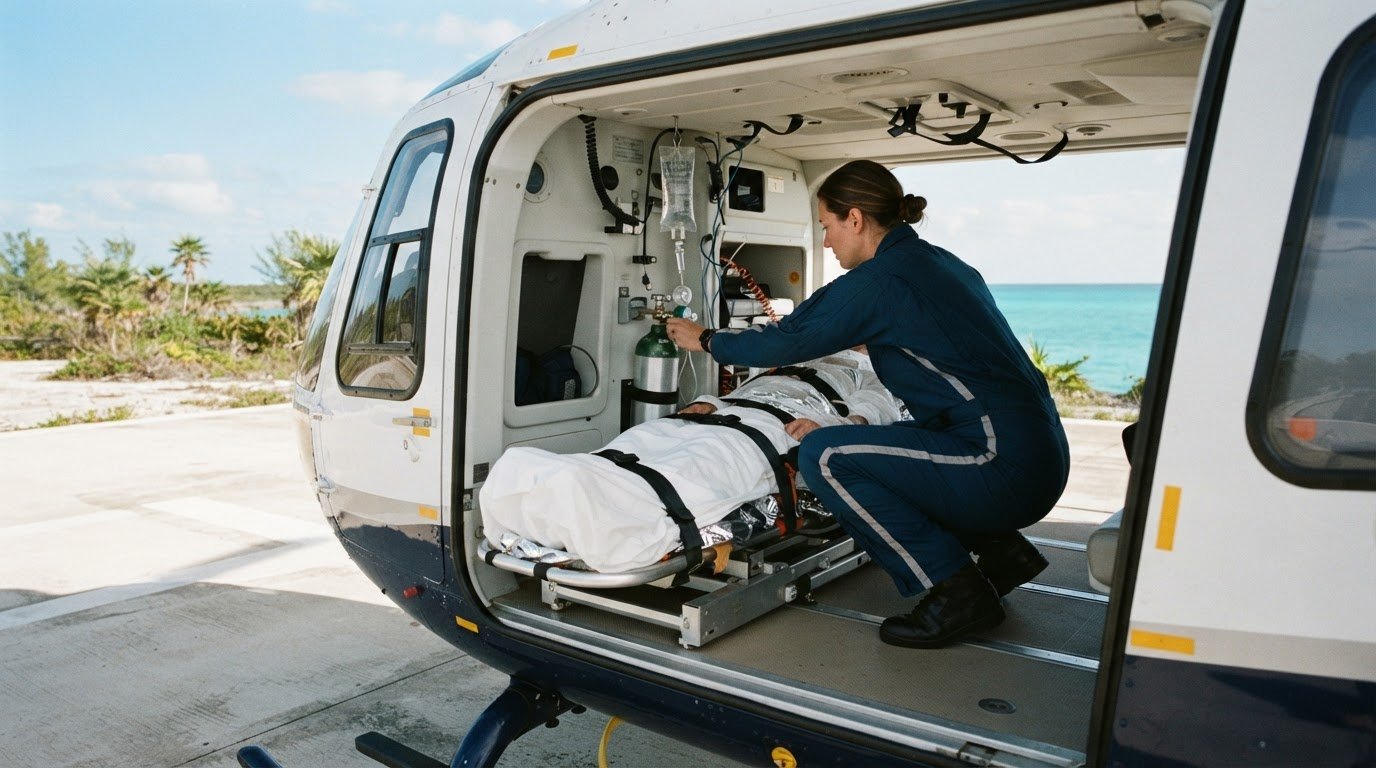
The aircraft is only one part of severe burn victim air transport. If burn shock is present, the team first stabilizes the patient, then plans transfer before serious secondary complications develop. The priority is to continue critical care throughout the journey, not simply to depart as quickly as possible.
A safe transfer plan accounts for fluid management, temperature control, airway and monitoring needs, and equipment suited to both the patient and the aircraft. Military and civilian transfers have different logistics, but both require a plan tailored to the patient’s condition and destination. This guide explains how teams prepare burn patients for flight, reduce hypothermia risk, organize essential equipment, and assess whether air medical transfer may be appropriate in the Bahamas.
Key Takeaways
- Keep the patient warm during care and flight: avoid ice on burns and use clean coverings to limit heat loss.
- Plan fluids and monitoring around the patient’s burn severity, age, condition, and time since injury.
- Prepare in-flight equipment for the patient’s critical-care needs, including reliable access for fluids and adequate transport supplies.
- Choose an air-transfer plan around clinical stability, destination, and operational needs; military and civilian routes involve different logistics.
Preventing hypothermia during care and transport
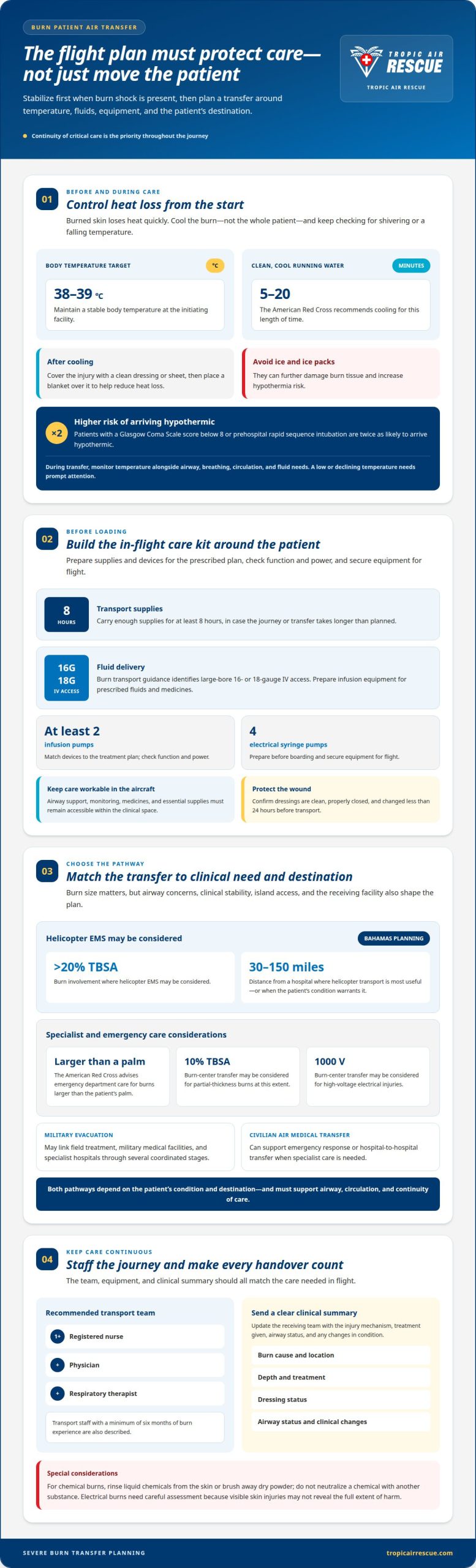
Burned skin loses heat quickly, so temperature control starts during emergency care. At the initiating facility, maintain a stable body temperature between 38 and 39 degrees Celsius. Cool the burn with clean, cool running water; the American Red Cross recommends 5-20 minutes. Keep cooling focused on the burned area and watch for shivering or falling body temperature, especially when large areas are involved.
Avoid ice and ice packs. They can further damage burn tissue and increase the risk of hypothermia. After cooling, cover the injury with a clean dressing or sheet, then place a blanket over it. This barrier helps reduce heat loss without putting ice or direct cold against damaged skin.
During transfer, the team should monitor temperature alongside airway, breathing, circulation, and fluid needs. Burn patients with a Glasgow Coma Scale score below 8 face increased hypothermia risk; those with that score or prehospital rapid sequence intubation are twice as likely to arrive hypothermic. A low reading or declining temperature calls for prompt attention during transport.
What are the risks and complications of flying with severe burns? Hypothermia, airway problems, and changing fluid needs can complicate care. Teams monitor the patient and continue supportive treatment during flight. Electrical burns also need careful assessment because visible skin injuries may not reveal the full extent of harm.
How much does emergency air ambulance transport for a burn victim cost? The price depends on the case and is provided after a quote request. Distance, aircraft, clinical staffing, and required equipment affect the cost. Does insurance cover air ambulance transport to a burn center? Coverage depends on policy terms and the transport arrangement. Before transfer, review the relevant air-medical benefits and authorization requirements with the insurer.
Critical care equipment for in-flight transfers
Equipment must support the patient’s current needs from loading through hospital handover. A transport kit should carry supplies for at least 8 hours, allowing care to continue if the journey or transfer takes longer than planned. For fluid delivery, burn transport guidance identifies large-bore 16- or 18-gauge IV access. Infusion equipment must be prepared to administer prescribed fluids and medicines safely in flight.
Pre-boarding equipment planning also includes at least 2 infusion pumps and 4 electrical syringe pumps. The team matches each device to the treatment plan, checks power and function, and secures equipment for flight. Airway support, monitoring, and access to essential supplies must remain workable within the aircraft’s clinical space.
- Fluid delivery: Prepare IV access and pumps for the prescribed resuscitation plan.
- Medication: Keep required drugs and delivery equipment ready for the patient’s needs.
- Monitoring: Track vital signs and changes that may require prompt intervention.
- Wound protection: Confirm dressings are clean, properly closed, and changed less than 24 hours before transport.
Wound care starts before boarding. A secure dressing protects injured tissue and helps the team monitor changes during transfer. The receiving hospital should be told the burn’s cause, location, depth, treatment, and dressing status. For chemical burns, rinse liquid chemicals from the skin or brush away dry powder. Don’t try to neutralize a chemical with another substance. Electrical burns also require careful assessment, as visible injuries may not show internal harm.
Hospital care is important for burns deeper than superficial burns. The American Red Cross advises emergency department care when a burn is larger than the patient’s palm. Transfer to a burn center may be considered for partial-thickness burns of 10% TBSA, or high-voltage electrical injuries of 1000 V. These criteria help teams assess the need for specialist care and prepare equipment for the receiving facility.
For a hospital-to-hospital transfer, interhospital transfer coordination connects the clinical handover with the flight plan.
Military and civilian air medical transport for burn patients
Military and civilian transfers share the same clinical priority: move the patient to appropriate burn care while supporting airway and circulation. Their systems differ. Military evacuation may link field treatment, military medical facilities, and specialist hospitals through several coordinated stages. Civilian air medical transport can support emergency response or hospital-to-hospital transfer when specialist care is needed. In either setting, the patient’s condition and destination shape the plan.
Planning severe burn victim air transport in the Bahamas means accounting for island geography, access, clinical needs, and the receiving facility. Helicopter EMS may be considered for burns involving more than 20% TBSA. Helicopter transport is most useful when an accident is 30 to 150 miles from a hospital, or when the patient’s condition warrants it. Burn size is one factor; airway concerns and clinical stability also matter.
Military evacuation may involve several handovers before a patient reaches specialist burn care. Each stage needs an up-to-date clinical summary, including the injury mechanism, treatment given, airway status, and any changes in condition. Civilian transfers also rely on clear coordination between the sending and receiving teams. Effective severe burn victim air transport is planned around continuity of care, not just the aircraft.
A recommended burn transport team includes at least one registered nurse, a physician, and a respiratory therapist. Transport staff with a minimum of six months of burn experience are also described. These roles support assessment and communication during the journey, especially if the patient’s condition changes. The team’s skills and equipment should match the care needed in flight.
For the Bahamas, choose a transfer pathway based on clinical need and destination, not simply whether it is military or civilian. Distance, airway risk, and access to specialist care help determine how the transfer is organized and what support must continue en route.
How long can a severe burn patient safely wait for air transport?
There is no safe, fixed waiting period for every severe burn. Timing depends on burn shock, airway status, circulation, temperature, and the care available at the current facility. The guiding principle is to stabilize initial burn shock, if present, then transfer before serious secondary complications develop. Waiting for a set time without considering these clinical factors may not reflect the patient’s needs.
Transport timing should be individualized, balancing initial stabilization against the need to reach specialist burn care. This is not a universal departure deadline. It reflects the balance between early stabilization and the need to reach specialist burn care. If the patient remains unstable, the team weighs the immediate risks of transport against the risks of staying at the current facility.
Before departure, the treating team assesses whether essential care can continue during the flight. This includes reviewing fluid resuscitation, airway needs, vital signs, wound care, and the patient’s response to treatment. Changes in breathing, circulation, or alertness can alter the plan. The receiving hospital also needs a clear clinical handover, including the time of injury and care already provided.
For families in the Bahamas, the key question is not simply how many hours have passed. It is whether the patient has been initially stabilized and whether the transfer team can maintain necessary care en route to the right destination. For example, a patient still requiring active resuscitation needs a plan for ongoing treatment, not just flight duration. Coordination among the sending facility, transport team, and receiving centre helps match transfer timing to clinical readiness.
When a transfer is being arranged, share the latest changes in the patient’s condition with the clinical team coordinating departure. Use medical transport coordination to align timing and care needs across the journey.
Tropic Air Rescue: Short-term Membership
Tropic Air Rescue offers Short-term Membership for people seeking emergency or interhospital air-medical transport in the Bahamas. When a severe burn patient needs a hospital transfer for specialist care, its Interhospital Transfer Services are a relevant option. The medical team’s assessment and the receiving facility’s needs guide transfer planning.
Membership is required. Members can choose Short-term or Annual Membership, and Tropic Air Rescue bills health insurers directly, so members incur no out-of-pocket costs. Coverage and clinical decisions remain important parts of arranging a transfer.
For a burn-related transfer, keep the treating team involved in sharing the patient’s condition and care needs. Contact Tropic Air Rescue to discuss Short-term Membership and transfer arrangements.
Keep the next decision coordinated
Air transport for a severe burn victim is one part of a larger transition in care. Clear communication among the family, treating facility, and receiving team helps keep decisions aligned as the patient’s needs change. A designated family contact can organize updates and reduce confusion during a demanding period.
As plans take shape, clarify who is coordinating the transfer and how important updates will reach those making care decisions. Shared understanding supports continuity from the current facility through arrival. In the Bahamas, reaching the appropriate destination may involve air travel, making coordinated planning especially important.
Tropic Air Rescue provides a point of contact for people considering air-medical transfer arrangements. To discuss the appropriate next step, contact Tropic Air Rescue. A clear conversation can help you understand how its membership and transfer services relate to your situation. Keep the treating medical team involved as plans develop, and move forward with calm, informed coordination.
Frequently Asked Questions
When does a severe burn victim need air medical transport?
Air medical transport may be considered when severe burns require specialist assessment and the patient cannot reach suitable care promptly by ground. Across the Bahamas, island geography can make air transfer relevant when distance, access, or the patient’s condition affects planning. Clinicians weigh burn extent, airway concerns, stability, and the destination’s capabilities. The goal is timely access to appropriate care, not flight for its own sake.
What type of aircraft is used to transport severe burn patients?
Helicopters are used for air-medical transport in the Bahamas when the mission and landing access suit them. Tropic Air Rescue provides helicopter air-medical service, and helicopters can reach remote locations inaccessible to fixed-wing aircraft. Aircraft choice depends on pickup and destination access, the patient’s condition, and clinical support needed en route. The treating and transport teams coordinate these details before departure.
How is a burn patient stabilized before air transport?
Stabilization starts with assessing the injury and immediate threats, then adjusting treatment as the patient’s condition changes. Before transfer, the handover should document when and how the injury occurred, airway findings, vital-sign trends, fluids and medicines given, and the response to treatment. For example, recording changes in breathing or alertness helps receiving clinicians compare the patient’s condition across facilities.
What medical equipment and staff are needed during burn air transport?
Transport requires clinicians able to manage the patient’s airway and ongoing care, supported by monitoring and treatment equipment matched to the case. Teams may track urine output as one measure of fluid response: transportation guidance gives targets of 0.5 mL/kg/h for adults and 1 mL/kg/h for children. Equipment planning must also account for power, secure placement, and staff access during flight.
How do emergency services arrange air transport to a burn center?
Emergency transfer requires coordination among the sending facility, transport team, and receiving burn centre. The clinical handover should include the injury mechanism, burn extent and depth, airway assessment, treatment already given, and any changes in condition. In the Bahamas, the route and landing arrangements must also suit the destination and access needs. This coordination supports continuity from departure through arrival.
What are the criteria for transferring a patient to a specialized burn center?
Transfer may be considered when an injury requires expertise or resources beyond the current hospital’s burn-care capacity. Assessment includes burn depth and area, possible inhalation injury, electrical or chemical cause, and the patient’s overall condition. Suspected inhalation injury may require hospital-based burn care. The receiving centre’s capabilities and the support needed during travel also shape the decision.