

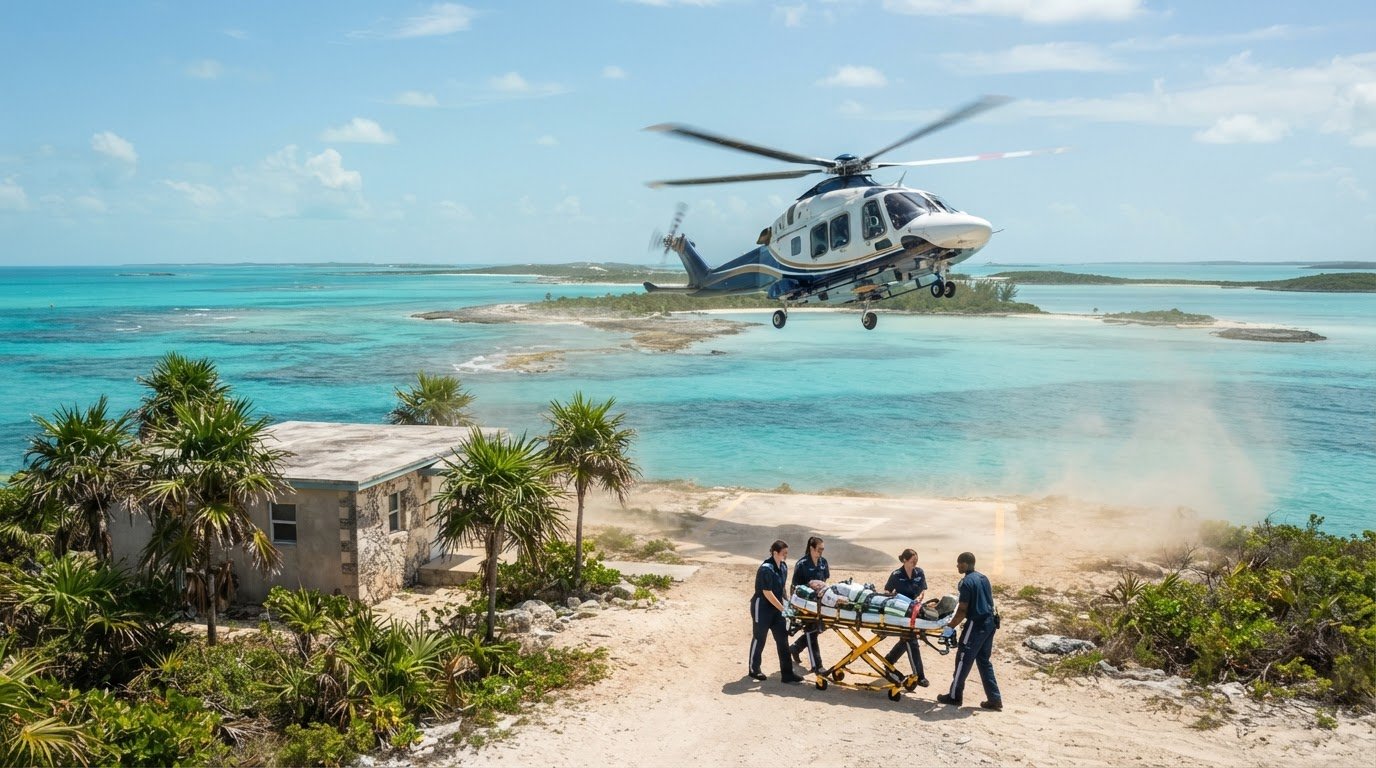
What happens when a local clinic can’t provide the level of care a patient needs, and the next suitable facility is beyond the island? Remote island medical evacuation Bahamas planning involves more than getting an aircraft airborne. It connects the patient’s medical needs with suitable transport and a receiving facility. For families and visitors, understanding who coordinates those steps can make an urgent situation easier to navigate.
A clinic may provide initial care, while a serious emergency may require transfer elsewhere. Helicopters can reach some remote locations without runways, but each response depends on the patient’s condition, access to the pickup point, and care available at the destination. This guide explains the stages of air-medical coordination, the information that can help responders, and how membership can support planning for medical transport before an emergency arises.
Key Takeaways
- Remote island medical evacuation Bahamas planning involves coordinating the patient’s needs, transport access, and an appropriate receiving facility.
- Clear clinical information and destination planning help connect an initial assessment with further care.
- Helicopters can reach some remote locations without runways. The appropriate aircraft depends on access and operational fit.
- Keep essential medical details, emergency contacts, and precise location information accessible before travel or an extended island stay.
- Tropic Air Rescue provides helicopter transport with remote-location landing capability and onboard life-support equipment. Membership is required to access the service.
Why remote island medical evacuation in the Bahamas can be complex
Remote island medical evacuation is the coordinated transport of a patient to appropriate care when local access is limited. It is not routine passenger air travel. The patient’s condition, the care available locally, and the receiving facility’s ability to continue treatment all shape the plan. The Medical evacuation overview describes the broader role of air ambulances and helicopters in moving patients who need care beyond their current location.
For people searching for “remote island medical evacuation Bahamas,” an aircraft is only one part of the plan. Distance from further care matters, but so do local services, access to a suitable landing location, and the care the patient may need next. These factors shape the route from initial assessment to further treatment.
What makes medical access different on a remote island?
Geographic separation can add coordination steps. A patient may first need assessment at a local clinic, then transfer to another facility for further evaluation or treatment. Clinic capabilities vary according to the services and resources available at each location. Planning around the patient’s needs and the specific care pathway is more useful than assuming every clinic has the same capacity.
Access on the ground matters too. A patient may be some distance from an airstrip or suitable landing area, so responders need clear directions to the pickup point. This is why remote island medical evacuation Bahamas planning involves more than measuring the distance between islands. Location, access, and the care available at each stage all influence the transfer.
When does air transport become part of the care pathway?
Air transport may be considered when a medical assessment indicates that the patient needs care beyond what is available locally and a receiving-care plan can be arranged. Clinical need and professional medical direction guide the decision, not distance alone. Emergency transport is different from flying for a routine appointment or scheduled journey.
Think of the pathway as connected steps, each with a distinct purpose:
- Reach a clinic: The patient receives an initial assessment and care appropriate to the local setting.
- Coordinate a transfer: The patient’s medical needs, transport access, and intended receiving facility inform the plan.
- Continue care: The patient is handed over for further assessment or treatment at the receiving facility.
Air transport does not replace the initial assessment or professional medical direction. It links stages of care when local access or available services are not sufficient for the patient’s needs. Knowing the difference between reaching a clinic, transferring between facilities, and accessing further care makes the remote island medical evacuation Bahamas process easier to understand. A flight alone does not resolve every access challenge.
How air medical coordination connects remote clinics with further care
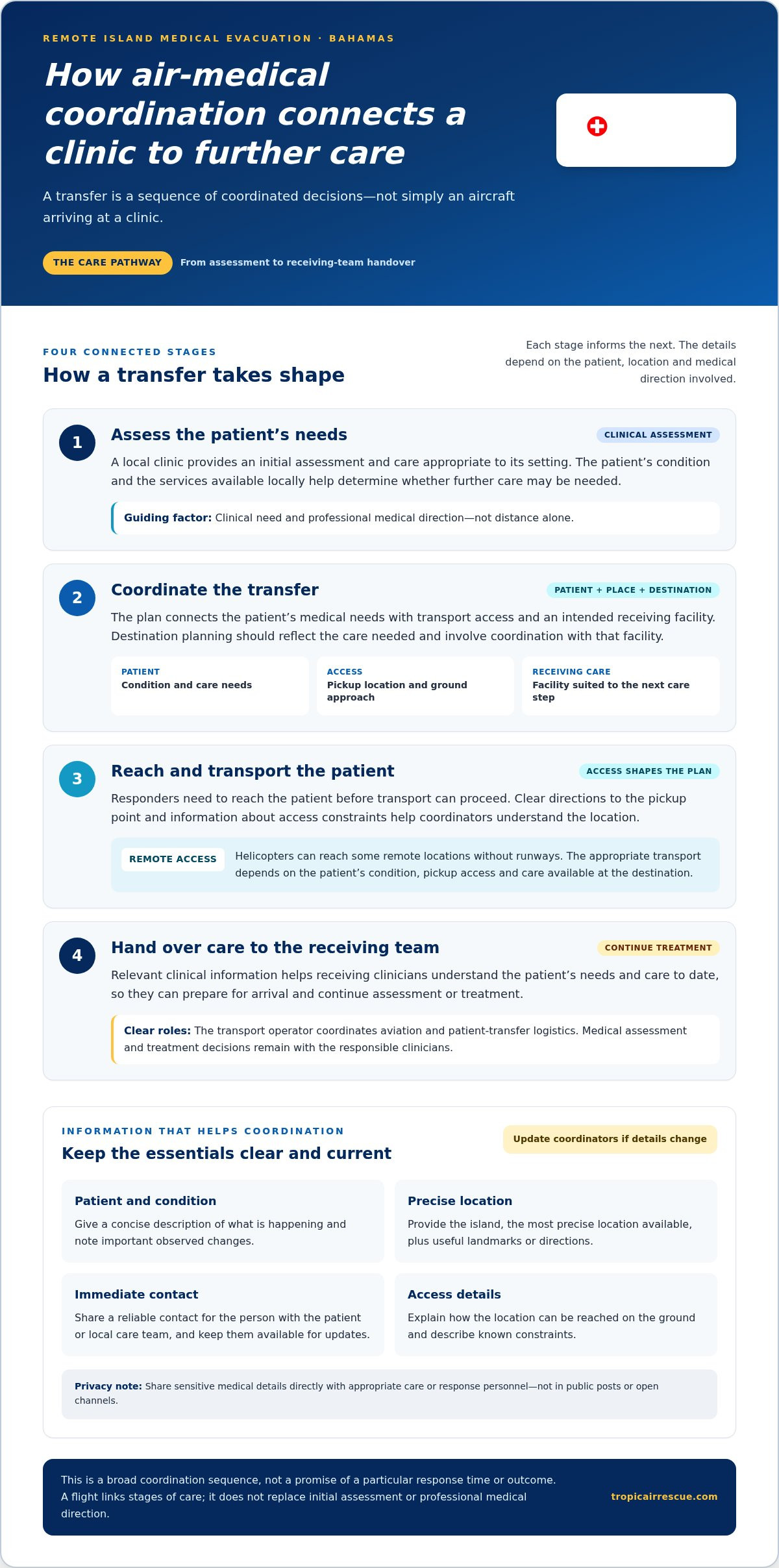
An air-medical transfer is a sequence of coordinated decisions, not simply an aircraft arriving at a clinic. The care team assesses the patient’s needs, transport is arranged around the patient and location, the patient is reached and transported, and receiving clinicians take over further care. Each stage informs the next, and the details depend on the circumstances and medical direction involved.
Assess the need, coordinate transport, reach the patient, and hand over care to the receiving team. This is the broad sequence, not a promise of a particular response time or outcome. For remote island medical evacuation in the Bahamas, keeping the clinical plan and transport plan aligned helps make each handoff more coherent.
What information helps coordinate an air-medical response?
Clear, current information helps coordinators understand the patient’s situation and the practical access needs. Relevant details vary by incident, but these examples can help you prepare:
- Patient and condition: Give a concise description of what is happening and note important changes observed by the people at the scene.
- Location: Provide the island and the most precise location available, along with landmarks or directions that can help responders find the patient.
- Immediate contact: Share a reliable way to reach the person with the patient or the local care team, and keep that person available for updates.
- Access details: Explain how the location can be reached on the ground and describe any known constraints on reaching the patient.
Accuracy matters. If the patient’s condition or access situation changes, pass on the updated information so coordinators can reassess the plan. Share sensitive medical details directly with the appropriate care or response personnel, not in public posts or open channels.
How does the clinic-to-receiving-care handoff work?
When further care is needed, the sending care team can share relevant clinical information with the receiving team so they can prepare for the patient’s arrival. The details depend on the case, but the purpose is practical: give the next clinicians context about the patient’s needs and care to date. Destination planning should reflect those needs and involve coordination with the intended receiving facility, rather than assuming the nearest location is automatically appropriate.
The transport operator coordinates aviation and patient-transfer logistics. Medical assessment and treatment decisions remain with the responsible clinicians. Keeping these roles clear connects transport with clinical direction without suggesting that the aircraft operator replaces the treating team.
This clinic-to-facility process is closely related to interhospital medical transfers, where continuity depends on coordination between the sending and receiving teams as well as transport. Tropic Air Rescue provides interhospital transfer services as part of its air-medical work in the Bahamas. If you’re planning ahead, explore air-medical membership options to understand how membership fits into a wider care pathway.
Helicopter or fixed-wing aircraft: what affects remote island access?
Aircraft choice starts with access, then accounts for the patient and the care plan. Fixed-wing aircraft need a suitable runway, while helicopters can reach some remote landing locations that lack one. Helicopter access may be relevant when a patient is far from an airstrip, but it is not the right choice for every transfer.
The comparison below covers general access considerations. Suitability depends on the location and circumstances of the response.
| Consideration | Helicopter | Fixed-wing aircraft |
|---|---|---|
| Access | Can reach some remote landing locations without a runway. | Requires access to a suitable runway for arrival and departure. |
| Landing requirements | Needs a landing area suitable for the aircraft and prevailing conditions. | Needs a usable airstrip and arrangements to connect the patient with it. |
| Operational fit | May suit a location where runway access is the key constraint. | May suit a pathway that can use runway access as part of the transfer plan. |
What access considerations can favor helicopter transport?
If an island location is not close to a runway, the ability to land at an appropriate remote site may help connect the patient with onward care. The site and conditions must be suitable for the operation, and the patient’s needs must fit the proposed transport plan. Advanced avionics support navigation, but they do not remove the need to assess the route, location, and operating conditions.
Tropic Air Rescue provides helicopter air-medical transport throughout the Bahamas. Its aircraft are equipped with advanced avionics and life-support equipment, and remote-location landing capability can support access where fixed-wing aircraft cannot land. The aircraft is one part of a coordinated medical pathway, not a substitute for assessment or care at the receiving facility.
What factors can change the transport plan?
A location that appears accessible in principle may not be suitable under current conditions. Weather, landing-area suitability, the patient’s condition, and other operational constraints can all affect the plan. The intended receiving care matters too: transport should connect the patient with an appropriate next step, not focus on aircraft access alone.
For remote island medical evacuation Bahamas planning, decisions depend on real-time assessment and coordination. No aircraft type is universally faster, safer, or clinically superior. The appropriate option depends on how the location, patient needs, operating conditions, and receiving-care plan fit together.
How to prepare for an air-medical emergency on a remote island
Preparation means making essential information easy to find and share if an emergency occurs. Before travel or a longer island stay, organize key medical details, emergency contacts, and location information where you and your companions can access them. If you’re researching “remote island medical evacuation Bahamas,” a practical first step is having clear, current information ready.
Use this checklist as a starting point:
- Medical summary: Keep current information about relevant conditions, allergies, medications, and other details that may help medical professionals.
- Emergency contacts: Save important contacts in your phone and keep a backup that companions can access.
- Location details: Note the island, accommodation or vessel location, nearby landmarks, and clear instructions for reaching the patient.
- Access information: Record practical constraints responders may need to know, such as gated access or a difficult route to the patient.
What details should travelers keep accessible?
Keep information current, concise, and available to the people who may need to communicate with responders. Precise directions matter: “near the waterfront” is less useful than a clear location and recognizable landmark. Share health details directly with medical professionals or appropriate responders. Don’t post private medical information in public forums or send it through channels you can’t trust. This preparation makes essential details easier to relay during a remote island medical evacuation Bahamas response.
What should a group or property team plan ahead?
Agree in advance on who will speak with responders and provide the patient’s location. Choose a second person to relay updates to companions, allowing the person communicating to stay focused. Keep the process simple: decide who calls, who shares directions, and who keeps others informed. Broader emergency-response planning can also cover local contacts, meeting points, and how a group will communicate if mobile access is limited.
During an active incident, follow instructions from local emergency responders and medical professionals. Share accurate updates when requested, avoid conflicting directions, and don’t attempt to direct aircraft or manage clinical care yourself. For anyone preparing for “remote island medical evacuation Bahamas” possibilities, clear communication and professional guidance are priorities.
Preparedness also includes understanding transport options before they’re needed. Membership can be part of that planning for individuals or groups spending time on remote islands. Explore Tropic Air Rescue membership options to learn about short-term membership for air-medical transport preparedness.
How Tropic Air Rescue supports remote island medical evacuation
Reaching a patient is only one part of connecting them with appropriate care. Tropic Air Rescue provides concierge helicopter air-medical transport throughout the Bahamas, supporting transfers from remote locations as part of a wider care pathway. The service is for medical transport, not routine passenger travel. Access, patient needs, and coordination with further care all matter.
What role can a helicopter air-medical service play?
A helicopter can land at some remote locations that fixed-wing aircraft can’t access, including places without a runway, when the landing area and conditions are suitable. This capability may help bridge the distance between an island location and a point of further care. It does not replace assessment by medical professionals or determine what treatment a patient needs.
Tropic Air Rescue’s aircraft have advanced avionics and life-support equipment. These capabilities support air-medical transport, while clinical direction and receiving-care coordination remain essential parts of the journey. Together, the transport plan and care plan connect the patient’s location with the next stage of care.
How can travelers consider coverage before departure?
Membership is required for Tropic Air Rescue’s service. Travelers can choose short-term or annual membership according to their anticipated length of stay in the Bahamas. Reviewing membership before departure makes transport preparedness part of trip planning, rather than a decision left until an urgent situation arises.
For members, Tropic Air Rescue bills health insurers directly and accepts insurance payouts as full payment, so members incur no out-of-pocket costs. Membership is the preparation step; any response still depends on the patient’s circumstances and coordination of the care pathway.
For anyone considering remote island medical evacuation in the Bahamas, a prepared air-medical service brings together helicopter access, onboard life-support equipment, and transport coordination. Each supports a different part of the journey, from reaching a remote location to connecting the patient with further care. None replaces clinical assessment or receiving-care planning.
Explore short-term or annual membership before travel. Reviewing membership in advance helps you make transport preparedness part of your plans, well before an emergency occurs.
Make transport preparedness part of your travel plan
Before your next island stay, consider how medical transport fits into your emergency plan. Knowing your options in advance can help you focus on sharing accurate information and following professional guidance if circumstances change. For remote island medical evacuation Bahamas, preparedness starts before anyone needs to travel for care.
Tropic Air Rescue provides helicopter air-medical transport throughout the Bahamas, with remote-location landing capability where fixed-wing aircraft cannot land and onboard advanced avionics and life-support equipment. Membership is required, so review the options before departure rather than during an emergency.
Explore medical evacuation membership before you travel and make a considered plan for your time in the islands.
Frequently Asked Questions
How does remote island medical evacuation work in the Bahamas?
Remote island medical evacuation in the Bahamas typically starts with a clinical assessment, followed by coordination between the people arranging transport and the care teams. The patient is reached and moved according to the plan, then handed over for further care. The pathway depends on the patient’s condition, location, and operating conditions. Medical professionals guide care decisions; transport coordination supports that plan rather than replacing clinical judgment.
Can a helicopter reach a remote clinic or island location?
Yes. A helicopter can reach some remote landing locations that fixed-wing aircraft cannot, but no aircraft can be assumed to reach every clinic or property. A suitable landing area and current operating conditions are essential considerations. Share a precise location and nearby access landmarks with responders. Tropic Air Rescue provides helicopter air-medical transport throughout the Bahamas, including access to remote locations where fixed-wing aircraft cannot land.
What happens if a remote clinic cannot provide the care a patient needs?
If local clinicians determine that a patient needs care beyond what’s available at that location, they may coordinate a transfer to an appropriate receiving facility. The destination depends on the patient’s needs and coordination with the receiving-care team, not a blanket rule about which facility to use. Clinic capabilities vary, so decisions should be guided by the professionals assessing the patient and planning the handoff.
Does weather affect medical evacuation by helicopter?
Yes. Weather is one factor aviation teams consider, alongside landing-area suitability, aircraft operations, and the patient’s needs. Conditions may affect whether an air response can proceed or require a change to the plan. Travelers can’t use a universal weather threshold to predict a departure. During an incident, follow current instructions from local responders and medical professionals, who can provide guidance based on conditions at the time.
Is helicopter evacuation always the best option for a remote island emergency?
No. The suitable aircraft depends on the specific situation. Patient condition, location, landing access, operating conditions, and the intended care destination all inform the plan. Helicopters can access some remote locations unavailable to fixed-wing aircraft, but that capability alone doesn’t determine the right transport. Case-specific assessment and coordination are needed to connect the patient with appropriate care.
What information should I have ready when requesting medical help on a remote island?
Be ready to give responders the patient’s precise location, a reliable callback number, and a concise description of what is happening. Share relevant medical information if requested, and update responders if the patient’s condition or access details change. Keep communication direct and follow local emergency professionals’ instructions.
Does medical evacuation membership cover remote island emergencies in the Bahamas?
Tropic Air Rescue requires membership to access its benefits and offers short-term and annual membership options. For members, the company bills health insurers directly and accepts insurer payouts as full payment, so members incur no out-of-pocket costs. Reviewing membership before travel helps you make air-medical transport part of your emergency preparedness plans.