

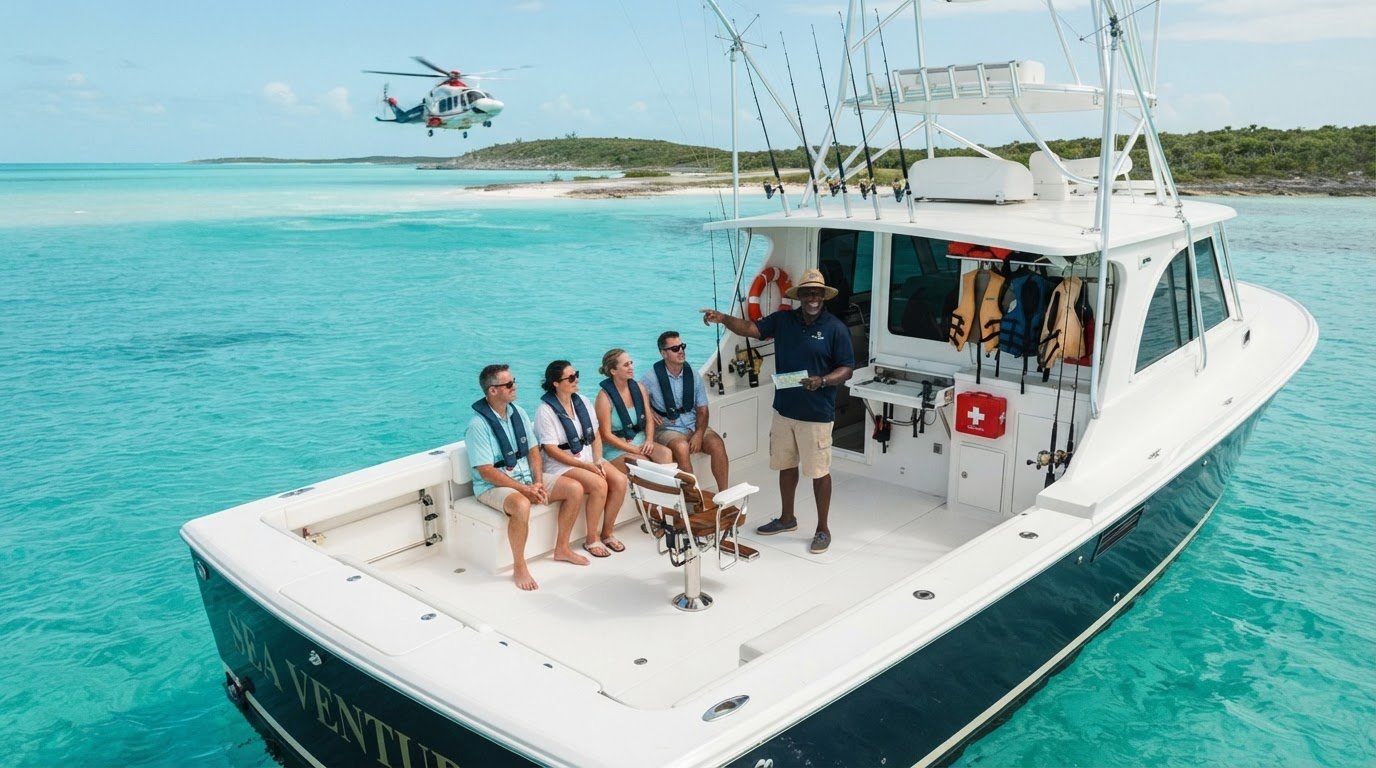
A life jacket should be available for every passenger on a fishing charter in The Bahamas, and emergency assistance can be reached by dialing 911 or 919. Medical safety for fishing charters in the Bahamas starts with these basics, then extends to the boat’s emergency readiness and your route to medical care. A calm day on the water still calls for a clear plan.
You’re right to look beyond the catch: knowing what safety equipment is on board and how to get help matters before departure. This guide explains what to check about life jackets, emergency assistance, charter licensing and insurance, and access to medical care. Use it to prepare for a fishing trip, from the dock to the nearest point of care.
Key Takeaways
- For personalized health advice, consult a healthcare provider or travel health clinic preferably 6 weeks before travelling, according to the Public Health Agency of Canada.
- Before departure, assess whether life jackets are accessible and suitable for each passenger, and understand the boat’s emergency procedures.
- Review charter licensing and insurance details so you understand the operator’s coverage and what your own travel insurance includes.
- Plan how you would reach medical care from your fishing location, and learn how Tropic Air Rescue’s Short-term Membership fits into emergency medical transport planning.
Boating safety and life jackets
A life jacket is wearable flotation equipment designed to help keep someone afloat. For boating in The Bahamas, make sure one is available for every passenger. Before leaving the dock, locate the jackets and check that one fits each person. Keep them accessible, not buried beneath fishing gear. For children, check the fit carefully and follow the captain’s instructions about wearing them.
Medical safety for fishing charters in the Bahamas also means knowing where essential supplies are kept. During the safety briefing, ask the captain to point out the first-aid kit. Carry personal medication in its original container, with prescription details accessible. Tell the captain about relevant health needs before departure so the crew understands what assistance a passenger may need.
Heat illness describes health problems caused by excessive heat; dehydration occurs when the body loses more fluid than it takes in. Sun exposure can burn skin, and boat motion can trigger seasickness. Bring drinking water, sun-protective clothing, and any familiar motion-sickness measures. Take breaks in the shade and drink regularly. Tell the crew promptly if someone feels faint, confused, unusually weak, or persistently nauseated.
For personalized preparation, the Public Health Agency of Canada advises consulting a healthcare provider or travel health clinic preferably 6 weeks before travelling. The same organization advises getting a flu shot at least 2 weeks before travelling. Use that appointment to discuss existing conditions, medication, and time on the water. Planning medical safety for fishing charters in the Bahamas includes sharing relevant concerns before boarding, especially if heat, sun, or boat movement could affect a passenger.
Before heading out with a charter, include learning about local boating regulations in your preparations for a trip to The Bahamas.
Emergency assistance numbers
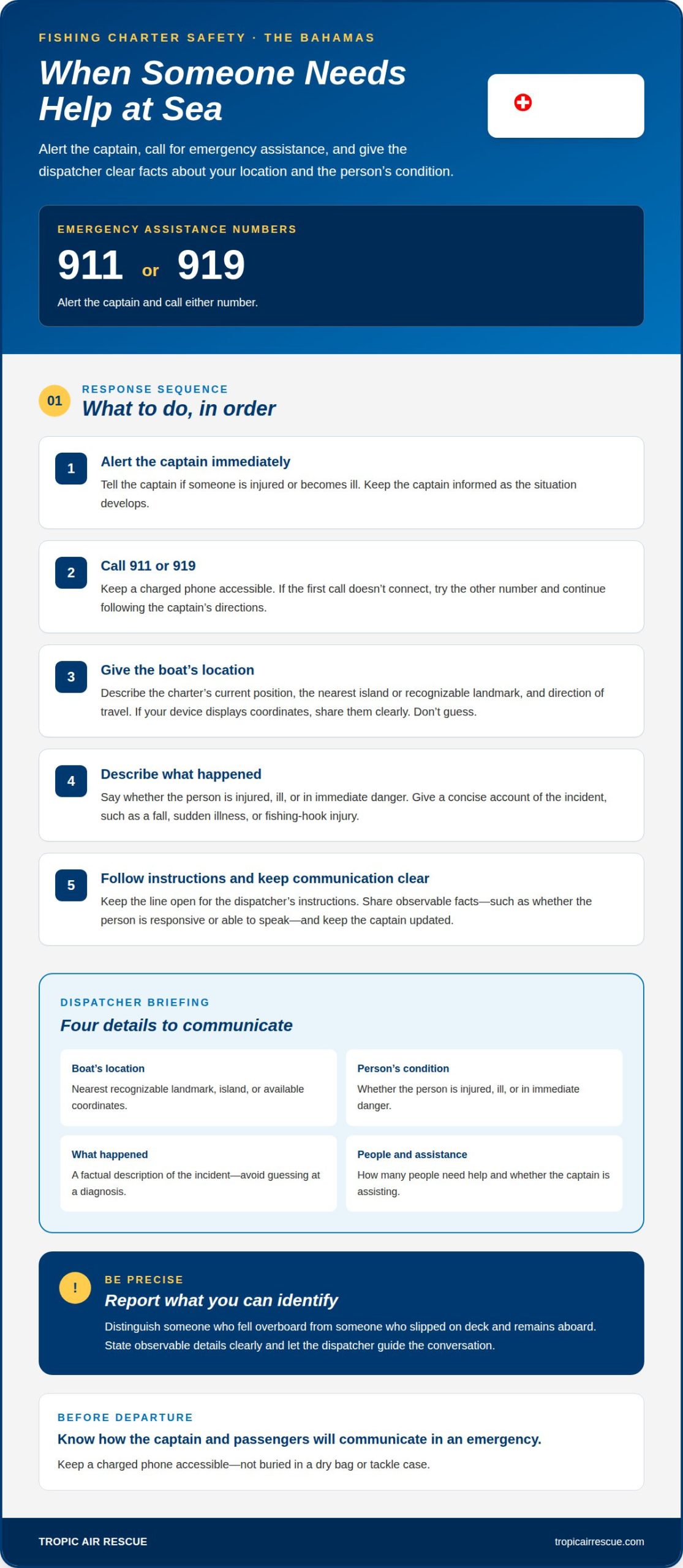
Emergency assistance numbers are telephone numbers used to request urgent help. In The Bahamas, emergency assistance can be reached by dialing 911 or 919. If an angler is injured or becomes ill aboard, alert the captain and call one of these numbers. Follow the dispatcher’s instructions and keep the captain informed.
A location description tells responders where help is needed. Before calling, note the charter’s current position, the nearest island or landmark, and the direction of travel. If your device displays coordinates, share them clearly. Don’t guess. Describe what you can identify and let the dispatcher guide the conversation.
An incident briefing is a short, factual account of what happened and who needs assistance. Give the dispatcher:
- The boat’s location or nearest recognizable landmark.
- Whether the person is injured, ill, or in immediate danger.
- What happened, such as a fall, sudden illness, or fishing-hook injury.
- How many people need help and whether the captain is assisting.
Specific details keep communication clear. For example, distinguish a passenger who fell overboard from someone who slipped on deck and remains aboard. Report observable facts, such as whether the person is responsive or able to speak. Avoid guessing at a diagnosis; the dispatcher needs a concise account of the situation and location.
What should anglers do if someone is injured or becomes ill on a fishing charter in the Bahamas? Alert the captain immediately, call 911 or 919, and give the dispatcher the boat’s location and the person’s condition. Keep the line open for instructions, and have another passenger relay updates to the captain if needed.
Before departure, identify how the captain and passengers will communicate during an emergency. Keep a charged phone accessible, rather than buried in a dry bag or tackle case. If the first call doesn’t connect, try the other number, 911 or 919, and continue following the captain’s directions. A clear location, concise incident details, and prompt communication are practical steps for an emergency at sea.
Anglers can request urgent help by calling 911 or 919 and giving the dispatcher the boat’s location and the person’s condition; the dispatcher can guide the call. The captain should be alerted and kept informed.
Licensing and insurance
A charter licence is authorization associated with operating a commercial boat or charter service. Before booking, compare the operator’s name and vessel details on the documents provided with the trip you plan to take. Keep the booking confirmation and licensing information together so you can identify the operator and vessel if plans change.
Insurance is a contract that may cover defined risks under stated terms. Read the charter’s written insurance information for the named insured, covered activities, exclusions, and claims contact. Compare it with your own travel or health insurance documents. Coverage depends on policy wording, so don’t treat a charter policy and a personal policy as interchangeable.
Do Bahamian fishing charter captains need first-aid, CPR, or emergency-response certification? A boating licence and a medical-response certificate are different credentials; one does not prove the other. Ask what current first-aid, CPR, or emergency-response training the captain holds, and what emergency role the crew has assigned.
Before booking, request the operator’s relevant licensing, safety, and equipment documents, and ask for a clear description of onboard emergency procedures. Compare the operator and vessel names across the paperwork. Check whether the response plan explains who calls for help and how the boat’s location is communicated. Ask where life jackets and the first-aid kit are kept, and whether passengers receive a safety briefing.
- Licensing: Match the named operator and vessel to the booking.
- Insurance: Review covered activities, exclusions, and the claims contact.
- Training: Treat captain credentials and emergency procedures as separate checks.
- Equipment: Identify the location of life jackets and first-aid supplies before departure.
Keep copies of the booking, insurance details, and operator information accessible on your phone. If a different vessel arrives, compare its identity with your booking before boarding. Clear records make it easier to identify the charter and boat if an incident occurs.
Medical services and facilities
Access to medical care on a fishing trip depends on the boat’s location and the care needed. Before leaving shore, plan how to describe an incident and reach assistance.
For an urgent incident, call 911 or 919 and give the dispatcher the vessel’s location, the person’s condition, and the help needed.
Emergency Treatment and Evacuation Costs
Emergency treatment and medical evacuation costs cover clinical care and transport to appropriate medical services. There is no single cost for care or evacuation in The Bahamas. The amount depends on the treatment required, the patient’s location, transport logistics, and insurance coverage.
Before travelling, read your policy for emergency treatment, medical transport, exclusions, and claims procedures. Keep the insurer’s emergency contact details accessible, and carry policy information separately from prescription records. In an emergency, prioritize appropriate care. Keep receipts and clinical documents for any later insurance claim.
Coast Guard and Emergency Medical Resources
Emergency medical resources are services that respond to urgent health incidents, while maritime responders assist with emergencies at sea. In The Bahamas, call 911 or 919 to reach emergency assistance, then state the boat’s location and the nature of the incident.
For a charter near an island, identify the nearest recognizable landmark and share any available position details with the dispatcher. The captain can communicate the vessel’s location and coordinate the response. Give clear updates if the boat moves or the passenger’s condition changes.
Medical facilities and transport options depend on where the charter is operating and what care the patient needs. After an initial assessment, a passenger may need a transfer between hospitals. Keep the passenger’s medication details and relevant medical history ready to support handover between care teams.
For a transfer between hospitals, Tropic Air Rescue’s Interhospital Transfer Services address medical transport needs after a patient reaches hospital care. Keep the treating team’s information available so the transfer can be coordinated around the patient’s condition and destination.
Tropic Air Rescue: Short-term Membership
Tropic Air Rescue’s Short-term Membership connects visitors in The Bahamas with emergency air-medical transport. Membership is required for its service, which provides emergency and interhospital transport throughout the Bahamas. This may be relevant if a serious illness or injury requires transport to medical care, or if a patient needs a transfer between hospitals.
Tropic Air Rescue can bill health insurers directly for members, who incur no out-of-pocket costs for the service. Review your insurance details and membership arrangements as part of your medical travel planning. A Short-term Membership is one option for visitors, while an Annual Membership is available for ongoing coverage needs.
For hospital-to-hospital needs, Interhospital Transfer Services address patient transport; Organ Transport supports a separate medical logistics need. To learn more about membership and medical transport in The Bahamas, visit Tropic Air Rescue.
Make the next step part of your plan
Medical safety for fishing charters in the Bahamas also means understanding how medical transport fits into your travel plans. Before your trip, consider who would coordinate care if an emergency required hospital treatment or a transfer between hospitals. Keep relevant insurance details and medical information accessible, and tell a trusted travel companion where to find them.
When your planning includes air-medical transport, Tropic Air Rescue offers Short-term Membership and Annual Membership, along with Interhospital Transfer Services. These options address different planning needs, from a stay in The Bahamas to a transfer between hospitals. Review the details that apply to your travel arrangements and keep your chosen information available during the trip.
For information about membership and medical transport, contact Tropic Air Rescue. A clear plan lets you focus on the trip with greater confidence.
Frequently Asked Questions
How can charter passengers contact emergency services or request maritime rescue in the Bahamas?
Call 911 or 919 in The Bahamas and state that you need emergency assistance at sea. Ask the captain to lead communication, since they can provide vessel details and coordinate onboard response. If another passenger calls, have them relay the boat’s name, location, nature of the emergency, and a callback number, then share any changes with the captain.
What travel insurance or medical evacuation coverage should visitors have for fishing charters in the Bahamas?
Choose travel insurance that addresses emergency medical treatment and medical evacuation, and read the policy’s exclusions and claims process. Check how it treats pre-existing conditions and activities on the water. Tropic Air Rescue membership is not an insurance policy or secondary coverage. Members must maintain medical insurance and are responsible for uncovered costs. Keep insurer contact details and policy documents accessible.
What medical and first-aid equipment are fishing charter boats in the Bahamas required to carry?
A life jacket should be available for every passenger. Before departure, ask the captain to show you where the first-aid kit is kept.