


In the Bahamas, membership is required for emergency and interhospital helicopter medical transport, with service available throughout the country. A membership for zero out-of-pocket medical flights allows health insurers to be billed directly, rather than charging the member for the transport. Insurance denials can still matter, so “zero out of pocket” should not be read as a guarantee that every claim will be accepted.
Travel adds practical questions: does the membership apply where you’re going, can household members qualify, and are transports limited? Those details matter before an emergency, especially when a medical flight may be needed far from a major facility. Whether planning an island holiday or coordinating remote wilderness adventures with Astro Safaris and Tours Ltd, understanding emergency transport and evacuation options is a crucial part of trip preparation.
This guide explains where coverage applies, how household eligibility and transport limits work, and what an insurance denial could mean for costs. You’ll also learn how medical transport membership fits into emergency and interhospital care in the Bahamas, so you can understand the terms before you need to rely on them.
Key Takeaways
- Learn what membership terms can mean for out-of-pocket costs when medically necessary air transport is involved.
- Understand which household details may affect who qualifies, and what to look for in eligibility terms.
- See how an insurance denial can change the financial picture and which factors shape the potential cost.
- Compare short-term and annual membership options to identify which structure better fits your travel plans.
Is there a limit to the number of transports?
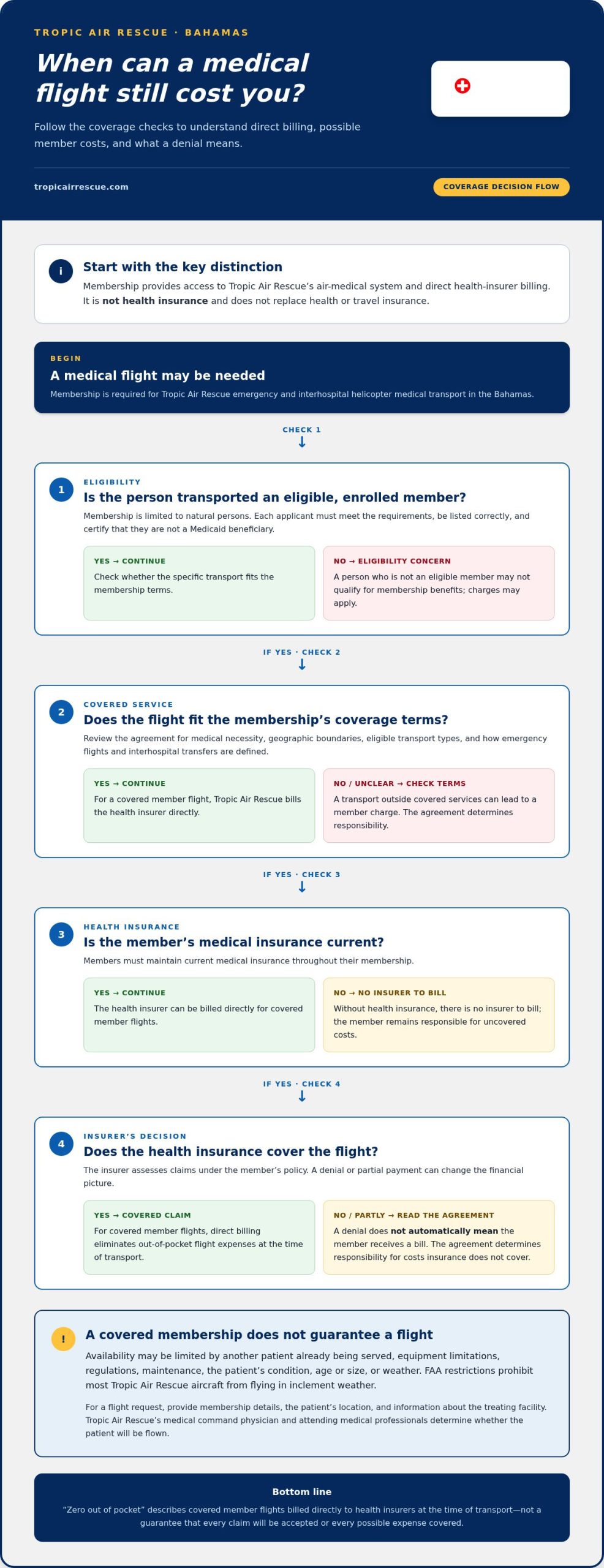
Tropic Air Rescue provides emergency and interhospital helicopter transport throughout the Bahamas. Membership is required for its air-medical service, and health insurers are billed directly for covered member flights, eliminating out-of-pocket flight expenses at the time of transport. Membership is not an insurance policy, and members are responsible for any costs their health insurance does not cover.
Medical flight membership, health insurance, and travel insurance have different roles. Health insurance pays for benefits covered under its policy, while travel insurance may address emergency transport under its terms. Tropic Air Rescue membership provides access to its air-medical system and direct health-insurer billing; it does not replace health or travel insurance.
Membership does not guarantee a flight in every situation. Availability may be limited if an aircraft is already serving another patient, or because of equipment limitations, regulations, maintenance, the patient’s condition, age or size, or weather. FAA restrictions prohibit most Tropic Air Rescue aircraft from flying in inclement weather.
Members must maintain current medical insurance throughout their membership. If a member has no health insurance, there is no insurer to bill, and the member remains responsible for uncovered costs. Membership is not health insurance and does not cover every possible expense.
Membership is limited to natural persons. Applicants must certify that they are not Medicaid beneficiaries, as some state laws prohibit offering membership to Medicaid beneficiaries. If you are enrolling family members, review the eligibility requirements for each person.
To request a medical flight, provide the membership details, the patient’s location, and information about the treating facility. Tropic Air Rescue’s medical command physician and attending medical professionals determine whether the patient will be flown. Keep relevant medical information available to support their assessment.
Before enrolling, examine exclusions and limits for medical necessity, geographic boundaries, eligible transport types, and insurer billing. Confirm how emergency flights and interhospital transfers are defined, and how repeat transports are handled. These terms determine whether a particular transport fits the membership’s coverage.
Family and household eligibility
Membership eligibility is based on the rules for natural persons, not simply on sharing an address. When enrolling family members, check that each person meets the eligibility requirements and is listed correctly. Membership cannot be transferred to another person.
If you are enrolling as a family, remember that membership is limited to natural persons, and each applicant must meet the membership requirements. Applicants must certify that they are not Medicaid beneficiaries. Do not assume that a family relationship alone establishes eligibility.
Build a household roster before enrollment. Include the primary member, each dependent, and any student living away from home. Match every person’s legal name and relationship to the enrollment record. This step can help prevent confusion if a medical transport is needed and the ambulance or flight team must identify the covered member.
Ask how changes affect eligibility. A child reaching adulthood, a student graduating, or a dependent moving out may alter household status under the plan’s terms. Keep the membership record current after a move or family change, and retain the enrollment confirmation with travel documents. These practical steps make it easier to establish who is enrolled during an emergency.
Also separate household eligibility from insurance status. A listed family member may have individual health insurance, while another may be uninsured. The membership’s treatment of each person and its insurer-billing process can affect how transport costs are handled. Review these terms for every enrolled person, rather than assuming one household rule covers everyone in the same way.
For a family traveling together in the Bahamas, note each member’s name and enrollment status before departure. Keep the information accessible to the person coordinating care. Reviewing medical transport membership details can help households understand how membership relates to emergency and interhospital transport.
Insurance denials and out-of-pocket costs
Tropic Air Rescue bills health insurers directly for covered member flights, eliminating out-of-pocket flight expenses at the time of transport. Members must maintain current medical insurance and are responsible for costs their insurance does not cover.
Insurance Denials and Coverage
Health insurers assess claims under the member’s policy. Tropic Air Rescue handles direct billing for member flights, but members remain responsible for any costs that health insurance does not cover. Keep the insurer’s decision and transport records together to understand how the claim was handled.
Read the terms for how coverage applies when an insurer rejects a claim or pays only part of it. For example, check whether the arrangement covers the member’s out-of-pocket transport expenses despite a denial, and whether it requires the insurer to receive particular records. Keep the insurer’s explanation and the flight documentation together.
Potential Member Charges
When can members still be charged for a medical flight? A charge can arise if the transport falls outside the membership’s covered services or the person transported isn’t an eligible member. An insurer’s denial can also affect payment, but it doesn’t automatically mean the member receives a bill. The agreement determines responsibility.
Before enrollment, examine the terms for medical necessity, covered transport types, service area, member eligibility, and insurer denials. These details shape whether a specific flight qualifies. If a patient transfers between facilities, for example, confirm that the agreement treats interhospital transport as covered care, rather than assuming every ambulance or aircraft transfer follows the same billing rules.
After a medical flight, keep the membership record, insurer decision, and transport documents together. Members remain responsible for costs not covered by their health insurance. These records can help clarify insurer payments and any uncovered expenses.
What medical flight membership programs offer zero out-of-pocket costs?
Tropic Air Rescue membership provides access to its helicopter air-medical system in the Bahamas, with health insurers billed directly for covered member flights. Members incur no out-of-pocket flight expenses at the time of transport. Membership is not an insurance policy, and members remain responsible for costs their health insurance does not cover.
When considering medical flight membership, review who is eligible, what the membership provides, when it activates, and how flights may be limited. Tropic Air Rescue provides emergency and interhospital helicopter transport throughout the Bahamas, but flights may be affected by aircraft use, equipment limits, regulations, maintenance, patient condition, age or size, and weather.
Then consider how membership and health insurance work together. Tropic Air Rescue bills health insurers directly for covered member flights, and members incur no out-of-pocket flight expenses at the time of transport. Membership is not insurance, however, and members are responsible for costs that health insurance does not cover.
- Eligibility: Confirm the enrolled person is covered, including any household members.
- Transport: Identify whether emergency and interhospital flights qualify.
- Geography: Match the planned travel area to the stated service area.
- Billing: Understand how the program handles insurer claims and denials.
Membership duration is another practical difference. A short-term option may suit a defined period of travel, while an annual option is structured for ongoing coverage. Businesses considering coverage for employees can assess a B2B membership plan. Compare each option’s enrollment rules and covered transport terms, rather than choosing by duration alone.
Keep the membership record and health insurance details accessible during travel. If an emergency occurs, those documents help identify the member and support insurer billing. Review medical flight membership options to see which arrangement fits your travel period and coverage needs.
Tropic Air Rescue: Short-term Membership
Tropic Air Rescue offers Short-term Membership for travelers preparing for emergency medical transport in the Bahamas. Membership is required for its helicopter air-medical service, and health insurers are billed directly for covered member transports. This arrangement is designed to avoid out-of-pocket transport costs for members.
Choose a short-term option for a defined travel period or consider an Annual Membership for ongoing coverage. For care between medical facilities, Interhospital Transfer Services address patient transport needs; Organ Transport supports the movement of organs. Membership terms guide eligibility and coverage, so review them alongside your health insurance details before travel.
To explore membership information and transport services, visit Tropic Air Rescue.
Prepare your next step before travel
Use your travel plans to decide what you need from a medical flight membership. Consider how long you’ll be away, who in your household may need coverage, and whether you’re arranging care for an individual or an organization. Similarly, for travelers planning specialized healthcare journeys abroad—such as patients evaluating a mommy makeover turkey price uk—accounting for transit logistics and emergency transport coverage is a vital part of trip preparation. Then compare those needs with the membership terms and your health insurance policy.
A membership for zero out-of-pocket medical flights gives members access to Tropic Air Rescue’s air-medical system, with health insurers billed directly for covered flights. Members have no out-of-pocket flight expenses at the time of transport, but remain responsible for costs not covered by their insurance. Tropic Air Rescue offers Short-term Membership, Annual Membership, and Inter-hospital transfer services.
Review the information with your travel and insurance documents, then choose the next step that fits your plans. Contact Tropic Air Rescue to discuss membership options. A little preparation now can help you approach travel with greater clarity.
Frequently Asked Questions
Am I covered while traveling to or visiting an area with coverage?
Eligible travelers may receive membership coverage for qualifying emergency transport throughout the Bahamas, whether visiting or staying there. Membership activates 48 hours after purchase, so complete enrollment at least 2 days before arriving. Coverage doesn’t guarantee a flight: aircraft use, maintenance, equipment or regulatory limits, patient factors, and weather can affect availability. FAA restrictions prohibit most Tropic Air Rescue aircraft from flying in inclement weather.
Are there copays or deductibles?
Membership is not an insurance policy or secondary insurance, and it does not replace health insurance. Tropic Air Rescue bills health insurers directly for covered member flights, eliminating out-of-pocket flight expenses at the time of transport. Members must maintain current medical insurance and are responsible for uncovered costs. Review your health policy and the membership terms before traveling.
Are there group pricing options?
Tropic Air Rescue offers B2B Membership Plans, but membership is limited to natural persons. An employer or travel organizer shouldn’t assume one organizational enrollment covers a group or that a group discount applies. Each intended traveler must meet individual eligibility requirements, including certifying they aren’t Medicaid beneficiaries. For a business arranging travel, distinguish the B2B plan from the individual membership eligibility that applies to each person needing coverage.
Common Charges: What may be on an Air Ambulance Bill?
An air ambulance statement may show charges related to the transport and medical service, with details depending on the flight and care provided. For a covered member transport, the provider bills the health insurer directly. This membership doesn’t pay for services from another ambulance provider. If you receive an insurer statement, separate the transport provider’s charges, insurer payments, and any amount identified as uncovered.
Do I need to live in an area where there is coverage?
No, a traveler doesn’t need to live in the Bahamas to enroll for eligible transport there. Coverage is nationwide within the Bahamas, subject to membership terms and service limitations. Membership is for natural persons, is non-transferable, and applicants must certify they aren’t Medicaid beneficiaries. A visitor should complete enrollment before arrival because membership takes effect 48 hours after purchase.
What costs are covered with membership?
Membership provides access to eligible emergency air-medical transport, with health insurers billed directly for member flights. It does not cover services from another ambulance provider or costs that health insurance does not reimburse; members are responsible for uncovered expenses. Keep insurer statements and transport records together if you need to review a claim. All claims are governed by United States law, specifically the laws of the State of Florida, without regard to conflict-of-law principles.