

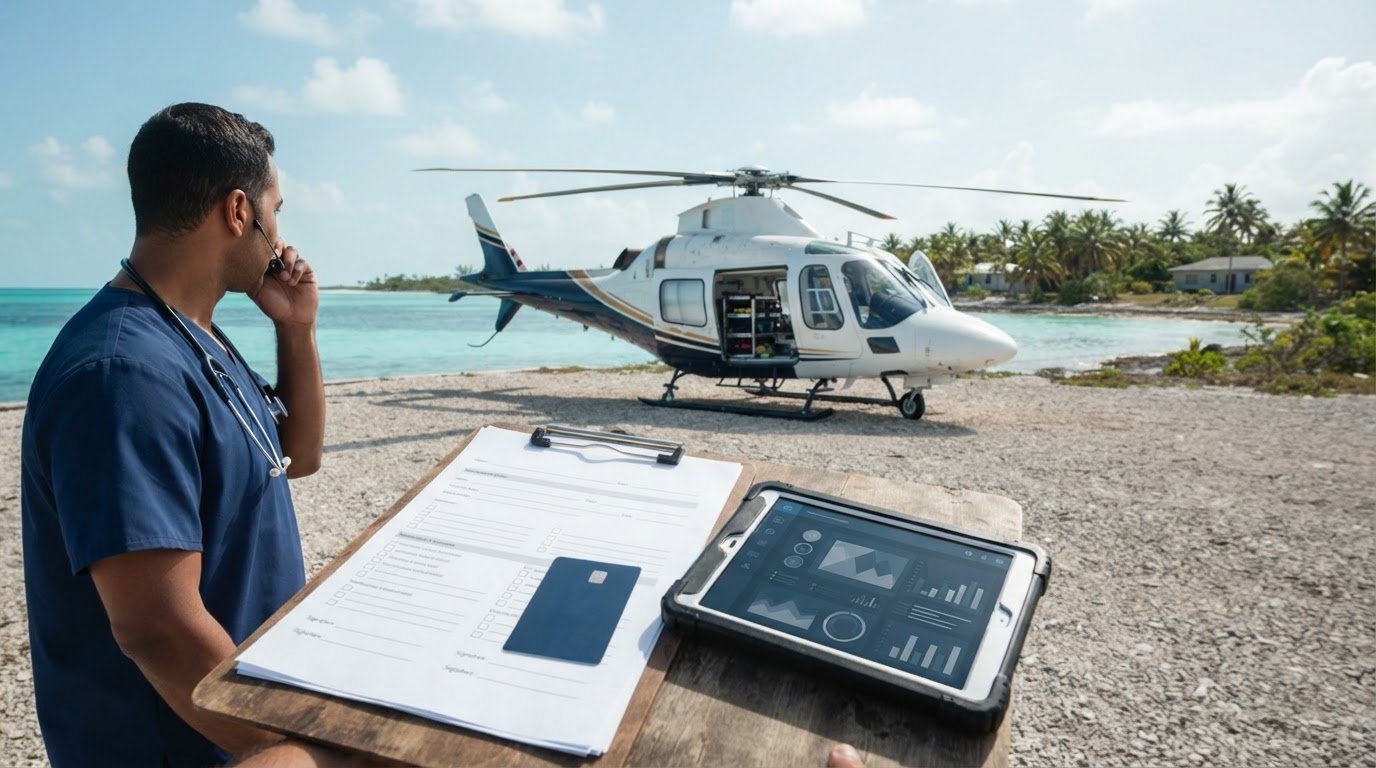
Insurance doesn’t automatically mean a medevac bill will be paid in full. In the Bahamas, how medevac billing works with insurance depends on the policy: the insurer may pay a provider directly, or reimburse the traveller after they pay. Coverage is subject to the plan’s limits and terms, and pre-approval and medical necessity can affect whether a claim qualifies.
It’s reasonable to expect insurance to help with emergency transport, but deductibles, coinsurance, exclusions, or other limits can leave costs unpaid. Understand who arranges the evacuation, what the policy covers, and when the insurer must be notified.
This guide explains direct insurer payment versus reimbursement, common exclusions and out-of-pocket expenses, and why approval matters. It also covers how membership-based interhospital transport fits into the process, so you can better understand the financial steps before an emergency or respond with greater clarity during one.
Key Takeaways
- Find out whether your policy pays the transport provider directly or reimburses you after you submit a claim, and review the plan’s coverage limit.
- Account for possible deductibles, coinsurance, and exclusions, including limits related to pre-existing conditions.
- Notify the insurer promptly: many policies set a 24-48-hour window for reporting a medical emergency and may require pre-approval.
- Understand that U.S. medevac cost examples are not a quote for transport in the Bahamas; your coverage and out-of-pocket exposure depend on your policy terms.
Direct insurer payment and reimbursement
Medevac billing generally follows one of two routes: the insurer pays a provider directly, or the traveller pays first and seeks reimbursement. Which route applies depends on the arrangements and the policy’s coverage terms.
Domestic and international flights follow the same basic distinction: direct payment or reimbursement after payment. A facility or travel assistance provider may coordinate with the insurer, while the traveller may need to submit a claim afterward.
Medical billing starts when a provider sends the insurer information about the service. The insurer verifies eligibility, processes the claim, and may pay the provider. A medical evacuation claim can include patient, provider, diagnostic, procedural, and charge information. The policy’s limits and terms determine how much may be paid.
Medicare and Medicaid Coverage
Medicare and Medicaid assess medevac claims under their own coverage rules, while private medical insurance follows the policy terms. Transport by aircraft alone doesn’t establish that a claim qualifies. Eligibility depends on factors such as the patient’s coverage, medical condition, treatment needs, and the information submitted by the provider. For an evacuation in the Bahamas, don’t assume a U.S. public program applies just because the patient has coverage in the United States.
Submitting an Insurance Claim
A claim is a formal request for insurance payment, supported by details of the transport and medical care. Accurate information helps the insurer assess eligibility and process the bill. Gather the insurer’s claim instructions, the provider’s billing information, and records describing the condition and treatment. Submit the claim through a channel the insurer accepts. Medical billing staff may send electronic claims through payer portals or clearinghouses.
Keep copies of the claim and any response from the insurer. Compare the explanation of payment with the billed services, including diagnostic and procedural details. If you expect reimbursement, follow the policy’s submission requirements and retain proof of payment. These records help clarify whether the insurer paid the provider or owes reimbursement to the traveller.
If the insurer denies payment, compare the stated reason with the claim and policy terms. Billing staff may submit an amended claim with medical notes explaining why transport was necessary. For a disputed bill, review the provider’s charges against the insurer’s decision and request a review through the insurer’s appeal process.
Health insurance gaps and out-of-pocket costs
Insurance may not cover every expense, even after a medically necessary evacuation. The policy limit, exclusions, and payment terms determine any remaining balance.
In-Network and Out-of-Network Coverage
Network status indicates whether a transport provider has an agreement with the insurer. Plans may treat emergency aircraft transport differently, so don’t assume it qualifies as in-network or out-of-network based on the emergency alone. Check how the policy covers emergency medical evacuation, whether it limits eligible providers, and how it calculates payment. Those terms can affect what the patient owes.
Air Ambulance Billing Rules
The No Surprises Act is a U.S. billing law that applies to certain air ambulance bills, but don’t assume its protections apply to an evacuation in the Bahamas. The relevant rules depend on the coverage and circumstances. For a flight involving the United States, identify the plan and service location, then ask the insurer how the law applies. The law doesn’t guarantee full payment.
Flight Costs and Insurance Payments
U.S. flight costs offer context, not a quote for transport in the Bahamas. There’s no standard health-insurance payment amount: the plan’s evacuation limit, eligible expenses, and policy terms determine what it pays. If covered charges exceed the limit, or a service isn’t covered, the traveller may be responsible for the remaining expense.
Checking Policy Details Before Travel
Before travelling to a remote area, find your policy’s emergency medical evacuation limit and definition of medical necessity. Check for exclusions relating to pre-existing conditions, where transport may take you, and whether transport to your home country is covered. Some plans arrange transport to the nearest appropriate medical facility, not a hospital chosen by the traveller. Travel insurance may cover a family member travelling with you, while standalone evacuation coverage may not.
Deductibles, coinsurance, and copayments can create a balance after insurance processing. For Bahamas travel involving a hospital-to-hospital move, review Bahamas transfer options as part of understanding the transport arrangements.
Insurer pre-approval and notification requirements
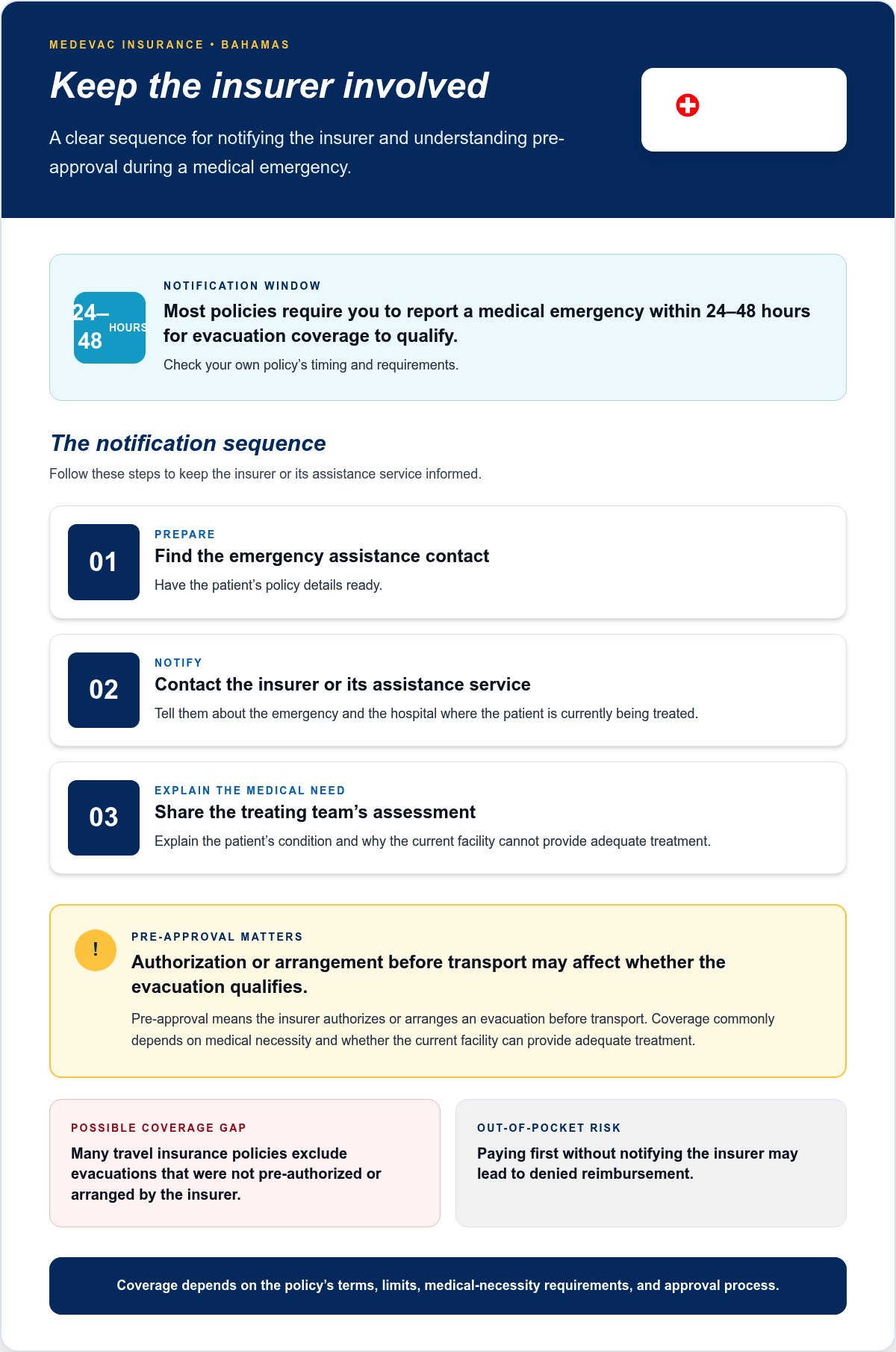
Pre-approval means the insurer authorizes or arranges an evacuation before transport. Coverage commonly depends on medical necessity and whether the current facility can provide adequate treatment. For a patient in the Bahamas, the insurer’s approval process can affect whether an air ambulance qualifies for payment or reimbursement.
Timing matters. Most policies require notification of a medical emergency within 24-48 hours for evacuation coverage to qualify. Many travel insurance policies exclude evacuations that weren’t pre-authorized or arranged by the insurer. Paying out of pocket without notifying the insurer may lead to denied reimbursement.
During travel, follow this sequence to keep the insurer involved:
- Locate the policy’s emergency assistance contact and have the patient’s policy details ready.
- Notify the insurer or its assistance service about the emergency and current hospital.
- Share the treating team’s assessment of the patient’s condition and why the facility cannot provide adequate treatment.
- Ask how the insurer will authorize or coordinate transport, and record the instructions and decision.
These steps clarify the insurer’s role before an ambulance or aircraft is arranged. Record calls, messages, approval details, and the names of the people involved. If the patient can’t make contact, a companion or care facility can help communicate the emergency and policy information.
Urgent medical needs can arise before an insurer completes its review. Still, don’t assume that arranging an air ambulance independently will qualify for coverage. Travel policies may deny reimbursement if the traveller pays first without notifying the insurer or using its arrangements. Early notification gives the insurer a chance to explain its process and document the request for emergency medical evacuation.
After transport, keep the insurer’s instructions and any written authorization with the medical and billing records. If the claim is questioned later, those records can show when notification occurred and what assistance the insurer provided. Policy terms remain central: approval, medical necessity, and the receiving facility’s ability to provide treatment all affect how the claim is assessed.
What does a medevac flight typically cost in the United States?
U.S. medical air evacuation costs can vary widely, and the billed amount isn’t necessarily what the insurer pays. These figures provide U.S. context, not a quote for transport in the Bahamas or for a particular flight.
The final bill reflects the transport arranged and the patient’s medical needs. An air ambulance may require different aircraft, clinical support, and coordination than other transport methods. The route and receiving facility also shape the operation. A U.S. cost example can’t establish what an evacuation in the Bahamas will cost.
Insurance payment depends on the plan, not on a standard percentage of the flight bill. Check the policy’s medical evacuation limit, definition of covered transport, and medical-necessity requirements. A plan may pay eligible expenses only up to its stated limit. If the bill exceeds that amount or the transport doesn’t meet the policy terms, the patient may face a balance.
To understand your exposure, compare these three items:
- Coverage limit: the maximum amount the plan may pay for evacuation.
- Eligible services: whether the policy covers the aircraft transport and related medical assistance.
- Payment terms: whether the insurer coordinates payment or reimburses eligible expenses afterward.
These details matter more than applying a U.S. price range to another country. A traveller in the Bahamas should review their own plan’s limits and terms rather than assume a U.S. estimate predicts the local bill. The insurer’s assessment also depends on whether the evacuation is medically necessary and covered under the policy.
Use U.S. figures as background only. For a medical evacuation in the Bahamas, review your policy wording and the insurer’s process rather than relying on a cost example from another market.
Tropic Air Rescue: Short-term Membership
Tropic Air Rescue’s Short-term Membership is a Bahamas option for people seeking emergency or interhospital helicopter medical transport. Membership is required. Tropic Air Rescue bills health insurers directly, so members incur no out-of-pocket costs.
Short-term Membership may suit a temporary stay; Annual Membership is another option for longer-term planning. Interhospital Transfer Services support a transfer when a patient needs care at another facility. Organ Transport is also available for medical logistics involving organ transport.
Membership-based transport is relevant when arranging emergency or interhospital care in the Bahamas. It differs from paying a transport bill first and seeking reimbursement afterward. Consider how this structure fits alongside your insurer’s policy and approval process.
Explore Short-term Membership with Tropic Air Rescue at tropicairrescue.com.
Prepare for the Next Decision
Understanding how medevac billing works with insurance is part of preparing for a difficult decision, not just managing paperwork afterward. Keep your policy details and key medical contacts accessible, and make sure someone travelling with you knows where to find them. Preparation can help you communicate clearly when circumstances change.
For travel in the Bahamas, consider what kind of medical transport planning fits your needs before an emergency arises. A conversation with Tropic Air Rescue can help you understand the available membership options and how they relate to medical transport. Use that discussion alongside your insurer’s policy information to make a more informed plan.
Contact Tropic Air Rescue to discuss your next step. Thoughtful preparation puts you in a stronger position to act with clarity.
Frequently Asked Questions
What is Medical Evacuation Insurance?
Medical evacuation insurance helps pay for eligible transport when a medical emergency requires care elsewhere. A policy may cover transport to the nearest appropriate medical facility, subject to its limits and terms. For example, a traveller in a remote part of the Bahamas may need transport to a hospital equipped to provide the required treatment. This coverage is distinct from insurance for treating an illness or injury itself.
What does Medevac Insurance Cover?
Medevac insurance may cover emergency transport by air or ground, depending on the plan and location. Some policies also include transport to a home country for continued treatment, travel for a companion, or repatriation of remains. These benefits aren’t universal. Read the certificate wording for the evacuation limit, eligible destinations, medical-necessity criteria, and exclusions such as non-medical evacuations or pre-existing conditions.
How does insurance coverage for air ambulance and medevac billing work?
Understanding how medevac billing works with insurance starts with identifying who arranges transport and how the policy pays. A care facility or travel assistance provider may coordinate directly with the insurer; another arrangement may require the traveller to pay first and submit a claim. Before travelling, note the insurer’s assistance contact and keep your policy details accessible. This helps a companion find essential information during an emergency.
What are common out-of-pocket costs and balance-billing risks for medevac flights?
Out-of-pocket exposure can include a deductible, coinsurance, copayment, or charges above the policy’s evacuation limit. If a plan excludes a transport expense, insurance may not pay that amount. A balance may also arise if a claim is denied or only partly approved. Compare the insurer’s explanation of payment with the provider’s bill, then follow the plan’s review or appeal process if the details conflict.
Does travel insurance or medical evacuation insurance cover medevac costs?
Either type of plan may cover eligible evacuation, but their benefits differ. Medical evacuation insurance focuses on transport and repatriation, while travel medical insurance can cover new illnesses or injuries during the insured dates. A comprehensive travel policy may combine both. For a Bahamas trip, check whether the policy covers the destination, medical transport, and the type of facility needed, rather than relying on the product name alone.