

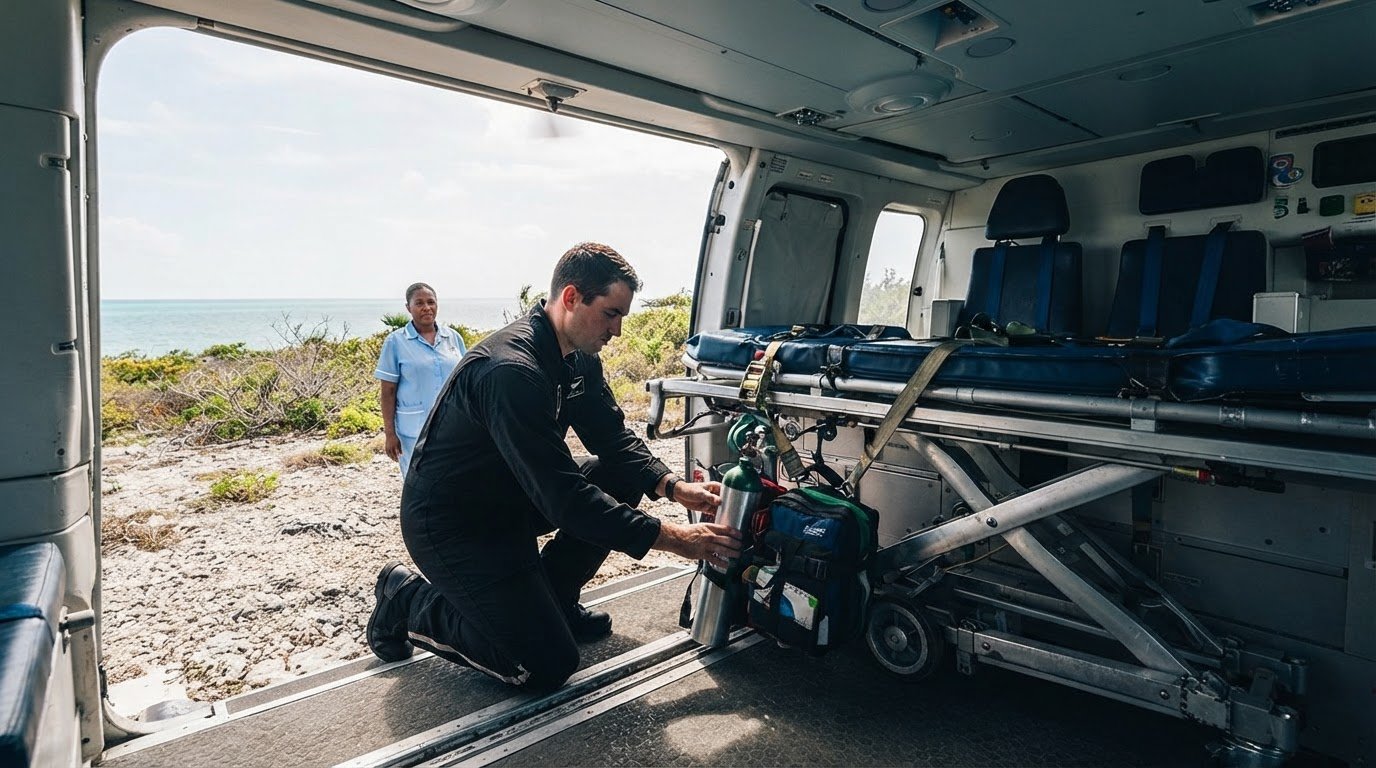
In the Bahamas, a fixed-wing air ambulance is generally better suited to longer transfers between airports, while a helicopter can reach locations without suitable runway access. The limitations of a fixed-wing air ambulance become decisive when a patient’s starting point or destination is remote, or when airport and ground transfers add complexity. The better choice depends on the patient’s condition, distance, weather and access at both ends of the journey.
It’s easy to assume the faster aircraft is always the better option. In practice, a fixed-wing aircraft’s long-distance capability matters only if the patient can reach suitable runways at both ends. A helicopter’s access advantage can make a regional transfer more direct.
This comparison explains how patient needs, route length and landing access shape the decision. It also outlines each aircraft’s constraints, when a combined air transfer may be suitable, and how helicopter transport can support interhospital transfers across the Bahamas.
Key Takeaways
- Match the aircraft to the patient’s condition and the medical support needed during transport.
- Assess runway access at both ends: a helicopter can reach locations without a suitable runway, while fixed-wing transport depends on airport access.
- Weigh the full route, including ground and ferry connections, rather than flight distance alone.
- Use the comparison and decision guide to see when helicopter transport, fixed-wing transport, or a combination may better fit the journey.
Fixed-Wing Air Ambulance vs Helicopter: Which Is Better for Patient Transport?
In the Bahamas, aircraft selection depends on the patient’s medical needs and whether suitable airports connect the route. A helicopter can reach remote locations without runway access.
A fixed-wing transfer has no single timetable. Medical assessment, clearance, coordination with the receiving facility, runway access, ground transfers and flight distance all affect the schedule.
Patient and Route Fit
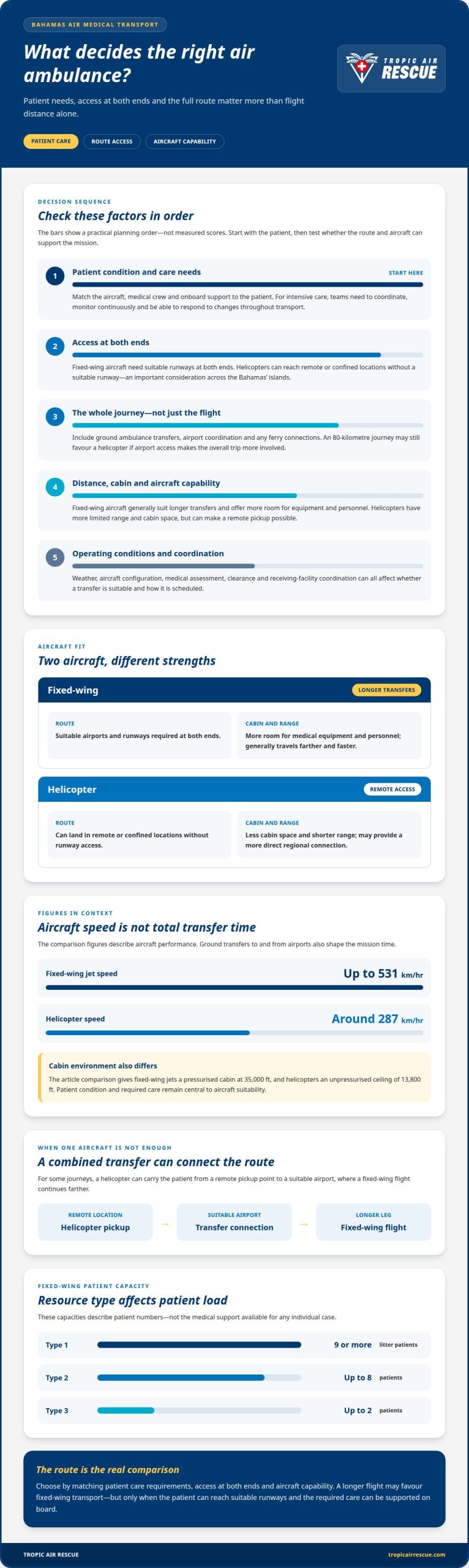
Fixed-wing aircraft suit longer journeys between airports, including transfers to specialized healthcare. Helicopters can serve a different route: for example, an island pickup may avoid extra ground or ferry connections. An 80-kilometre journey can still favour helicopter transport when airport access makes the overall trip more involved. The route, not distance alone, matters.
Medical Equipment and Personnel Space
Fixed-wing aircraft typically offer more room for medical equipment and personnel than helicopters. The extra workspace can support complex care, equipment placement and crew movement during longer transfers. A helicopter’s more limited cabin space can constrain these tasks, so the patient’s condition and care requirements help determine whether its cabin configuration is suitable.
Airport and Runway Access
Fixed-wing aircraft need suitable runways for takeoff and landing, so both ends of the route must accommodate the aircraft. Runway suitability depends on the aircraft and operating conditions. Helicopters can land in confined or remote locations, reducing reliance on airports. In the Bahamas, island geography makes access at the pickup and receiving locations an important planning factor.
Range and Aircraft Capability
Fixed-wing aircraft generally travel farther and faster than helicopters, making them suitable for long-distance transfers. Actual range depends on aircraft capability and configuration, pilot capability, medical crew qualifications and weather. Helicopters have more limited range, but can reach locations that fixed-wing aircraft cannot. For some journeys, a helicopter can cover a regional leg before a fixed-wing flight continues farther.
| Aircraft | Route and access | Cabin and range |
|---|---|---|
| Fixed-wing | Suitable airports and runways required | More space; longer-distance travel |
| Helicopter | Remote or confined landing access | Less cabin space; shorter range |
Choose by matching patient needs, route access and aircraft capability.
Choosing transport based on patient condition and distance
Consider the patient’s condition and the distance together. A patient in a remote location may need advanced care at a distant facility, while the available aircraft affects how directly the journey can proceed. A helicopter can connect a remote pickup point to a suitable airport, followed by a longer fixed-wing flight. Ground ambulances may still be needed at either end, so the full journey involves more than flight time.
For an intensive-care transfer, the patient’s support needs determine the aircraft and crew requirements. The sending and receiving medical teams must communicate so the destination can prepare to continue care. Continuous monitoring and the ability to respond to changes in the patient’s condition matter throughout the transfer. A longer flight may suit a fixed-wing aircraft, but only if the patient’s care needs can be supported on board.
Infectious-disease transport requires specialized teams and equipment compliant with CDC guidance. The suitability of an air ambulance resource depends on the teams and equipment needed for infectious-disease transport. An aircraft’s ability to carry a patient does not mean it can safely support the required infection-control measures.
Patient load also varies by fixed-wing resource type. The stated capacities are 9 or more litter patients for Type 1, up to 8 for Type 2, and up to 2 for Type 3. These figures describe patient capacity, not the medical support available for an individual case. Match the resource to both the number of patients and the care each requires.
International repatriation must comply with the healthcare and transportation regulations of the countries involved. Fixed-wing transport requires medical assessment and clearance to evaluate fitness to fly and potential risks. EURAMI’s standard requires providers to hold an aircraft insurance certificate stating liability and coverage limits. Planning should also account for language barriers and cultural differences that may affect continuity of care.
Organ movements have distinct coordination needs alongside patient transfers. Organ transport coordination is relevant when the mission involves moving an organ rather than a patient.
Fixed-wing and helicopter air ambulance comparison
For an emergency flight, compare speed, access, cabin environment and patient-care requirements. Fixed-wing jets can reach speeds of up to 531 km/hr, while helicopters travel around 287 km/hr. Those figures describe aircraft speed, not the full time to hospital. Transfers to and from airports also shape the mission time.
Cabin conditions differ, too. Fixed-wing jets can fly at 35,000 ft in a pressurised cabin; the comparison figure for helicopters is an unpressurised ceiling of 13,800 ft. A pressurised environment can matter for patients with certain medical conditions. Aircraft type alone does not determine suitability: the patient’s condition and required medical care remain central.
Cabin space affects critical-care delivery. Fixed-wing aircraft typically provide more room for medical equipment, personnel and movement around the patient. A helicopter’s tighter working environment can restrict crew movement and complex procedures. For a long flight requiring sustained ventilation management or repositioning, available workspace may influence care. The appropriate setup depends on the transfer’s clinical requirements.
Helicopters can suit time-critical emergencies because they can deploy rapidly and bypass road traffic. This can help when a patient needs prompt hospital transport and ground access is difficult. Fixed-wing aircraft are generally used for longer-distance or international medical transport. A journey may combine aircraft, with a helicopter covering a regional leg before a fixed-wing flight continues the longer route.
| Criterion | Fixed-wing | Helicopter |
|---|---|---|
| Speed comparison | Up to 531 km/hr | Around 287 km/hr |
| Cabin environment | Pressurised at the stated 35,000 ft comparison | Unpressurised ceiling comparison of 13,800 ft |
| Typical role | Long-distance medical transport | Regional and time-critical access |
| Working space | Typically more room for equipment and crew | More constrained cabin workspace |
Choose by matching the patient’s care needs with route access, cabin environment and the full journey to hospital, not flight speed alone.
What weather conditions can prevent a fixed-wing air ambulance flight?
Weather can affect whether air transport is feasible. For a fixed-wing air ambulance, conditions at departure, along the route and at arrival all matter. The flight plan must work for the entire journey, not just the conditions at the sending hospital. If weather makes the planned flight infeasible, the timing or aircraft choice may change.
Assess conditions at each stage of the route: the departure airport, flight path and receiving airport. Clear conditions at departure do not mean they will remain suitable throughout the journey. Weather at the destination can also prevent the aircraft from completing the transfer as planned. This route-wide view is essential for patients travelling between islands or onward to another healthcare facility.
Fixed-wing aircraft depend on airport access at both ends. Weather that affects airport operations can therefore affect the transfer, even if the aircraft can fly the distance. A suitable runway is useful only if the aircraft can operate there in the conditions on the day. Consider the aircraft’s capabilities alongside the complete route.
Helicopters also face weather-related limits and are more sensitive to weather than fixed-wing aircraft. Their ability to reach remote locations does not remove that constraint. In the Bahamas, island-to-island access and the planned landing location are part of the operational picture. Aircraft selection should account for weather alongside the patient’s needs, distance and available access.
A practical plan assesses conditions at the origin, en route and at the destination, then considers whether the selected aircraft can complete each leg and coordinates with the receiving facility. Medical teams also need clear communication if changing conditions affect the planned handover. This keeps care and transport planning connected.
Weather changes can require a revised plan, including a different departure time or aircraft. The critical point is that a fixed-wing flight depends on suitable conditions across its route, not simply on its longer-distance capability. For help coordinating a Bahamas medical transfer, discuss transport planning.
Tropic Air Rescue
Tropic Air Rescue provides helicopter air-medical transport for emergency and interhospital transfers throughout the Bahamas. Its aircraft can land at remote locations inaccessible to fixed-wing aircraft, making helicopter transport relevant when a patient’s location or route limits runway access. The team’s advanced avionics and life-support equipment support medical transport planning around patient needs and destination access.
For eligible members, Short-term Membership and Annual Membership provide access to the service, with health insurers billed directly. Interhospital Transfer Services support movement between medical facilities, while Organ Transport addresses time-sensitive movement of organs. These options can help when the decision turns on access across islands, medical needs and coordination between facilities.
Contact Tropic Air Rescue to discuss membership or an interhospital transfer.
Plan the Next Step With Confidence
Choosing medical transport is a coordinated decision, not simply an aircraft selection. The limitations of fixed-wing air ambulance transport matter most when access, patient needs or the route determine what is practical. Start with the patient’s medical requirements and the locations involved, then coordinate the transport plan with the receiving facility.
For medical transport in the Bahamas, Tropic Air Rescue offers Short-term Membership, Annual Membership and Interhospital Transfer Services. Membership is available to natural persons and activates after the required waiting period. These options are relevant when planning coverage or arranging a transfer between medical facilities. Share the patient’s location, destination and transfer needs to start the conversation.
Contact Tropic Air Rescue to discuss your situation and the available membership or interhospital transfer option. A measured next step can bring clarity to a complex transport decision.
Frequently Asked Questions
How far can an air ambulance fly?
There’s no single range for every air ambulance. A comparison lists fixed-wing jets at over 3,300 km and helicopters at about 761 km, but aircraft type and configuration affect actual range. Pilot capability, medical crew qualifications and weather also shape whether a particular route is feasible. Treat these figures as broad comparisons, not a guarantee that an aircraft can complete a specific journey without operational planning.
Need help choosing the right medical aircraft?
For medical transport in the Bahamas, Tropic Air Rescue provides helicopter air-medical service. It may be relevant when the patient’s location or route calls for helicopter access. To frame the decision, identify the patient’s current facility, intended receiving facility and medical support needs. Those details help distinguish a transfer that needs direct helicopter access from one involving an airport-based flight or a combined route.
When is helicopter medical transport more suitable?
Helicopter transport can be more suitable when a patient is at a remote location without practical runway access. For example, a transfer from a small island may avoid separate ferry and ground-ambulance legs. Helicopters can also reach confined locations and bypass road traffic. The key advantage is access to the pickup point, particularly when extra transfer stages complicate the journey.
What are the main limitations of fixed-wing air ambulances?
The main limitations of a fixed-wing air ambulance are its dependence on suitable runway access and the extra transfers airports can require. A patient may need ground transport between a hospital and the aircraft at each end. Aircraft range and cabin capacity also vary by configuration. Weather can affect whether a flight is feasible, so a long-range aircraft is not automatically the best fit for every medical mission.
How do runway length and airport access limit fixed-wing air ambulance use?
A fixed-wing aircraft needs a runway that meets its takeoff and landing requirements. A nearby airfield is not enough if its runway cannot accommodate the aircraft. Airport access also adds transfer stages: ground ambulances may take the patient from the hospital to the airport and onward after landing. When landing access permits, a helicopter route can be more direct.
Can fixed-wing air ambulances transport patients who need critical care or specialized equipment?
Yes, a fixed-wing air ambulance can be configured for critical-care transport, with equipment matched to the patient’s needs. Available equipment may include cardiac monitors, ventilators, infusion pumps and oxygen delivery systems. Larger cabins can provide more workspace for crew and equipment. A non-critical-care resource is a different matter: it isn’t designated for critical-care patients unless its Aeromedical Transport Manager determines transport is necessary.